
MMI in Workers’ Comp: Run a Free 50-State Estimate Before You Settle

Maximum medical improvement is the medical finding that your condition has stabilized as much as it’s going to. Once your doctor declares MMI, temporary disability checks usually stop, and your claim shifts into permanent valuation, meaning an impairment rating and either a settlement or ongoing permanent benefits. If you just got this news, your first move is asking your doctor to put the MMI rationale in writing and checking your state’s appeal deadline immediately.
TL;DR:
- Most states base impairment ratings on the AMA Guides, and using the correct edition can significantly affect the estimated benefits.
- Disputing an MMI determination requires prompt action, solid documentation from your treating physician, and awareness of strict deadline windows.
- Settlement options vary between lump-sum payments and ongoing structured payments, with the choice impacting future medical rights and total payout.
- A realistic benefit estimate tailored to your state and injury type strengthens your negotiating position and helps avoid undervaluation or rushed agreements.
- Follow your state’s appeal procedures carefully and gather all relevant medical records before accepting any settlement to maximize your leverage.
Table of Contents
- What MMI in Workers Compensation Actually Means
- Who Decides MMI and How Impairment Ratings Get Assigned
- How Reaching MMI Changes Your Benefits and Settlement Timing
- Disputing MMI and Your Rights to Reopen the Claim
- What to Do Right After an MMI Determination
- Why Documentation Beats Speed After MMI
- Get a Realistic Number Before You Negotiate Anything
- Where to Confirm the Details for Your State
- Sources
- FAQ
What MMI in Workers Compensation Actually Means
MMI does not mean you’re healed, and it doesn’t mean you’re pain-free. It means a doctor believes further treatment won’t produce significant additional recovery. Minnesota’s Department of Labor and Industry defines MMI as the point after which no further significant recovery can reasonably be expected, and once that determination is valid, the insurer typically doesn’t need to request another one except in specific circumstances.
Some states call this “permanent and stationary” instead of MMI. The label changes, the legal effect doesn’t.
- Maintenance or palliative care can often continue after MMI, even though wage-replacement checks stop.
- Reaching MMI doesn’t close your medical file; it closes the temporary-benefits chapter.
- State wording differences matter because they affect appeal windows and reopening rights.
Roughly every state runs its own version of this process, and Observed notes that MMI is really a shift in claim phase, not an endpoint to your care.
Who Decides MMI and How Impairment Ratings Get Assigned
Your treating physician usually makes the first MMI call. Insurers frequently order an independent medical examination (IME) to get a second opinion, and some states appoint their own evaluators when the two sides disagree.
- Treating physician: knows your case history, often the most trusted voice, but not the final word if contested.
- Insurer’s IME doctor: paid by the insurance company, sometimes reaches a different conclusion.
- State-designated evaluator: some states step in when treating doctor and IME conflict.
Once MMI is set, the impairment rating comes next, usually assigned using the AMA Guides to the Evaluation of Permanent Impairment. This is the medical standard most states rely on to translate a physical condition into a percentage number that feeds directly into benefit formulas. The Department of Labor’s procedure manual makes clear that impairment ratings should only be calculated once MMI is confirmed, since rating a condition too early can undercount your loss.
Pro Tip: Ask which edition of the AMA Guides your state uses before your rating exam. Older and newer editions can produce meaningfully different percentages for the same injury.
How Reaching MMI Changes Your Benefits and Settlement Timing
MMI is the hinge point where your claim stops being about recovery and starts being about valuation. Temporary total disability (TTD) or temporary partial disability (TPD) payments typically end at MMI. What replaces them depends entirely on your impairment rating and your state’s benefit schedule. A TTD calculator can show you what you were receiving weekly before the switch, which is worth documenting for comparison.
Here’s the general sequence most claims follow after MMI:
- Doctor issues MMI finding along with an impairment rating.
- Insurer reviews the rating and calculates a permanent partial disability (PPD) award, or in severe cases, permanent total disability (PTD) status.
- You and the insurer discuss whether to settle the claim outright or continue with scheduled permanent benefit payments.
- If you settle, a judge or state board typically has to approve the agreement before funds are released.
The dollar conversion depends heavily on where you live. Some states apply a straight percentage against a scheduled dollar amount per body part; others use a formula involving your average weekly wage and the impairment percentage together. A PPD calculator built around your state’s schedule gives you a realistic range instead of a guess.
Settlement structure matters as much as the number itself:
- Compromise and Release: a lump-sum payment that typically closes out future medical rights on the claim.
- Structured/scheduled settlement: ongoing periodic payments, sometimes paired with continued medical coverage.
The trade-off, according to LegalClarity’s breakdown of post-MMI options, usually comes down to how likely you are to need future treatment. Trading medical rights for a bigger check up front makes sense for some injuries and is a costly mistake for others, particularly if you have hardware, ongoing therapy needs, or a condition prone to relapse. Once a judge approves a settlement, insurers generally issue payment within a defined window set by state rule, so ask your attorney or claims adjuster for the exact timeline in your state before you sign anything.
Disputing MMI and Your Rights to Reopen the Claim
When your treating doctor and the insurer’s IME disagree about whether you’ve hit MMI, or disagree about the impairment percentage, you have options. Most states let you request a second opinion, formally document your treating physician’s contrary rationale, or push for a hearing before a workers’ comp judge or state evaluator.
- Get your treating doctor’s disagreement in writing, with specific medical reasoning, not just a one-line objection.
- Request copies of the IME report so your doctor can respond point by point.
- File your dispute before the deadline. These windows are often short, sometimes just weeks, and missing one can forfeit your right to challenge the finding entirely.
- Ask about reopening rights. Most states allow claims to reopen if your condition genuinely worsens after settlement, but the burden of proof and time limits vary sharply by state.
Acting fast isn’t optional here. A dispute filed even a few days late can lock in a rating you believe undervalues your injury.
What to Do Right After an MMI Determination
- Ask your doctor for a written MMI rationale, including the specific impairment rating and what it’s based on.
- Look up your own state’s workers’ comp agency page to confirm the actual appeal deadline. Don’t assume another state’s rule applies to you.
- Consider a second medical opinion if the rating feels low relative to your actual limitations, and gather every relevant medical record now, while it’s easy to get.
- Run a state-specific settlement calculator to see a realistic weekly rate and settlement range before you negotiate with the insurer.
Pro Tip: Insurers negotiate harder with workers who show up with numbers. Walking into a settlement conversation with a documented estimate in hand changes the tone of the conversation almost immediately.
Why Documentation Beats Speed After MMI
The biggest mistake we see is rushing to sign a settlement before understanding what the number should be. The second biggest is letting a treating doctor’s disagreement with an insurer’s IME go undocumented, which quietly weakens your leverage. A realistic, state-specific estimate paired with a clear medical record doesn’t just inform you. It changes how an adjuster negotiates with you, because they know you’re not guessing.
— Daniel
Get a Realistic Number Before You Negotiate Anything
This website offers free calculators that use your average weekly wage, state, and injury type to generate an estimate of your TTD and PPD benefits along with a likely settlement range, incorporating state-specific 2026 benefit caps.
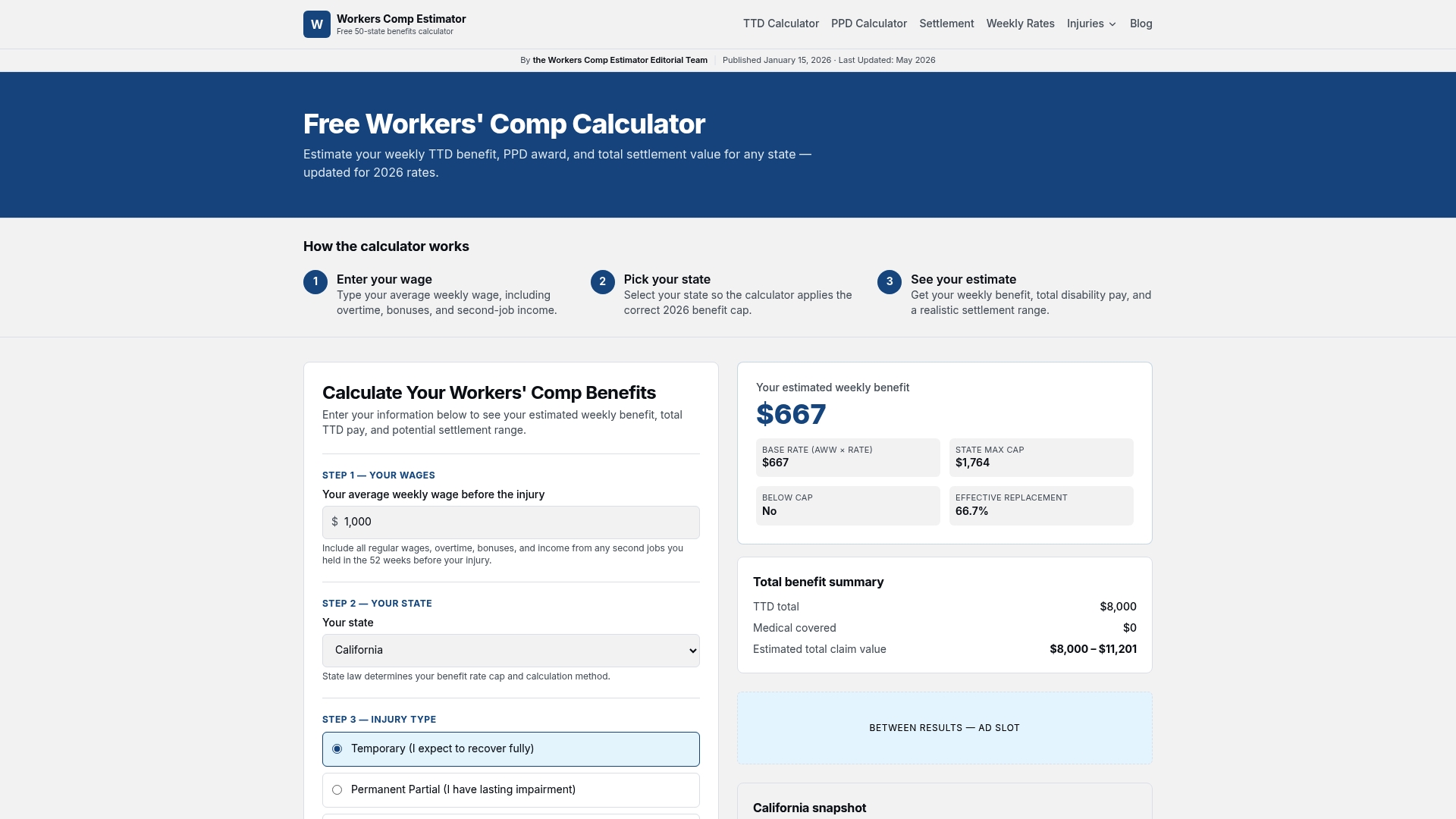
That means you walk into a negotiation with a specific weekly figure and settlement band instead of a vague sense that “it seems low.” Whether you’re in Oregon, Texas, Illinois, or anywhere else, the state caps differ enough to swing your estimate by hundreds of dollars a week. Save your results, print them, and bring them to any conversation with an insurer or attorney. If your injury involves a specific body part, our back injury, knee injury, or shoulder injury settlement pages break the numbers down further. Run your estimate now at Workers’ Comp Calculator before you agree to anything.
Where to Confirm the Details for Your State
Check your state’s weekly benefit rates for exact caps, review Minnesota’s official MMI guidance as a model of how states explain the process, and consult the AMA Guides overview for impairment methodology. If your dispute needs legal muscle, firms like Jose A Loayza Law outline when hiring an attorney makes sense.

This article is general information, not a substitute for advice from a qualified lawyer. Consult a qualified legal professional about your own circumstances before acting on anything here.
Sources
- Work comp: Maximum medical improvement | Minnesota Department of Labor and Industry
- Unified Procedure Manual — Impairment ratings (U.S. Department of Labor, OWCP)
- AMA Guides overview — American Medical Association
- Observed
FAQ
What Happens if You Reach MMI but You’re Still in Pain?
MMI means your doctor doesn’t expect further significant medical improvement, not that you’re pain-free. Many states still allow maintenance or palliative care after MMI, even though wage-replacement payments typically stop.
How Much Time Do You Get to Dispute an MMI Finding?
Deadlines vary significantly by state and can run from a few weeks to a few months, so check your state workers’ comp agency page immediately rather than assuming a general rule applies.
What Is the Typical Payout for a Permanent Impairment Rating?
There’s no single number. It depends on your state’s benefit schedule, your average weekly wage, and your impairment percentage, which is why running a PPD calculator for your specific state matters more than any general figure.
How Long After Reaching MMI Do Settlements Typically Get Paid?
Once a judge or state board approves a settlement, insurers are generally required to issue payment within a set window defined by state rule, so confirm the exact timeline with your attorney or claims adjuster.
Recommended
More from the blog
File the correct state claim and collect medical and wage records. Run the free 50 State calculator to see your likely weekly TTD and settlement before...
Run a state specific 2026 workers' comp settlement calculation. Use the free 50 state calculator to see how state caps change your payout.
See what workers’ compensation may cover after an eye injury, from treatment and lost wages to vision loss awards, with a free 2026 estimate by state.
Free workers' comp calculators
Put the numbers in this article to work on your own claim.
Weekly benefit, PPD, and settlement in one place.
What your weekly temporary disability check should be.
Scheduled weeks and permanent impairment awards.
Light-duty benefit when you earn less while healing.
Federal employee FECA award by body part.
Lump-sum value of your full claim.
Turn a 5%, 10%, or 20% rating into dollars.
Max and min weekly rates for all 50 states.
Typical settlement ranges by injury and state.
Average settlement for fusion, rotator cuff, knee replacement, and more.
Why comp does not pay it, and when a third-party claim does.
When carriers typically make an offer.
What coverage costs by class code and payroll.
Guides, state updates, and claim strategy.