
Free 50 State Payout Estimate Before You File a Workers’ Comp Claim

Report the injury to your employer immediately, get medical care, and file your state claim form before the deadline passes. Your employer or state workers’ compensation board can point you to the correct form, and the U.S. Department of Labor handles claims for federal employees. Once you’ve filed, an online tool can help you estimate what your weekly benefit and settlement might actually look like.
TL;DR:
- Reporting your injury immediately to a supervisor and confirming it in writing is crucial within most states’ narrow notification windows to preserve your claim rights.
- Filing the correct claim form promptly, providing accurate details, and keeping copies of all submitted documentation prevent processing delays and potential denials.
- Gathering comprehensive medical records, pay stubs, photos, witness contacts, and incident reports beforehand strengthens your case and supports accurate benefit calculations.
- Using a workers’ compensation calculator helps estimate your weekly benefit and settlement range based on your wages, injury type, and state benefit caps before negotiations.
- Keeping detailed logs of all claims communication and updating your insurer in writing about changes ensures you maintain control and can address disputes efficiently.
Table of Contents
- How Do You Report a Work Injury and Get Medical Care?
- Where Do You File Your Workers’ Comp Claim Form?
- What Documents Should You Include With Your Claim?
- How Long Does It Take to Get Workers’ Comp Benefits?
- What Should You Never Say to an Adjuster?
- When Should You Hire a Workers’ Comp Attorney?
- How Can a Calculator Help You Estimate Your Benefits?
- How Do You Track Your Claim After You File?
- What Are Your Rights and Responsibilities During a Claim?
- What Can You Do if Your Claim Is Disputed or Denied?
- A Quick Note on Getting This Right
- Estimate Your Benefits Before You Negotiate With an Insurer
- Sources
- FAQ
How Do You Report a Work Injury and Get Medical Care?
The clock starts the moment you get hurt, not when you decide to deal with it. Most states give you a narrow window to notify your employer, and missing it can sink an otherwise solid claim. Tell your supervisor or HR in person or by phone right away, then follow up in writing, even if it’s just a text or email that says what happened, when, and where.
Written notice matters because memories fade and stories shift. Keep a copy of whatever you send, and note the date and the name of the person you told.
- Report the injury to a supervisor or manager the same day, if possible.
- Send a follow-up email or text confirming the date, time, and nature of the injury.
- Ask if your employer has a designated clinic or list of approved doctors.
- If it’s an emergency, go straight to the ER and worry about paperwork later.
- Keep every receipt, discharge paper, and prescription slip from that first visit.
Many states require you to see an employer-authorized doctor for the claim to proceed smoothly, though you can usually get a second opinion later. At that first appointment, tell the doctor clearly that the injury happened at work. This gets it into your medical chart as work-related from day one, which matters enormously if the insurer later questions how you got hurt.
Write down what happened while it’s fresh. A short, dated note: what you were doing, what broke or slipped or fell, who else was nearby, and how you felt afterward. This contemporaneous timeline becomes evidence if the insurer disputes the cause later, and it’s far more convincing than a memory reconstructed six weeks after the fact.
Where Do You File Your Workers’ Comp Claim Form?
Filing the claim is a separate step from reporting the injury, and conflating the two is one of the most common ways people lose time on their case. Reporting tells your employer you got hurt. Filing is the formal paperwork that puts your state’s workers’ compensation system on notice and starts the clock on benefits.
- Find your state’s official form. Every state workers’ compensation board publishes its own claim form, and they’re not interchangeable. New York uses Form C-3, which must generally be filed within two years of the accident, or two years after you discover a work-related condition. Other states use different numbers and different deadlines, so pull the form straight from your state board’s website rather than trusting a generic template.
- Fill in the essential fields carefully. You’ll typically need your employer’s name and address, the date and location of the injury, a description of how it happened, your treating doctor’s information, and your average weekly wage. Errors here (a wrong date, a vague injury description, a missing wage figure) are a leading cause of processing delays.
- Submit through the right channel. Some states have you file directly with the board, others route the form through your employer or its insurer first. Colorado’s Division of Workers’ Compensation publishes step-by-step submission instructions and a customer service line if you get stuck.
- Keep a copy of everything you submit, along with proof of the date it was sent, whether that’s a certified mail receipt, an online confirmation number, or an email timestamp.
Your employer is also required to report the injury to its insurance carrier, and the insurer typically opens a claim file on its end. But don’t assume your employer filed anything on your behalf. The safest approach is to file your own paperwork with the state board even if your employer says it’s “handled.”
If you work for the federal government, skip the state process entirely. Federal employees file under the Federal Employees’ Compensation Act (FECA) and must register with the Department of Labor’s ECOMP portal to submit claims and medical evidence. Trying to use a state form instead will waste weeks.
What Documents Should You Include With Your Claim?
Claims examiners decide fast, often based on whatever paperwork is sitting in front of them. The thinner your file, the more room there is for doubt. Gather these items early, before memories fade or paper trails go cold.
- Medical records and treatment notes. Request copies from every provider you saw, including the ER, urgent care, and any follow-up specialist. Most clinics will release records to you directly if you ask in writing.
- Pay stubs and time cards. These establish your average weekly wage, which determines your benefit rate. Pull at least the last 52 weeks if your job has irregular hours or overtime.
- Your job description. Useful if the insurer questions whether the injury was work-related or within your normal duties.
- Photos of the scene, equipment, or hazard that caused the injury, taken as soon as possible.
- Witness names and contact information. Get this the day it happens. Coworkers move on, and their memories fade fast.
- Any incident report filed with your employer, plus a copy for your own records.
Organize everything into a single folder, physical or digital, and keep duplicates somewhere separate from your original file. If your back or hand injury requires ongoing treatment, note every appointment date as you go rather than trying to reconstruct a timeline months later.
Pro Tip: Ask your treating doctor’s office for a written summary each time your condition changes. A one-paragraph update from your doctor carries more weight with an adjuster than pages of raw chart notes they’ll skim past.
How Long Does It Take to Get Workers’ Comp Benefits?
Insurers generally have a set window to accept or deny your claim once it’s filed, which varies by state. Medical treatment authorization usually comes faster than wage-replacement checks, since insurers want the injury treated regardless of fault determinations. Temporary total disability (TTD) payments, if you’re approved, typically start after you have passed your state’s required waiting period, which varies by location.
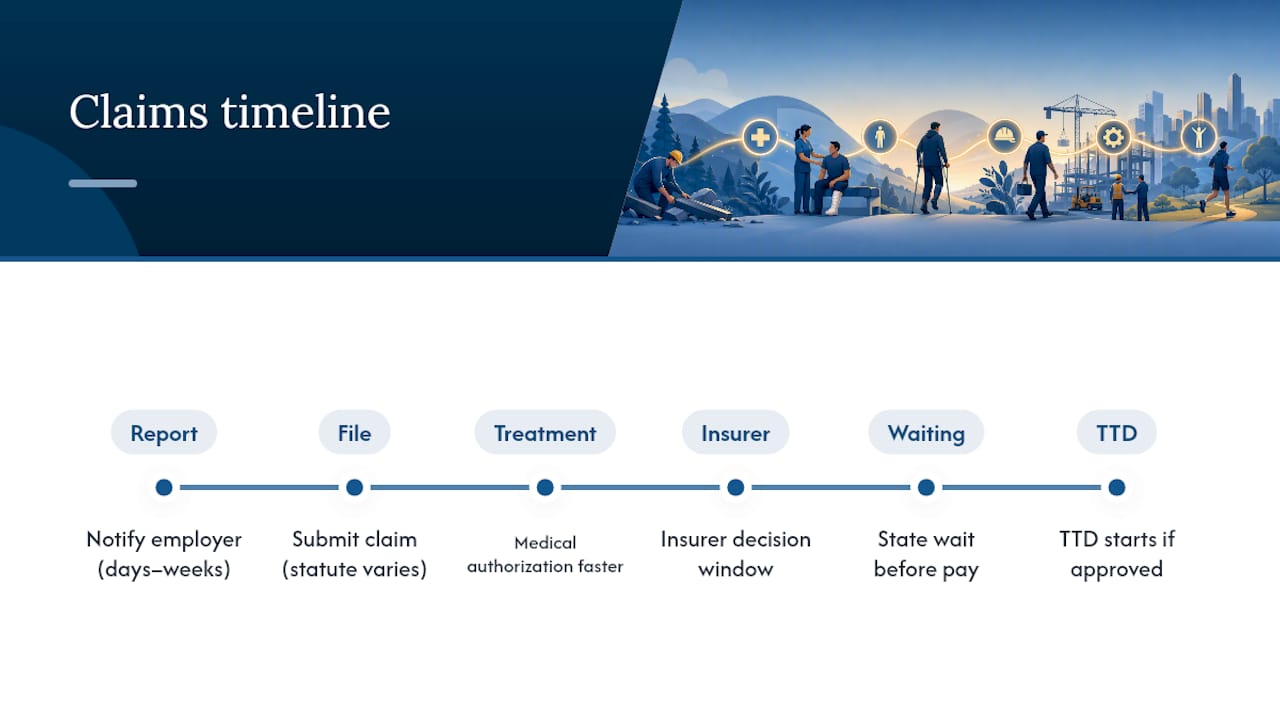
Filing deadlines and reporting deadlines are not the same thing, and mixing them up is a costly mistake. Reporting to your employer usually has to happen within days or weeks. Filing the actual claim form has a longer statute of limitations, which varies depending on the state, but you should never wait that long on purpose. The no-fault system most states use) still requires solid documentation, and delay gives an insurer more room to argue your injury isn’t work-related.
If your employer or insurer goes quiet, don’t just wait it out. Follow up in writing, keep a log of every call, and contact your state workers’ compensation board if you get no response within a couple of weeks.
What Should You Never Say to an Adjuster?
Adjusters are trained to ask open-ended questions that invite you to guess, speculate, or minimize. Every extra word you offer beyond the plain facts is something that can be used to delay or shrink your claim later.
- Don’t speculate about what caused the injury if you’re not certain. Say what you know and stop there.
- Don’t give a recorded statement without talking to an attorney first. You can decline politely, and legal guidance on this point consistently recommends it.
- Don’t volunteer details about prior injuries, unrelated health conditions, or your general fitness unless directly and specifically asked.
- Don’t skip appointments or ignore your doctor’s restrictions. If you can’t get an appointment, document the attempt and the reason.
- Don’t post about your activities on social media. A photo from a birthday party can be twisted into “proof” you’re not really hurt.
A short, factual answer beats a long, defensive one every time. “I hurt my shoulder lifting a pallet at 2 p.m. on Tuesday” is a complete sentence. You don’t owe the adjuster a theory of the case.
When Should You Hire a Workers’ Comp Attorney?
Not every claim needs a lawyer, but certain situations almost always call for one: a denied claim, a dispute over whether you have a permanent impairment, disagreement about what caused the injury, or an insurer that keeps delaying without explanation. Most workers’ comp attorneys work on contingency, meaning they take a percentage of what you recover rather than charging upfront. If your injury is severe or catastrophic, firms like Tyler Injury Law handle the kind of complex documentation those cases require.
Bring your claim file, medical records, and any denial letter to your first consultation. Your state workers’ compensation board can also answer procedural questions and direct you to forms, even before you decide whether you need representation.
How Can a Calculator Help You Estimate Your Benefits?
Before you call an insurer or an attorney, it helps to know roughly what your claim should be worth. A calculator built specifically for workers’ comp takes your average weekly wage, your state, and your injury type, then runs those numbers against your state’s benefit caps to produce a weekly TTD estimate and a settlement range.
That’s the core function behind Workerscompestimator’s free 50-state tool. State caps matter more than most injured workers realize. Two people with identical injuries and wages in different states can end up with very different maximum weekly benefits, because each state sets its own cap and formula. Knowing your state’s 2026 cap before you negotiate keeps you from accepting a lowball offer out of ignorance.
To get a useful estimate, gather a few things first:
- Your pay stubs or time cards to calculate an accurate average weekly wage.
- The date your treatment started and any ongoing appointment dates.
- Your doctor’s notes describing the injury type and severity.
- Your state of residence and employment, since caps and formulas vary.
With those numbers in hand, you can walk into a call with an adjuster or a consultation with an attorney already knowing what a fair range looks like, rather than reacting to whatever number they offer first.
How Do You Track Your Claim After You File?
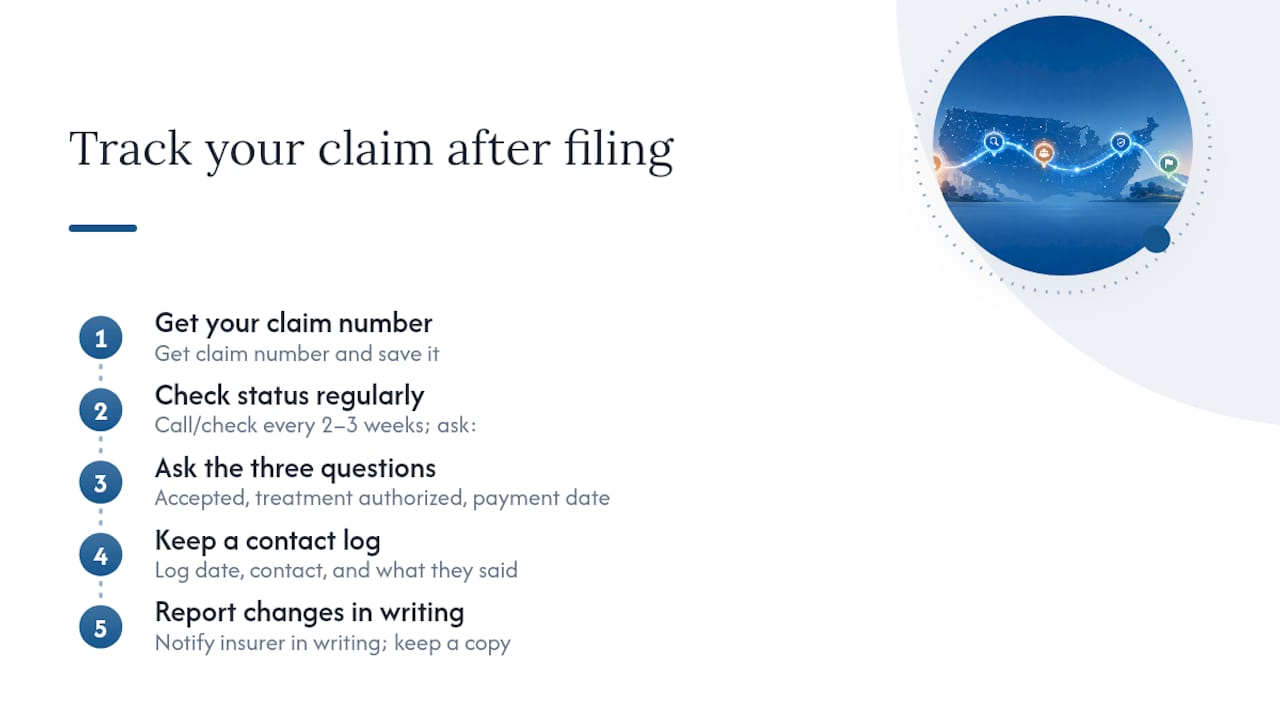
Once your paperwork is submitted, the waiting starts, and this is where a lot of claims quietly stall. Ask for a claim number the moment your employer or the state board confirms receipt, and write it down somewhere you’ll actually find it again. That number is your reference point for every phone call, letter, or online portal check from here forward.
Most state boards let you check claim status online or by phone, and some insurers provide their own portal or dedicated adjuster contact. Call every two to three weeks if you haven’t heard anything, and always ask the same three questions: has the claim been accepted, is medical treatment authorized, and when does the first wage-replacement payment go out.
Keep a simple log, even a notebook works, with the date of each call, who you spoke to, and what they told you. This matters more than it sounds like it should. Adjusters change, claims get transferred between desks, and verbal promises have a way of disappearing without a paper trail. If someone tells you your claim was approved on a Tuesday call, and no check arrives for a month, that log is what backs up your follow-up complaint.
If you switch doctors, change your address, or return to modified duty, notify the insurer in writing and keep a copy. Small updates like these are exactly the kind of detail that gets lost between departments if you rely on a phone call alone.
What Are Your Rights and Responsibilities During a Claim?
You have the right to choose or request a second opinion from a doctor in most states, though the initial visit often has to go through an employer-approved provider. You have the right to receive a written explanation if your claim is denied, and you have the right to appeal that denial through your state’s process. You cannot legally be fired simply for filing a workers’ comp claim, though the rules protecting you vary by state.
Your responsibilities run the other direction. You’re expected to report the injury promptly, attend scheduled medical appointments, follow your doctor’s restrictions, and respond to reasonable requests for documentation. Skipping appointments or ignoring work restrictions gives an insurer grounds to argue you’re not taking your recovery seriously, which can slow or reduce your benefits.
You also have an obligation to be accurate. Exaggerating symptoms or omitting a prior injury when asked directly can be used to deny the entire claim, not just the disputed portion. The no-fault structure most states use protects you from having to prove your employer was negligent, but it doesn’t protect you from your own inconsistencies. Consistency between what you told your employer, what you told your doctor, and what you write on the claim form is what holds a case together.
What Can You Do if Your Claim Is Disputed or Denied?
A denial isn’t necessarily the end of your claim, and jumping straight to a formal appeal is sometimes the slower route. Many states offer an informal resolution step first, often called mediation or a pre-hearing conference, where a neutral party helps you and the insurer work out a disagreement without a judge.
If the dispute centers on your medical condition, an independent medical examination or a second opinion from a different doctor can sometimes resolve it faster than litigation. Insurers occasionally deny claims based on one doctor’s assessment that another qualified physician disagrees with, and a documented second opinion can be enough to reverse a denial without ever reaching a hearing.
Before escalating, call the adjuster and ask specifically why the claim was denied. Sometimes it’s a missing document or a form filled out incorrectly, not a substantive dispute, and refiling with the missing piece resolves it in days. Put your request for reconsideration in writing, reference your claim number, and attach whatever new documentation supports your position. Keep a copy of that letter and note the date you sent it. If informal resolution doesn’t work, that paper trail becomes the foundation of your formal appeal.
A Quick Note on Getting This Right
Careful documentation is the single biggest factor separating claims that get paid smoothly from claims that drag on for months. Take one minute right now, if you haven’t already, and write down the date, time, and location of your injury, along with who you told about it. That one note can matter more than anything else in your file later.
Nobody plans to get hurt at work, and nobody wants to become an expert in claim forms overnight. But the workers who come out of this process with fair compensation are almost always the ones who kept records instead of trusting memory.
— Daniel
Estimate Your Benefits Before You Negotiate With an Insurer
A workers’ comp calculator gives you a real number to work from before an adjuster hands you their number first. Instead of guessing what your weekly check should be, plug in your average weekly wage, your state, and your injury type, and see a realistic weekly TTD estimate along with a settlement range based on your state’s benefit caps.
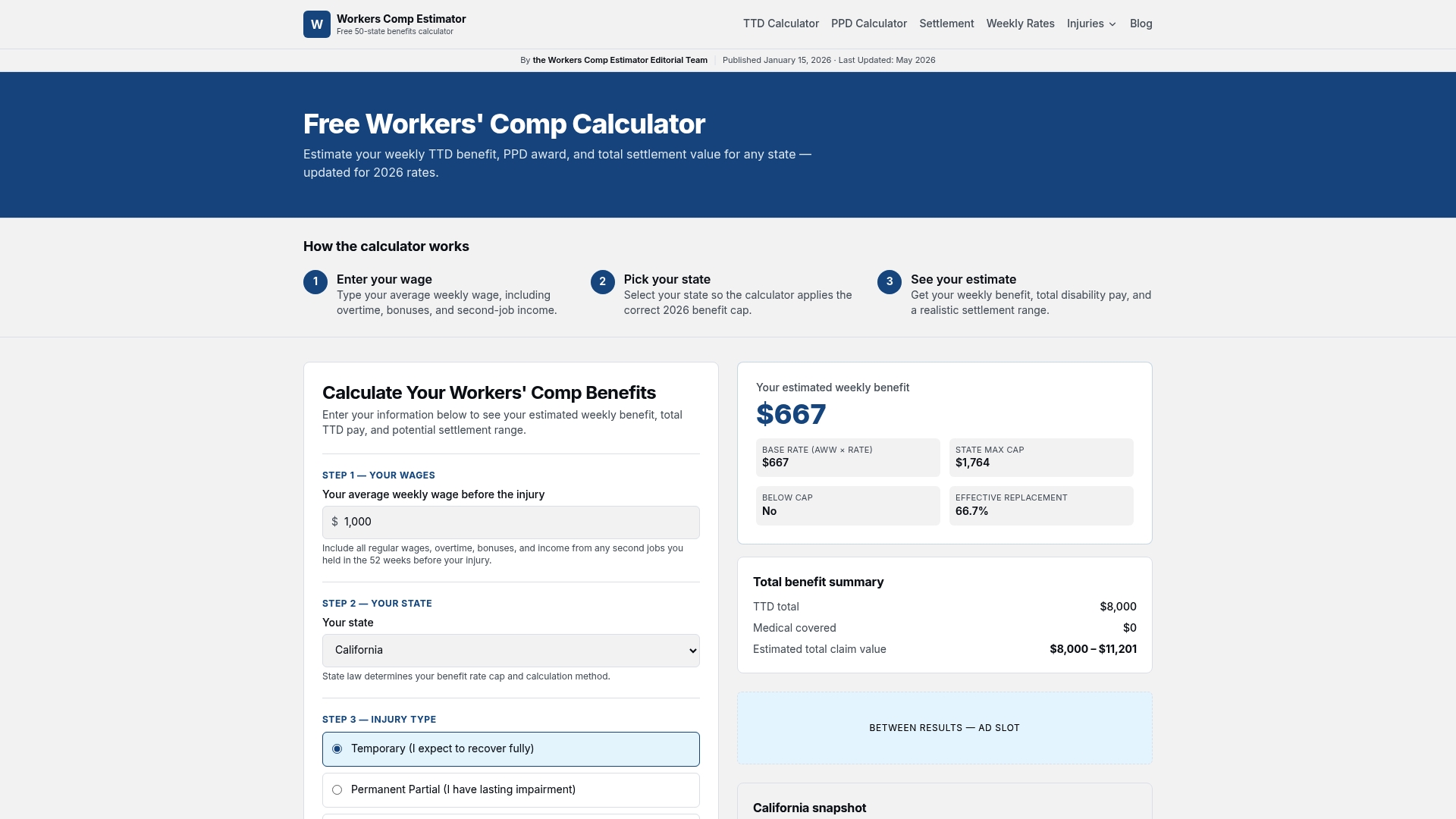
That matters because caps vary enormously. A worker in Wyoming is looking at a very different weekly maximum than a worker in Washington or California, and if you don’t know your state’s number, you have no way of knowing whether an insurer’s first offer is fair or low. The calculator also breaks out injury-specific estimates, including permanent partial disability awards, so you can see how a scheduled injury might factor into a settlement.
Pull your pay stubs and treatment dates together, then run your numbers through the free 50-state estimator before your next call with an adjuster or attorney.
This article is general information, not a substitute for advice from a qualified lawyer. Consult a qualified legal professional about your own circumstances before acting on anything here.
Sources
- How to File a Workers’ Compensation Claim if You Were Hurt on the Job (Federal Employees) — U.S. Department of Labor
- File a Claim - Workers’ Compensation Board - NY.gov
- File a Workers’ Compensation Claim — Colorado Division of Workers’ Compensation
- Usa
FAQ
How does an employer file a workers’ comp claim?
Employers report the injury to their workers’ compensation insurance carrier, usually through a first-report-of-injury form, once you’ve notified them of the incident. This is separate from your own state claim form, which you should still file yourself.
Is filing a workers’ comp claim worth it?
Yes, in almost every case, since it covers medical treatment and a portion of lost wages without you having to prove your employer was at fault. The main risk isn’t filing itself, it’s waiting too long or leaving out documentation that supports your claim.
What should you not say to a workers’ comp adjuster?
Avoid speculating about the cause of your injury, giving a recorded statement without advice, volunteering unrelated medical history, or posting about physical activities on social media. Stick to short, factual answers about what happened.
What are the three main requirements to obtain workers’ compensation?
Generally, you need an employment relationship with the employer, an injury or illness that arose out of and in the course of that employment, and timely reporting and filing within your state’s deadlines. Exact requirements vary by state, so check your state workers’ compensation board for specifics.
Recommended
More from the blog
Run a state specific 2026 workers' comp settlement calculation. Use the free 50 state calculator to see how state caps change your payout.
Learn how MMI changes your workers' comp benefits, appeal deadlines, and settlement choices — and run the free 50‑state estimator to estimate your likely...
See how 2026 state caps, wages, and surgery affect your U.S. hernia workers' comp payout. Run a free 50 state calculator for a realistic estimate.
Free workers' comp calculators
Put the numbers in this article to work on your own claim.
Weekly benefit, PPD, and settlement in one place.
What your weekly temporary disability check should be.
Scheduled weeks and permanent impairment awards.
Light-duty benefit when you earn less while healing.
Federal employee FECA award by body part.
Lump-sum value of your full claim.
Turn a 5%, 10%, or 20% rating into dollars.
Max and min weekly rates for all 50 states.
Typical settlement ranges by injury and state.
Average settlement for fusion, rotator cuff, knee replacement, and more.
Why comp does not pay it, and when a third-party claim does.
When carriers typically make an offer.
What coverage costs by class code and payroll.
Guides, state updates, and claim strategy.