
Estimate Your 2026 Workers’ Comp Payout with Free 50 State Calculator

A workers’ comp settlement estimate comes down to one formula: your impairment rating multiplied by your state’s statutory weeks, multiplied by your weekly benefit rate (typically two thirds of your average weekly wage, capped by your state). Run your numbers through a state-specific calculator to see your likely range right now. That number is a starting point, not a promise. Calculators can’t see disputed facts, a stubborn adjuster, or how a judge might rule on your case.
TL;DR:
- The settlement calculation depends on impairment rating, statutory weeks, and weekly benefit rate, with caps that vary significantly by state in 2026.
- Accurate estimation requires precise average weekly wage data, proper impairment rating, and knowledge of state-specific caps, especially for high-wage earners.
- Settling early before reaching maximum medical improvement often undervalues the claim, as future medical costs and accurate ratings are not yet finalized.
- State caps can drastically affect settlement amounts, with some states capping weekly benefits well below two thirds of the AWW.
- Using a state-specific calculator with thorough documentation can help injured workers negotiate better settlements and avoid accepting lowball offers.
Table of Contents
- How Is a Workers Comp Settlement Calculation Done?
- What Information Do You Need to Estimate Your Settlement?
- What Are the State Caps on Workers Comp Benefits in 2026?
- How to Use a Workers Comp Settlement Calculator
- When Should You Settle: MMI, Ratings, and Timing
- What Types of Workers Comp Settlements Are There?
- Does Returning to Work Change Your Settlement Value?
- How Do Insurers and Attorneys Negotiate a Final Number?
- How Do Future Medical Costs and Life Expectancy Affect Settlement Value?
- How TTD and PPD Benefits Factor Into Your Settlement
- Why State-Specific Numbers Beat National Averages
- Run Your Numbers Before You Talk to an Adjuster
- Sources
- FAQ
How Is a Workers Comp Settlement Calculation Done?
Every state builds its math on the same three ingredients: how badly you’re hurt (impairment rating), how long the state pays for that type of injury (statutory weeks), and how much you earned before you got hurt (weekly benefit rate). Where states split is in how they classify the injury.
Scheduled injuries (loss of a finger, hand, arm, leg, eye, or hearing) get a fixed number of weeks set by law. Non-scheduled injuries (back, neck, most internal injuries, and anything the legislature didn’t list) usually get paid as a percentage of “whole person” disability, applied against a different set of statutory weeks or a lump-sum formula unique to that state.
Here’s the basic sequence most adjusters and calculators follow:
- Determine average weekly wage (AWW) from pay records.
- Calculate the weekly benefit rate, generally two thirds of AWW, capped at the state maximum.
- Get the impairment rating from a doctor using the AMA Guides.
- Multiply the rating by the applicable statutory weeks for that body part or condition.
- Multiply that result by the weekly benefit rate to get the PPD portion of the settlement.
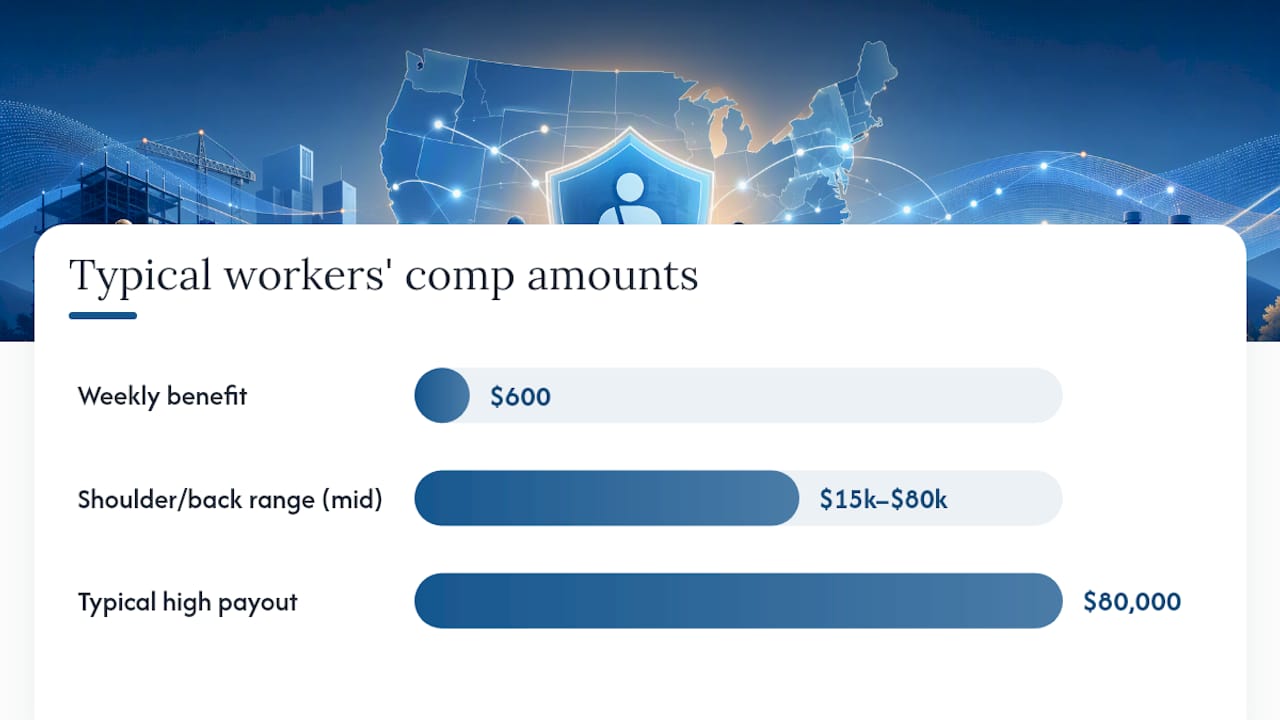
Weekly rate at two thirds of AWW is $600.
Pro tip: Shoulder and back injuries usually land in a wide range, often anywhere from $15,000 to $80,000 depending on rating and state, because the statutory weeks and caps vary so much from one jurisdiction to the next.
What Information Do You Need to Estimate Your Settlement?
Your average weekly wage is the number everything else multiplies against, so getting it wrong throws off the entire estimate. AWW typically includes base wages, regular overtime, bonuses, and commissions, calculated over a lookback period that’s often 13, 26, or 52 weeks depending on your state. Seasonal work or a recent raise can complicate that calculation, which is exactly the kind of detail an adjuster will scrutinize.
Your impairment rating comes from a physician applying the AMA Guides to the Evaluation of Permanent Impairment, and it can’t be finalized until you reach Maximum Medical Improvement (MMI), the point where your condition has stabilized. Beyond the rating itself, a few other factors push value up or down: whether you needed surgery, whether you’ll need future medical care, any prior disability to the same body part, your age, and whether you can realistically return to your old job.
Before you run a calculator or talk settlement with an adjuster, gather:
- Recent pay stubs (at least 13 to 26 weeks)
- Your final impairment rating report
- Surgical records and treatment notes
- Any vocational or return-to-work evaluations
Pro tip: Ask your doctor’s office for a copy of the impairment rating report the day it’s finalized. Adjusters sometimes “misplace” these, and having your own copy prevents a slow-walked negotiation.
What Are the State Caps on Workers Comp Benefits in 2026?
Every state sets a maximum weekly benefit rate, and that cap acts as a hard ceiling on your wage-replacement and PPD math, no matter how high your actual wages were. Earn $2,500 a week in a state capped at $1,300, and your benefit rate stops at $1,300, not two thirds of your real paycheck.
The gap between states is significant. Massachusetts caps its 2026 maximum weekly benefit at $1,922, while Oklahoma caps at $923. Run the identical back injury, same rating, same statutory weeks, through both states and the settlement value can differ by tens of thousands of dollars purely because of where the injury happened.
Before you trust any number:
- Check your exact state’s current maximum on the 2026 Workers’ Comp Weekly Benefit Rates page.
- Confirm it against your state workers’ comp board, since caps sometimes adjust mid-year.
- Compare your calculator’s assumed cap to your state’s actual figure before relying on the estimate.
How to Use a Workers Comp Settlement Calculator
Running a calculator takes about five minutes once you have your paperwork together, and the output tells you far more than a single number.
- Pick your state. Caps and statutory weeks are state-specific, so this determines every other input.
- Enter your gross average weekly wage. Use pay stubs, not a guess.
- Select your injury type. Choose a scheduled body part (hand, knee, shoulder) or the general wage-loss option for back and non-scheduled injuries.
- Enter your impairment rating, or leave it blank to see a range across common ratings if you haven’t been rated yet.
The output typically shows your weekly benefit rate, the statutory weeks that apply, an estimated lump-sum range, and whether that value is usually paid as a structured payment or a single lump sum. Try the free settlement calculator and adjust the rating field to see how much a higher or lower percentage shifts your total.
Pro tip: No calculator can weigh litigation risk, a disputed injury cause, or how convincing your vocational evidence is to a judge. Those factors move real settlements up or down after the math is done.
When Should You Settle: MMI, Ratings, and Timing
Maximum Medical Improvement is the point where your doctor determines your condition has plateaued, which is also the earliest point an accurate impairment rating can be assigned. Settling before MMI is one of the most common mistakes injured workers make, because it locks in a number based on a rating that hasn’t stabilized yet, often undervaluing both the PPD portion and future medical exposure.
Insurance adjusters sometimes push early settlement offers precisely because pre-MMI numbers tend to run lower. A few signals it’s time to consider settling for real:
- You’ve reached MMI and have a finalized impairment rating.
- Your doctor has outlined what future treatment, if any, you’ll need.
- You understand whether the offer includes or excludes future medical rights.
- You’ve had at least one conversation with an attorney or gotten a second medical opinion, especially if the first rating seems low relative to your actual limitations.
What Types of Workers Comp Settlements Are There?
Two structures dominate: Compromise and Release (C&R), and stipulated awards. A C&R closes your claim entirely in exchange for a lump sum. Once you sign it, you typically can’t reopen the claim later even if your condition worsens or needs more surgery. A stipulated award sets your PPD percentage and payment schedule while often keeping medical benefits open, which matters enormously if you’re not fully sure your treatment is finished.
Negotiation moves the number within a range, and the levers that matter most are your impairment rating, a documented projection of future medical costs, corrections to a miscalculated AWW, and how strong (or weak) the insurer thinks their litigation position is. Insurers routinely build present-value models around life expectancy, wage growth, and return-to-work probability, then apply a negotiation discount, so documenting every reason your case could get more expensive for them is your strongest leverage.
A few cautions before you sign anything:
- If you’re a Medicare beneficiary or likely to become one, a Medicare Set-Aside arrangement may need to be built into your settlement to cover future injury-related medical costs.
- Workers’ comp disability benefits are generally excluded from federal taxable income, but confirm your specific situation with a tax professional.
- Watch for offers that undervalue future medicals or quietly exclude reopening rights without saying so plainly.
Does Returning to Work Change Your Settlement Value?
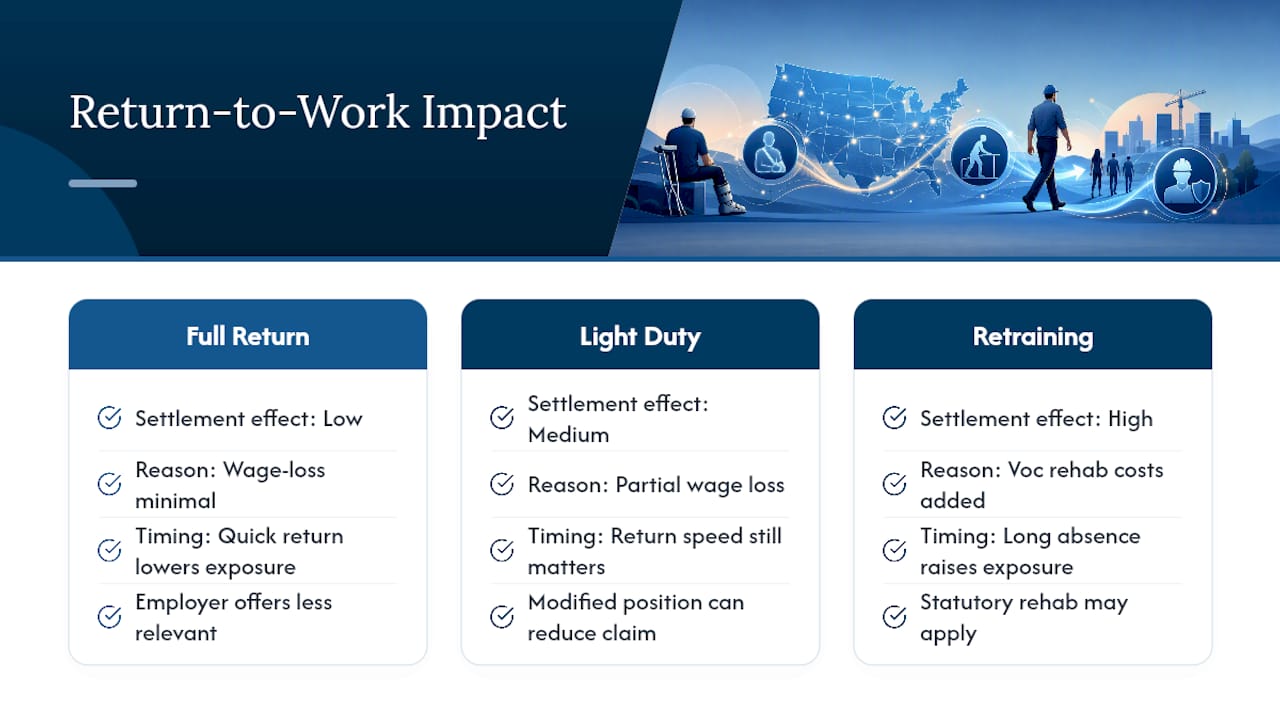
Vocational rehabilitation and return-to-work status shift settlement value more than most injured workers expect. If you return to your old job at your old pay, insurers argue your wage-loss exposure is minimal, which tends to pull the settlement toward the lower end of the PPD range alone. If you can’t return to the same job and need retraining, vocational rehabilitation benefits get added to the equation, and that additional exposure often increases what the insurer is willing to pay to close the file.
Vocational evaluators typically assess whether you can perform your old job’s essential functions, whether reasonable accommodations exist, and if not, what retraining or job placement would cost. That cost projection becomes part of the settlement conversation, especially in states where vocational rehabilitation is a statutory right rather than a discretionary benefit.
A worker who returns to light-duty work at reduced pay sits in a middle zone. You’re not fully wage-loss disabled, but you’re not back to baseline either, and that partial wage loss often gets factored into ongoing benefit calculations or folded into the lump-sum negotiation. Insurers watch return-to-work timing closely, because a worker who goes back quickly signals lower long-term exposure, while one who stays out for months with an uncertain prognosis signals the opposite.
If your employer offers a modified position specifically to reduce your claim’s value, that’s worth flagging to an attorney. Some accommodation offers are genuine; others are structured mainly to cut off wage-replacement benefits before your condition has actually stabilized.
How Do Insurers and Attorneys Negotiate a Final Number?
The number on a calculator screen and the number on a settlement check rarely match exactly, and the gap between them is negotiation. Insurance adjusters carry reserve estimates for every open claim, essentially their internal guess at what the case will eventually cost, and their opening offer is almost always below that reserve. Your job, or your attorney’s, is to present evidence that pushes their internal number up.
The strongest levers are a well-documented impairment rating, a credible future medical cost projection, and any AWW correction that was calculated incorrectly at the start of the claim. Litigation risk cuts both ways: if the insurer disputes causation or believes they’d win at hearing, they’ll lowball the offer, and if your medical documentation and legal position are strong, they often move closer to full statutory value to avoid the cost of litigating.
Attorneys typically work on contingency in workers’ comp cases, taking a percentage of the settlement rather than an upfront fee, which is why a second opinion from a licensed attorney rarely costs you anything to explore before accepting an early offer. Red flags worth raising before signing include an offer that doesn’t mention future medical rights, a rating significantly lower than your treating doctor’s assessment, or pressure to sign quickly before you’ve reached MMI.
How Do Future Medical Costs and Life Expectancy Affect Settlement Value?
Future medical exposure is often the single largest unknown in a settlement, and insurers price it using cost multipliers tied to your expected remaining treatment needs and, in some cases, your life expectancy. A knee that will likely need replacement surgery in ten years carries very different future exposure than one that’s fully healed with no anticipated procedures.
If you’re a current or likely future Medicare beneficiary, this calculation gets more complex. CMS guidance on Medicare Set-Aside arrangements requires that a portion of the settlement be earmarked specifically for future injury-related medical costs Medicare would otherwise cover, and professional MSA preparation is often recommended for cases involving significant future treatment.
The practical takeaway: document every piece of future medical need your doctor identifies, from anticipated surgeries to ongoing physical therapy to potential joint replacement down the road. Vague or absent future medical documentation lets insurers argue your future exposure is minimal, which shrinks the settlement. A clear, doctor-backed projection does the opposite.
How TTD and PPD Benefits Factor Into Your Settlement
Temporary Total Disability (TTD) and Permanent Partial Disability (PPD) cover two different phases of your claim, and understanding which one you’re in changes what a fair settlement number looks like. TTD pays while you’re actively recovering and unable to work at all, usually at two thirds of your AWW up to the state cap, and it continues until you either return to work or reach MMI.
PPD kicks in once you’ve reached MMI and received an impairment rating, and it’s the portion most settlement calculators are built around: rating times statutory weeks times your weekly rate. If your case settles before you’ve exhausted TTD, any unpaid TTD owed typically gets folded into the total settlement figure alongside the PPD calculation, which is one more reason settling too early can leave money on the table. A worker who’s still collecting weekly TTD checks and gets pressured into an early lump-sum offer may be giving up both ongoing wage replacement and an accurately rated PPD award at the same time.
Why State-Specific Numbers Beat National Averages
The workers’ comp system was designed by fifty different legislatures, and it shows. I’ve seen too many injured workers Google “average workers comp settlement,” find a national figure, and either get their hopes up or feel cheated when their actual offer looks nothing like it. National averages are close to useless here, because a hand injury in Oklahoma and the identical hand injury in Massachusetts can differ by tens of thousands of dollars purely on statutory weeks and caps.
What actually moves the needle is precision: the exact AWW calculated from real pay stubs, an impairment rating from a doctor who used the AMA Guides correctly, and a weekly benefit rate checked against your state’s current cap rather than an outdated number from a blog post. Calculators built around every state’s 2026 caps specifically because that variation is the whole story, not a footnote to it. Running your numbers through a state-specific tool before you talk to an adjuster gives you a number to defend instead of a number to hope for.
The gap between a rough guess and a documented estimate is often the same gap between accepting a lowball offer and knowing it’s low.
— Daniel
Run Your Numbers Before You Talk to an Adjuster
There is a free calculator built on every state’s actual 2026 caps, so the number you see reflects your real state, not a national average that doesn’t apply to your case.
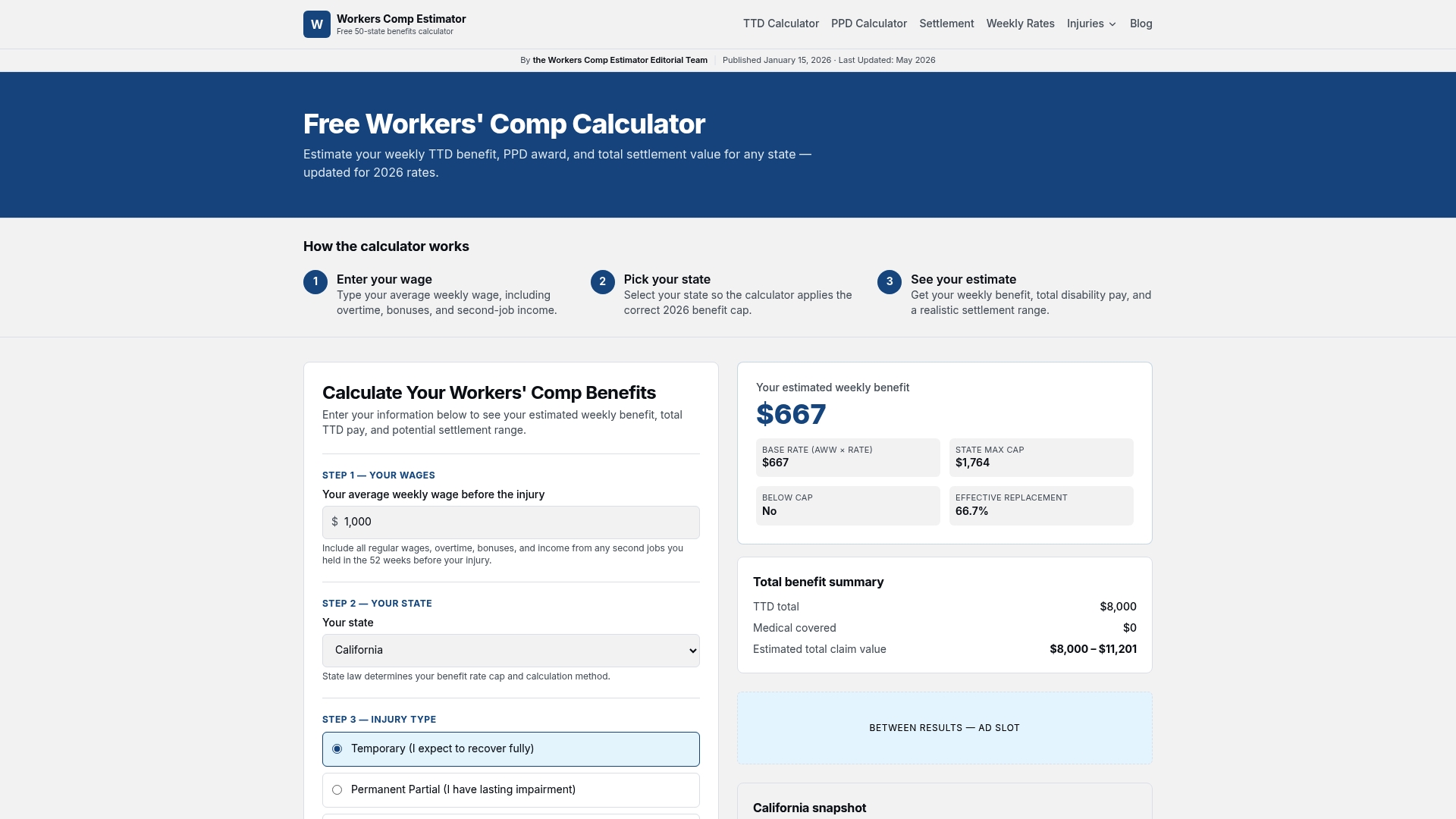
Start with the free 50-state settlement calculator and enter your AWW, state, and injury type to see your likely range. If you’re missing your impairment rating, run it without one first to see the spread, then rerun it once your doctor finalizes the report. Save your pay stubs, medical records, and the calculator’s output together in one file. That packet is exactly what a licensed workers’ comp attorney will want to see if your adjuster’s offer comes in lower than what your own numbers show. If you’re in a state with a particularly low cap, like the Oklahoma calculator shows, that documentation matters even more, since every dollar of AWW accuracy counts against a tighter ceiling.
This article is general information, not a substitute for advice from a qualified financial advisor. Consult a qualified financial professional about your own circumstances before acting on anything here.
Sources
FAQ
What Is the Formula for Workers’ Comp Settlements?
Most states calculate the core value as impairment rating multiplied by statutory weeks for that injury, multiplied by your weekly benefit rate, which is typically two thirds of your average weekly wage capped at the state maximum.
How Much Will I Actually Receive From a $50,000 Settlement?
Attorney fees (commonly a contingency percentage), any outstanding medical liens, and a Medicare Set-Aside if you qualify for one all come out of the gross figure, so your net amount is typically lower than the headline number, often by 15% to 25% depending on fees and liens involved.
What Is a Typical Workers Comp Settlement for a Back Injury Involving L4-L5-S1 Levels?
There’s no single “typical” figure because Florida’s non-scheduled injury math, statutory caps, and your specific impairment rating all drive the number differently case by case. Running your actual AWW and rating through a state-specific calculator gives a far more useful estimate than any generic average.
How Much of a $25,000 Settlement Do I Keep?
After attorney contingency fees and any outstanding medical or disability liens are deducted, most injured workers keep roughly 70% to 85% of a settlement’s gross value, though the exact amount depends on your fee agreement and lien situation.
Recommended
More from the blog
See how 2026 state caps, wages, and surgery affect your U.S. hernia workers' comp payout. Run a free 50 state calculator for a realistic estimate.
File the correct state claim and collect medical and wage records. Run the free 50 State calculator to see your likely weekly TTD and settlement before...
Use the free 50-state estimator that applies 2026 state caps to estimate your workers' comp lump sum. Run your numbers, check SSDI/Medicare impact, and...
Free workers' comp calculators
Put the numbers in this article to work on your own claim.
Weekly benefit, PPD, and settlement in one place.
What your weekly temporary disability check should be.
Scheduled weeks and permanent impairment awards.
Light-duty benefit when you earn less while healing.
Federal employee FECA award by body part.
Lump-sum value of your full claim.
Turn a 5%, 10%, or 20% rating into dollars.
Max and min weekly rates for all 50 states.
Typical settlement ranges by injury and state.
Average settlement for fusion, rotator cuff, knee replacement, and more.
Why comp does not pay it, and when a third-party claim does.
When carriers typically make an offer.
What coverage costs by class code and payroll.
Guides, state updates, and claim strategy.