
Functional Capacity Evaluation in Workers’ Comp: What to Expect

A functional capacity evaluation (FCE) is a structured, hands-on test of what your body can safely do at work after an injury. A trained clinician, usually a physical or occupational therapist, has you lift, carry, bend, walk and use your hands, then writes a report on your limits. In a workers’ comp claim, that report can shape your work restrictions, your return-to-work plan and the evidence behind your benefits. Here is how it works, how to prepare, and what to do if the result looks wrong.
TL;DR
- An FCE measures your safe physical abilities and compares them with the demands of your job. It is not a treatment session.
- Plan on roughly 3 to 6 hours, and longer in some states or clinics. Bring your medication list and any assistive devices you use.
- The report recommends restrictions, but it is one piece of evidence next to your doctor’s opinion and the vocational record.
- Be honest and consistent. Do the tasks as you actually can, and tell the evaluator about pain as it happens.
- If you disagree with the result, your state has a process for objecting or getting another opinion, and the deadlines can be short.
Table of Contents
- What a functional capacity evaluation is
- Why someone asks for an FCE
- What the evaluation tests
- How long it takes and what the day looks like
- How to prepare
- What the report says and how it is used
- Does an FCE decide your benefits or settlement?
- If you disagree with the FCE
- Our perspective
- Estimate what your restrictions could mean
- FAQ
- Sources
What a functional capacity evaluation is
The Orthopaedic Section of the American Physical Therapy Association describes an FCE as a comprehensive, performance-based medical assessment of physical and sometimes cognitive abilities for safe participation in work and other major life activities. The same guideline names four parts: an intake interview, a review of your medical records, a physical examination, and functional testing that matches real job content.
The point is objective measurement. Your doctor can tell you where it hurts and what the scan shows. An FCE shows what happens when you lift a 30-pound box, climb a ladder rung or hold a sustained posture, and for how long.
State rules use the same idea in slightly different words. Vermont’s vocational rehabilitation rule defines an FCE as an objective determination of your ability to take part in work-setting activities, and it requires matching your physical capabilities to job requirements. The same rule says a registered physical or occupational therapist, or another qualified medical provider, must perform it.
Why someone asks for an FCE
An FCE is usually ordered when a question about your work ability is still open. Washington’s Department of Labor and Industries explains in its injured worker guide that an FCE may be requested to plan a return to work, guide treatment recommendations, or evaluate your ability to perform work activities.
Who can ask depends on the state. Texas rules authorize an FCE at the request of an employer, carrier or the Division to determine whether an injured employee can perform physical activities in the workplace or in a modified-duty setting.
New York’s official FCE form lists the most common uses. They include determining safe maximal function at maximum medical improvement, setting a vocational baseline and return-to-work restrictions, assessing job-task modifications, and deciding whether more treatment or work hardening is indicated. The same form says an FCE may be performed only at maximum medical improvement and should not be prescribed before three months after the injury unless a significant documented change justifies it. If you want to understand that milestone first, our guide to MMI in workers’ comp explains it.
In practice, you may see an FCE requested when:
- your doctor is close to releasing you but unsure what duties are safe;
- the insurer wants to know whether you can return to your old job or need modified duty;
- a vocational counselor needs facts before suggesting retraining;
- a permanent restriction needs to be set after you plateau.
What the evaluation tests
The test list is broader than most people expect. Washington’s FCE elements document lists posture and mobility, sitting, standing, walking, climbing, bending, stooping, kneeling, squatting, crawling, reaching, balance, lifting, carrying, pushing, pulling, grasping, dexterity, keyboarding, foot controls and endurance, plus job-specific tasks.
The evaluator may also review:
- strength and range of motion;
- gait and sensation;
- your reported pain level;
- the medications you take;
- assistive devices such as a brace or cane;
- how consistent your effort is from one test to the next.
That last item matters. Washington’s framework includes cardiorespiratory endurance testing and a level-of-effort assessment using observation, heart-rate response, repeated testing and isometric grip testing. Evaluators use these checks to judge whether the results reflect your true safe ability.
Job-specific testing
A good FCE does not stop at generic lifting numbers. The same Washington document says additional testing may be based on job descriptions or job analyses. Colorado’s task-force supplement goes further: job descriptions should be obtained from the worker, the employer and the vocational specialist when available, and an unbiased job analysis is recommended when those descriptions materially differ.
This is worth checking before test day. If your employer’s written job description says you lift 20 pounds but you really lift 60 pounds of tile, tell your evaluator and your doctor, and bring the details.
How long it takes and what the day looks like
Washington’s guide says an FCE typically lasts 3 to 6 hours, though the length can vary by clinic. Colorado’s supplement describes a typical FCE as about 5.5 hours, which may extend to 7 to 8 hours, with a one-hour lunch break. It also requires specific justification when the evaluation is spread over two days.
A typical session runs like this:
- Interview. The evaluator asks about your injury, daily activities, job duties, medications and goals.
- Explanation. Each activity is explained, and you can ask questions before you start.
- Physical tasks. You sit, stand, walk, use your hands and arms, and handle weight. Weights usually build up in steps.
- Observation. The therapist watches how you move and records supporting data. Johns Hopkins notes that the final report includes an assessment of your physical condition.
- Report. The clinic writes up results and recommendations, usually sent to the requesting party and your treating doctor.
Expect to be tired afterward, and some people are sore the next day. Tell the evaluator and your treating doctor if symptoms flare.
How to prepare
You cannot study for an FCE, and you should not try to look stronger or weaker than you are. You can still prepare well.
Before the day
- Ask who ordered the FCE, who will receive the report, and which job it will be compared with.
- Make sure your treating doctor knows it is scheduled and has cleared you for the testing.
- Write down your current medications, doses and any devices you use. The evaluation elements include reported pain, medications, assistive devices, daily activities and goals.
- Write a short, accurate list of what your job really requires: weights, distances, positions, tools, hours on your feet.
On the day
- Wear comfortable clothing and supportive closed shoes.
- Eat normally and bring water. Take your usual medications unless your doctor says otherwise.
- Describe pain and limits as they happen, in plain words: “sharp pain in the lower back when I bend past this point.”
- Stop when a task is unsafe. Pushing through pain to impress the evaluator can hurt you and distort the report.
- Do each task the way you would do it at work, not in an exaggerated or minimized way.
Consistency is the quiet theme here. Because evaluators compare repeated measures and your reported symptoms with what they see, the most reliable approach is simply to be accurate.
What the report says and how it is used
The report records the maximum safe abilities that were observed and recommends work restrictions. According to Mayo Clinic, an FCE assesses maximum safe functional abilities and provides recommendations for final work restrictions. In workers’ comp it can support fit-for-duty testing, transitional-duty recommendations and return-to-work placement guidance.
Some states spell out what the report must contain. Ohio’s Bureau of Workers’ Compensation separates occupationally focused FCEs, which compare functional abilities with job requirements, from other types. Its payment policy requires documentation of tests performed, results, relevant findings, cooperation, consistency, safety of movement and body mechanics, adaptations, job-specific limitations or accommodations, and vocational rehabilitation readiness.
Here is how the findings can play out:
| Report finding | What it may lead to |
|---|---|
| Abilities below your job’s demands | Permanent restrictions, modified duty, or a vocational rehabilitation referral |
| Abilities that meet the job | Release to full duty, and possible reduction of wage-loss benefits |
| Borderline or inconsistent results | A second opinion, repeat testing, or more medical review |
| Need for conditioning | Work hardening or further treatment before release |
Courts have seen all of these. In a 2018 Sixth Circuit case, an FCE found the worker could do light-demand jobs but did not meet the strength, lifting, carrying or positional demands of his press-assistant job. The Tenth Circuit’s 2016 decision in Adair held that a required FCE arising from a workers’ comp claim was job-related and a business necessity, which matters if an employer requires one before you return.
For more on how clinician limits translate into pay, see our page on return-to-work restrictions.
Does an FCE decide your benefits or settlement?
No. An FCE does not set your weekly check and does not fix a settlement number by itself. It is evidence. A 2026 California Workers’ Compensation Appeals Board decision shows the pattern: the panel described the FCE’s lifting, endurance, pace and positional findings, but relied on the broader medical and vocational record when deciding impairment and labor-market capacity.
That is the right way to think about it. Your benefits come from your state’s formulas, your average weekly wage, your impairment rating and the rest of the file. Restrictions that limit what work you can do can strengthen the case that you lost earning capacity. Findings that show broad capacity can be used to argue for a lower offer. Either way, the FCE is read alongside your treating physician’s opinion.
To see how the rating side fits, read how an impairment rating affects your payout. If you want to see what permanent disability looks like in dollars under your state’s 2026 caps, our permanent disability guide walks through it, and the body part values by state page covers scheduled awards.
And the idea of matching a person’s physical capacity to job demands is not unique to the U.S.; it also underlies fitness for work assessments used in other workplace systems.

If you disagree with the FCE
A report you think understates your pain or overstates your ability is not the last word. What you can do depends on your state.
- California. The Division of Workers’ Compensation says that in permanent disability cases, a worker who disagrees with the doctor’s evaluation may object and request a panel of three qualified medical evaluators. An agreed medical evaluator can also resolve disputes when both sides agree.
- Deadlines. California’s injured worker guidebook says that in some cases you must send a letter to the claims administrator within 30 days of receiving a medical report if unrepresented, or 20 days if represented. Do not wait.
- Second opinions. West Virginia’s personnel division FAQ says an employee who disagrees with an FCE may obtain a second or third opinion, but pays for it unless the agency requested the FCE. That FAQ concerns West Virginia public employment and is not a nationwide rule.
A few steps help in any state:
- Ask for a complete copy of the report and the raw data.
- Show it to your treating doctor and ask whether it matches their findings.
- Write down anything that was wrong: tasks not done as described, symptoms not recorded, job demands misstated.
- Check your state agency’s rules on objections and the deadline.
- Talk to a workers’ comp attorney before you accept a settlement that relies on the report. Many offer free consultations.
If the claim itself has been denied, our claim denial guide lays out the next actions.
Our perspective
We built our calculators because injured workers keep getting asked to accept numbers they cannot check. The FCE is a perfect example. It arrives as a stack of clinical measurements, and it is easy to assume it settles everything.
It does not. It is one of the clearest pieces of evidence about your work capacity, and that makes it worth understanding before it happens. If your restrictions are accurate, they feed straight into the vocational and wage-loss questions that drive your claim value.
Our approach is to pair the clinical side with the money side. We use each state’s 2026 benefit caps and all of your income sources in the wage calculation, so you can see what a given restriction or rating might mean in weekly and total terms before you respond to an offer. An estimate does not replace a lawyer or your doctor. It gives you a realistic number to bring to them.
Walk into your FCE informed, get your report in writing, and compare the outcome with an estimate built for your state.
Daniel
Estimate what your restrictions could mean
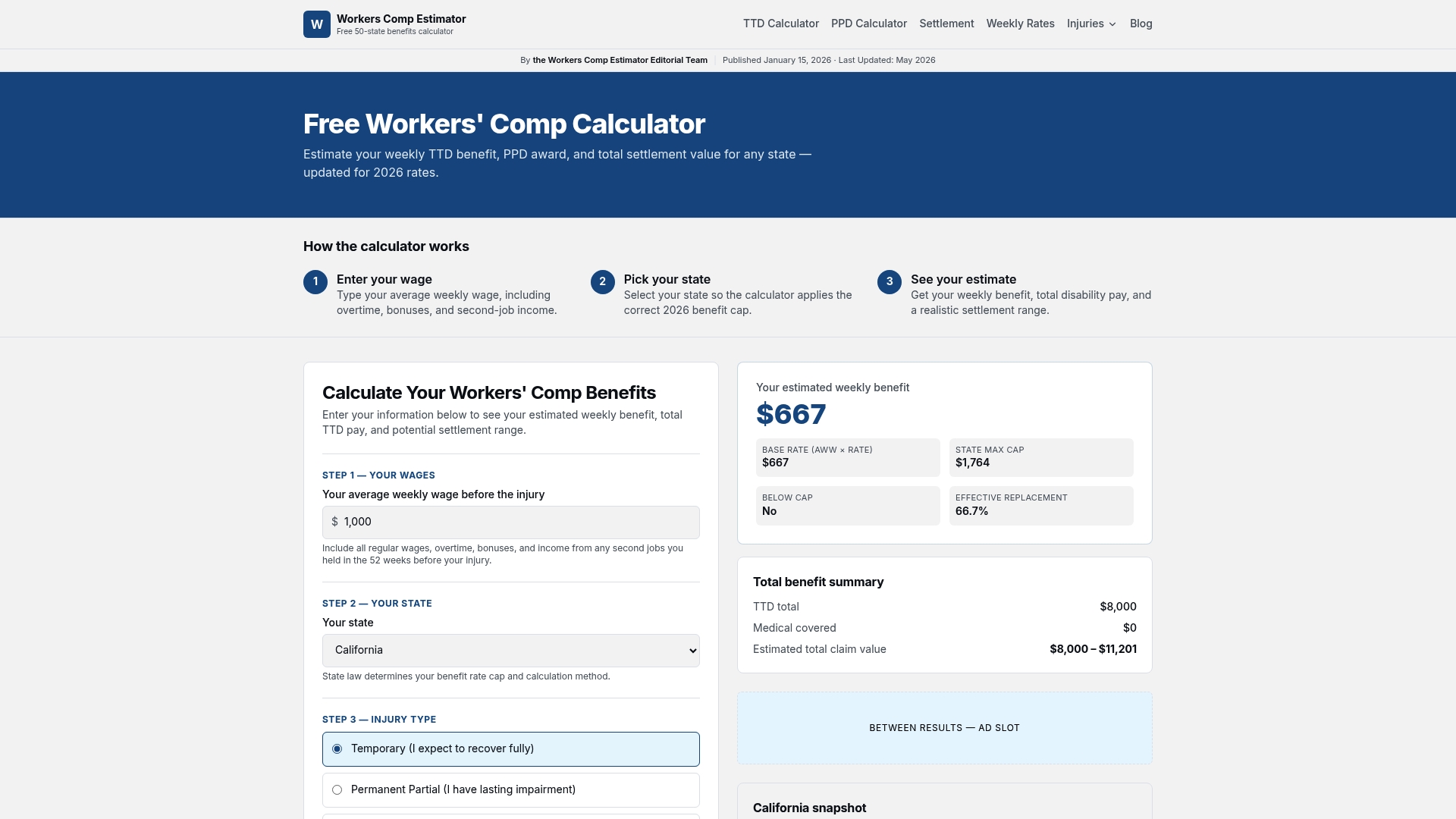
Once you know your restrictions or rating, the next question is what they are worth. Our free calculator uses your average weekly wage, state and injury type to estimate weekly disability benefits, and it applies each state’s 2026 caps. You can run it in a couple of minutes at Workers’ Comp Calculator, or go straight to the settlement calculator if you have an offer on the table.
If you are still off work, the TTD calculator shows your temporary benefit estimate. If you are back on lighter duty at reduced pay, try the temporary partial disability calculator. If the FCE points toward retraining, our page on vocational rehabilitation estimates explains what may be available.
FAQ
Is an FCE mandatory in workers’ comp?
It depends on the state and who is asking. Texas rules, for example, allow an employer, carrier or the Division to request one. Refusing a required evaluation can put your benefits at risk, so ask your attorney or state workers’ comp agency before you decline, and ask your doctor if you have a medical concern about the testing.
Can an FCE hurt my claim?
It can if the results show abilities that exceed your job demands, because the findings may support a release to work or a lower offer. It can also help, since documented limits support restrictions. Accurate, consistent effort and honest symptom reports give you the most reliable result, and you can challenge a report you believe is wrong.
Who performs the evaluation?
Usually a physical or occupational therapist trained in functional testing. Vermont’s rule, for instance, requires a registered physical or occupational therapist or another qualified medical provider. Ask for the evaluator’s credentials and whether the clinic is approved in your state.
What should I wear and bring?
Wear loose, comfortable clothes and closed supportive shoes. Bring photo ID, your medication list, any braces or devices you use, and notes about your real job duties. Eat normally and bring water.
Can the evaluator tell if I am faking?
Evaluators use repeated measures, heart-rate response and grip testing to check consistency. Colorado’s task-force supplement cautions that an FCE cannot be the only tool for deciding malingering, and that computerized isometric testing should not set specific restrictions because it is not job-specific. Honest effort is your best protection.
Sources
- Understanding Your Functional Capacity Evaluation, Washington L&I
- Functional Capacity Evaluation Elements, Washington L&I
- Physical Medicine Services (Functional Capacity Evaluation), Texas Department of Insurance
- Vermont workers’ compensation vocational rehabilitation rule
- Current Concepts in Functional Capacity Evaluation, APTA Orthopaedic Section
- Task Force Supplement for Functional Capacity Evaluation, Colorado
- Practitioner’s Report of Functional Capacity Evaluation, New York WCB
- Work-related assessments, Mayo Clinic
- Payment Policy for Functional Capacity Evaluations, Ohio BWC
- Functional Capacity Evaluations, Johns Hopkins Medicine
- Sixth Circuit opinion, 2018
- Tenth Circuit opinion, 2016
- California WCAB panel decision, Freeman
- Permanent disability benefits, California DWC
- Workers’ Compensation in California: A Guidebook for Injured Workers
- Functional Capacity Evaluation FAQ, West Virginia Division of Personnel
- Fitness for work assessments
Recommended
More from the blog
How long you have to report a work injury and file a workers' comp claim. See how deadlines work in Florida, Texas, Massachusetts, Kentucky and more.
Learn when workers' comp can reduce or deny U.S. unemployment, which payment types matter, and how to convert lump sums to weekly amounts before you file.
Worker-first IME playbook for U.S. claims: prepare, challenge an adverse IME report with four concrete steps, meet state deadlines, and use free 50 state...
Free workers' comp calculators
Put the numbers in this article to work on your own claim.
Weekly benefit, PPD, and settlement in one place.
What your weekly temporary disability check should be.
Scheduled weeks and permanent impairment awards.
Light-duty benefit when you earn less while healing.
Federal employee FECA award by body part.
Lump-sum value of your full claim.
Turn a 5%, 10%, or 20% rating into dollars.
Travel reimbursement for medical appointments.
Max and min weekly rates for all 50 states.
Typical settlement ranges by injury and state.
Average settlement for fusion, rotator cuff, knee replacement, and more.
Why comp does not pay it, and when a third-party claim does.
When carriers typically make an offer.
What coverage costs by class code and payroll.
Guides, state updates, and claim strategy.