Beat an Unfavorable IME in Workers’ Comp: 4 Steps for U.S. Workers

An IME, or Independent Medical Examination, is an evaluation ordered by the insurer, employer, or a state agency, performed by a doctor who has never treated you. The exam produces a report that can change whether treatment gets approved, when you’re declared at maximum medical improvement, and how much your claim is worth. In nearly every state, skipping a properly scheduled IME risks a suspension of your benefits, so attend, document what happens, and treat the exam as evidence, not a routine checkup.
TL;DR:
- An IME involves a one-time evaluation by a doctor with no prior treatment relationship, focusing on causation, MMI, treatment necessity, and impairment rating.
- The process and selection of examiners vary by state, with some requiring pre-approval and others allowing the insurer wide discretion, affecting objectivity.
- Preparing thoroughly, including documenting questions, bringing relevant records, and responding honestly, can influence the report’s credibility and your claim outcome.
- Missing or refusing a scheduled IME without a valid reason can lead to suspension of benefits or claim termination, emphasizing the importance of attendance.
- An unfavorable IME report can be challenged through objecting to errors, obtaining a rebuttal from your doctor, or requesting additional objective testing like an FCE.
Table of Contents
- What Is an IME in Workers Comp?
- Who Orders an IME and Who Pays for It?
- What Happens During an IME Appointment?
- How Do You Prepare for an IME?
- What Happens If You Miss or Refuse an IME?
- How Do You Challenge an Unfavorable IME Report?
- Do IME Rules Vary by State?
- An IME Carries Weight, but It Doesn’t Decide Your Claim Alone
- Estimate What an MMI Finding Could Mean for Your Benefits
- Authoritative State and National Resources
- Sources
- FAQ
What Is an IME in Workers Comp?
An independent medical examination workers compensation claim relies on is a one-time evaluation designed to answer specific questions: Is your injury caused by the work incident? Have you reached maximum medical improvement (MMI)? Does your current treatment plan still make sense? What’s your permanent impairment rating? The exam is called “independent” because the doctor has no prior relationship with you, not because the process itself is neutral. The AMA Guides describe the IME as a targeted evidentiary tool meant to answer the requesting party’s questions, and reports typically address:
- Causation, meaning whether your condition ties directly to the workplace injury
- Necessity of ongoing treatment or proposed procedures
- MMI status and readiness for impairment rating
- Functional limitations affecting work capacity
This is different from an FCE (functional capacity evaluation), which measures physical performance rather than rendering a medical opinion.
Who Orders an IME and Who Pays for It?
The insurance carrier or self-insured employer typically requests and pays for the IME. Judges, hearing officers, or state workers’ comp agencies can also order one, especially when a case is contested or stalled.
- Some states, including Washington, require examiners to be pre-approved and scheduled through a state system rather than picked freely by the carrier
- Other states let the insurer choose almost any licensed physician in the relevant specialty
- Ohio’s manual requires the examiner’s report to stay medically sufficient and limited to allowed conditions unless causation is specifically at issue
The selection method matters. A carrier-picked doctor with a heavy caseload for that same insurer raises fair questions about objectivity, and it’s one reason Washington’s approved-examiner system exists in the first place.
What Happens During an IME Appointment?
The IME process in workers compensation follows a predictable sequence, even though the specific questions vary by case.
- Records review. The examiner reads your medical file, imaging, and the referral questions before you ever walk in.
- Focused physical exam. Expect range-of-motion testing, strength checks, and a symptom interview relevant to your injury, not a full physical.
- Report drafting. The doctor writes findings on causation, MMI, impairment percentage under the AMA Guides, and work restrictions.
- Turnaround. Reports commonly land within two to six weeks, though state deadlines vary.
- Use in your claim. The report becomes evidence the insurer, adjuster, or judge weighs alongside your treating physician’s records.
That last point deserves attention: a single IME opinion carries real weight, but it doesn’t automatically override your treating doctor’s opinion in a hearing.
How Do You Prepare for an IME?
Treat the appointment like a deposition, not a doctor visit. Preparation protects your credibility and your claim.
- Bring photo ID, the IME notice letter, your medication list, and a pain or symptom diary
- Wear clothing that allows an easy physical exam of the injured area
- Arrive 15 minutes early; late arrivals sometimes get treated as a no-show
- Answer questions honestly and briefly, correcting any factual error the examiner states out loud
- Avoid volunteering extra medical history or venting frustration about your employer or your claim
Pro Tip: Write down everything you remember within an hour of leaving, including exact questions asked, the exam’s duration, and any comment the examiner made about your prognosis. That memo becomes valuable if the report later contradicts what actually happened.
Call your treating doctor or attorney the same day. A same-day debrief catches details before memory fades.

What Happens If You Miss or Refuse an IME?
Missing a properly noticed IME without a legitimate reason carries real consequences for a workers comp IME guidelines process built around attendance.
- Benefits can be suspended, and Oregon’s guidance confirms that unjustified refusal can also block further treatment authorization
- Repeated missed exams can escalate toward termination of benefits in some states
- Most states require advance written notice and reimbursement for travel time and mileage
- Keep every receipt and put reschedule requests in writing, never a phone call alone
An MMI finding from the IME carries its own weight because it can end temporary disability payments and trigger the impairment rating that shapes settlement talks.
How Do You Challenge an Unfavorable IME Report?
An adverse report isn’t the final word. Justia outlines several concrete remedies once you’ve read the report closely enough to spot problems.
- Flag objective errors first. Wrong dates, misquoted test results, or an inaccurate medical history are the easiest points to dispute.
- Request a treating-physician rebuttal. Ask your doctor to respond directly to the IME’s specific conclusions, not just restate your history.
- Order an FCE if capacity is disputed. A functional capacity evaluation gives you objective data to counter an IME that overstates what you can physically do.
- Pursue formal remedies. Depending on your state, that means requesting a neutral or state-appointed exam, filing for a hearing, or submitting a correction request through the insurer or agency.
Ohio’s manual is a useful model here: it requires impairment opinions to rest on objective clinical findings, so pointing out where a report lacks that objective backing is often the sharpest angle at hearing.
Do IME Rules Vary by State?
Yes, significantly. States differ on examiner approval systems, scheduling, reporting deadlines, and whether you can record the exam or bring an observer.
- Washington runs a formal approved-examiner and scheduling system with published timelines
- Oregon spells out attendance obligations and reimbursement rules in its own IME FAQ
- Ohio governs report content and examiner scope through its Medical Examination Manual
Check your state workers’ compensation agency’s page the moment you receive an IME notice. If you’re unrepresented, most agencies have an ombudsman or claims-help line that will explain the rules in plain language rather than legal jargon.
An IME Carries Weight, but It Doesn’t Decide Your Claim Alone
An IME report is influential evidence, not a verdict. Judges weigh it against your treating physician’s opinions, objective test results, and the consistency of your own documentation. The workers who do best after a rough IME are the ones who moved fast: they wrote down what happened, got a rebuttal on record, and watched their state’s deadlines instead of waiting to see what the insurer did next. Deadlines in this process are unforgiving, so when in doubt, consult your state agency or an attorney before a filing window closes.
— Daniel
Estimate What an MMI Finding Could Mean for Your Benefits
Once an IME sets your MMI date or impairment rating, your weekly checks and settlement number both shift. You can use free online calculators to see those numbers before negotiating with an adjuster who already has them calculated. Your impairment percentage feeds directly into a permanent partial disability award, and your MMI date determines when temporary benefits stop.
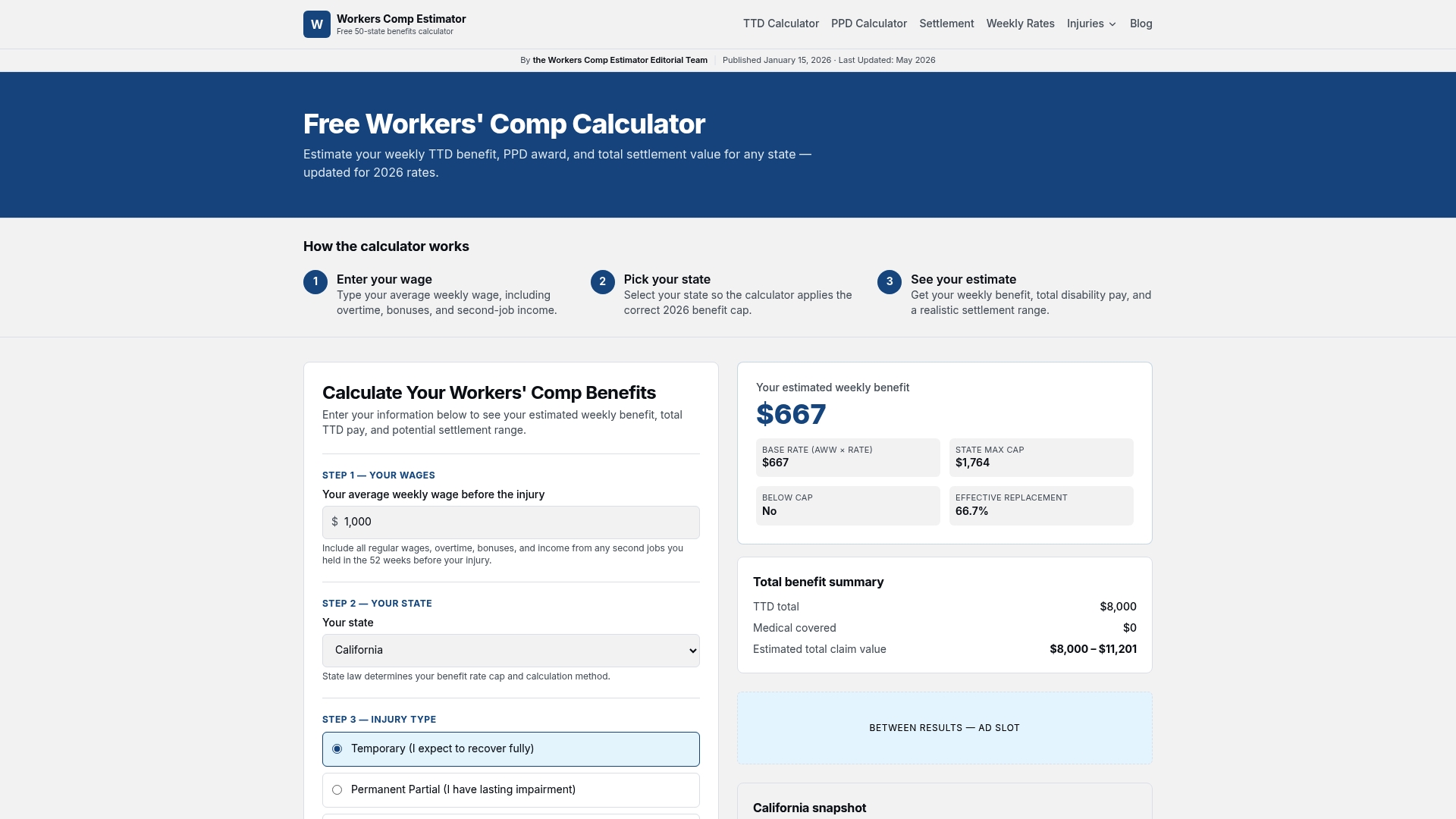
Run your numbers through the PPD calculator to see what an impairment rating might translate into, or use the TTD calculator to check your current weekly rate against your state’s 2026 cap. If you’re weighing a settlement offer that references your IME’s impairment rating, the settlement calculator gives you a realistic range to compare it against before you sign anything. Start with the free 50-state estimator and know your numbers before your next call with the insurance company.
Authoritative State and National Resources
- Oregon DCBS — IME FAQ
- Washington L&I — IME and Impairment Rating Information
- Ohio Industrial Commission — Medical Examination Manual
- AMA Guides — IME Evaluation Overview
If your injury has affected your mental health alongside the physical claim, California’s mental health leave rights are worth reviewing, since some IME referrals touch on psychological conditions too.
This article is general information, not a substitute for advice from a qualified lawyer. Consult a qualified legal professional about your own circumstances before acting on anything here.
Sources
- Department of Consumer and Business Services : Independent medical examinations (IME) : Frequently asked questions : State of Oregon
- Ohio Industrial Commission — Medical Examination Manual
- Washington State Department of Labor & Industries — IME and impairment rating information
- Independent Medical Examinations in Workers’ Compensation Claims — Justia
FAQ
How Long After an IME Does a Settlement Happen?
There’s no fixed timeline, but once the report arrives (commonly two to six weeks after the exam) it often becomes the basis for settlement discussions, especially if it establishes MMI or an impairment rating.
What Should You Not Say During an IME?
Don’t volunteer opinions about fault, exaggerate or downplay symptoms, or offer extended personal history the examiner didn’t ask about. Answer the question asked, and nothing more.
Who Pays for an IME in Workers Comp?
The insurance carrier or self-insured employer almost always pays for the IME they request, and travel costs are often reimbursable to the worker under state rules like Oregon’s.
Can an Employer Request an IME?
Yes. A self-insured employer or its insurance carrier can request an IME, and in most states you’re required to attend once you receive proper written notice.
What Happens If the IME Report Disagrees With My Doctor?
The insurer or judge weighs both opinions along with objective test results; a documented rebuttal from your treating physician, backed by an FCE where appropriate, can meaningfully offset an unfavorable IME.
Recommended
More from the blog
See how 2026 state caps, wages, and surgery affect your U.S. hernia workers' comp payout. Run a free 50 state calculator for a realistic estimate.
U.S. guide for Medicare eligible claimants: see the $25,000/$250,000 CMS review triggers, learn funding and admin options, and use free 50 state...
Use the free 50-state estimator that applies 2026 state caps to estimate your workers' comp lump sum. Run your numbers, check SSDI/Medicare impact, and...
Free workers' comp calculators
Put the numbers in this article to work on your own claim.
Weekly benefit, PPD, and settlement in one place.
What your weekly temporary disability check should be.
Scheduled weeks and permanent impairment awards.
Lump-sum value of your full claim.
Turn a 5%, 10%, or 20% rating into dollars.
Max and min weekly rates for all 50 states.
Typical settlement ranges by injury and state.
Fusion, rotator cuff, knee replacement, and more.
When carriers typically make an offer.
What coverage costs by class code and payroll.
Guides, state updates, and claim strategy.