
Avoid Low Offers: 50 State Calculator for Impairment Rating Payouts

An impairment rating becomes money by converting your medical percentage into compensable weeks (or a body-part share), then multiplying that by your state’s weekly benefit rate. State caps, minimums, and lump-sum discounting all shrink or shape the final number. There is no federal formula.
TL;DR:
- Most states cap weekly benefits between roughly $1,129 and $1,922, with scheduled awards relying on fixed weeks per injury and varying by jurisdiction.
- Lump-sum impairment settlements are typically discounted 10% to 20% below the total of weeks times weekly rate, depending on insurer discounts and negotiation.
- A proper impairment payout calculation requires applying your state’s specific schedule, weeks per body part, impairment percentage, and caps, not just the medical rating.
- Disputes often arise from premature MMI declarations, calculation errors, or missing medical records, making second opinions and complete documentation essential.
- Vocational factors can influence the final payout in wage-loss states, sometimes exceeding the medical impairment percentage if earning capacity is strongly affected.
Table of Contents
- What Determines Your Impairment Rating Payout?
- Where States Differ on Caps and Formulas
- Two Worked Examples: Scheduled Award vs. Whole-Person
- When Does MMI Trigger the Impairment Payment?
- How Do You Dispute a Low Impairment Rating?
- Why the AMA Guides and State Tables Both Matter
- PPD vs. PTD: How Your Rating Shapes Each
- Do Vocational Factors Change Your Payout?
- What Happens After You Get Your Rating?
- Is an Impairment Rating Payout Taxable?
- Does an SSDI or Other Settlement Affect Your Payout?
- Using an Impairment Estimate in Real Negotiations
- Get a State-Specific Impairment Payout Estimate
- Where to Verify These Numbers Yourself
- Sources
- FAQ
What Determines Your Impairment Rating Payout?
The math has four moving parts, and skipping any one of them is how workers end up accepting a lowball offer.
- Confirm your state’s model. Some states use scheduled awards tied to specific body parts (arm, leg, hearing). Others calculate off a whole-person impairment table or a weeks-per-percent multiplier. The formula differs by jurisdiction, so the first step is figuring out which system applies to you.
- Calculate your weekly benefit rate. Take your average weekly wage (AWW) and multiply it by your state’s compensation percentage, commonly around 66.67% or 70%. That figure then gets checked against your state’s statutory maximum and minimum.
- Convert the impairment percentage into weeks. Multiply the scheduled weeks for that body part by your impairment percentage, or apply your state’s weeks-per-percent rule for whole-person cases.
- Multiply weeks by the weekly rate. That product is your gross impairment payout before any lump-sum discounting.
Statistic to know: Discounted lump-sum offers typically run 10% to 20% below the total value of remaining weekly payments, depending on the discount rate insurers use and how hard you negotiate.
Where States Differ on Caps and Formulas
The weekly-rate formula itself varies, and so does what that rate gets multiplied against.
- Some states cap weekly benefits well below others. Oregon’s 2026 maximum runs near $1,601 per week, while Massachusetts sits closer to $1,922 per week and Michigan tops out around $1,129 per week.
- Scheduled-injury states assign a fixed number of weeks per body part. A thumb might carry 30 weeks, a leg 200, and your percentage applies against that specific number.
- Whole-person states instead multiply a broader weeks cap (often 300 to 500 weeks) by your percentage, or apply a state-set weeks-per-percent rate.
- Any temporary disability checks you already received can reduce, or in a few states offset, the impairment payout, and statutory caps sometimes limit the total regardless of your rating.
Where impairment percentage drives the outcome most directly, it’s in states that use pure impairment-based formulas. In wage-loss states, vocational and earning-capacity evidence can outweigh the medical number entirely.
Two Worked Examples: Scheduled Award vs. Whole-Person
Numbers make this concrete. Here’s how the same math plays out under each system.
-
AWW = $900. State compensation percentage = 66.67%. Weekly rate = $600, under the state max, so it holds.
-
Scheduled weeks for a hand injury = 200 weeks (illustrative, check your state’s schedule).
-
Compensable weeks = 200 × 20% = 40 weeks.
-
Total payout = 40 weeks × $600 = $24,000.
-
AWW = $1,000. State percentage = 66.67%. Weekly rate = $667.
-
Whole-person cap = 400 weeks (illustrative).
-
Compensable weeks = 400 × 15% = 60 weeks.
-
Total payout = 60 weeks × $667 = $40,020.
Statistic to know: If either worker takes a lump sum instead of weekly checks, expect the insurer’s initial offer to land 10% to 20% under that full weeks-times-rate total. On the $40,020 example, a lump sum offer would typically be notably less than the total weekly payments, depending on negotiation.
When Does MMI Trigger the Impairment Payment?
Your doctor has to declare Maximum Medical Improvement before anyone assigns an impairment percentage. MMI means your condition has stabilized. It doesn’t mean you’re healed. It means further treatment isn’t expected to improve your function.
- Impairment ratings are only assigned after MMI, and that timing shift matters because it usually ends your temporary total disability (TTD) checks and opens the door to permanent partial disability (PPD) payments.
- Most states give you a window to reopen a claim if your condition worsens after settlement, with the length of the window varying by jurisdiction.
- Insurers sometimes push for an early MMI declaration to fix the impairment number and stop temporary benefits sooner. Confirm actual medical stability before signing off.
How Do You Dispute a Low Impairment Rating?
A rating that looks too low isn’t automatically wrong, but a few patterns show up again and again in disputed claims.
- Premature MMI: your doctor declared stability before you’d actually plateaued.
- Calculation errors: the adjuster applied the wrong schedule or misconverted a body-part rating into whole-person terms.
- Missing records: the rating doctor didn’t have your full treatment history, imaging, or specialist notes.
Evidence that actually moves the needle includes a second opinion grounded in the AMA Guides, complete medical records, and, where wage loss is part of your state’s formula, a vocational assessment showing reduced earning capacity. Most states set firm deadlines for requesting an independent medical examination (IME) or filing a dispute, so don’t sit on it.
Pro Tip: Never sign a final release or settlement agreement while you still have unanswered questions about your rating. Once you sign, reopening the claim gets much harder, even if your condition later worsens.
Why the AMA Guides and State Tables Both Matter
Two separate systems have to work together to turn a diagnosis into a dollar figure, and understanding both is what lets you catch a bad offer before you accept it.
- Physicians use the AMA Guides to the Evaluation of Permanent Impairment to assign the clinical percentage. That’s a medical judgment, not a legal one.
- State statutes then take that percentage and run it through a weekly-rate formula, a schedule of weeks, and a maximum benefit cap.
- A useful calculator has to apply both layers correctly, not just the medical rating in isolation.
- Workerscompestimator builds its estimates around 2026 state weekly benefit rate tables, plus injury-specific PPD and settlement modeling, so the numbers you see reflect your actual state’s caps rather than a generic average.
PPD vs. PTD: How Your Rating Shapes Each
Permanent partial disability (PPD) and permanent total disability (PTD) are not the same claim wearing different labels. They’re separate legal categories, and your impairment rating plays a different role in each one.
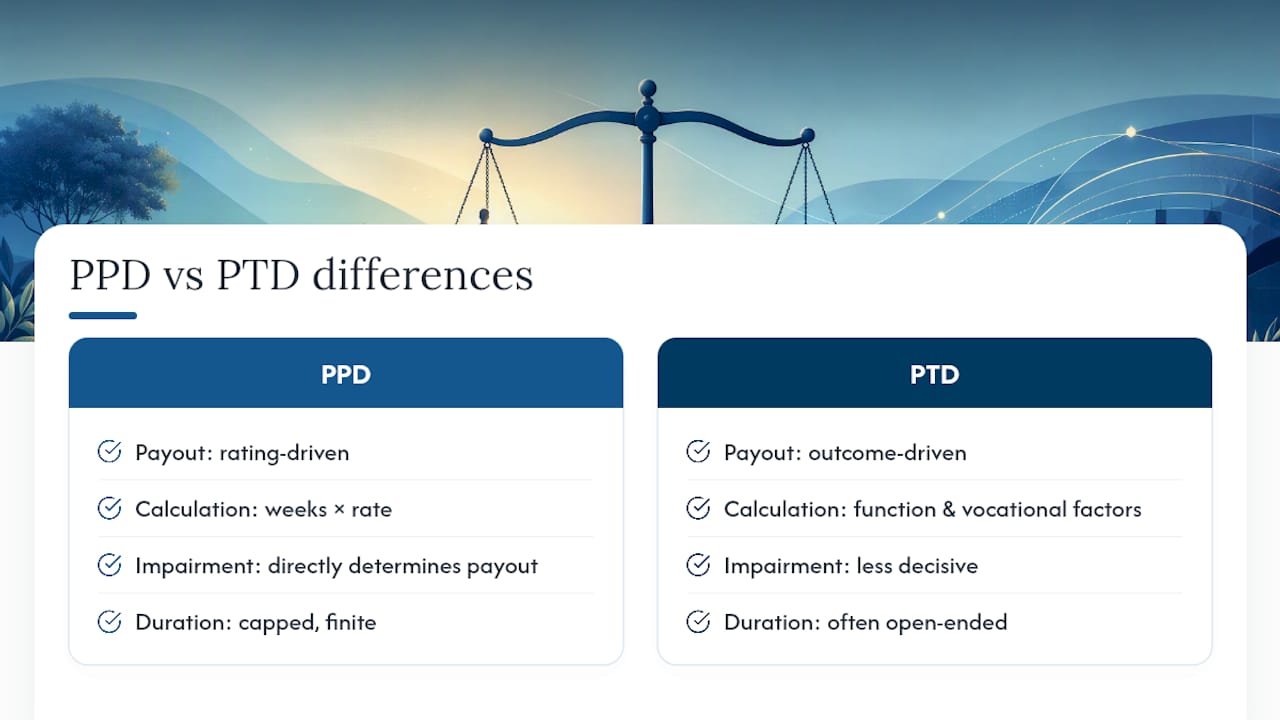
PPD covers workers who retain some ability to work despite a lasting impairment. Your rating directly drives the payout here: the percentage feeds straight into the weeks-times-rate formula covered earlier, whether your state uses a scheduled body-part table or a whole-person system. A 10% rating produces roughly half the compensable weeks of a 20% rating on the same schedule, all else equal.
PTD is different. It applies when a worker is considered unable to return to any substantial gainful employment, sometimes because of a single catastrophic injury (loss of both hands, total blindness) that many states treat as automatically total under statute, and sometimes based on a combination of impairment severity and vocational factors. In PTD cases, the impairment percentage often matters less than the functional outcome.
The practical distinction: PPD payouts are usually capped and finite. PTD payouts tend to be open-ended but require a much higher evidentiary bar to prove. Some states presume PTD status once impairment crosses a specific threshold; others require a full vocational hearing regardless of the percentage. Knowing which category your claim falls into changes both your negotiating leverage and your timeline expectations.
Do Vocational Factors Change Your Payout?
Your impairment percentage sets a floor, not always the final number. In wage-loss and hybrid states, how that injury affects your actual ability to earn a living can move the payout well beyond what the medical rating alone would suggest.

Vocational factors typically considered include age, education, prior work history, transferable skills, and the local job market for someone with your restrictions.
This is where earning capacity evaluations come into play. A vocational expert compares pre-injury and post-injury earning potential, and that gap can become part of the settlement math in states that weigh wage loss alongside or instead of pure impairment tables. In impairment-based states, this factor matters less, since the formula runs almost entirely off the percentage and the schedule.
If you’re in a state where vocational loss carries real weight, a low impairment percentage doesn’t necessarily mean a low payout, and a high percentage doesn’t guarantee a large one, if you can return to comparable work. This is also where legal representation earns its fee: proving diminished earning capacity requires documentation most workers don’t think to gather on their own, including job search records, functional capacity exams, and sometimes labor market surveys.
What Happens After You Get Your Rating?
Once a physician assigns your percentage, the claim moves into a fairly predictable sequence, and knowing the steps helps you avoid getting rushed into a bad decision.
First, the insurance carrier’s adjuster reviews the rating and typically issues a written offer, either as periodic PPD payments or a lump-sum settlement proposal. This offer is a starting point, not a final number. Adjusters routinely open with a figure lower than what the statutory formula actually supports, banking on workers not checking the math themselves.
Second, if you disagree with the offer or the rating itself, most states require you to file a formal dispute or request a hearing within a set statutory window, sometimes 30 days, sometimes longer. Missing that deadline can forfeit your right to challenge the number later.
Third, many claims move toward a settlement agreement, often called a “compromise and release,” which finalizes the payout in exchange for closing the claim. Once signed, most states treat this as final, so review any settlement with a workers’ comp attorney before signing, especially if the offer arrived quickly after your MMI declaration.
Attorneys handling these claims typically work on contingency, taking a percentage of the settlement rather than charging upfront. That fee structure is worth weighing against the size of the dispute. For a small, straightforward scheduled award, self-negotiation using a reliable calculator estimate may be enough. For six-figure whole-person claims involving disputed vocational loss, legal representation is usually worth the percentage it costs.
Is an Impairment Rating Payout Taxable?
Workers’ compensation impairment payments are generally not subject to federal income tax, whether paid as a lump sum or in periodic installments. This applies to both PPD and PTD payments under the workers’ comp system specifically, since these benefits arise from a workplace injury claim rather than ordinary wages.

There’s one meaningful exception worth knowing about. If you also receive Social Security Disability Insurance (SSDI), a portion of your workers’ comp payout can trigger what’s called an “offset,” which may make part of your combined benefits taxable. This happens because federal law caps the combined amount of SSDI and workers’ comp a person can receive, and the offset calculation can shift some of what would otherwise be tax-free workers’ comp income into the taxable SSDI category on paper.
State tax treatment generally mirrors the federal approach, but a few states have their own quirks worth checking with a tax professional or your state revenue department, particularly if your settlement includes components beyond the impairment award itself, such as future medical set-asides or vocational rehabilitation payments, which can sometimes be treated differently depending on how the settlement agreement is structured.
The bottom line for most workers: don’t assume you owe taxes on a workers’ comp impairment payout, but do flag any overlap with SSDI to a professional before filing, since that’s the scenario most likely to create an unexpected tax bill.
Does an SSDI or Other Settlement Affect Your Payout?
Impairment payouts rarely exist in isolation. If you’re also drawing Social Security Disability Insurance, receiving a separate personal injury settlement, or negotiating a broader workers’ comp settlement that bundles medical and wage-loss components, the pieces interact in ways that can change your net result.
The SSDI offset is the big one. If your workers’ comp impairment payments push you over that threshold, the Social Security Administration reduces your SSDI check to bring the total back under the cap. Some states structure settlements specifically to minimize this offset by allocating more of the settlement to future medical expenses rather than indemnity benefits, which SSDI doesn’t count against the cap the same way.
If your workers’ comp claim settles via a full “compromise and release,” that settlement typically closes out your right to future medical benefits and wage-loss claims tied to that injury, separate from whatever SSDI or Social Security retirement benefits you’re entitled to independently. The two systems run on different eligibility rules, so settling one doesn’t automatically resolve the other, but the dollar amounts can still offset each other under federal formulas.
A third-party personal injury settlement, say, from a car accident that also triggered a workers’ comp claim, adds another layer. Workers’ comp insurers often have subrogation rights, meaning they can claim reimbursement from that separate settlement for benefits already paid. Before finalizing any settlement involving multiple benefit sources, it’s worth having someone run the numbers across all of them together, since optimizing one in isolation can quietly shrink another.
Using an Impairment Estimate in Real Negotiations
A calculator estimate is enough when your case is straightforward: a clear scheduled injury, no dispute over MMI, no major vocational complications. Get a formal IME or an attorney involved once the rating is contested, the injury affects whole-person function, or wage loss is on the table. Weigh any lump-sum discount against your need for long-term security, and always check your own state’s caps before you agree to anything.
— Daniel
Get a State-Specific Impairment Payout Estimate
Workerscompestimator gives you the one thing a generic online formula can’t: numbers built around your actual state’s 2026 caps, not a national average that quietly overstates or understates what you’re owed. The calculator applies your weekly benefit rate, your state’s scheduled weeks or whole-person table, and your impairment percentage together, then models both periodic PPD payments and lump-sum equivalents side by side.
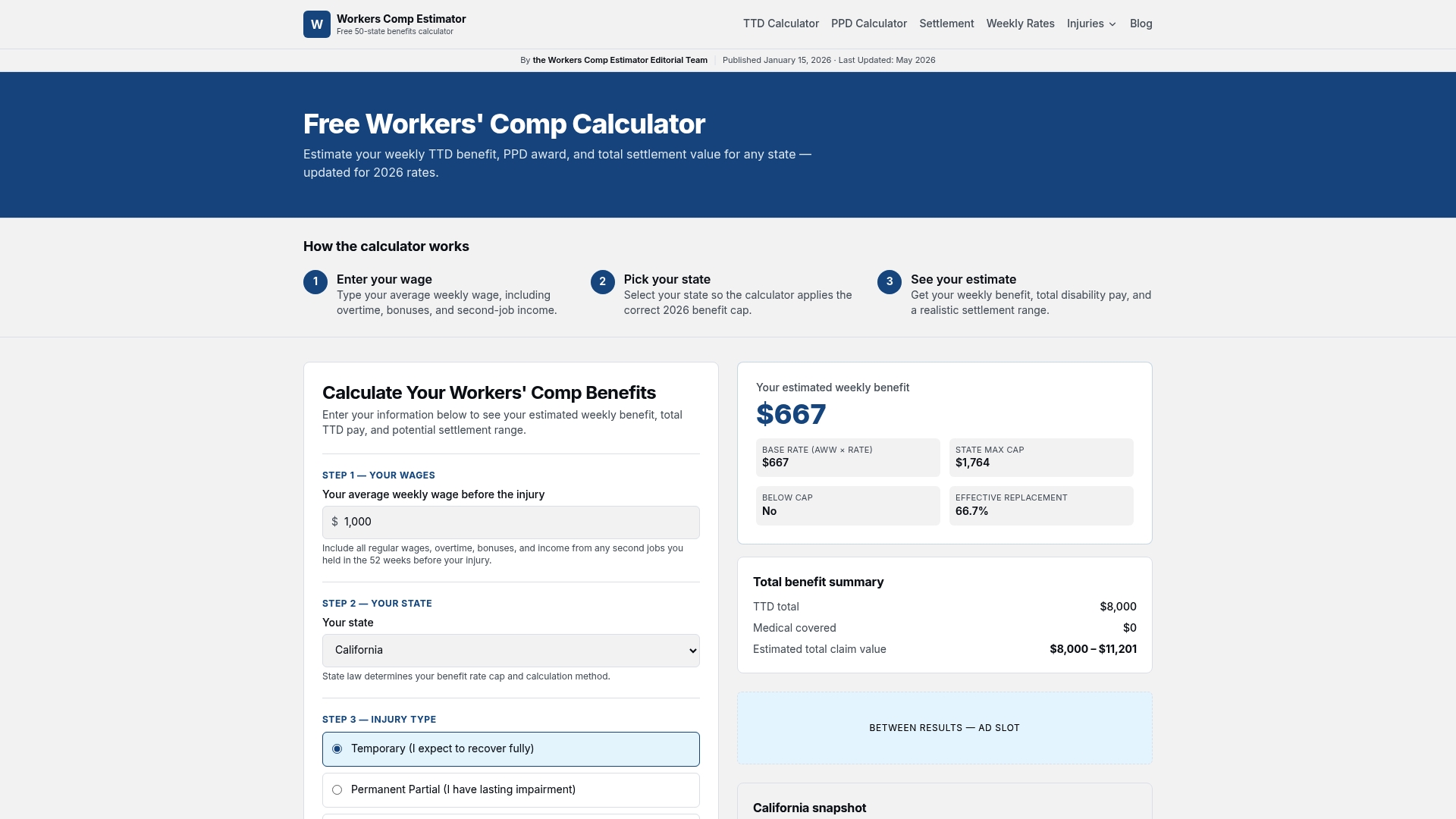
Start with the free 50-state estimator to see your baseline weekly rate and cap. If your injury involves a specific body part, run it through the PPD calculator for a scheduled-award estimate, or the settlement calculator if you’re comparing a lump-sum offer against ongoing payments. Save or print the report and bring it into any conversation with an adjuster or attorney. If your rating is disputed or your injury is catastrophic enough to raise PTD questions, use that estimate as a baseline, then consult a workers’ comp attorney before signing anything.
Where to Verify These Numbers Yourself
Cross-check any estimate against primary sources before you rely on it for a negotiation.
- The AMA Guides overview explains how physicians assign the clinical percentage behind your rating.
- DOL procedural guidance covers MMI requirements and rating timing.
- Your state’s workers’ compensation board publishes the official weekly-rate tables and schedule of weeks that actually govern your claim.
This article is general information, not a substitute for advice from a qualified financial advisor. Consult a qualified financial professional about your own circumstances before acting on anything here.
Sources
- How to Calculate an Impairment Rating Payout: The Formula - LegalClarity
- AMA Guides — Overview
- DOL — Impairment rating procedural guidance
FAQ
Is a 4% Impairment Rating Bad?
Ratings in the 1% to 5% range typically indicate a slight permanent limitation, which produces a smaller payout than a rating in the 21%-plus severe range, but it still qualifies for compensation under most state formulas.
What Is the Lump-Sum Payout for a Whole-Person Impairment Rating?
It’s your compensable weeks (whole-person weeks cap multiplied by your impairment percentage) times your weekly benefit rate, then typically discounted 10% to 20% if paid as a lump sum instead of weekly checks.
How Do You Calculate an Impairment Rating Payout?
Multiply your compensable weeks (from the schedule or whole-person table times your impairment percentage) by your state-determined weekly benefit rate. A free calculator that applies your state’s 2026 caps will do this math automatically.
What Does a 30% Impairment Rating Mean?
It produces meaningfully more compensable weeks, and therefore a larger payout, than a mild rating under the same state schedule.
Should You Accept a PPD Settlement Before Reaching MMI?
No. Ratings and settlements should follow MMI, since settling before your condition stabilizes risks locking in a payout based on an inaccurate, premature impairment percentage.
Recommended
More from the blog
Use the free 50-state estimator that applies 2026 state caps to estimate your workers' comp lump sum. Run your numbers, check SSDI/Medicare impact, and...
Get a state-accurate 2026 estimate for your U.S. burn injury settlement. Use the free 50-state calculator with your AWW, MMI date, impairment rating, and...
See how 2026 state caps, wages, and surgery affect your U.S. hernia workers' comp payout. Run a free 50 state calculator for a realistic estimate.
Free workers' comp calculators
Put the numbers in this article to work on your own claim.
Weekly benefit, PPD, and settlement in one place.
What your weekly temporary disability check should be.
Scheduled weeks and permanent impairment awards.
Light-duty benefit when you earn less while healing.
Federal employee FECA award by body part.
Lump-sum value of your full claim.
Turn a 5%, 10%, or 20% rating into dollars.
Max and min weekly rates for all 50 states.
Typical settlement ranges by injury and state.
Average settlement for fusion, rotator cuff, knee replacement, and more.
Why comp does not pay it, and when a third-party claim does.
When carriers typically make an offer.
What coverage costs by class code and payroll.
Guides, state updates, and claim strategy.