Protect Your U.S. Unemployment: Report Workers’ Comp Payments First

Workers comp can reduce or completely block your unemployment benefits, but the outcome depends entirely on your state. Some states cut unemployment insurance dollar for dollar against wage-replacement workers’ comp payments, some deny benefits outright for any week you receive workers’ comp, and a few carve out exceptions for certain payment types. Report every workers’ comp payment to your state unemployment agency now, with dates and amounts documented, before you file or continue any UI claim.
TL;DR:
- Workers’ comp payments like temporary total disability often lead to a dollar-for-dollar offset or full denial of unemployment benefits, depending on state laws.
- Some states classify workers’ comp as medical-only or permanent partial disability, which generally do not affect unemployment eligibility or benefits.
- Accurate reporting of all workers’ comp payments, including dates and amounts, before filing is crucial to avoid overpayment issues or delays.
- Converting lump-sum settlements into a weekly equivalent helps assess their impact on unemployment benefits accurately, using state-specific calculations and tools.
- Claimants should verify their state’s specific rules, deadlines, and payment classifications by consulting official labor department resources and considering legal or assistance support when needed.
Table of Contents
- How the Workers Comp Offset Unemployment Rule Actually Works
- Which Workers’ Comp Payments Actually Affect Your Unemployment Claim
- How Rules Differ by State, and What to Check Where You Live
- What to Do Right Now to Protect Your Unemployment Claim
- Doing the Math: Converting Workers’ Comp Into a Weekly Number
- What Claimants Should Actually Expect
- Estimate Your Workers’ Comp Benefits Before You File
- Where to Verify These Rules Yourself
- Sources
- FAQ
How the Workers Comp Offset Unemployment Rule Actually Works
There’s no single federal formula for how workers’ comp and unemployment interact. Congress left that decision to the states, and the result is a patchwork of approaches that can pay out very differently for two claimants with nearly identical injuries in neighboring states.
Three outcomes show up most often. A dollar-for-dollar offset reduces your weekly unemployment benefit by the exact amount of wage-replacement workers’ comp you’re receiving for that same week. A complete denial blocks unemployment entirely for any week you’re drawing workers’ comp, regardless of the amount. And a no-effect outcome applies in states or situations where the two programs simply don’t touch, often because the workers’ comp payment is classified as medical rather than wage replacement.
The concept of “constructive receipt” complicates timing. If your workers’ comp payment is scheduled or legally payable to you, some states count it against your unemployment benefit for that week even if the check hasn’t landed yet. That’s why matching payment periods to claim weeks matters more than watching your bank account.
The U.S. Department of Labor’s guidance on workers’ compensation makes clear that state agencies frequently need to conduct fact-finding to determine how a specific payment should be classified, because the purpose of the payment, not just its existence, drives the outcome. A DOL guide sheet on disqualifying or deductible income confirms states apply different formulas: some run a full dollar-for-dollar reduction, others apply a partial disregard, and others deny benefits outright.
Underneath all of this sits a federal floor. Under 20 CFR Part 604, states must confirm you’re able and available for work before paying unemployment for any given week. Being on workers’ comp doesn’t automatically fail that test, but if your treating doctor has you on full restriction with no release date, an adjudicator may flag your claim for exactly that reason.
Federal data-sharing adds another layer of scrutiny. UIPL 19-17 directs states to use federal crossmatch data to catch overlapping payments, meaning a state with an offset law will likely detect concurrent workers’ comp and unemployment claims even if you never report them yourself. Reporting first, on your terms, beats getting caught later.

Which Workers’ Comp Payments Actually Affect Your Unemployment Claim
Not every workers’ comp payment carries the same weight with a UI adjudicator. The type of benefit you’re receiving often determines whether it counts against you at all.
- Temporary total disability (TTD). This is straight wage replacement for weeks you can’t work at all, and it’s the payment type most likely to trigger a dollar-for-dollar offset or an outright denial, since it directly competes with unemployment’s own purpose.
- Temporary partial disability (TPD). Paid when you’re working reduced hours or a lighter-duty job at lower pay, TPD gets treated similarly to TTD in most states, though a few states only offset the portion that overlaps your lost wages.
- Permanent partial disability (PPD). Periodic PPD payments for a lasting impairment can be treated as deductible income in some states and ignored in others, largely because PPD compensates for a permanent loss rather than an inability to work right now.
- Medical-only payments. Covering doctor visits, surgery, or physical therapy, these typically don’t affect unemployment eligibility since they aren’t replacing lost wages, but you still need to report them so the agency can confirm that classification itself.
- Vocational rehabilitation payments. These usually pass through UI review without penalty because they support a return to work, which aligns with unemployment’s own goals rather than conflicting with them.
- Lump-sum settlements. A one-time settlement doesn’t map cleanly onto weekly UI benefits, so agencies often convert it into a weekly equivalent by dividing the total by the number of weeks it’s meant to cover, then apply that weekly figure against your claim for those weeks.
The label on your settlement paperwork matters. A lump sum broken into medical and wage-loss components with clear dollar amounts for each is far easier for an adjudicator to process correctly than one vague total.
How Rules Differ by State, and What to Check Where You Live
Three broad state models explain most of what claimants encounter. The offset model reduces your weekly unemployment payment by the wage-replacement workers’ comp amount for that week, dollar for dollar. The denial model blocks unemployment entirely for any week workers’ comp is paid, no matter the amount. The conditional model sits in between, applying an offset or denial only to specific payment types, such as TTD, while leaving PPD or medical-only payments untouched.
Vermont illustrates a state that spells out claimant-facing detail rather than leaving you to guess. Its labor department maintains a dedicated page on receiving both UI and workers’ comp benefits, outlining eligibility criteria and filing windows tied to your medical release date. Washington state takes a similar approach, with its Employment Security Department explaining eligibility after a workplace injury, including how being able and available factors into the decision.
Before you file anything, run through this checklist:
- Search your state labor department’s site for a page specifically about workers’ comp and unemployment interaction, not just general UI eligibility rules.
- Note your state’s reporting deadline for a workers’ comp payment. Missing it can trigger an overpayment finding months later.
- Check whether your state’s UI handbook lists a specific formula, a flat denial, or a payment-type distinction.
- Confirm the appeal deadline for any adverse determination. Most states give you a narrow window, often 10 to 30 days.
Pro Tip: Call your state UI office and ask them to classify your specific workers’ comp payment type before you file a claim. A five-minute phone call can save weeks of appeal paperwork later.
Timing drives almost every dispute. The date your medical provider signs off on work restrictions, the specific week a workers’ comp check covers, and the day you file your UI claim all have to line up. When they don’t, agencies default to caution and deny first, ask questions later.
What to Do Right Now to Protect Your Unemployment Claim
Getting ahead of an offset dispute is almost always easier than fighting one after the fact. Work through these steps in order.
- Report every workers’ comp payment to your state UI office immediately, including the exact dates, dollar amounts, and whether the payment is TTD, TPD, PPD, or medical-only, as explained in Workers’ Compensation for Movers: What Owners Must Know.
- Get a written medical release letter from your treating physician that states your specific work restrictions and, if applicable, a return-to-work date. This single document does more to resolve able-and-available disputes than anything else you can provide.
- Convert any lump-sum settlement into a weekly equivalent before you compare it to your unemployment weekly benefit amount, so you know roughly what an adjudicator will see when they run the same math.
- Keep a written log of every call and letter with the UI office, including names, dates, and reference numbers, and request written determinations rather than relying on verbal answers.
- File an appeal within your state’s deadline if you’re denied and you believe your payment type was misclassified. Include your medical documentation and any breakdown showing which portion of your settlement was wage replacement versus medical cost.
- Contact a claimant assistance program or a workers’ comp attorney if the dollar amounts involved are significant or if the agency’s fact-finding drags on for more than a few weeks without resolution.
Most of these disputes come down to paperwork gaps, not bad-faith denials. A settlement agreement that separates medical costs from wage-loss compensation, with clear weekly breakdowns, resolves more UI conflicts than any appeal letter ever will.
Doing the Math: Converting Workers’ Comp Into a Weekly Number
Comparing workers’ comp to unemployment requires putting both figures on the same weekly basis, since a lump sum and a weekly UI check aren’t naturally comparable. The standard method: divide your lump-sum settlement by the number of weeks it’s intended to replace to get a weekly equivalent figure you can set next to your state’s UI weekly benefit amount.
You’ll need four inputs to run this yourself: your average weekly wage before the injury, your state of residence, the payment type (weekly TTD rate versus lump settlement), and either the settlement total or your current weekly workers’ comp rate.
Say your settlement totals a lump sum covering multiple weeks of wage-loss. You can calculate the weekly equivalent by dividing the total amount by the number of weeks covered, which you then compare against your state’s maximum weekly UI benefit to see whether an offset would zero out your unemployment check or only partially reduce it.
Workerscompestimator’s free 50-state workers’ comp calculator runs this conversion using each state’s 2026 caps, and state-specific tools like the Oregon workers’ comp calculator or the Ohio benefits calculator show how sharply the math shifts once you cross a state line.

What Claimants Should Actually Expect
Most workers’ comp and unemployment conflicts are administrative headaches, not legal battles. An adjudicator misclassifies a payment, the claimant scrambles to prove otherwise, and the whole thing drags on for weeks longer than it should have.
Expect some delay while your state runs fact-finding, especially if your settlement lumps medical and wage-loss into one number. Reporting early and clearly, before an agency’s data crossmatch flags a discrepancy on its own, consistently shortens that process. Before signing any settlement or making a decision that affects your UI eligibility, run the numbers through a calculator first, not after.
— Daniel
Estimate Your Workers’ Comp Benefits Before You File
There are online tools that provide fast, state-specific numbers built on actual 2026 benefit caps, so you can estimate what your workers’ comp payment converts to in weekly terms before you talk to your state UI office.
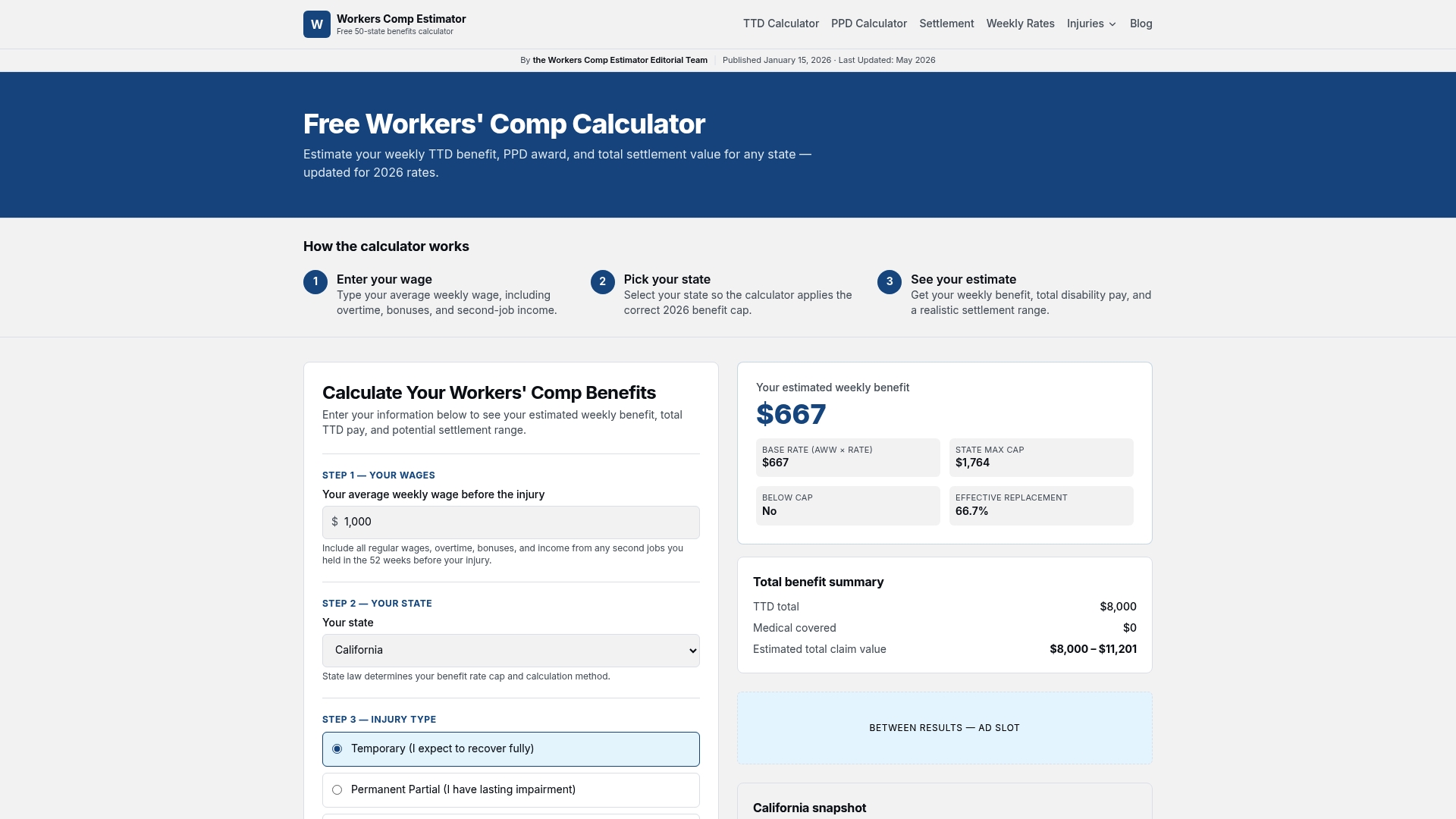
Enter your average weekly wage, your state, and your injury type into the free 50-state estimator, and you’ll get a weekly TTD figure and a potential settlement range in under a minute, with no account or personal contact information required. If you already have a settlement offer on the table, the settlement calculator converts that lump sum into the weekly equivalent your UI office will use for its own math, so you walk into that conversation with the same numbers they’ll be looking at. Run your state and your numbers before you accept anything or file another claim.
Where to Verify These Rules Yourself
For the current rules in your state, start with the U.S. Department of Labor’s UIPL guidance, the eCFR’s Part 604 eligibility standards, and your own state UI agency’s handbook page before relying on any third-party summary. If workers’ comp overlaps with Social Security Disability, the SSA’s POMS offset rules govern that separate calculation.
This article is general information, not a substitute for advice from a qualified financial advisor. Consult a qualified financial professional about your own circumstances before acting on anything here.
Sources
- eCFR: Regulations for eligibility for unemployment compensation (20 CFR Part 604)
- Guide Sheet 5: Disqualifying or deductible income (DOL handbook)
- U.S. Department of Labor: Workers’ compensation
- Vermont Department of Labor: Receiving both UI and workers’ comp benefits
FAQ
How does workers’ comp affect unemployment benefits?
It depends on your state’s law and the type of workers’ comp payment you’re receiving. Wage-replacement payments like TTD often trigger a dollar-for-dollar offset or a full denial, while medical-only payments usually don’t affect your unemployment claim at all, according to DOL guidance.
Can you collect workers’ comp and unemployment at the same time in New York?
New York generally does not allow you to collect full unemployment benefits for any week you’re also receiving workers’ comp wage-replacement payments, since the state treats WC as disqualifying income for that period. Check New York’s Department of Labor handbook directly, since exact treatment can depend on whether you’re totally or partially disabled.
Does a workers’ comp settlement count as income for unemployment?
A lump-sum settlement is typically converted into a weekly equivalent by dividing the total by the number of weeks it covers, and that weekly figure can then count against your unemployment benefit. You can estimate that weekly number yourself using a settlement calculator before your state agency runs its own calculation.
What pays more, workers’ comp or unemployment?
Workers’ comp wage-replacement benefits usually pay a higher percentage of your prior earnings, often around two-thirds of your average weekly wage up to a state cap, compared to unemployment’s typically lower weekly maximum. The TTD calculator shows your specific weekly rate so you can compare it directly against your state’s unemployment weekly benefit amount.
What should I do if my state denies unemployment because of my workers’ comp payment?
Request a written determination explaining the denial reason, then check whether your payment was correctly classified as wage replacement versus medical or vocational rehab. If you believe the classification was wrong, file an appeal within your state’s deadline and include medical documentation and a clear breakdown of your settlement or weekly WC rate.
Recommended
More from the blog
File the correct state claim and collect medical and wage records. Run the free 50 State calculator to see your likely weekly TTD and settlement before...
Compare workers comp and personal injury for U.S. workers. Learn which deadlines matter, how liens reduce settlements, and use the free 50 State...
Worker-first IME playbook for U.S. claims: prepare, challenge an adverse IME report with four concrete steps, meet state deadlines, and use free 50 state...
Free workers' comp calculators
Put the numbers in this article to work on your own claim.
Weekly benefit, PPD, and settlement in one place.
What your weekly temporary disability check should be.
Scheduled weeks and permanent impairment awards.
Lump-sum value of your full claim.
Turn a 5%, 10%, or 20% rating into dollars.
Max and min weekly rates for all 50 states.
Typical settlement ranges by injury and state.
Fusion, rotator cuff, knee replacement, and more.
When carriers typically make an offer.
What coverage costs by class code and payroll.
Guides, state updates, and claim strategy.