
Get Workers’ Comp Vocational Rehabilitation Estimates for 50 States
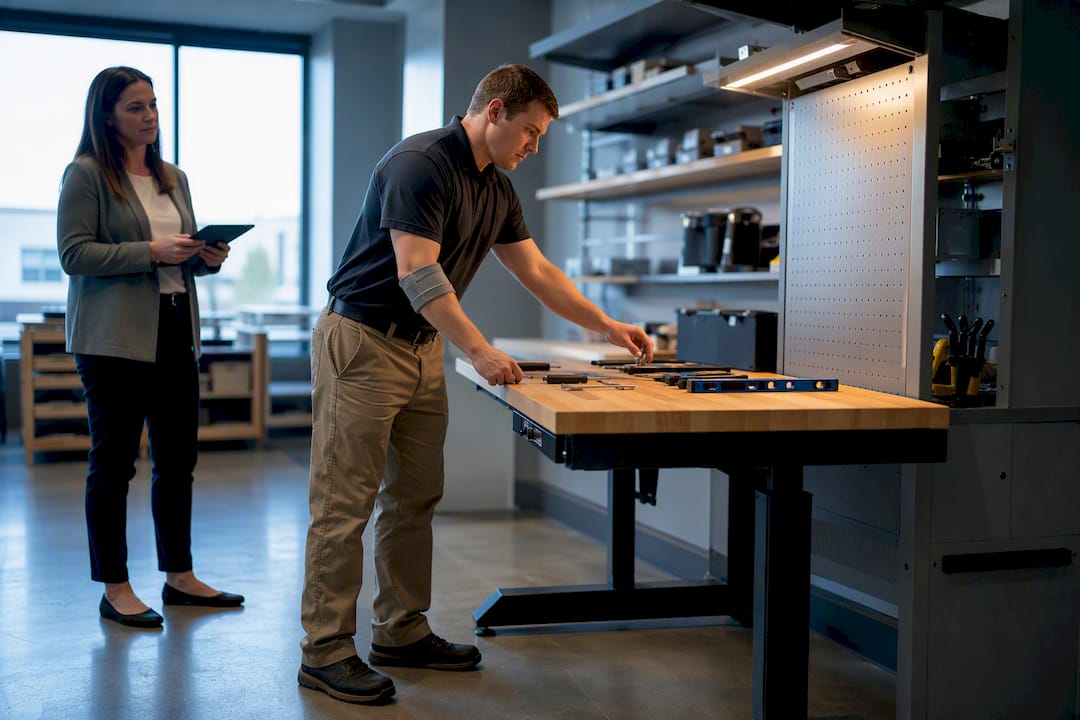
Vocational rehabilitation can be a workers’ compensation benefit that helps you retrain and find suitable work when you can’t return to your old job. It covers assessment, counseling, retraining, and job placement, but whether you get it automatically depends on your state and the specifics of your claim. Federal employees fall under separate rules entirely. The sections below cover eligibility, what services actually pay for, how to request them, what happens if your carrier says no, and where the rules shift from state to state.
TL;DR:
- About 30 states require workers’ compensation carriers to provide vocational rehabilitation once you meet permanent restrictions after maximum medical improvement.
- Eligibility depends on documented medical restrictions, inability to return to your previous job, and the absence of suitable modified tasks or jobs in your area.
- VR services typically include assessments, counseling, retraining, job placement, assistive equipment, and travel reimbursement, with costs usually covered by the insurer or state fund.
- If denied, injured workers should formally request a hearing and provide supporting evidence, often with legal help, to challenge the carrier’s decision.
- Being proactive early by documenting restrictions, requesting evaluations, and engaging vocational counselors improves chances of securing benefits and avoiding delays.
Table of Contents
- What Is Vocational Rehabilitation in Workers’ Comp?
- Who Qualifies for Vocational Rehabilitation?
- What Services Does Vocational Rehabilitation Actually Cover?
- How to Request Vocational Rehabilitation for Your Claim
- How the VR Process Works and Who Pays for It
- If Your Carrier Denies Vocational Rehabilitation
- How Vocational Rehabilitation Rules Differ by State
- Why Being Proactive About VR Pays Off
- Estimate Your Benefits While You Pursue Vocational Rehabilitation
- Sources
- FAQ
What Is Vocational Rehabilitation in Workers’ Comp?
Vocational rehabilitation (VR) is a workers’ comp benefit built around one goal: getting you back to earning a living when your injury permanently blocks you from doing your old job. It’s not the same as a modified-duty program your employer might offer while you heal. Modified duty is temporary and employer-driven, often just light tasks until you’re cleared for full duty. VR kicks in when your restrictions are permanent, and it’s usually run by a certified rehabilitation counselor (CRC) rather than your supervisor.
A well-run VR program does more than hand you a job listing. According to industry analysis on return-to-work programs, effective vocational rehabilitation blends:
- Medical restrictions and functional capacity
- Your existing skills and work history
- Realistic labor-market conditions in your area
- Psychological readiness to change careers or fields
Who Qualifies for Vocational Rehabilitation?
You generally become a candidate for VR once your doctor says you’ve hit maximum medical improvement (MMI) and you’re left with permanent restrictions that rule out your time-of-injury job. That’s the trigger in most states: not just “hurt,” but “hurt in a way that changed what work you can physically do.”
Here’s where it gets tricky. Roughly 30 states require carriers or state funds to provide VR once you meet eligibility thresholds. The rest treat it as discretionary, meaning you may need to request it yourself rather than wait for the adjuster to offer it.
Common eligibility triggers include:
- Permanent work restrictions confirmed after MMI
- Inability to return to your pre-injury position or employer
- No suitable modified-duty job available with your employer
- A wage loss tied directly to your restrictions
Federal employees operate under different terms. Under FECA, the Department of Labor can direct a federal worker into vocational rehabilitation, and refusing that directed program can reduce or suspend your wage compensation. That’s a meaningfully higher stake than most state systems carry.
What Services Does Vocational Rehabilitation Actually Cover?
VR benefits go well beyond a resume workshop. The exact menu varies by state, but most programs draw from the same toolkit.
- Vocational assessment: testing your transferable skills, aptitudes, and interests against your medical restrictions
- Counseling and job-search coaching: résumé help, interview prep, and labor-market guidance from a CRC
- Retraining or schooling: tuition, books, and fees for a program tied to a realistic job goal
- On-the-job training: wage subsidies or trial placements with a new employer
- Assistive equipment: adaptive tools or technology needed to perform a new role
- Travel reimbursement: mileage or transportation costs tied to evaluations, training, or interviews
Michigan’s guidance is a useful benchmark: it outlines assessments, retraining, placement help, and reimbursement of related expenses as standard components of a VR plan, under state oversight.
One wrinkle worth knowing: if VR lands you in a job that pays less than your old one, many states offer a wage-loss benefit to partly offset the gap. It’s not automatic everywhere, so ask your counselor directly.
Pro Tip: Keep every receipt tied to your VR plan, mileage, course fees, even parking for evaluations. Reimbursement requests get denied far more often for missing paperwork than for being unreasonable.
How to Request Vocational Rehabilitation for Your Claim
If VR isn’t offered automatically, you’ll need to push for it yourself. Here’s the order that tends to work:
- Ask your treating physician to document permanent restrictions and specifically note that you cannot return to your prior job. This medical language is what triggers eligibility in most states.
- Submit a written request to the claims adjuster and your employer asking for a vocational evaluation. Email creates a timestamp; a phone call doesn’t.
- Request a formal vocational assessment if one hasn’t been scheduled. This is what determines what training or placement path fits your restrictions.
- Gather supporting records: medical reports, job history, prior training, and any transferable skills documentation.
- Log every communication with dates, names, and outcomes.
- Escalate if the carrier stalls. Contact your state workers’ compensation board for a vocational evaluation or file for a hearing.
How the VR Process Works and Who Pays for It
Most state programs follow a similar sequence: eligibility screening, then a vocational assessment, then a written plan (often called an Individual Written Rehabilitation Plan, or IWRP), followed by implementation and eventual case closure once you’re placed or the plan concludes.
Retraining periods commonly run up to 52 weeks, with extensions available in some states for longer certificate or degree programs, according to Michigan’s published guidance. During that window, you typically keep receiving your temporary disability check while training, so long as you’re actively participating.
- The insurance carrier or state fund generally pays for tuition, materials, and reimbursable expenses.
- Wage benefits during retraining continue under the same TTD or TPD structure as before.
- If you settle your claim while a VR plan is still open, that settlement can close out future VR eligibility, so read the release language carefully before signing.
If Your Carrier Denies Vocational Rehabilitation
A denial isn’t the end of the road. Every state with mandatory VR rules has a dispute process, and it usually starts with paperwork rather than a courtroom.
- Request the denial in writing, not just a phone explanation.
- File a formal application for a hearing with your state’s workers’ compensation division or board.
- Submit supporting evidence: your physician’s documented restrictions, your vocational evaluation request, and any labor-market survey showing suitable jobs don’t exist in your field.
Wisconsin’s process is a clear example: injured workers who believe they were wrongly denied can request a formal hearing through the state’s Workers’ Compensation Division rather than simply accepting the carrier’s decision.
Pro Tip: If your hearing request involves a technical labor-market dispute, that’s usually the point to bring in a workers’ comp attorney. Most work on contingency, so it costs nothing upfront to get a read on your case.
How Vocational Rehabilitation Rules Differ by State
There’s no single national rulebook here, and that’s the part that trips people up. About 30 states mandate VR once you meet eligibility, while others leave it discretionary, meaning you have to ask.
- New York runs vocational rehabilitation counselors through its Workers’ Compensation Board, with public guidance on services and how to connect with one.
- Virginia sets provider certification standards and reimbursement rules through its Workers’ Compensation Commission.
- Wisconsin ties insurer responsibilities to specific timelines tied to how long you’ve received disability benefits.
- Federal employees under FECA face a different calculus: the Department of Labor can direct rehabilitation, and refusing it can affect your wage-loss compensation.
Always check your specific state board’s page before assuming your rights match a friend’s experience in another state.
Why Being Proactive About VR Pays Off
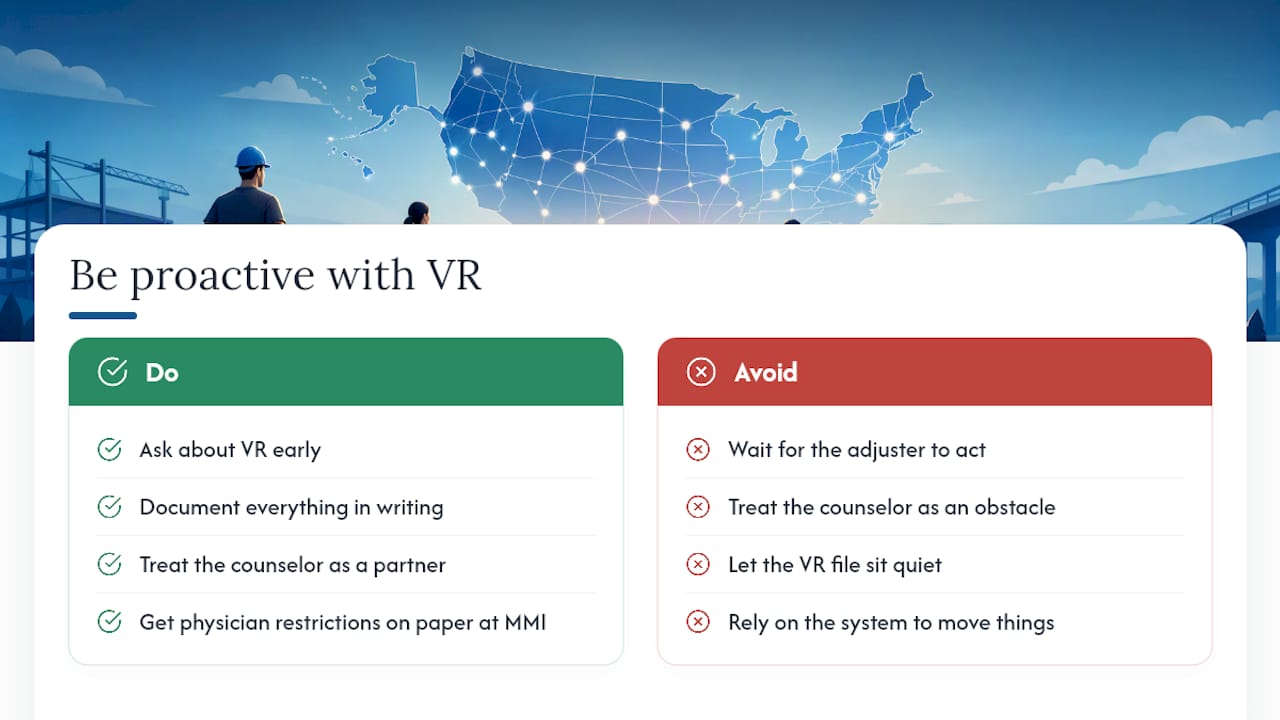
The injured workers who fare best with vocational rehabilitation aren’t the ones who wait for the adjuster to bring it up. They’re the ones who ask early, document everything, and treat the vocational counselor as a partner instead of an obstacle. Carriers manage caseloads, not careers, and a VR file that sits quiet often stays quiet.
Getting your physician’s restrictions on paper the moment you hit MMI, and following up in writing when nothing happens within a few weeks, tends to move things faster than waiting to see what the system offers on its own.
— Daniel
Estimate Your Benefits While You Pursue Vocational Rehabilitation
Workers’ comp attorneys and adjusters throw around numbers during negotiations, and it helps to walk in already knowing roughly where you stand. Free calculators estimate weekly Total Temporary Disability rate, potential permanent partial disability awards, and overall settlement ranges using your state’s actual 2026 benefit caps, so you’re not negotiating blind while a VR plan is still open.
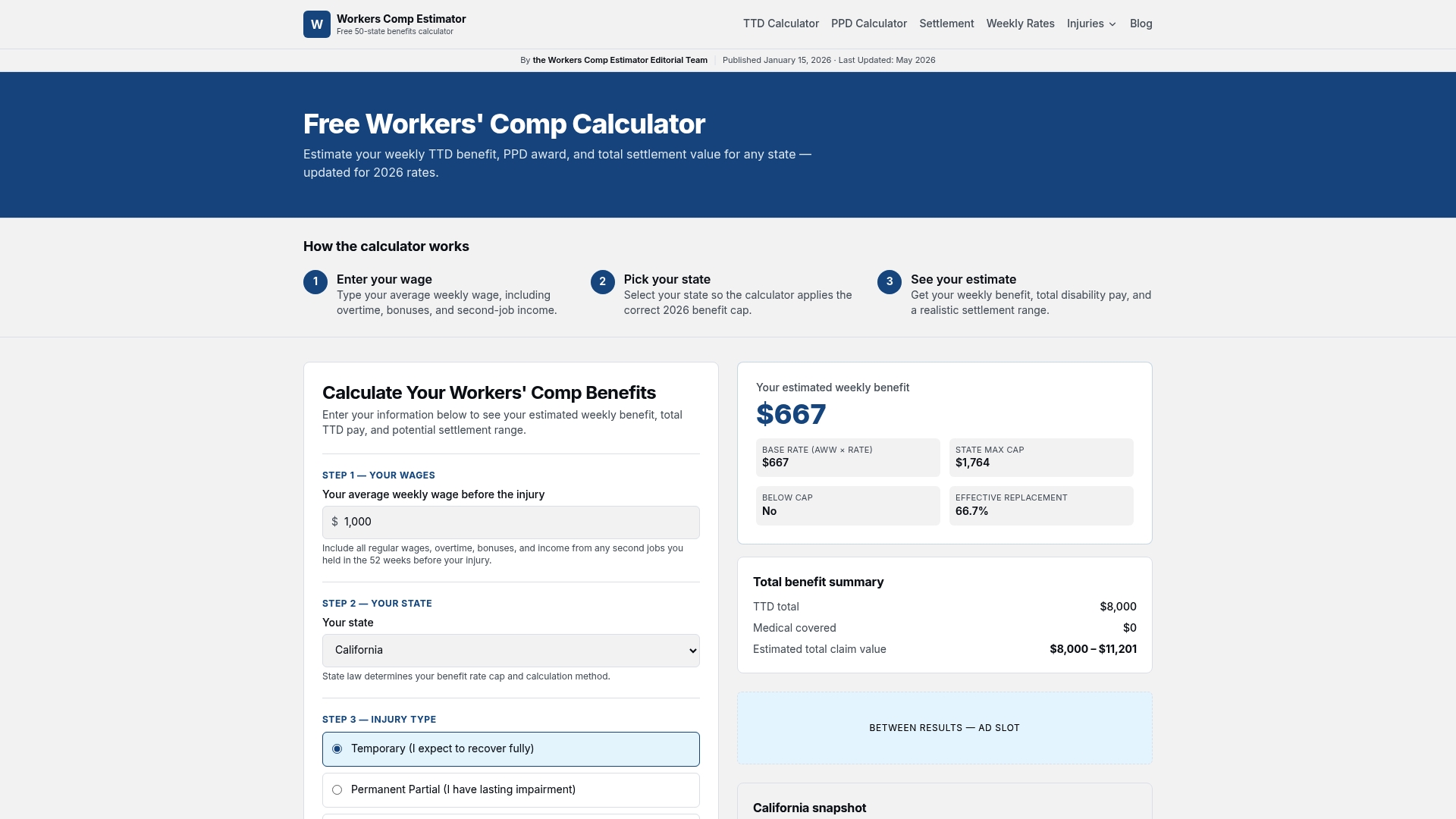
If you’re still receiving TTD checks during retraining, the TTD calculator shows what your weekly benefit should look like under your state’s cap. If a settlement offer is on the table and you’re weighing whether to close out an open VR plan, the settlement calculator gives you a realistic range before you sign anything. State-specific tools like the Virginia calculator and Michigan calculator reflect your exact state’s rules. None of this replaces legal advice, but it gives you numbers to bring into the conversation instead of guesses. Start with the free workers’ comp calculator and run your own estimate today.
This article is general information, not a substitute for advice from a qualified lawyer. Consult a qualified legal professional about your own circumstances before acting on anything here.
Sources
- FECA vocational rehabilitation (DOL / OWCP)
- Workers’ Compensation Vocational Rehabilitation Services (NY WCB)
- Michigan vocational rehabilitation guidance (MDOL publication)
- Vocational Rehabilitation Guidelines | Virginia Workers’ Compensation Commission
FAQ
What does vocational rehabilitation pay for?
It typically covers vocational assessment, counseling, tuition and books for retraining, on-the-job training wages, assistive equipment, and travel reimbursement for evaluations or training.
What are examples of vocational rehabilitation services?
Common services include transferable-skills testing, résumé and interview coaching, short-term certificate programs, on-the-job training placements, and job-search assistance from a certified rehabilitation counselor.
Is vocational rehabilitation funding being cut?
Funding and program rules vary by state and change periodically through legislation; check your state workers’ compensation board directly rather than relying on national headlines, since VR is administered state by state.
What disabilities qualify for vocational rehabilitation?
Any permanent work restriction that prevents you from returning to your time-of-injury job can qualify you, including permanent lifting limits, mobility restrictions, or repetitive-motion injuries confirmed after MMI.
How long does workers’ comp retraining usually last?
Retraining periods commonly run up to 52 weeks, with extensions possible in some states for longer training programs, as outlined in Michigan’s VR guidance.
Recommended
More from the blog
Turn national averages into a state specific 2026 estimate. Estimate gross and net pay with 2026 state caps and a free 50 state tool.
Find out whether PTSD qualifies for U.S. workers' compensation, when first-responder presumptions apply, how FECA and state rules affect proof, and use a...
U.S. action plan after a workers comp claim denial: 8 steps for the first 30 days, when to hire counsel, and a free 2026 state-cap payout estimate.
Free workers' comp calculators
Put the numbers in this article to work on your own claim.
Weekly benefit, PPD, and settlement in one place.
What your weekly temporary disability check should be.
Scheduled weeks and permanent impairment awards.
Light-duty benefit when you earn less while healing.
Federal employee FECA award by body part.
Lump-sum value of your full claim.
Turn a 5%, 10%, or 20% rating into dollars.
Max and min weekly rates for all 50 states.
Typical settlement ranges by injury and state.
Average settlement for fusion, rotator cuff, knee replacement, and more.
Why comp does not pay it, and when a third-party claim does.
When carriers typically make an offer.
What coverage costs by class code and payroll.
Guides, state updates, and claim strategy.