
What an Impairment Rating Means for Your Workers’ Comp Payout

An impairment rating is a percentage, assigned by a doctor after you reach maximum medical improvement, that measures how much a work injury has permanently reduced the function of your body. That number, whether it lands on your whole body or a single scheduled body part, is the main input insurers use to calculate your permanent partial disability check, so a difference of even a few points can shift a settlement by thousands of dollars.
Before you sign anything, do three things:
- Confirm your doctor has actually declared maximum medical improvement (MMI) in writing, not just implied it.
- Find out which edition of the AMA Guides your state requires. An outdated edition can get a rating thrown out.
- Run the percentage through a PPD calculator before you accept a number from an adjuster. A rating means nothing to your bank account until it’s converted to dollars.
Key Takeaways
A correct impairment rating depends on the right AMA Guides edition, complete objective documentation, and a verified dollar conversion before you settle.
| Point | Details |
|---|---|
| Confirm MMI in writing | Don’t accept a rating exam scheduled before your doctor has documented maximum medical improvement. |
| Match the AMA edition | Verify your state’s required AMA Guides edition since a mismatched edition can invalidate a rating. |
| Demand a complete report | A defensible rating needs objective findings, narrative rationale, and a cited AMA table, not just a number. |
| Convert percent to dollars early | Small rating differences move real money, so calculate your payout before any settlement talk. |
| Verify your offer with Workerscompestimator | Use the PPD calculator to check an insurer’s number against your actual state caps and wage. |
This article is general information, not a substitute for advice from a qualified lawyer. Consult a qualified legal professional about your own circumstances before acting on anything here.
Table of Contents
- What Does an Impairment Rating Workers Comp Claim Actually Measure?
- Who Can Legally Assign an Impairment Rating?
- How Do You Calculate a PPD Payout From an Impairment Rating?
- What State Rules Should You Confirm Before Accepting a Rating?
- How Do You Dispute or Reopen an Impairment Rating?
- How Should You Prepare for Your Impairment Rating Exam?
- Impairment Rating vs. Disability Rating: What’s the Difference?
- Does an Impairment Rating Affect Your Return to Work?
- What Factors Can Change Your Impairment Rating Outcome?
- What Role Does Vocational Evaluation Play Alongside Impairment Rating?
- How Does an Impairment Rating Affect Future Medical Benefits?
- A Few Common Mistakes That Cost Workers Real Money
- Check Your Offer Before You Sign Anything
- Sources
- FAQ
What Does an Impairment Rating Workers Comp Claim Actually Measure?
Impairment ratings come in two flavors, and mixing them up is one of the most common ways injured workers get shortchanged. A whole-person impairment rating measures how much your entire body’s function has dropped, expressed as a percentage. A scheduled body-part rating measures loss to a specific, listed part, like an arm, hand, or leg, converted into a set number of weeks by state statute.
The rating can’t happen until you hit MMI, the point where your treating doctor decides further treatment won’t meaningfully improve your condition. That date matters because a rating assigned too early, before scarring, range of motion, or nerve damage has stabilized, tends to run low. A report that skips an explicit MMI statement is a red flag on its own.
Most states anchor their process to the AMA Guides to the Evaluation of Permanent Impairment, now in its sixth edition with annual digital updates. The Guides break the body into diagnostic tables by condition and body region, and the most recent updates replaced older grade modifiers with specific individual elements (SIEs) and diagnosis-based impairment (DBI) tables, a change meant to cut down on rater-to-rater guesswork.
A valid rating needs more than a number on a form. It needs:
- Objective findings, things like range-of-motion measurements or imaging results, not just the doctor’s impression.
- A written narrative connecting those findings to the specific AMA table and diagnostic row used.
- A clear calculation showing how the raw finding was converted into a whole-person or body-part percentage.
Why this matters in dollars: Across the states in one NCCI analysis, the average whole-body impairment rating comes out to roughly 6.5%. NCCI’s own researchers note that a shift of even a single percentage point across a claims population changes total permanent partial disability costs enough to matter at a system level, which tells you something important about your individual claim: small percentage disputes are worth fighting.
Who Can Legally Assign an Impairment Rating?
Not every doctor who treats your injury is qualified to rate it, and knowing the difference protects you from a report that won’t survive a challenge. Most states require the rating physician to hold an active medical license, and many either require or strongly favor board certification along with demonstrated training in the AMA Guides methodology, sometimes evidenced by credentials like those from ABIME or AADEP.
You’ll typically encounter one of two paths. Your treating physician, the doctor who has managed your care from day one, may issue the rating directly. Or the insurance carrier may schedule an independent medical examination (IME) with a doctor you’ve never met, specifically to produce a rating for the claims file. IME doctors are paid by the insurer, which doesn’t automatically make their findings wrong, but it does mean their incentives are different from your treating doctor’s.
A defensible impairment report should contain five things, in this order:
- An explicit MMI statement with the date it was reached.
- Objective clinical findings, such as measured range of motion, strength testing, or diagnostic imaging.
- A narrative explanation connecting those findings to the injury.
- A specific citation to the AMA Guides table and diagnostic row used for the calculation.
- The final whole-person or body-part percentage, shown with the math that produced it.
The DEEOIC procedural manual, which governs impairment awards for federal energy workers, requires this same combination: rater qualifications, narrative rationale, and a clean percentage calculation, before a claims examiner will accept the rating.
Pro Tip: If your report is missing the AMA table citation or reads like a one-paragraph summary with no measurements attached, ask your doctor’s office for an addendum before you let the insurer see it. A thin report is easy for an adjuster to lowball and hard for you to dispute later.
How Do You Calculate a PPD Payout From an Impairment Rating?
Converting a percentage into a dollar figure comes down to three or four numbers: your impairment rating, your average weekly wage, your state’s weekly-rate fraction (commonly 66.67% or 70% of your wage), and either a statutory number of weeks for a scheduled body part or a whole-person weeks multiplier for unscheduled injuries.
Here’s how the math actually runs in practice.
- Scheduled body-part example. Say your state schedules 200 weeks for total loss of an arm, and your rating comes back at 15% impairment to that arm. Multiply 200 weeks by 15%, giving you 30 compensable weeks. If your average weekly wage is $900 and your state pays two-thirds of that as the weekly rate, you get roughly $600 per week. Thirty weeks at $600 comes to $18,000, before any state cap or offset is applied.
- Whole-person, unscheduled example. For an unscheduled injury like a back or a whole-body condition, many states multiply a fixed number of weeks (say 400 weeks, which some states assign for 100% whole-person impairment) by your percentage. A 10% whole-person rating would produce 40 compensable weeks. At the same $600 weekly rate, that’s $24,000.
Those numbers are illustrative of the mechanics, not a promise of what your state pays. Every state sets its own statutory weeks, its own wage fraction, and its own maximum weekly cap, so the same 10% rating can produce very different checks depending on where you’re filing. Run your actual wage and state through the settlement calculator to see the real range for your situation, and check the current weekly benefit rates for your state’s cap before you compare that number to anything an adjuster offers.
A few things routinely trip people up at this stage. State maximum weekly caps mean a high wage earner may not get the full two-thirds calculation, capped instead at a flat dollar ceiling. Some states apply a tort or third-party offset if you’re also pursuing a separate injury claim. And insurers frequently propose lump-sum settlements at a discounted present value, meaning the number they offer today is deliberately lower than the sum of the weekly payments over time. NCCI’s claims data makes the underlying point clearly: because small rating differences move real money, it’s worth doing this math yourself before you agree to a lump sum.

What State Rules Should You Confirm Before Accepting a Rating?
Workers’ comp is state law, not federal law, which means the rules governing your specific claim depend entirely on where you were injured, not on general advice. Before you accept any number, verify five things on your state’s official workers’ comp board site.
- The specific AMA Guides edition your state requires by statute, since a rating done under the wrong edition can be procedurally challenged and thrown out.
- Whether your injury falls under a scheduled body-part list or the unscheduled/whole-person category, since the math is different for each.
- The weeks-per-point or statutory weeks table your state applies to convert a percentage into compensable time.
- Your state’s weekly-rate formula and maximum cap, since two states with identical wages and identical ratings can produce very different checks.
- The deadline to reopen a claim if your condition worsens after settlement, since these windows range from a couple of years to much longer depending on the state.
NCCI’s research confirms what any adjuster who’s worked multiple states already knows: schedules, conversion formulas, required editions, and caps all vary meaningfully state to state, so a benchmark from a friend’s claim in another state tells you almost nothing about yours.
Finding this information isn’t difficult, but you need to search the right terms. Go to your state workers’ comp board’s official site, not a law firm’s marketing page, and search for phrases like “permanent partial disability schedule,” “impairment rating statute,” or “AMA Guides edition adopted.” Most boards publish a claimant handbook or FAQ page with these details in plain language, and many post the actual statutory weeks table as a PDF.
How Do You Dispute or Reopen an Impairment Rating?
Getting a rating you disagree with isn’t the end of the process, it’s usually the start of one. The first move is documentation, not confrontation: write down every factual error in the report, missed injuries, wrong measurements, an incomplete history, and request a written clarification from the rating physician before you do anything else.
If the insurer ordered an IME and that report came back lower than expected, you have real options.
- Flag factual errors directly. If the IME doctor got your job duties, prior injuries, or exam findings wrong, that’s a concrete, arguable mistake, not just a difference of medical opinion.
- Get a second rating. A rater experienced in the AMA Guides methodology, ideally board certified, can produce a competing rating that highlights where the IME’s table selection or measurements went wrong.
- Check your reopening window immediately. States set hard deadlines, sometimes tied to the date of your last payment, for reopening a claim if your condition worsens. Missing that window can permanently close the door, especially once you’ve accepted a lump-sum settlement.
Attorneys typically work on contingency in these disputes, taking a percentage of any increase they secure rather than an upfront fee, which means bringing one in rarely costs you money out of pocket if your rating is genuinely disputable. For a look at how these negotiations play out in real cases, this guide to disability attorney settlement negotiations walks through the kind of leverage points attorneys use.
Pro Tip: Never sign a lump-sum settlement release the same day you receive it. Take it home, run the numbers through a calculator, and sleep on it. Insurers rarely rescind a fair offer just because you took 48 hours to check the math.
How Should You Prepare for Your Impairment Rating Exam?
Walking into a rating exam unprepared is how workers end up with numbers they can’t challenge later, because the exam itself only lasts a few minutes and the report that comes out of it becomes the record for your entire claim.
Before the appointment, confirm three things with your treating doctor’s office: that MMI has actually been documented in your chart, that any imaging or diagnostic tests relevant to your injury are current, and that your doctor is willing to write a narrative statement connecting your specific findings to an AMA Guides table, not just hand you a bare percentage.
Once you have a number in hand, the fastest way to sanity-check it is to run it through a PPD calculator. You’ll need your average weekly wage, your state, and the impairment percentage from your report. The calculator applies your state’s weekly-rate fraction and statutory weeks or weeks-per-point schedule automatically, using current benefit caps, so you get a realistic dollar range instead of guessing.
That output is worth more than a mental estimate when you’re negotiating. Print or screenshot the calculator’s result, along with the wage and percentage you entered, and bring it to any conversation with the adjuster or your attorney. Because NCCI’s analysis shows how sensitive PPD costs are to small rating changes, having your own documented estimate makes it much harder for an adjuster to lowball you with a number pulled from thin air.
If your case involves a common injury type, like a shoulder, knee, or back, an injury-specific calculator can narrow the range further using typical scheduled weeks for that body part. Checklist for the exam itself:
- Bring copies of all imaging and diagnostic test results.
- Bring a written list of ongoing symptoms and functional limitations, dated and specific.
- Ask the rater directly which AMA Guides edition they’re using and whether it matches your state’s requirement.
- Request a copy of the final written report, not just a summary letter.
Impairment Rating vs. Disability Rating: What’s the Difference?
These two terms get used interchangeably, and that confusion costs people money. An impairment rating is a medical measurement, a doctor’s assessment of how much function your body has permanently lost, expressed as a percentage under the AMA Guides. It doesn’t ask whether you can still do your job.
A disability rating, by contrast, is a legal and vocational conclusion about how that impairment affects your ability to work and earn a living. Two workers with an identical 15% impairment rating to the same body part can end up with very different disability outcomes: a desk worker might return to full duty with no wage loss, while a construction worker with the same physical limitation might be unable to perform their job at all.
Some states fold disability entirely into the impairment number, using the AMA percentage directly in the PPD formula regardless of your occupation. Other states layer in additional factors, age, education, and job market access, when calculating permanent partial or permanent total disability benefits. This is why the same medical report can produce a $15,000 settlement in one state and a much larger one in another for the identical injury and occupation, because the disability layer on top of the impairment number is doing different work depending on the jurisdiction.
Knowing which system your state uses tells you whether your fight is purely medical (challenging the percentage) or also vocational (challenging the wage-loss and job-access conclusions attached to it).
Does an Impairment Rating Affect Your Return to Work?
A rating can shape how your employer and the insurer treat your file long after the settlement check clears. Many states use the rating, or a related work-capacity evaluation, to determine whether you’re released to full duty, light duty, or unable to return at all, and that classification affects both your wage-loss benefits and your standing with your employer.
A low impairment rating doesn’t automatically mean you’re cleared to return to your old job. It’s a measurement of anatomical or functional loss, not a job-specific capacity test. A warehouse worker with a 5% impairment to the lower back might still be unable to lift the weights their job requires, even though the percentage sounds minor on paper.
Employers are not universally required to hold your position open indefinitely, and rules on job protection during a workers’ comp claim vary significantly by state and by whether the Family and Medical Leave Act applies to your situation. If your rating comes with permanent restrictions, ask early whether your employer can accommodate modified duty, because that conversation often needs to happen before your rating is finalized, not after.
Workers who return to modified duty sometimes see their impairment rating cited later as evidence they’re fully capable, even when the rating and the job’s actual demands don’t match. Documenting your functional limitations in writing, separate from the bare percentage, protects you if that argument comes up down the line.
What Factors Can Change Your Impairment Rating Outcome?
Two workers with the same injury, treated the same way, can walk out with different percentages, and the reasons usually come down to a handful of recurring variables.
Pre-existing conditions are the biggest wildcard. If you had a prior injury or degenerative condition in the same body part, the rating physician may apportion part of the impairment to that pre-existing state, reducing the percentage attributed to your current work injury. This apportionment step is where a poorly documented history can quietly cost you points.
Age factors into some AMA Guides calculations, particularly for conditions where natural degeneration is expected to accelerate impairment over time, though it plays a smaller role than most workers assume.
Other common variables that shift outcomes:
- Which AMA Guides edition and table the rater selects, since different diagnostic rows can produce different percentages for the same underlying condition.
- How complete the objective testing is, since sparse range-of-motion data tends to produce conservative, lower ratings.
- Whether the rater is your treating physician or an insurer-selected IME doctor, since the working relationship and incentive structure can subtly shape how findings get interpreted.
- The quality of your own symptom documentation leading up to the exam.
None of these factors are things you can control after the fact, which is exactly why preparation before the rating exam, not disputes after it, is where most workers have the most leverage.
What Role Does Vocational Evaluation Play Alongside Impairment Rating?
An impairment rating tells you what’s medically wrong. A vocational evaluation tells you what that means for your paycheck, and the two assessments frequently get requested together in claims involving significant permanent restrictions.
A vocational evaluator looks at your impairment rating alongside your work history, education, transferable skills, and the local job market, then produces an opinion on whether you can return to your prior occupation, need retraining, or face a genuine loss of earning capacity. In states that calculate permanent total or permanent partial disability based on wage-loss potential rather than a flat schedule, this evaluation can matter as much as the medical rating itself.
This step becomes especially important when the impairment rating looks moderate on paper but the practical job impact is severe. A 12% whole-person rating might sound modest, but if it eliminates your ability to perform the only trade you’ve worked for twenty years, a vocational evaluation is what puts that reality into the record. Insurers sometimes resist ordering one because it can push settlement value higher, so if your state’s system allows for vocational input and no one has raised it, ask your attorney or claims examiner directly whether you qualify for one.
How Does an Impairment Rating Affect Future Medical Benefits?
Settling your permanent partial disability claim based on an impairment rating does not automatically end your right to medical treatment, but the two are connected in ways that catch people off guard. In many states, accepting a lump-sum settlement includes language that closes out future medical benefits for that injury unless you specifically negotiate to keep them open.
Read any settlement agreement carefully for the phrase “medical benefits closed” or similar language before you sign. Some states allow you to settle the indemnity (wage-loss and impairment) portion of your claim while keeping medical benefits open for the same injury, which matters enormously if you expect future surgery, therapy, or complications. Others require an all-or-nothing settlement.
Your impairment rating can also resurface years later if your condition changes. If your state’s reopening window is still active and your condition genuinely worsens, a new rating exam may be ordered, and the updated percentage can trigger additional benefits, but only if you preserved that right rather than signing it away in a full-and-final settlement.
A Few Common Mistakes That Cost Workers Real Money
The most expensive mistake I see is accepting the first percentage handed over without checking the math behind it. Adjusters aren’t obligated to explain how a number converts to dollars, and most workers never ask.
The second is ignoring which AMA Guides edition was used. It sounds like a technicality until you learn a mismatched edition can get a rating challenged and redone, sometimes to your benefit.
The third is treating a low percentage as final because MMI documentation was thin. A few missing percentage points, multiplied across your statutory weeks, routinely means thousands of dollars. Use a calculator, get the documentation, and don’t rush the decision.
Check Your Offer Before You Sign Anything
Workerscompestimator turns the abstract impairment percentage in your medical report into a real dollar figure, using your actual state’s caps, weekly-rate formula, and statutory weeks, so you’re comparing an insurer’s offer against a number grounded in your own claim instead of a guess.
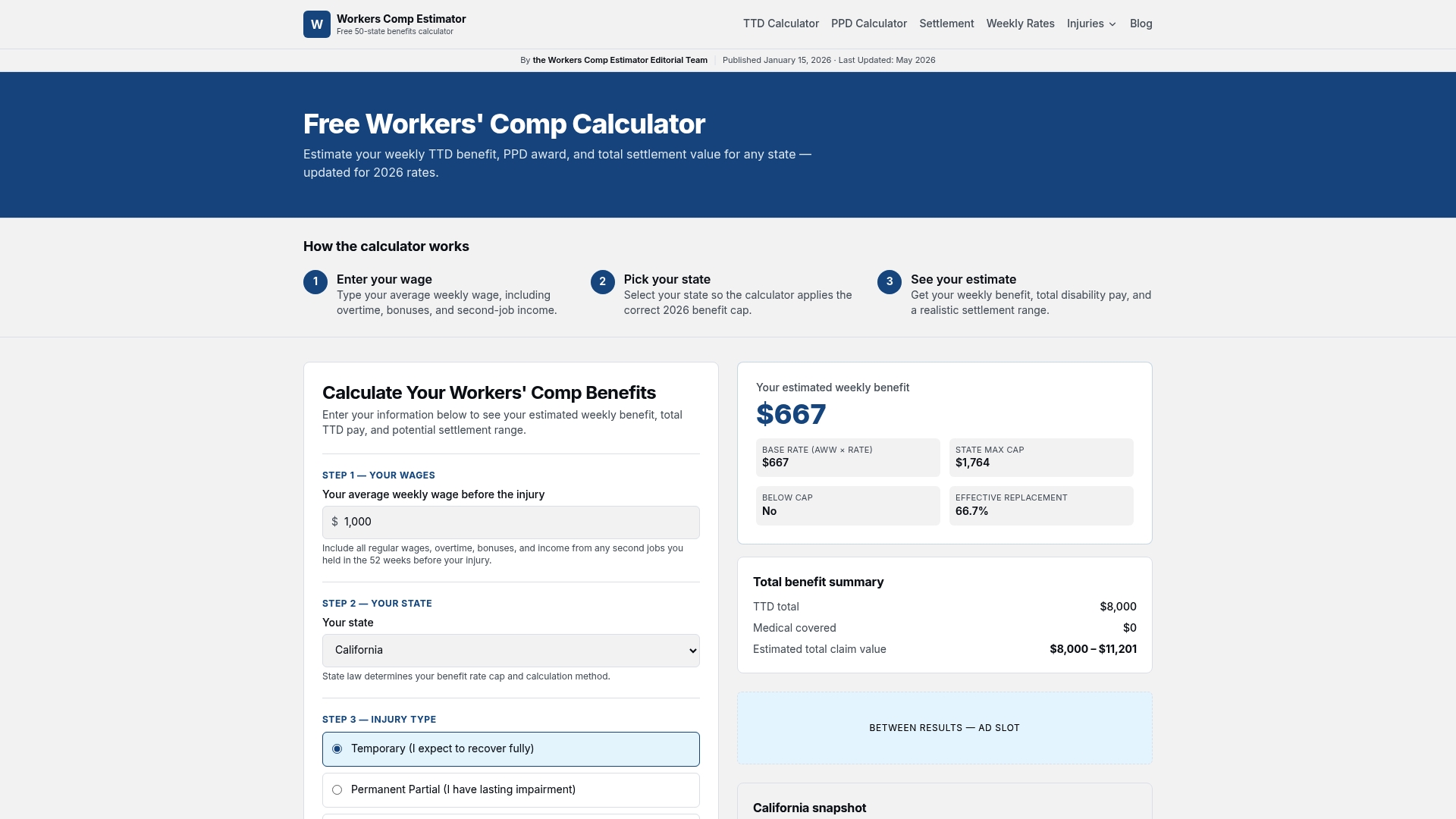
Start with the PPD calculator to convert your impairment percentage into an award estimate, or use the settlement calculator to model a full lump-sum range. Both tools apply your state’s 2026 benefit caps automatically, whether you’re filing in California, Massachusetts, Colorado, or any of the other 47 states covered. Enter your wage, state, and rating now at Workerscompestimator and get a number you can bring into your next conversation with an adjuster or attorney.
Sources
- Impairment Ratings in Workers Compensation: Gaining Insights From Claim Demographics — NCCI
- Chapter 2-1300 Impairment Ratings — U.S. Department of Labor (DEEOIC)
- AMA Guides | Evaluation of Permanent Impairment overview — American Medical Association
- How to Calculate an Impairment Rating Payout: The Formula — LegalClarity
FAQ
Is a 4% Impairment Rating Bad?
A 4% rating is low but not automatically wrong. It’s worth reviewing since even a modest rating can be disputed if the report lacks objective findings or MMI documentation, and small point increases can meaningfully raise your payout.
What Does a 20% Impairment Rating Mean?
Converted to dollars, that percentage gets multiplied by your state’s statutory weeks or weeks-per-point schedule and your weekly benefit rate.
What Does a 30% Impairment Rating Mean?
Run the exact figure through a PPD calculator using your own wage and state to see the real range.
What Is the Highest Impairment Rating You Can Get?
Recommended
More from the blog
Discover settlement ranges for knee injury workers' comp claims and learn the essential steps to maximize your benefits and protection.
Unlock the secrets of the workers comp settlement formula. Learn how to calculate your payout and maximize your benefits effectively.
Learn how Texas workers’ comp impairment ratings affect benefits, deadlines, and disputes, then use the payout calculator before accepting an offer.
Free workers' comp calculators
Put the numbers in this article to work on your own claim.
Weekly benefit, PPD, and settlement in one place.
What your weekly temporary disability check should be.
Scheduled weeks and permanent impairment awards.
Light-duty benefit when you earn less while healing.
Federal employee FECA award by body part.
Lump-sum value of your full claim.
Turn a 5%, 10%, or 20% rating into dollars.
Max and min weekly rates for all 50 states.
Typical settlement ranges by injury and state.
Average settlement for fusion, rotator cuff, knee replacement, and more.
Why comp does not pay it, and when a third-party claim does.
When carriers typically make an offer.
What coverage costs by class code and payroll.
Guides, state updates, and claim strategy.