
Workers’ Comp Ankle Settlement: What It Pays and Why

There is no single number for a workers’ comp ankle settlement. One 2023 National Safety Council dataset, as summarized by a claims-help company, put the average ankle settlement at $30,720, and a fracture averaged far more at $62,240. Your own figure depends on your state’s formula, your wage, your doctor’s rating and the way the case closes. This guide compares the real options for settling an ankle claim and shows how to test any offer against the math.
TL;DR
- Average figures are a starting point only. The same ankle injury pays very differently in different states because each state sets its own formulas, caps and schedules.
- Most ankle settlements combine three pieces: lost-wage benefits, medical care and a permanent impairment payment. An offer that leaves one out is incomplete.
- Your doctor’s documented rating of what is left after healing, not the words “ankle injury,” drives the permanent portion.
- A lump sum can close your medical rights, so compare it with what ongoing benefits would pay before you sign.
- You can estimate your range for free with our settlement calculator before you talk to the insurer.
Table of Contents
- Why ankle settlements have no national average
- What an ankle claim can include
- How the permanent part is calculated
- The main ways an ankle claim can close
- What moves an ankle estimate up or down
- Perspective: why we tell people to slow down
- Check your own number
- Before you accept an offer
- FAQ
- Sources
Why ankle settlements have no national average
Workers’ compensation in the United States is controlled by state legislatures and agencies, and each jurisdiction uses its own approach. Wage definitions, waiting periods, weekly rates, schedules and caps can all change the result. When ProPublica tried to compare what states pay for lost limbs, it needed more than 600 calculations built on 52 separate formulas.
That is why the numbers you see online range so widely. A law firm’s page about one state’s ankle cases, a national average and a forum post about a surgery are describing different systems. Treat each as context, never as a quote for your claim.
The same data source shows how much severity matters. Per the figures above, an average ankle settlement of $30,720 was split into $14,159 for indemnity (wage and disability payments) and $16,561 for medical care. Ankle fractures averaged $62,240, and amputations averaged about $126,000. A mild sprain that heals in weeks and a fusion that ends a career sit at opposite ends of that range.

What an ankle claim can include
A work-related ankle injury, whether a sprain, a fracture or a ligament tear, can generate several kinds of benefits. California’s official notice to employees lists the typical set: medical care that is reasonably necessary, temporary disability payments while you recover, and permanent disability payments for lasting, measurable loss of function. Other states use different names but a similar structure.
- Medical treatment. Surgery, physical therapy, braces, prescriptions and follow-up care.
- Temporary disability (TTD or TPD). A share of your wages while you cannot work or can only work reduced hours. California’s guide says temporary disability can be up to two-thirds of wages, within state minimum and maximum weekly limits, and for most injuries it may not exceed 104 weeks within five years of the injury.
- Permanent disability (PPD). Payment for what the ankle can no longer do once you have healed as much as you will.
- Settlement value. If you and the insurer agree to close part or all of the claim, a lump sum replaces some or all of these future payments.
A settlement is not an extra payment on top. It is a negotiated price for benefits you might otherwise receive over time.
How the permanent part is calculated
The permanent piece is where ankle cases are won or lost, and it works in one of two broad ways depending on your state.
Scheduled awards
Many states assign a number of weeks to each body part. New York’s Workers’ Compensation Board explains that a Schedule Loss of Use award uses the maximum statutory weeks for the body part, the percentage of function lost as assigned by a judge, and your average weekly wage. Federal law works similarly: under the Longshore Act, total loss of use of a foot entitles the worker to 205 weeks of compensation. Whether an ankle is counted with the foot or the leg, and how many weeks it carries, is a state-by-state question.
The general shape is weeks times percentage of loss times a weekly rate. As a simple illustration only, with invented numbers: if a state schedule gave 100 weeks, a doctor assigned 20% loss of use and the weekly rate were $600, the permanent award would be 100 x 0.20 x $600 = $12,000. Real schedules, rates and caps differ, so use your state’s figures.
Impairment ratings
Other states rate your whole-person or body-part impairment using a medical guide or a state schedule, then convert the rating to money. California’s official rating schedule recognizes separate ankle categories, including atrophy, ankylosis, arthritis, range of motion, muscle strength, ligament instability and fracture. The rating follows the documented residual condition, not just the diagnosis.
Federal employees are different again. Under FECA, schedule awards are based on the AMA Guides and payable only after maximum medical improvement. That timing point applies broadly: permanent ratings are usually set after you stop improving, so an early offer may come before the real picture is known.
Our impairment rating payout calculator shows how a rating converts to dollars in your state.
The main ways an ankle claim can close
The question “what is my ankle settlement worth” is really a choice between structures. Here is how the realistic options compare.
| Option | What you get | Main advantage | Main risk |
|---|---|---|---|
| Keep receiving statutory benefits | Weekly payments and medical care as the law provides | Medical care stays open | Slower, with ongoing insurer control of treatment |
| Scheduled or rated permanent award | Fixed amount from weeks, percentage and rate | Predictable, formula-based | Depends heavily on the doctor’s rating |
| Lump-sum settlement | One payment for indemnity, sometimes medical too | Cash now, a clean end to the claim | May close future medical rights; hard to reopen |
| Settlement through an attorney | Negotiated lump sum, net of fees | Help with disputed ratings | Fees reduce what you keep |
Our guide to workers’ comp settlement types covers how each one works in more detail.
Where our calculator fits
We built our free calculators to put a defensible range in your hands before negotiation. They use 2026 state benefit caps, count all income sources in your wage, and run injury-specific and settlement scenarios. They are an estimate, not a quote and not legal advice. An ankle claim in a state with a low cap can look very different from the same claim elsewhere, and the weekly benefit rates for all 50 states and DC show how wide that gap is.
Where an attorney fits
An attorney is the right comparison when your rating is disputed, the claim was denied or the insurer’s offer is far below your estimate. Fees are regulated and vary. In Washington, for example, fees on claim resolution settlement agreements are limited by statute to 15 percent of the total paid to the worker. Other states set their own limits. Our breakdown of workers’ comp attorney fees explains what a 10 to 25 percent fee does to a payout.
A quick example of the fee effect: on a $30,000 settlement, a 15 percent fee is $4,500, leaving $25,500 before any other deductions such as unreimbursed medical liens. Check your state’s rules for what can be taken out.
What moves an ankle estimate up or down
- Surgery and hardware. Fractures and surgeries generally rate higher than sprains that heal without lasting loss, consistent with the NSC averages above.
- Lasting limits. Reduced range of motion, instability, arthritis or chronic pain documented by your treating doctor support a higher rating.
- Work restrictions. Under federal longshore guidance, a disability award requires both a physical impairment and an actual economic loss. If you can return to the same wage, some systems pay less. Standing, climbing and walking jobs make restrictions matter more.
- Your wage. Weekly benefits are a percentage of your average weekly wage, up to a cap. Higher earners often hit the cap, so their estimate is driven by state law, not their pay.
- Timing. Waiting periods and reporting deadlines vary by state, so report the injury promptly and confirm your state’s deadline.
Perspective: why we tell people to slow down
We see the same pattern from injured workers: an insurer offers a round number early, and the worker has nothing to compare it with. Averages online make it worse, because they blend states, injury types and legal fees into one figure that fits nobody.

Our view is that an ankle offer should be tested in three steps. First, rebuild your weekly benefit from your real wage and your state’s 2026 cap. Second, find out whether your doctor has given a permanent rating, because without one the permanent value is a guess. Third, ask exactly what the lump sum gives up, especially future medical care. A good offer survives all three. A rushed one rarely does.
We also think it is fair to say what a calculator cannot do. It cannot see your medical file or predict a judge. It can tell you when an offer looks far from the formula, and that is often the signal to get a second opinion.
— Daniel
Check your own number
Start with the Workers’ Comp Settlement Calculator: enter your average weekly wage, your state and your injury type to see an estimated weekly benefit and a settlement range based on 2026 caps.
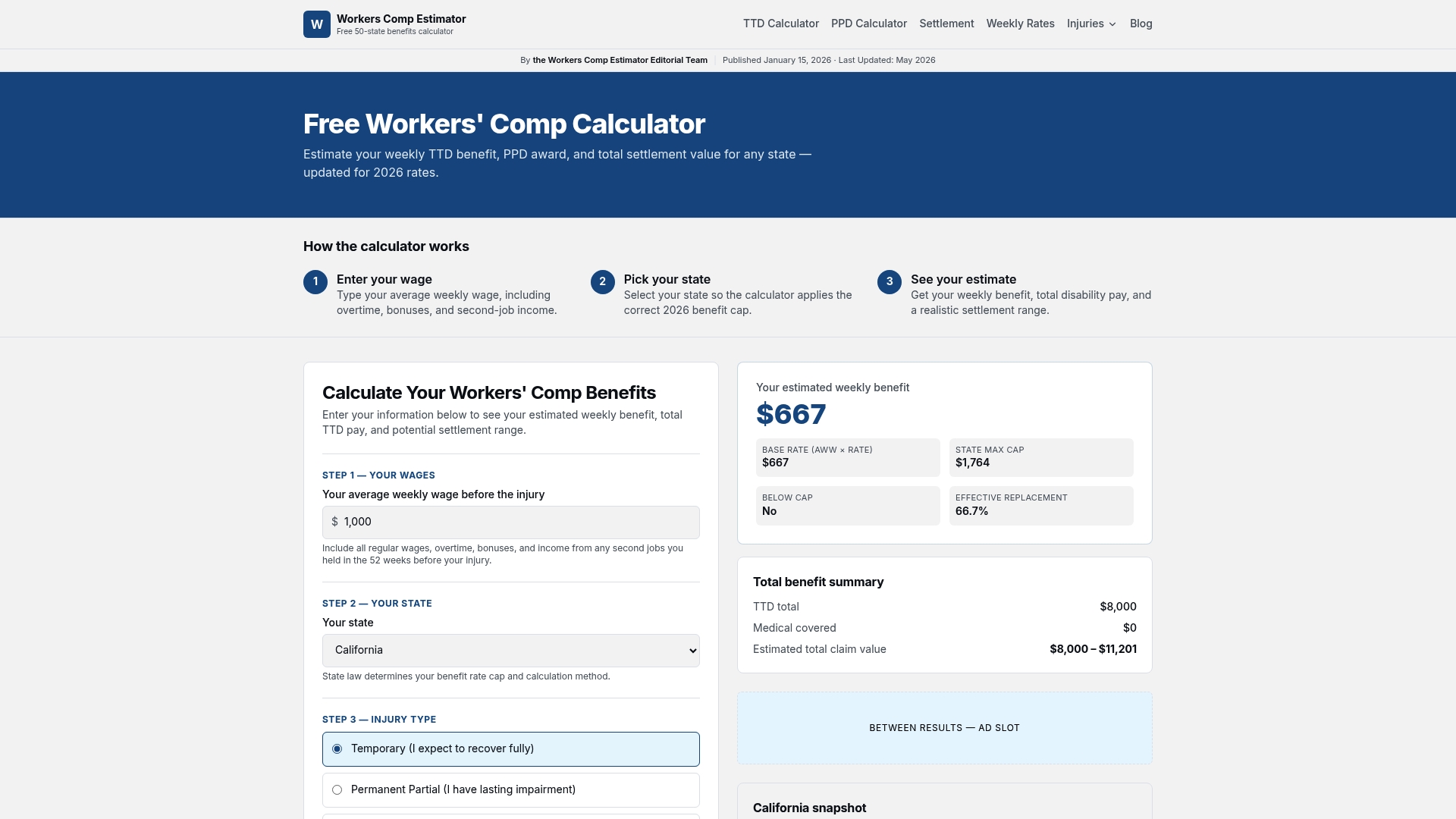
If you only need the weekly figure while you are off work, use the TTD calculator. If you live in one of these states, the state pages apply its specific cap: Texas, Ohio, Oregon or Washington. The body part settlement chart shows how ankle and foot values compare with other injuries.
Before you accept an offer
- Ask for the math. Request the weeks, rating and rate used. Compare them with your state’s formula.
- Confirm the rating source. Doctors and adjusters do not always apply impairment guides the same way, so a second medical opinion can matter.
- Separate medical from cash. Find out whether future ankle care stays covered after you sign.
- Subtract fees and liens. The number that matters is what reaches you.
- Mind your deadlines. Reporting and filing limits differ by state and can end a claim.
- Do not sign under pressure. Settlements are often hard or impossible to reopen.
If the offer is far below your estimate, or the claim was denied, talk to a licensed workers’ compensation attorney in your state before signing.
FAQ
How much is a workers’ comp settlement for a sprained ankle?
It is usually at the low end because many sprains heal without permanent loss. The national average across ankle claims was $30,720 in the 2023 data cited above, but a minor sprain with no permanent rating may settle for much less or close with only medical and wage benefits. Your state’s formula and your doctor’s rating decide the actual figure.
How much of a $30,000 settlement will I actually get?
Subtract attorney fees and any liens or repayments. With a 15 percent fee, as Washington allows on claim resolution settlements, $30,000 becomes $25,500 before other deductions. Fee caps and allowed deductions differ in every state.
Can I get a lump sum for an ankle injury?
Often yes, but the rules depend on your state and require agreement or approval. A lump sum can end your right to future benefits, including medical care, so compare it with what ongoing benefits would pay first.
When is an ankle settlement offered?
Typically after you reach maximum medical improvement, when your doctor can say what permanent limits remain. Offers made earlier are common but rest on less information about your recovery.
Sources
- Atticus: How Much Is a Workers’ Comp Ankle Injury Settlement?
- ProPublica: Methodology for Workers’ Comp Benefits
- WCRI/IAIABC: Workers’ Compensation Laws as of January 1, 2025
- California DWC: Notice to Employees
- California Guide to Workers’ Compensation
- New York WCB: Schedule Loss of Use Award
- U.S. Department of Labor: Pamphlet LS-560
- California Schedule for Rating Permanent Disabilities
- U.S. Department of Labor: FECA Procedure Manual
- USDOL OALJ LHWCA Benchbook, Topic 8.2
- Washington RCW 51.52.120
Recommended
More from the blog
Compare workers' comp and disability for U.S. workers: what each pays, SSDI's five-month wait, tax rules, and a free 50-state calculator to estimate your...
State by state 2026 resource for injured workers. Run the calculator to compare a buyout versus keeping lifetime medical open and get the questions to ask.
Compare the main workers' comp settlement types: stipulations, compromise and release, lump sum, structured and medical-only deals, and what each one closes.
Free workers' comp calculators
Put the numbers in this article to work on your own claim.
Weekly benefit, PPD, and settlement in one place.
What your weekly temporary disability check should be.
Scheduled weeks and permanent impairment awards.
Light-duty benefit when you earn less while healing.
Federal employee FECA award by body part.
Lump-sum value of your full claim.
Turn a 5%, 10%, or 20% rating into dollars.
Travel reimbursement for medical appointments.
Max and min weekly rates for all 50 states.
Typical settlement ranges by injury and state.
Average settlement for fusion, rotator cuff, knee replacement, and more.
Why comp does not pay it, and when a third-party claim does.
When carriers typically make an offer.
What coverage costs by class code and payroll.
Guides, state updates, and claim strategy.