
What 10–25% Costs You in U.S. Workers’ Comp Attorney Fees

Most workers’ compensation lawyers get paid a state-capped percentage of what they recover for you, and you pay nothing out of pocket up front. Exact caps and formulas depend entirely on state law, but the national pattern runs lower than standard personal-injury contingency rates. A workers’ comp judge or board almost always has to sign off on the fee before your attorney gets a dollar of it.
TL;DR:
- Most workers’ compensation lawyer fees are capped between 10% and 25%, with lower limits designed to leave more settlement funds for the injured worker.
- Fees are typically calculated as a percentage of benefits secured through representation and must be approved by a state workers’ compensation board or judge before payment.
- State laws often detest a sliding scale or hourly framework to limit total fees, with Florida, California, and Texas implementing specific models to control costs.
- Fees usually apply only to contested benefits, not those voluntarily paid by insurers, and the lawyer’s cut is deducted from the settlement before you receive your share.
- Injured workers should run their own settlement estimates before signing, using state-specific calculators, to understand their net recovery after legal fees and prepare for negotiations.
Table of Contents
- How Are Attorney Fees Workers Comp Cases Calculated?
- What Are Typical Workers’ Comp Attorney Fees by State?
- How Do Workers’ Comp Boards Approve Attorney Fees?
- Attorney Fees vs. Case Costs: Who Pays What?
- What Should You Ask Before Hiring a Workers’ Comp Lawyer?
- Why Fee Transparency Matters More Than People Realize
- Estimate Your Net Recovery Before You Sign Anything
- Sources
- FAQ
How Are Attorney Fees Workers Comp Cases Calculated?
Almost every workers’ comp lawyer works on contingency. That means the fee comes out of what you recover, either as a percentage of a lump-sum settlement or as a percentage of past-due benefits the attorney won for you through a hearing or appeal.
The mechanics vary more than most injured workers expect:
- Flat percentage states set one number (say, 15% or 20%) and apply it across the board.
- Sliding-scale states, like Florida, shrink the percentage as the recovery grows larger.
- A handful of states, including Texas, use an hourly-rate structure with statutory caps on both the rate and the total hours billable, layered under an overall percentage ceiling.
Timing matters just as much as the rate. In many states, an attorney cannot collect a fee on benefits the insurer was already paying voluntarily before the lawyer got involved. The fee typically applies only to what the attorney actually secured through representation, meaning disputed or contested benefits, not the checks that were already flowing.
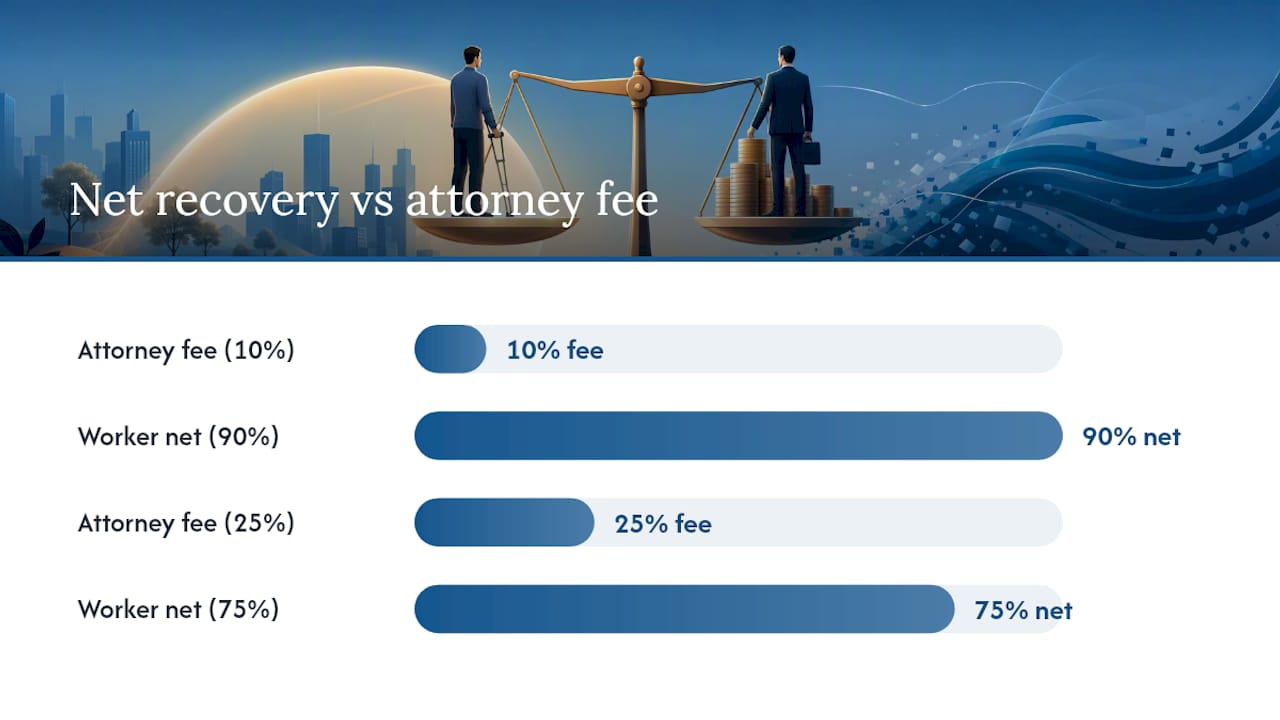
The attorney’s cut is $6,000, deducted directly from the settlement before you receive the balance. You never write a separate check.
What Are Typical Workers’ Comp Attorney Fees by State?
Nationwide, workers’ comp attorney fees typically fall somewhere between 10% and 25%, with a lot of cases landing around 15% to 20% depending on the state and how complicated the claim is, according to AllLaw. That’s noticeably lower than the roughly 33% contingency rate common in personal-injury cases, and it’s not an accident.
Fee Cap Snapshot: Florida’s sliding scale runs from 20% down to 5% depending on recovery size. Texas caps total fees at roughly 25% of the award under its hourly-rate framework. California’s guideline range sits in a similar band, subject to adjustment by the state board.
State legislatures deliberately keep workers’ comp contingency percentages below personal-injury norms so more of the settlement stays available for medical bills and living expenses, a rationale SuperLawyers has documented in its cost breakdowns.
A few states worth knowing by name:
- Florida sets a statutory sliding scale: 20% of the first $5,000 recovered, 15% of the next $5,000, 10% of remaining benefits paid in the first ten years, and 5% after that, per Florida Statute §440.34.
- California works off a guideline percentage range, but the Workers’ Compensation Appeals Board can adjust the fee up or down based on the actual work involved.
- Texas uses the hourly model under Labor Code §408.221, with fees submitted to the Division for approval and an overall cap that often lands near 25% of the award. Workers in Texas can run their own numbers through a Texas benefits calculator before assuming what a lawyer’s cut will look like.
- New York and Massachusetts both require board approval of the fee amount rather than allowing a fixed statutory percentage to apply automatically, so the final number often depends on case complexity.
How Do Workers’ Comp Boards Approve Attorney Fees?
Almost every state requires a workers’ compensation judge or board to review and approve the fee before it becomes final, a protection Nolo points to as one of the biggest differences between workers’ comp and other contingency-fee law.
Boards generally weigh:
- The time and labor the case actually required.
- How novel or difficult the legal or medical issues were.
- The skill the attorney had to bring to the table.
- What similar attorneys typically charge in that area.
- The benefits ultimately secured for the worker.
Texas law spells this out almost word for word, listing time, difficulty, customary local fees, and results obtained as the factors a judge must weigh under §408.221. In rare penalty situations, a court can even shift fee responsibility onto the employer or insurer, usually when they’ve acted in bad faith or unreasonably delayed benefits.
Pro Tip: If a proposed fee feels out of line with the work done, you can generally object and request a hearing. Boards have the authority to reduce fees that don’t match the effort or result, though you’ll usually need to file that objection rather than just complain informally.
Attorney Fees vs. Case Costs: Who Pays What?
Fees and costs are not the same thing, and mixing them up is where a lot of injured workers get blindsided. The fee is what the attorney is paid for their work. Costs are the actual expenses of building the case: medical record requests, expert witness fees, filing fees, deposition transcripts.
Most firms advance these costs and deduct them from your recovery at the end, though Justia notes that whether you owe those costs back if you lose depends entirely on your retainer agreement and your state’s rules.
- Some firms absorb the loss if the case doesn’t succeed.
- Others require reimbursement regardless of outcome.
- A few states restrict what costs can even be passed to the client.
Small percentage differences and cost policies add up fast, which is exactly why reading the retainer line by line matters more than most people assume.
What Should You Ask Before Hiring a Workers’ Comp Lawyer?
A first consultation is your best shot at avoiding surprises later. Come prepared with direct questions rather than general ones.
- What is the exact fee percentage or formula you’ll apply to my case?
- Does that fee apply to benefits the insurer was already paying, or only to benefits you help me win?
- How are case costs handled, and do I owe them back if we lose?
- Who advances costs during the case, and when are they deducted?
Ask for the fee agreement in writing. Most states legally require written disclosure of the fee arrangement before it’s binding, and a lawyer who hedges on that request is telling you something.
Pro Tip: Watch for vague retainer language, any request for upfront payment, or evasive answers about costs. Those are the three most common red flags injured workers report after the fact.
Before you sign anything, run your own numbers. A settlement calculator that lets you plug in a likely gross award and subtract a realistic fee percentage gives you a net-recovery figure to compare against whatever the insurer offers. Partner resources like Tyler Injury Law’s guidance on catastrophic injury claims can also help you think through what to ask a local attorney before you commit.
Why Fee Transparency Matters More Than People Realize
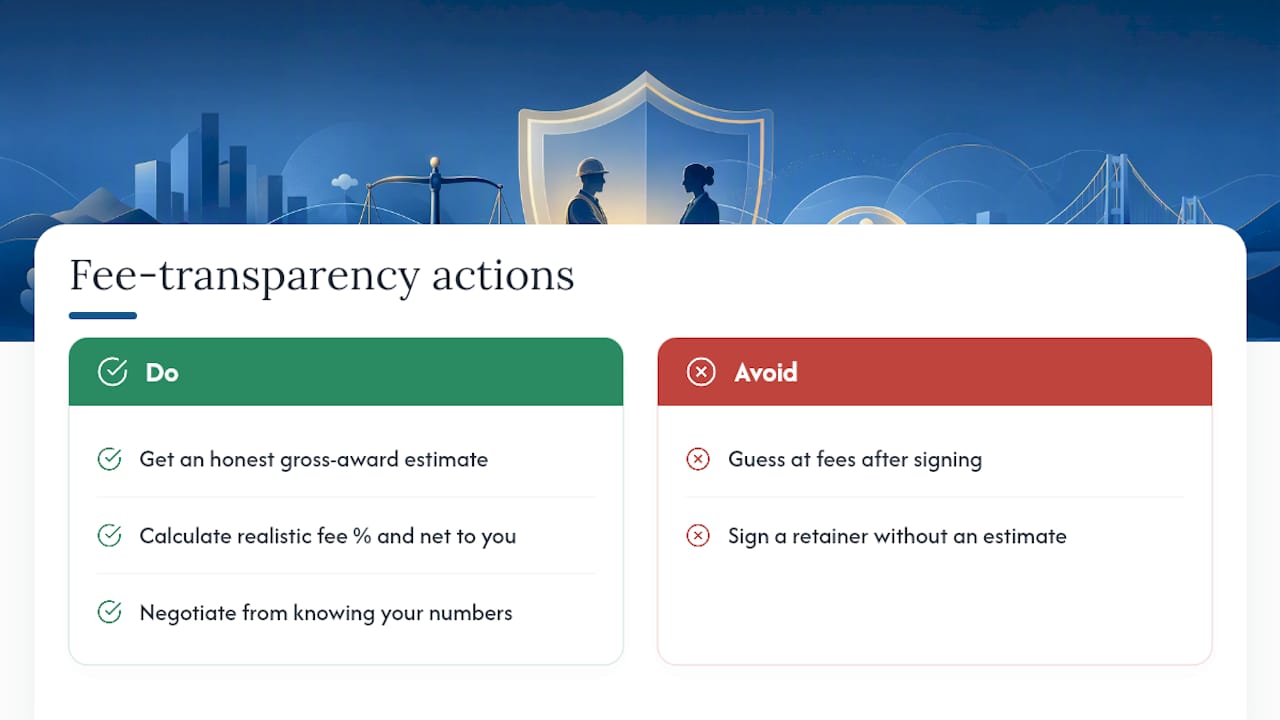
Every dollar that goes to a fee is a dollar not going to your medical bills or your mortgage. That’s not a knock on attorneys, most earn every bit of a capped contingency fee by fighting delay tactics and lowball offers. But you’re better off negotiating from a position of knowing your numbers, not guessing at them after the fact.
Before you sign a retainer, get an honest estimate of your gross award and what a realistic fee percentage would leave you with. That single step changes how you evaluate any offer that follows.
— Daniel
Estimate Your Net Recovery Before You Sign Anything
Workerscompestimator gives you the numbers a fee conversation should start with, not end with. Instead of guessing what 15% or 20% actually costs you in dollars, you plug in your state, your average weekly wage, and your injury type, and get a real estimate of your weekly TTD or PPD benefits and potential settlement value, built around each state’s 2026 benefit caps.
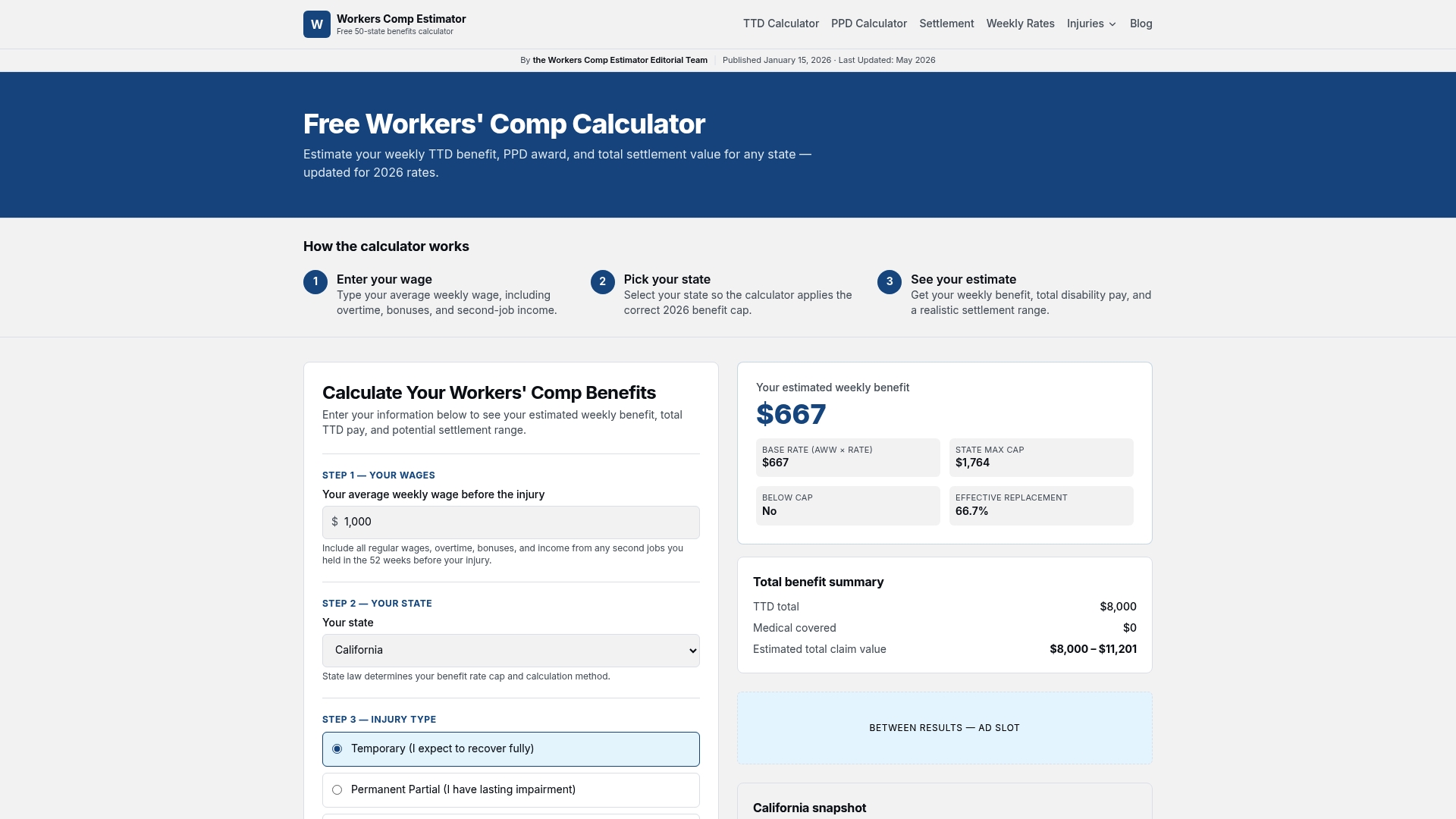
That matters because a fee percentage means nothing until you see it against an actual number. Run a gross award through the settlement calculator, subtract the percentage your state allows, and you walk into a consultation already knowing roughly what you’d net. Injured workers in states like California, Oregon, and Massachusetts can start with their own state-specific calculator to see maximum weekly rates before a lawyer ever quotes a fee. Check the full weekly benefit rate table for your state and run a free estimate at Workerscompestimator before you sign anything.
Sources
This article draws on Florida Statute §440.34, Texas Labor Code §408.221, and legal-guide resources including Nolo, AllLaw, and Justia for national context.
This article is general information, not a substitute for advice from a qualified lawyer. Consult a qualified legal professional about your own circumstances before acting on anything here.
- Workers’ Comp Lawyer Costs and Fees — AllLaw
- 2025 Statutes 0440.34 | Florida House of Representatives
- How Much Will It Cost To Hire a Workers’ Compensation Lawyer? — SuperLawyers
FAQ
What’s the Most a Workers’ Comp Lawyer Can Charge?
It depends on the state, but most caps fall between 10% and 25% of the recovery, with Florida’s sliding scale topping out at 20% on the first portion recovered and Texas generally capping total fees near 25%.
Is a 40% Attorney Fee High for Workers’ Comp?
Yes.
Do I Pay My Workers’ Comp Lawyer if I Lose?
Usually not for the fee itself, since contingency means no recovery, no fee, but whether you owe advanced case costs if you lose depends on your retainer agreement and state rules.
Recommended
More from the blog
See how 2026 state caps, wages, and surgery affect your U.S. hernia workers' comp payout. Run a free 50 state calculator for a realistic estimate.
Run a state specific 2026 workers' comp settlement calculation. Use the free 50 state calculator to see how state caps change your payout.
Use the free 50-state estimator that applies 2026 state caps to estimate your workers' comp lump sum. Run your numbers, check SSDI/Medicare impact, and...
Free workers' comp calculators
Put the numbers in this article to work on your own claim.
Weekly benefit, PPD, and settlement in one place.
What your weekly temporary disability check should be.
Scheduled weeks and permanent impairment awards.
Light-duty benefit when you earn less while healing.
Federal employee FECA award by body part.
Lump-sum value of your full claim.
Turn a 5%, 10%, or 20% rating into dollars.
Max and min weekly rates for all 50 states.
Typical settlement ranges by injury and state.
Average settlement for fusion, rotator cuff, knee replacement, and more.
Why comp does not pay it, and when a third-party claim does.
When carriers typically make an offer.
What coverage costs by class code and payroll.
Guides, state updates, and claim strategy.