
Free 50 State Estimator: Workers’ Comp vs Disability for U.S. Workers

If you got hurt on the job, you file workers’ comp, which pays your medical bills and part of your wages. If your injury or illness has nothing to do with work, you’re looking at disability insurance or SSDI, which replaces income but won’t touch a medical bill. Report a workplace injury to your employer today if that’s your situation; start gathering medical records for an SSDI or disability claim if it’s not.
TL;DR:
- Workers’ compensation pays directly for medical bills and part of your wages only if the injury is work-related, with benefit caps varying widely by state.
- SSDI and disability insurance provide income replacement regardless of causation but may take several months to start and do not cover medical expenses.
- Combining workers’ comp and SSDI benefits is possible but limited by an 80 percent cap on total disability income, which may lead to benefit reductions or offsets.
- Workers’ comp benefits typically start within weeks after reporting, while SSDI payments can be delayed by several months due to its eligibility and application process.
- Running state-specific benefit calculators before signing settlement offers ensures accurate estimates and prevents undervaluing your claim.
Table of Contents
- Workers Comp vs Disability: What Each One Actually Pays
- How Do You Qualify, and When Does the Money Start?
- Can You Collect SSDI and Workers’ Comp at the Same Time?
- How Long Do Benefits Last, and Are They Taxed?
- What Should You Do First After an Injury or Diagnosis?
- When Does Each Coverage Actually Apply?
- What Most People Get Wrong About These Two Systems
- Get a Real Number Before You Negotiate Anything
- Where to Verify These Rules Yourself
- Sources
- FAQ
Workers Comp vs Disability: What Each One Actually Pays
The split comes down to one question: did the injury happen because of your job? Workers’ compensation pays for medical treatment tied to a work injury and covers part of your lost wages while you recover. Insurers typically pay doctors and hospitals directly, so you’re not stuck fronting the bill and filing for reimbursement, according to New York Life’s coverage comparison.
Disability insurance works differently. It hands you a cash benefit to replace lost income, but it almost never pays medical providers. That’s the trade-off: workers’ comp covers the hospital bill and part of the paycheck, disability insurance covers the paycheck and nothing else.
- Workers’ comp: medical care paid directly, plus Temporary Total Disability (TTD) or Permanent Partial Disability (PPD) wage benefits.
- Disability insurance/SSDI: cash income replacement only, commonly 50 to 70 percent of your prior wages.
- Workers’ comp requires work causation. Disability insurance and SSDI cover illness or injury from any cause, on or off the clock.
- State-run temporary disability programs (California’s among them) and employer-provided short-term or long-term disability policies are separate from federal SSDI, with their own rules and payouts.
Workers’ comp benefit caps vary sharply by state, from roughly $675 a week in Georgia to over $1,900 in Connecticut, which is exactly why a national average is nearly useless for planning your own claim.
How Do You Qualify, and When Does the Money Start?
Timing is where these two systems diverge the most. Workers’ comp kicks in almost immediately after a workplace incident. SSDI can take months before a single check arrives.
- Workers’ comp: report the injury to your employer right away (most states require it within days), and the insurer opens an investigation. Benefits can start within weeks once causation is accepted.
- SSDI: you need enough recent work credits and a condition meeting SSA’s strict disability standard, then you wait through a mandatory five-month period before payments begin.
- Short-term/long-term disability policies: elimination periods run anywhere from a few days to several months, depending on your specific plan.
- State disability programs: where they exist, they can bridge income gaps faster than SSDI, though eligibility and payout caps differ state to state, per California’s EDD guidance.
A warehouse worker with a torn rotator cuff gets workers’ comp checks within a month. Someone diagnosed with early-stage multiple sclerosis might wait five months or longer before SSDI pays anything.
Can You Collect SSDI and Workers’ Comp at the Same Time?
Yes, but rarely at full value on both sides. The Social Security Administration caps your combined public disability income so it doesn’t exceed 80% of what you earned before you became disabled, according to SSA’s own guidance on the offset rule.
If your workers’ comp payments plus SSDI push you past that 80% ceiling, SSA reduces the SSDI portion, not the workers’ comp portion.
- Some states run reverse-offset plans, where the state workers’ comp system, not SSA, absorbs the reduction instead.
- A lump-sum settlement gets prorated by SSA into a monthly equivalent for offset purposes, which can quietly shrink your SSDI check for years after the settlement closes.
- Timing and structuring a settlement changes how much SSA claws back, so this is a spot where a workers’ comp attorney’s language choices matter.
- Report any change in workers’ comp status to SSA promptly. Overpayments get clawed back later, often at the worst possible time.
How Long Do Benefits Last, and Are They Taxed?
Duration and tax treatment are where a lot of workers get surprised months into a claim.
- Workers’ comp pays TTD until you reach “permanent and stationary” status or hit your state’s benefit duration cap; permanent partial or total awards, plus ongoing medical care, vary widely by state.
- Short-term disability typically runs a matter of weeks to a few months.
- Long-term disability can stretch for years, sometimes until retirement age, depending on the policy.
- Tax treatment: workers’ comp benefits are generally tax-free. Disability benefits are taxable only if your employer paid the premiums; if you paid the premiums yourself with after-tax dollars, the payout is usually tax-free, per FindLaw’s benefits comparison.
What Should You Do First After an Injury or Diagnosis?
The steps differ depending on which system applies, and mixing them up costs people money.
- Get medical care immediately and tell the provider explicitly that the injury is work-related if it is.
- Report the injury to your employer in writing, even if you already told a supervisor verbally. Keep a copy.
- File your workers’ comp claim using your state’s required form; processing timelines vary but many states require an initial response within a couple of weeks.
- File SSDI early if your condition is long-term and non-work-related. SSA’s review process is slow, and delay only pushes your first check further out.
- Appeal a denial through your state’s administrative hearing process for workers’ comp, or SSA’s reconsideration and hearing stages for SSDI. Common denial reasons include disputed causation, insufficient medical evidence, or missed deadlines.
Pro Tip: If your employer disputes that an injury is work-related, don’t wait on the outcome to file for state disability benefits where they exist. It’s one of the few ways to keep income flowing while the workers’ comp claim gets sorted out.
When Does Each Coverage Actually Apply?
Concrete scenarios make this easier than any definition.
- Fall off a ladder at a job site: workers’ comp is your primary and immediate path. If the injury leaves you with a permanent impairment, SSDI can become relevant later.
- Diagnosed with cancer unrelated to your job: disability insurance or SSDI is the route, since there’s no work causation to establish.
- Repetitive strain injury with disputed causation: your employer’s insurer may deny the claim while investigating, and state disability programs, where available, can cover the income gap in the meantime.
What Most People Get Wrong About These Two Systems
The biggest mistake I see isn’t confusing the programs. It’s the delay. Workers wait days or weeks to report a job injury because they think it’ll heal on its own, and that delay becomes the insurer’s first argument for denial. The second mistake is failing to notify SSA when a workers’ comp settlement changes, which triggers overpayment demands nobody sees coming. The third is guessing at benefit amounts instead of running the actual numbers through a state-specific calculator, since state caps swing by more than $1,000 a week depending on where you live.
— Daniel
Get a Real Number Before You Negotiate Anything
Guessing your weekly benefit is how people accept lowball settlement offers. Workerscompestimator built its calculators around each state’s actual 2026 benefit caps, so the number you see reflects what your state will actually pay, not a national average that doesn’t apply to your claim.
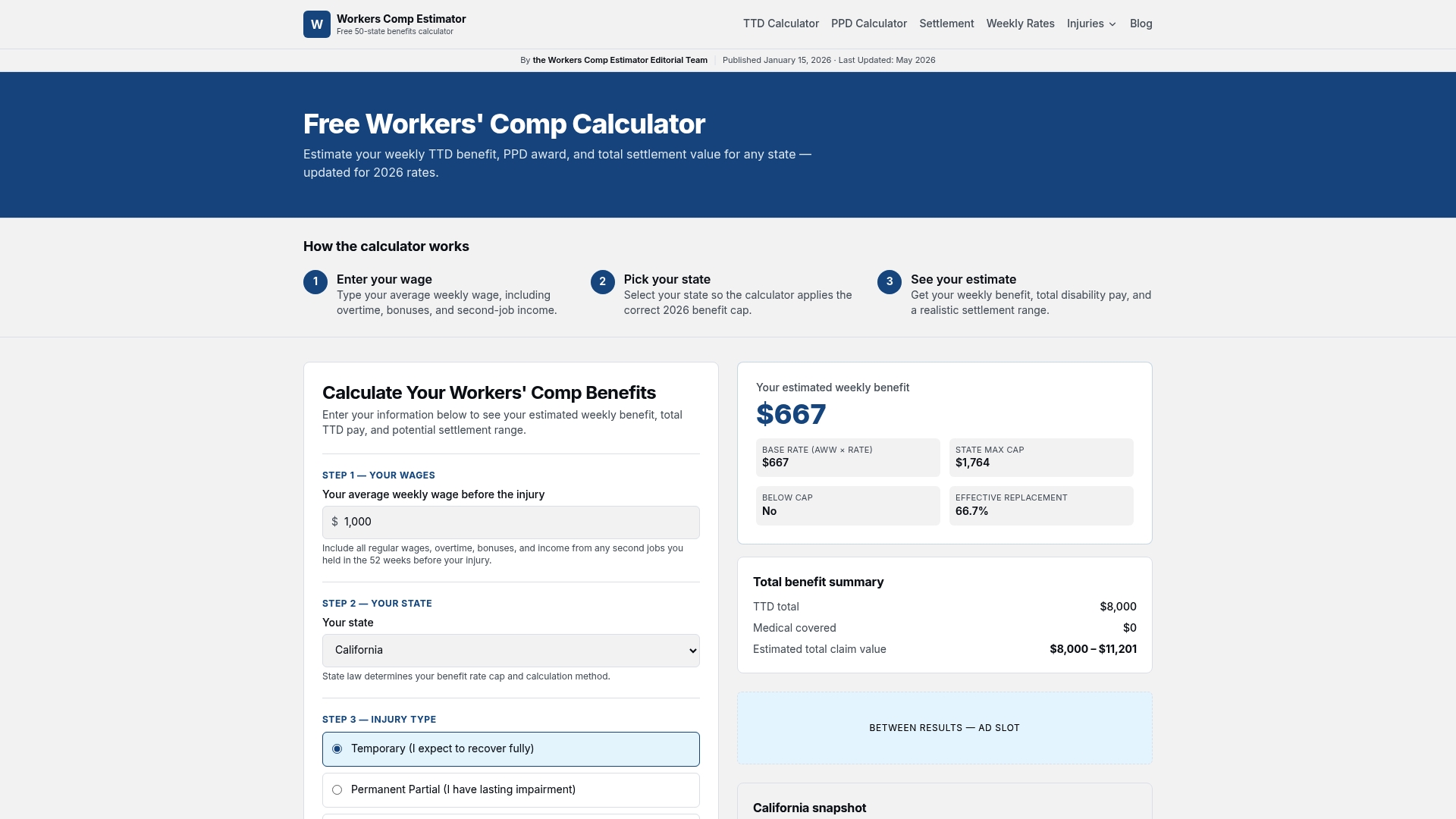
Enter your state and your average weekly wage into the Free 50-State Estimator to see your likely TTD benefit and a settlement range in under a minute. If you already know your injury type, the TTD calculator or a state-specific tool like the California workers’ comp calculator gets you there faster. Run your numbers before you sign anything an insurance adjuster puts in front of you.
Where to Verify These Rules Yourself
- SSA: How Workers’ Compensation Affects Your Benefits
- U.S. Department of Labor: OWCP Workers’ Comp Overview
- California EDD: Workers’ Comp and Disability Benefits
- FindLaw: Workers’ Comp vs. Disability Benefits
This article is general information, not a substitute for advice from a qualified financial advisor. Consult a qualified financial professional about your own circumstances before acting on anything here.
Sources
- How Workers’ Compensation and Other Disability Payments May Affect Your Benefits — SSA
- OWCP workers’ compensation overview — U.S. Department of Labor
- Workers’ compensation vs. disability insurance — New York Life
- The difference between workers’ comp and disability benefits — FindLaw
FAQ
How much disability will I get if I make $60,000 a year?
Disability insurance typically replaces 50 to 70 percent of your prior wages. Workers’ comp uses a different formula tied to your state’s weekly benefit cap, which you can check with a state-specific calculator.
Can you collect SSDI while on workers’ comp?
Yes, but SSA caps your combined public benefits at 80% of your prior average earnings and reduces the SSDI portion if you go over that limit.
Is workers’ comp considered disability benefits?
Workers’ comp is a distinct benefit for work-related injuries, separate from disability insurance and SSDI, which cover non-work-related conditions. They’re often grouped together in conversation, but eligibility rules and payment structures differ substantially.
What are the three types of disability insurance?
The three common categories are short-term disability, long-term disability, and SSDI (federal Social Security Disability Insurance). Some states also run their own state disability insurance programs that function alongside these.
Do I need a work injury to qualify for state disability programs?
No. State disability insurance programs, where they exist, generally cover non-work-related injuries and illnesses, filling the gap that workers’ comp doesn’t cover.
Recommended
More from the blog
Understand SSA's 80% offset, proration rules, and what to report to avoid SSDI overpayments. Estimate exposure with a free 2026 state-cap workers' comp...
Use the free 50-state estimator that applies 2026 state caps to estimate your workers' comp lump sum. Run your numbers, check SSDI/Medicare impact, and...
Use 2026 U.S. state caps and a free 50‑state calculator to estimate your permanent disability workers' comp pay. Learn P&S/MMI ratings, apportionment, and...
Free workers' comp calculators
Put the numbers in this article to work on your own claim.
Weekly benefit, PPD, and settlement in one place.
What your weekly temporary disability check should be.
Scheduled weeks and permanent impairment awards.
Light-duty benefit when you earn less while healing.
Federal employee FECA award by body part.
Lump-sum value of your full claim.
Turn a 5%, 10%, or 20% rating into dollars.
Max and min weekly rates for all 50 states.
Typical settlement ranges by injury and state.
Average settlement for fusion, rotator cuff, knee replacement, and more.
Why comp does not pay it, and when a third-party claim does.
When carriers typically make an offer.
What coverage costs by class code and payroll.
Guides, state updates, and claim strategy.