
Workers Comp Settlement Formula: Calculate Your Payout

The core workers comp settlement formula has two parts. Your weekly benefit equals your average weekly wage (AWW) times your state’s replacement rate, capped at the state maximum. Your permanent partial disability (PPD) payout equals scheduled weeks times that weekly benefit times your impairment rating percentage. Add unpaid temporary benefits and future medical costs, and you get a rough settlement range.
Here’s the shorthand:
-
Weekly benefit = AWW × state rate (usually 66.67%), capped at the state maximum weekly benefit
-
PPD lump sum = Scheduled weeks × weekly benefit × impairment rating
-
Total settlement estimate = PPD lump sum + unpaid TTD + future medical buy-out (if applicable)
The impairment rating, typically set using the AMA Guides to the Evaluation of Permanent Impairment, does the heaviest lifting in that math. The state maximum weekly benefit (tied to each state’s average weekly wage, or SAWW) puts a ceiling on what even a high earner can collect. You can run all three numbers through the Free Workers’ Comp Calculator to get a state-specific estimate in under a minute.
Pro Tip: Because the impairment rating multiplies directly into your PPD number, a shift from 10% to 15% on a 400-week scheduled injury can move your settlement by tens of thousands of dollars. Fight for an accurate rating before you fight over anything else.

Key Takeaways
The workers comp settlement formula multiplies scheduled weeks, your weekly benefit, and your impairment rating, and that rating alone can swing your payout by tens of thousands of dollars.
| Point | Details |
|---|---|
| Core formula | Weekly benefit (AWW × state rate) and PPD lump sum (scheduled weeks × weekly benefit × impairment rating) drive your estimate. |
| Impairment rating matters most | Ratings under the AMA Guides typically run 5% to 25%+, and small shifts change payouts significantly. |
| State rules vary widely | Replacement rates range from 60% to 80%, and maximum weekly benefits differ by thousands of dollars between states. |
| Net differs from gross | Attorney fees (commonly around 10%) and medical liens reduce your gross settlement before you receive it. |
| Verify with a calculator | Workerscompestimator’s Free Workers’ Comp Calculator applies your state’s 2026 caps and scheduled weeks automatically to estimate your settlement. |
Where to Verify Your Numbers
-
DOL/OWCP for AMA Guides methodology and federal impairment standards
-
OSHA for general worker rights guidance
-
Your state’s workers’ compensation board for binding scheduled-weeks charts and current caps
-
Workerscompestimator’s state calculators for quick 2026 cap lookups
Table of Contents
How Does the Workers Comp Pay Formula Actually Work?
Every calculation starts with your average weekly wage. Most states pull your gross earnings, before taxes, from the 52 weeks prior to your injury, then divide by 52. Overtime, bonuses, and income from a second job typically count too, if you worked them regularly. Skip any of those and you’ll understate your own benefit.
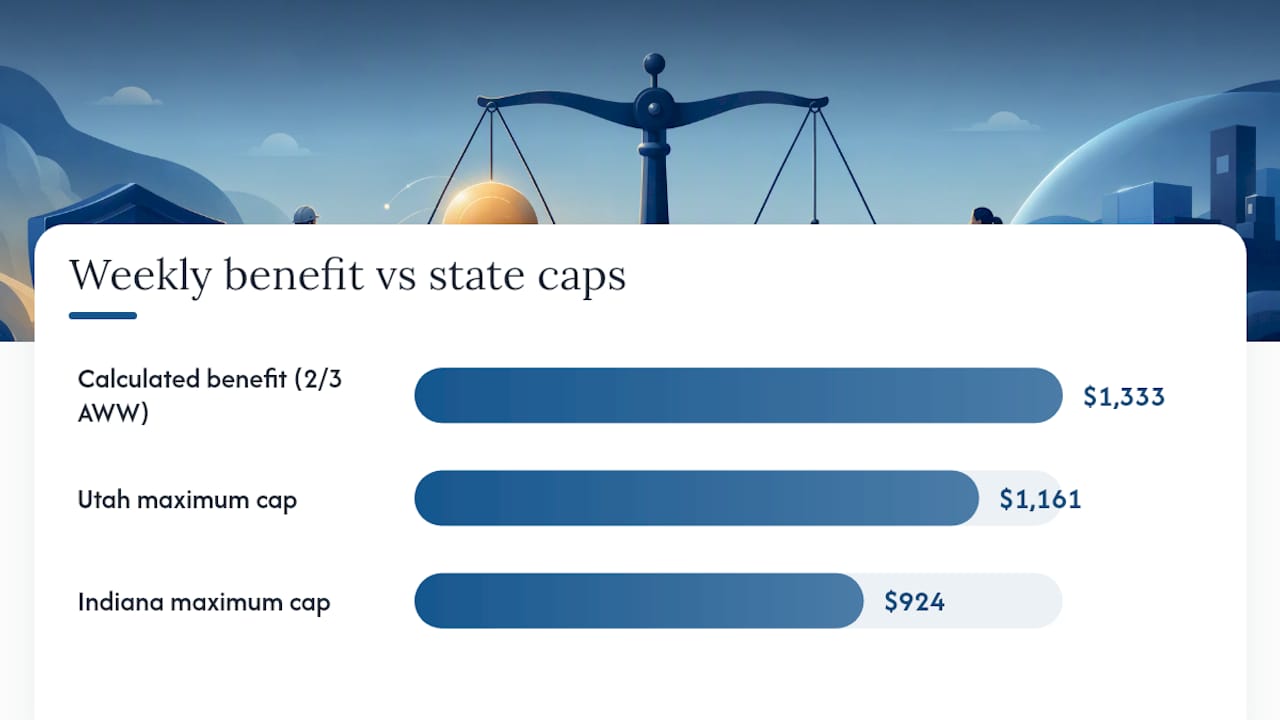
Once you have AWW, apply your state’s replacement rate. Two-thirds (66.67%) is the standard used by most states, but that raw number never stands alone. It gets checked against your state’s maximum weekly benefit, and if your calculated amount exceeds that cap, the cap wins. A worker earning $2,000 a week might calculate a $1,333 weekly benefit, only to have it knocked down to $1,161 in Utah or $924 in Indiana.
Scheduled awards work differently. Each state publishes a chart assigning a fixed number of weeks to specific body parts, an arm, a leg, a hand, an eye. Multiply those scheduled weeks by your weekly benefit and by your impairment percentage, and you get the PPD payout for that body part.
Whole-person or “unscheduled” injuries, think back injuries, psychological trauma, or systemic conditions, don’t fit a body-part chart. States handle these with alternative formulas that can factor in age, occupation, and your realistic ability to return to similar work.
Before you calculate anything, pull your state’s current numbers:
-
Your state’s scheduled-weeks chart for the specific body part injured
-
The 2026 maximum weekly benefit for your state
-
Your state’s exact wage-replacement percentage (not every state uses 66.67%)
Two Worked Examples: Scheduled and Whole-Person
Example 1: Scheduled body part. Say a worker in Oregon loses partial function in an arm. Weekly benefit: $900 (under the Oregon maximum of $1,601). Scheduled weeks for an arm in this hypothetical: 200.
-
Weekly benefit: $900
-
PPD math: 200 weeks × $900 × 0.20
-
Gross PPD award: $36,000
Example 2: Whole-person back injury. A worker with a $1,000 AWW and a 25% whole-person impairment rating, using an Illinois-style approach with 400 available weeks for total loss:
-
Weekly benefit: $666.67 (66.67% of $1,000 AWW)
-
Formula: 400 weeks × $666.67 × 0.25
-
Gross PPD award: approximately $66,667
Both figures are gross, before attorney fees, liens, or medical reimbursement. Add unpaid temporary benefits and any future medical buy-out separately, and you’ll land closer to a realistic settlement offer.
Why Do State Rules Change Your Settlement Amount?
Your state decides almost everything about your number. Wage-replacement rates aren’t universal. Massachusetts and New Hampshire use 60%. Connecticut and Rhode Island apply 75% to after-tax wages, and Iowa, Michigan, and Alaska go as high as 80% after-tax. Two workers with identical injuries and wages can walk away with very different weekly benefits based purely on where they live.
Scheduled-weeks charts vary just as widely. A hand might carry 244 weeks in one state and a very different number in another. There’s no shortcut here: you check your own state’s chart.
-
Confirm your state’s exact wage-replacement percentage before running any math
-
Look up the 2026 maximum weekly benefit, since it updates annually with the state’s average wage
-
Check your state’s official scheduled-weeks chart, not a generic national average
State pages like the California calculator, Washington calculator, and Minnesota calculator have these figures baked in for 2026.
Pro Tip: Texas applies different rules for the first few weeks of a claim than it does afterward. If you’re filing in Texas, check the Texas-specific calculator rather than assuming standard timing applies.
How Do Impairment Ratings Actually Get Set?
An impairment rating is a physician’s percentage assessment of how much permanent function you lost. It’s the single number that decides how big your PPD check gets, because it multiplies directly against scheduled weeks and your weekly benefit.
Most ratings come from the AMA Guides to the Evaluation of Permanent Impairment, now in its sixth edition, which gives doctors a structured method for scoring specific injuries rather than guessing.
-
Minor injuries often land in the 5% to 10% range
-
Serious, life-altering injuries can reach 25% or higher
-
A five-point difference in rating can swing a settlement by tens of thousands of dollars on a high-week scheduled injury
If your treating physician’s rating seems low, an independent medical examination (IME) from a second doctor can challenge it. Document every functional limitation, lifting restrictions, range-of-motion loss, chronic pain, because vague complaints rarely move a rating upward. Precise medical records do.
TTD, PPD, and PTD: What Each Benefit Actually Covers
Workers comp benefits break into distinct categories, and knowing which ones apply to you determines what belongs in your settlement math.
-
TTD (temporary total disability): weekly payments while you’re completely unable to work and still recovering
-
TPD (temporary partial disability): partial payments when you can work reduced hours or lighter duty
-
PPD (permanent partial disability): the lump-sum or scheduled award for lasting impairment
-
PTD (permanent total disability): ongoing benefits when you can never return to meaningful work
-
Medical benefits: coverage for treatment, which can be bought out with a future medical estimate in a full settlement
A full settlement typically bundles unpaid TTD, the PPD lump sum, and a future medical estimate if you’re closing out your claim entirely. Lump sums make sense when you want certainty and control over your money now. Structured settlements fit better when ongoing medical needs are unpredictable and you want the insurer’s obligation to continue rather than end.
What Mistakes Cost Injured Workers the Most Money?
The most expensive mistake is calculating AWW from net pay instead of gross wages, which understates your entire benefit before you even start. Close behind: leaving out regular overtime or bonus income, forgetting your state’s cap exists, and misreading a scheduled-weeks chart from the wrong state.
Watch for red flags in an insurer’s first offer: an aggressive discount rate that shrinks your future medical buy-out too much, an AWW that doesn’t match your actual pay stubs, or a missing future medical component entirely.
-
Recalculate AWW yourself using gross wages before accepting any insurer figure
-
Get your impairment rating in writing and challenge it if it feels low relative to your actual limitations
-
Ask what discount rate the insurer used, since pushing back on an aggressive rate can raise your lump-sum offer
Pro Tip: Ask the insurer to show their AWW calculation line by line. If they can’t produce it, that’s a sign they’ve estimated low.
How Do You Use an Online Workers Comp Calculator?
A calculator does the same math you’d do by hand, just faster and with your state’s current caps already loaded.
-
Enter your state, since that sets your replacement rate and maximum weekly benefit automatically
-
Enter your gross wages, either as a 52-week total or a weekly figure with overtime and bonuses included
-
Select your injury type or body part, which pulls the correct scheduled-weeks value
-
Enter your impairment rating if you have one, or leave it blank to see a range
-
Enter any return-to-work wages, which factor into TPD calculations if relevant
The output gives you three numbers worth checking closely: your weekly benefit, your PPD lump-sum estimate, and (if applicable) a discounted lump-sum figure for future payments converted to a one-time amount. Run your numbers through the Workers’ Comp Settlement Calculator to see how they line up with your state’s 2026 figures.
When Should You Bring in a Workers Comp Attorney?
Call an attorney when liability is disputed, when future medical needs are complicated, when your impairment rating feels too low, or when the insurer’s discount rate looks aggressive.
The typical timeline runs through several stages: TTD payments during initial recovery, reaching maximum medical improvement (MMI), getting your impairment rating assigned, a negotiation window with the insurer, and, if talks stall, a formal hearing.
-
TTD period ends once you reach MMI, the point where your condition has stabilized
-
Your impairment rating gets assigned around MMI and becomes the basis for PPD talks
-
Negotiation typically follows, with a hearing as the fallback if no agreement is reached
-
Attorney fees are state-regulated and commonly run a moderate percentage of your settlement
-
Medical liens and subrogation claims get deducted before you see your net check
-
Your net recovery will always be lower than the gross settlement figure quoted in negotiations
A practical note on running your own numbers
I’d treat any formula-based estimate as a floor, not a final answer. The math above gets you close, but impairment ratings get disputed, discount rates get negotiated, and state caps change every year. Run your numbers through a calculator built for your state, then verify the impairment rating and cap figures against your own paperwork before you trust any number enough to negotiate with it.
Get a State-Specific Estimate in Minutes
Running this formula by hand works, but it’s slow, and it’s easy to grab the wrong scheduled-weeks chart or an outdated cap. Workerscompestimator builds the 2026 maximum weekly benefit, state replacement rate, and scheduled-weeks data directly into the calculator, so you get a weekly benefit figure and a PPD lump-sum estimate without hunting through state statutes.
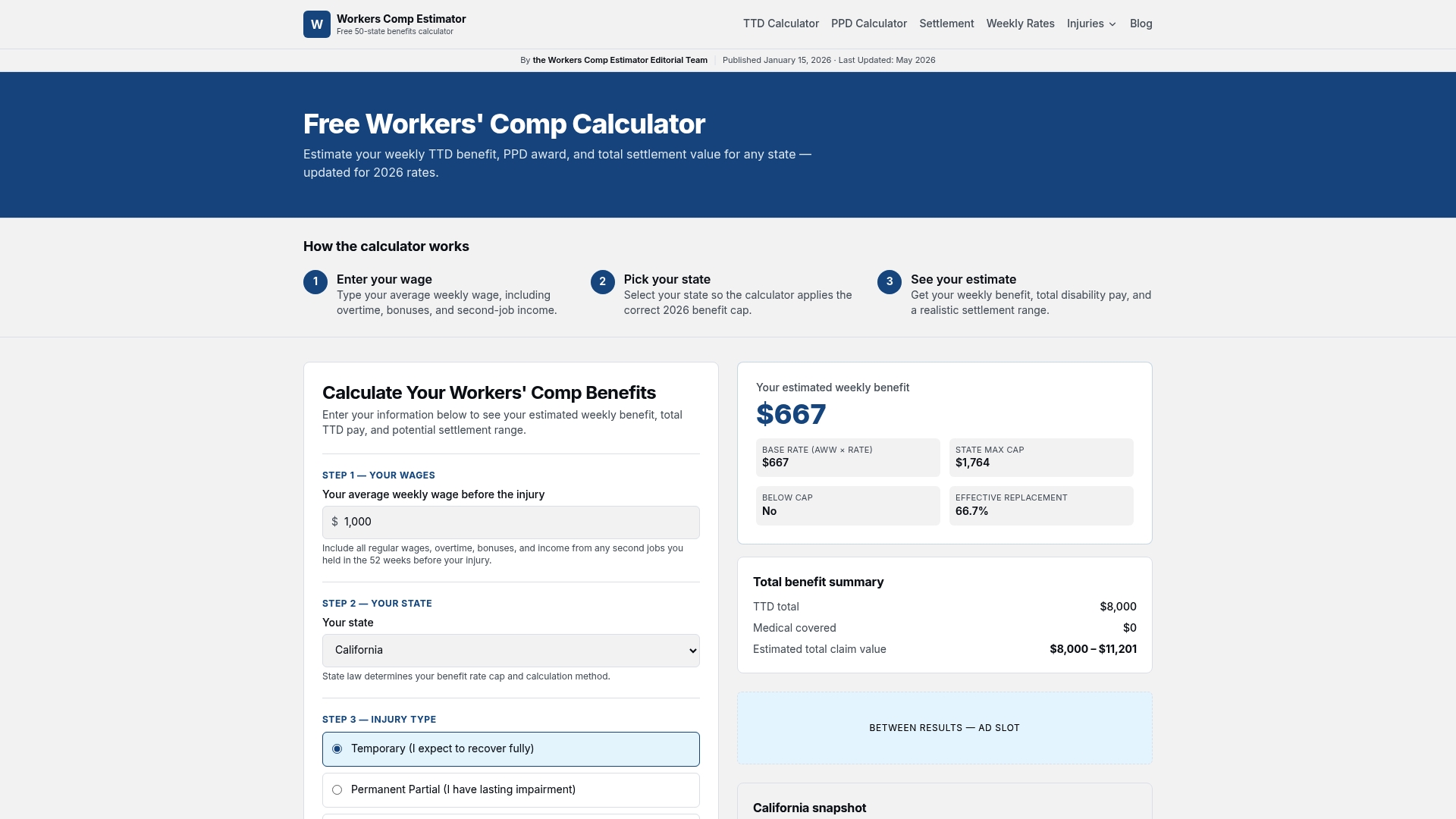
You’ll see your estimated weekly benefit, your PPD lump-sum range, and a settlement estimate that already accounts for your state’s 2026 cap, numbers you can bring straight into a conversation with an adjuster or attorney. Enter your wages, state, and injury type into the Workers’ Comp Settlement Calculator now and see where your case likely lands before you agree to anything.
Frequently Asked Questions
What is the basic workers comp settlement formula? Weekly benefit equals AWW times your state’s replacement rate, capped at the state maximum. PPD lump sum equals scheduled weeks times the weekly benefit times your impairment rating.
How do I calculate workers comp benefits if I worked overtime? Include regular overtime and bonuses in your gross wage total when calculating AWW, then divide by 52. Most states count this income if it was earned consistently.
Does a higher impairment rating always mean a bigger settlement? Yes, because the rating is a direct multiplier in the PPD formula. A higher percentage on the same scheduled weeks and weekly benefit produces a proportionally larger award.
Are workers comp settlements paid as a lump sum or over time? Both options exist. Lump sums (often called compromise-and-release settlements) pay everything at once and typically end the insurer’s future obligations, while structured settlements pay over time.
Do attorney fees reduce my final settlement check? Yes.
This article is general information, not a substitute for advice from a qualified lawyer. Consult a qualified legal professional about your own circumstances before acting on anything here.
Sources
Recommended
More from the blog
Discover settlement ranges for knee injury workers' comp claims and learn the essential steps to maximize your benefits and protection.
Understand how an impairment rating impacts your workers' comp payout. Learn key steps to maximize your settlement before signing any documents.
Learn how Texas workers’ comp impairment ratings affect benefits, deadlines, and disputes, then use the payout calculator before accepting an offer.
Free workers' comp calculators
Put the numbers in this article to work on your own claim.
Weekly benefit, PPD, and settlement in one place.
What your weekly temporary disability check should be.
Scheduled weeks and permanent impairment awards.
Light-duty benefit when you earn less while healing.
Federal employee FECA award by body part.
Lump-sum value of your full claim.
Turn a 5%, 10%, or 20% rating into dollars.
Max and min weekly rates for all 50 states.
Typical settlement ranges by injury and state.
Average settlement for fusion, rotator cuff, knee replacement, and more.
Why comp does not pay it, and when a third-party claim does.
When carriers typically make an offer.
What coverage costs by class code and payroll.
Guides, state updates, and claim strategy.