
Protect Your Care in 2026: State Workers’ Comp Lifetime Medical Check

“Lifetime medical” means your employer’s insurance stays responsible for paying reasonable, necessary treatment tied to your work injury for as long as you need it, with no end date. Most claims eventually reach a fork: keep medical open under that ongoing promise, or accept a lump-sum buyout that closes it permanently. Before signing anything, get written future-care cost estimates from your doctor and confirm whether Medicare’s interests need to be addressed first.
TL;DR:
- Keeping medical open offers ongoing protection for future injuries, with no fixed limit, especially if your injury progresses or requires unexpected procedures.
- A lump-sum buyout provides immediate payment but transfers all future medical costs to you, which can be risky if your condition worsens or new treatments become necessary.
- Medicare rules require setting aside funds through a WCMSA if you’re a beneficiary or near enrollment, and improper handling can lead to claim denials or recovery actions.
- State-specific rules affect the ability to keep medical open, including caps on total spending, reopening conditions, deadlines, and whether open medical is permitted at all.
- Using a state-specific settlement calculator and consulting your doctor’s written future-care projections ensure accurate valuation before accepting any settlement offer.
Table of Contents
- What Lifetime Medical Benefits Cover and Who Qualifies
- Open Medical vs. Closed Medical: How Each Path Works
- Medicare, WCMSAs, and What Happens if Medicare Gets Involved
- How Buyouts Are Valued and What Actually Drives the Price
- How Lifetime Medical Rules Change by State
- How to Request or Preserve Lifetime Medical Benefits
- Questions to Ask Before You Sign Any Settlement
- Using a Calculator to Model Your Own Numbers Before You Decide
- What I’d Tell a Friend Facing This Decision
- Run Your Numbers Before the Insurance Company Runs Theirs
- Sources
- FAQ
What Lifetime Medical Benefits Cover and Who Qualifies
Lifetime medical coverage under workers comp isn’t a blank check. It’s tied to one legal test that shows up in nearly every state statute: the treatment has to be reasonable, necessary, and related to the original work injury. Meet that standard, and the insurer keeps paying, indefinitely, for care connected to the injury.
In practice, that usually includes:
- Doctor visits and specialist consultations tied to the injury
- Surgeries, including revision surgeries if the first one fails
- Prescription medications, from pain management to anti-inflammatories
- Durable medical equipment like braces, wheelchairs, or prosthetics
- Physical therapy, occupational therapy, and rehabilitation
- Mental health treatment when it’s connected to the physical injury, such as depression following a permanent disability
The catch is that “reasonable and necessary” is a moving target the insurer gets to challenge. Adjusters routinely send claims through utilization review, and if that review flags a treatment as excessive or unrelated, they can require an independent medical examination (IME) before paying another dollar. Your treating physician’s opinion carries real weight here. Courts and workers’ comp boards generally give more deference to the doctor who has actually managed your care over months or years than to a one-time IME examiner hired by the insurance carrier. That’s why keeping detailed, consistent medical records matters just as much as the injury itself.
Tennessee’s state guidance on lifetime medical benefits frames this the same way most states do: the employer’s obligation continues as long as treatment stays reasonable, necessary, and connected to the original injury, and it stops being open-ended only if the parties agree to settle it closed.
Open Medical vs. Closed Medical: How Each Path Works
Every settlement negotiation eventually forces a choice between two structures. Understanding both before you talk numbers changes the entire negotiation.
- Open medical means the insurer stays on the hook for future treatment related to your injury, with no cap on dollar amount or time. You get periodic indemnity payments or a settlement for lost wages and disability, but medical coverage keeps running in the background. This protects you if your condition worsens or you need a surgery nobody anticipated at settlement time.
- Closed medical (also called a full-and-final settlement) trades that ongoing promise for a lump sum today. Once you sign, the insurer’s medical obligation ends. Every future appointment, prescription, or surgery related to that injury becomes your responsibility, unless Medicare or another payer covers it.
The financial logic is straightforward but the risk sits on opposite sides. A closed settlement hands you a bigger check now, one that might look attractive if you’re behind on rent or want to move on with your life. Keeping medical open means smaller near-term payments but ongoing protection if your injury turns out to need more care than anyone expected at the time of settlement.
State terminology adds another wrinkle. What Tennessee calls a settlement, California might call a compromise and release, and other states use terms like stipulation or commutation. The mechanics are similar but the procedural rules, and sometimes the ability to reopen a closed case, vary by jurisdiction. Never assume the settlement structure in one state maps cleanly onto another; always confirm what your state actually allows before you compare offers.
Medicare, WCMSAs, and What Happens if Medicare Gets Involved
If you’re a Medicare beneficiary, or likely to become one soon, a workers’ comp settlement can’t just ignore Medicare. Federal Medicare Secondary Payer rules require that Medicare’s interests be considered before a claim closes, because Medicare is designed to pay second, not first, for injury-related care that workers’ comp should be covering.
That’s where a Workers’ Compensation Medicare Set-Aside (WCMSA) comes in. A WCMSA sets aside part of your settlement specifically for future Medicare-covered treatment related to the injury, and CMS requires those approved funds to be exhausted before Medicare will step in and pay for related care. You can fund it two ways: a lump sum deposited up front, or a structured annuity with an initial deposit covering the first two years of projected treatment plus any anticipated surgeries, followed by annual deposits after that.
Not every settlement needs formal CMS review. The WCMSA Reference Guide lays out the thresholds that trigger it include being a Medicare beneficiary with a total settlement over a certain amount, or having a reasonable expectation of enrolling in Medicare soon with a sufficiently large anticipated settlement

Fall under those numbers and CMS review is optional. Many attorneys still recommend setting aside an MSA-style estimate anyway, since documenting how Medicare’s interests were considered reduces the risk of future claim denials or recovery actions, even without formal approval.
Once your WCMSA is approved and funded, you’re required to file annual attestations confirming how the money was spent. If the account runs dry, temporarily or for good, and you’ve reported it correctly, Medicare resumes paying for otherwise-covered, injury-related bills. Skip the attestation or spend the funds on unrelated care, and you risk Medicare denying claims until the paperwork catches up.
How Buyouts Are Valued and What Actually Drives the Price
A fair buyout number isn’t a guess. It’s built from a handful of concrete inputs, and the strength of your negotiating position depends on how well you can document each one.
The core variables insurers and attorneys weigh include:
- Your age and statistical life expectancy
- The severity and permanence of the injury
- Likely future surgeries, injections, or procedures your doctor expects
- Local cost of care and prescription pricing in your area
- Medical inflation, which tends to outpace general inflation year over year
Several law-firm and worker-education resources consistently make the same point: if future medical care is likely, keeping medical open usually protects the worker better than accepting a lump-sum buyout. The decision is genuinely case-specific, but it hinges almost entirely on how credible your future-cost estimate is.
Depending on how complex your case is, you may need more than one professional. An MSA allocator calculates the Medicare set-aside amount. A medical economist or life-care planner projects long-term treatment costs. An attorney negotiates the settlement itself and flags interactions with SSDI, since a large lump sum can trigger offsets against Social Security Disability Insurance in some circumstances.
Pro Tip: Ask your treating physician, in writing, exactly what care they expect you’ll need over the next five, ten, and twenty years. That single document becomes the anchor for every dollar figure in the negotiation, and it’s the piece adjusters find hardest to argue against.
Running your own numbers first, using a settlement calculator to compare a proposed buyout against projected weekly benefits, gives you a baseline before anyone else’s estimate lands on the table.
How Lifetime Medical Rules Change by State
No federal law standardizes workers’ comp. Each state writes its own rules, which means the same injury can play out very differently depending on where you work.
States differ on several fronts that materially affect your case:
- Whether open medical is even permitted, or whether the state pushes most claims toward a closed settlement
- Statutory caps on total medical spending or a maximum number of weeks certain benefits can run
- Rules for reopening a case if your condition worsens after settlement, some states allow it, others treat closed as permanently closed
- Deadlines for filing appeals, requesting hearings, or challenging a denied treatment
Given that spread, your state’s own workers’ compensation agency is the only reliable source for the rules that actually apply to you, not a generic guide written for a different jurisdiction. Tennessee’s lifetime medical benefits page is a solid example of the format most states use: it defines the reasonable-and-necessary standard, explains what closing medical means, and lists factors workers should weigh before agreeing to a settlement. Look for the equivalent page on your own state’s labor or workforce department site, and cross-check it against your state’s statutes and administrative code before you rely on anything a law firm’s marketing page tells you.
How to Request or Preserve Lifetime Medical Benefits
Protecting your right to ongoing care takes documentation, not luck. Follow these steps as your claim moves toward settlement talks.
- Document your current treatment and get a written projection from your treating doctor covering expected future care, procedures, and costs.
- Ask your attorney or adjuster about indemnity-only settlements, resolving lost-wage claims while leaving medical benefits open and untouched.
- If Medicare enrollment is likely within 30 months, or you’re already enrolled, request an MSA cost estimate early and ask whether your settlement meets the CMS review thresholds.
- File any required forms with your state workers’ compensation board promptly, request a hearing if medical benefits are being unfairly denied, and track every deadline in writing.
Pro Tip: Call your state board directly, not just the insurance adjuster, and ask specifically who handles disputes over medical benefit denials. Most states have a designated ombudsman or claims examiner whose entire job is helping injured workers navigate exactly this kind of dispute, free of charge.
Questions to Ask Before You Sign Any Settlement
A signature on a workers’ comp settlement is permanent in most states. Before you get anywhere near that signature, put these questions in front of the insurer, adjuster, or your own attorney, in writing, and get answers you can keep.
- Does this settlement close my medical benefits entirely, or does it stay open?
- If it closes, what’s my realistic out-of-pocket exposure for future treatment?
- Is a Medicare Set-Aside required here, or just recommended, and who will manage those funds?
- Is the payment a single lump sum or a structured annuity, and what happens to remaining funds if I pass away or the account runs out early?
- What are my state’s specific rules and deadlines for reopening a claim if my condition changes?
Get these answers before you compare dollar figures. A bigger number on paper means very little if it comes with medical exposure you didn’t see coming.
Using a Calculator to Model Your Own Numbers Before You Decide
Comparing a settlement offer to the value of staying on lifetime medical requires real numbers, not gut instinct. The Free Workers’ Comp Calculator gives you state-specific estimates built on each state’s 2026 benefit caps, so you can see what your weekly Total Temporary Disability benefit and potential settlement value should look like before you sit down with an adjuster.
Using it is simple: enter your state, your average weekly wage, and your injury type. Within seconds you get a personalized estimate you can hold up against whatever number the insurance company puts on the table. State pages like the Massachusetts and Michigan calculators show how differently benefit caps play out depending on where you file.
- Pair the calculator’s estimate with your doctor’s written future-care projection for a full picture of what a buyout should actually cost.
- Cross-check your state’s cap against the full 2026 weekly benefit rate table to confirm you’re negotiating from an accurate baseline.
What I’d Tell a Friend Facing This Decision
The insurance company’s opening offer is built to look generous while quietly transferring risk onto you. That’s not cynicism, it’s just how settlement negotiations work on both sides of the table.
If there’s one rule I’d want every injured worker to internalize, it’s this: never trade away open-ended medical coverage for a number you haven’t stress-tested against your own doctor’s projections and Medicare’s rules. Get the numbers first. Protect Medicare’s interest properly. Then decide.
— Daniel
Run Your Numbers Before the Insurance Company Runs Theirs
Workerscompestimator gives you the one thing an adjuster’s opening offer never does: an independent, state-specific number to compare it against, built on each state’s actual 2026 benefit caps instead of a one-size-fits-all national average.
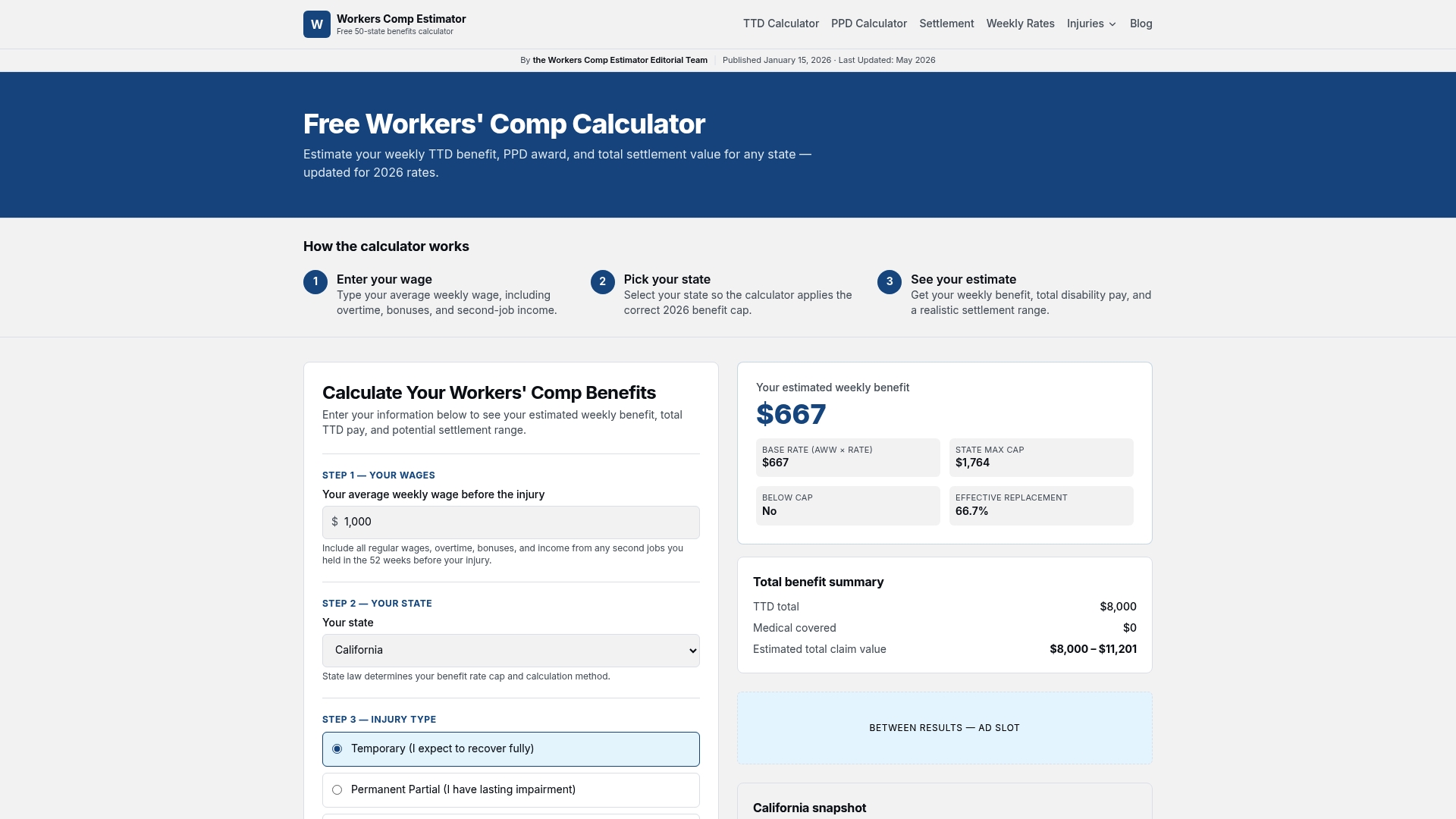
Enter your state, average weekly wage, and injury type into the Workers’ Comp Calculator, and you’ll see your projected weekly benefits and settlement range in under a minute, free, with no sign-up required. If you’re weighing a buyout against keeping medical open, run the same inputs through the settlement calculator to see how a lump-sum offer stacks up against projected long-term costs. Having your own numbers in hand before you negotiate is the single most practical step covered in this entire guide, and it takes less time than reading one insurance company brochure.
This article is general information, not a substitute for advice from a qualified lawyer. Consult a qualified legal professional about your own circumstances before acting on anything here.
Sources
- Workers’ Compensation Medicare Set-Aside Arrangements | CMS
- Lifetime Medical Benefits | Tennessee Department of Labor & Workforce Development
FAQ
What is the longest you can be on workers’ comp?
There’s no universal cap. If your medical benefits stay open, coverage for injury-related treatment can continue for life, though wage-replacement benefits like temporary disability often have state-specific week limits that differ from medical coverage.
What is the lifetime maximum for workers’ comp medical benefits?
Most states impose no dollar cap on lifetime medical benefits as long as treatment remains reasonable, necessary, and related to the injury, though a handful of states apply statutory limits, which is why confirming your own state’s rules matters.
What is the payout for permanent impairment?
Permanent impairment payouts vary by state formula, body part affected, and impairment rating, and they’re typically calculated separately from ongoing medical benefits. A PPD calculator can help you estimate that portion of your claim independently from future medical exposure.
What does future medical mean in workers’ compensation?
Future medical refers to anticipated treatment, surgery, medication, or therapy you’ll likely need after your claim resolves. It’s the central figure insurers and attorneys estimate when valuing whether to keep medical benefits open or offer a lump-sum buyout to close them.
Recommended
More from the blog
Use the free 50-state estimator that applies 2026 state caps to estimate your workers' comp lump sum. Run your numbers, check SSDI/Medicare impact, and...
File the correct state claim and collect medical and wage records. Run the free 50 State calculator to see your likely weekly TTD and settlement before...
Run a state specific 2026 workers' comp settlement calculation. Use the free 50 state calculator to see how state caps change your payout.
Free workers' comp calculators
Put the numbers in this article to work on your own claim.
Weekly benefit, PPD, and settlement in one place.
What your weekly temporary disability check should be.
Scheduled weeks and permanent impairment awards.
Light-duty benefit when you earn less while healing.
Federal employee FECA award by body part.
Lump-sum value of your full claim.
Turn a 5%, 10%, or 20% rating into dollars.
Max and min weekly rates for all 50 states.
Typical settlement ranges by injury and state.
Average settlement for fusion, rotator cuff, knee replacement, and more.
Why comp does not pay it, and when a third-party claim does.
When carriers typically make an offer.
What coverage costs by class code and payroll.
Guides, state updates, and claim strategy.