
Spot Underpayments: Wage Loss Benefits and 2026 State Caps

If you miss work because of a job injury, you’re almost certainly eligible for wage loss benefits, and the number to know is two-thirds. Most states replace roughly 66.67% of your average weekly wage while you’re disabled, capped by a state maximum and floored by a state minimum. The exact amount depends on your state, your injury classification, and how your average weekly wage gets calculated.
TL;DR:
- Overtime worked regularly before injury significantly impacts your average weekly wage and should be carefully verified to avoid losing potential benefit income.
- Benefits generally replace around 66.67% of your pre-injury weekly wage, but caps and minimums vary by state, which can limit your actual payout.
- Wage loss benefits start after a short waiting period, often around one week, unless employer-paid wages offset or delay initial payments.
- Returning to part-time or lower-paying work reduces future benefits, but most states calculate it as two-thirds of the earning difference, based on your pre-injury wage.
- Proper documentation and proactive number verification are crucial, as insurers frequently miscalculate or underpay benefits, making a clear paper trail essential.
Table of Contents
- Who Qualifies for Wage Loss Benefits
- When Benefits Start and How Waiting Periods Work
- How Wage Loss Benefits Are Calculated
- Minimum and Maximum Benefits: A Sample Calculation
- Reduced Earnings and Returning to Work
- What to Do When Payments Are Late or Disputed
- Using a Calculator to Check Your State’s Caps
- How Wage Loss Benefits Interact With Other Programs
- How Long Wage Loss Benefits Last
- Why Wage Loss Claims Get Denied
- Appealing a Denied Wage Loss Claim
- What Settling a Claim Does to Future Benefits
- Building the Paper Trail That Wins Your Claim
- An Injured Worker’s Perspective on Getting Paid Correctly
- Get a Real Number Before You Talk to the Insurer
- Sources
- FAQ
Who Qualifies for Wage Loss Benefits
You qualify for wage loss benefits when a work-related injury or illness keeps you from doing your job at full capacity, and a doctor’s note backs that up. The medical evidence matters as much as the injury itself. An insurer isn’t paying you for pain; it’s paying you because a physician documented that you can’t perform your normal duties, or can only perform limited ones.
Workers’ compensation systems generally sort wage loss into four categories:
- Temporary total disability (TTD): You can’t work at all for a period, and you’re expected to recover enough to return.
- Temporary partial disability (TPD): You can work, but only in a reduced or modified capacity while healing.
- Permanent partial disability (PPD): You’ve reached maximum medical improvement but retain a lasting impairment that limits earning capacity.
- Permanent total disability (PTD): The injury permanently prevents you from returning to any gainful employment.
State rules diverge in ways that catch people off guard. Your date of injury locks in which version of the state’s benefit schedule applies, even if the law changes later. If you had more than one employer at the time of injury, some states let you combine those wages for a higher average. And in a number of states, if your employer keeps paying your regular salary during recovery, that continuing pay can offset or delay your indemnity check.
When Benefits Start and How Waiting Periods Work
Nearly every state builds in a waiting period before wage loss checks start, and that gap trips up more injured workers than any other rule in the system.
- The waiting period typically runs over a short initial period. New York, for example, does not pay lost wage benefits for the first week of disability, following state guidance on lost wage benefits.
- Retroactivity kicks in if you’re still out. Many states make that initial waiting period retroactive once your disability stretches beyond a system-specific threshold, so you eventually get paid for the whole period.
- Employer-paid wages can offset insurer payments. If your employer voluntarily continues your salary, the insurer may reduce or delay indemnity checks and later seek reimbursement once the claim is confirmed.
- Payment depends on three triggers: a timely injury report to your employer, a filed claim, and a physician’s work-status note establishing you can’t perform your job.
- If checks are late, act in writing. Request a payment status update from the insurer, log every missed payday with dates and amounts, and escalate to your state workers’ comp board if the silence continues.
How Wage Loss Benefits Are Calculated
Your benefit starts with your average weekly wage, or AWW, and that number is where most disputes begin. States typically calculate AWW using your gross earnings over the 52 weeks before your injury, though methods vary. Some average total earnings divided by weeks worked; others use the highest-earning quarters if your schedule was irregular.
What counts toward AWW differs by jurisdiction, but Department of Labor guidance on wage-loss compensation defines wages broadly to include:
- Base salary and hourly pay
- Regular overtime (if it’s a consistent part of your schedule, not a one-time spike)
- Bonuses and commissions
- Tips, where properly reported
- Accrued sick and vacation pay, in some formulas
Pro Tip: Overtime is the single biggest source of AWW disputes. If you worked overtime regularly in the year before your injury, pull your payroll records and confirm the insurer actually included it. Insurers sometimes average it out or drop it entirely, and that mistake alone can shave real money off your weekly check.
Most states apply a replacement rate in the 60% to 70% range, commonly landing on two-thirds, or 66.67% of your average weekly wage, before applying any state cap.
Some states use more complex comparisons. Washington’s loss-of-earning-power framework, for instance, weighs a “Method A/Method B” comparison and applies a cap around 1.5 times the state average wage, with adjudicators required to use whichever formula pays the worker more, up to that ceiling.
Minimum and Maximum Benefits: A Sample Calculation
Every state sets a maximum weekly benefit, usually tied to the state’s average weekly wage and adjusted on a fixed schedule, often annually on a set date like July 1. Minimum weekly benefits exist too, protecting low-wage workers from checks so small they’re meaningless, and both figures are typically indexed each year.
Here’s how the math actually plays out:
- Start with your AWW. Say your average weekly wage before the injury was $900.
- Apply the replacement rate. Based on typical state formulas, you get roughly two-thirds of that amount per week.
- Check it against your state’s cap. If your state’s 2026 maximum is $1,764 (California’s current ceiling), you’re well under it and receive the full $600.
- Check it against the minimum. If your calculated benefit fell below the state floor, you’d be bumped up to that minimum instead.
The result: a $900 earner in a state with a $1,764 cap gets the full two-thirds calculation. But swap in a high earner making $3,000 a week, and the same math produces roughly $2,000, which gets capped down to $1,764. That gap between “what the formula says” and “what the cap allows” is exactly why checking your state’s weekly benefit rate matters before you assume your check is correct. One more wrinkle: your benefit rate is generally frozen based on your date of injury, so later increases to the state maximum usually don’t apply retroactively to your claim.
Reduced Earnings and Returning to Work
Going back to work part-time or in a lower-paying role doesn’t end your wage loss claim; it usually just changes the math. Under “working wage loss” rules, common in states like Ohio, you’re typically paid two-thirds of the difference between your pre-injury AWW and what you’re currently earning, following state administrative guidance on wage loss compensation.
- Working wage loss applies once you’ve returned to some job, even at reduced hours or pay.
- Non-working wage loss applies if you haven’t returned at all, but many states require proof of a genuine, ongoing job search to keep the checks coming.
- Concurrent employment lets you fold in wages from a second job you held at injury time, which can meaningfully raise your AWW and your benefit.
- Refusing suitable light duty that your doctor clears you for can get your benefits reduced or cut off entirely, so document why an offered position doesn’t match your restrictions if you decline it.
What to Do When Payments Are Late or Disputed
Delays usually trace back to missing paperwork: an unreported injury, a claim that was never formally filed, or a physician’s note that doesn’t clearly state your work restrictions.
- Collect everything as it happens. Save pay stubs, medical work-status notes, and every email or letter from the insurer.
- Know the retroactive math. If a claim is initially denied and later accepted, insurers typically owe back pay covering the entire period you were out, not just from the acceptance date forward.
- Prepare for a hearing if it’s disputed. Bring your payroll records, medical documentation, and a clear written timeline. A judge will look closely at how the insurer calculated your AWW and whether the right replacement rate was applied.
Pro Tip: File everything in writing, even a simple email confirming a phone call. Verbal promises from an adjuster disappear the moment there’s a dispute; a paper trail doesn’t.
Using a Calculator to Check Your State’s Caps
The fastest way to sanity-check an insurer’s number is to run it yourself. The Free Workers’ Comp Calculator asks for your average weekly wage, your state, and your injury type, then returns an estimated weekly TTD or PPD benefit along with a rough settlement range, built on 2026 state caps and rate tables.
State maximums vary enormously, which is exactly why a one-size answer doesn’t work:
- Oregon’s 2026 cap sits around $1,601 per week
- Massachusetts runs as high as $1,922 per week
- Indiana caps out at roughly $924 per week
Running your numbers before an insurer call gives you a concrete figure to compare against theirs, and a specific question to ask if the two don’t match.
How Wage Loss Benefits Interact With Other Programs
Wage loss benefits rarely exist in isolation, especially if your disability drags on long enough to brush up against Social Security or unemployment.
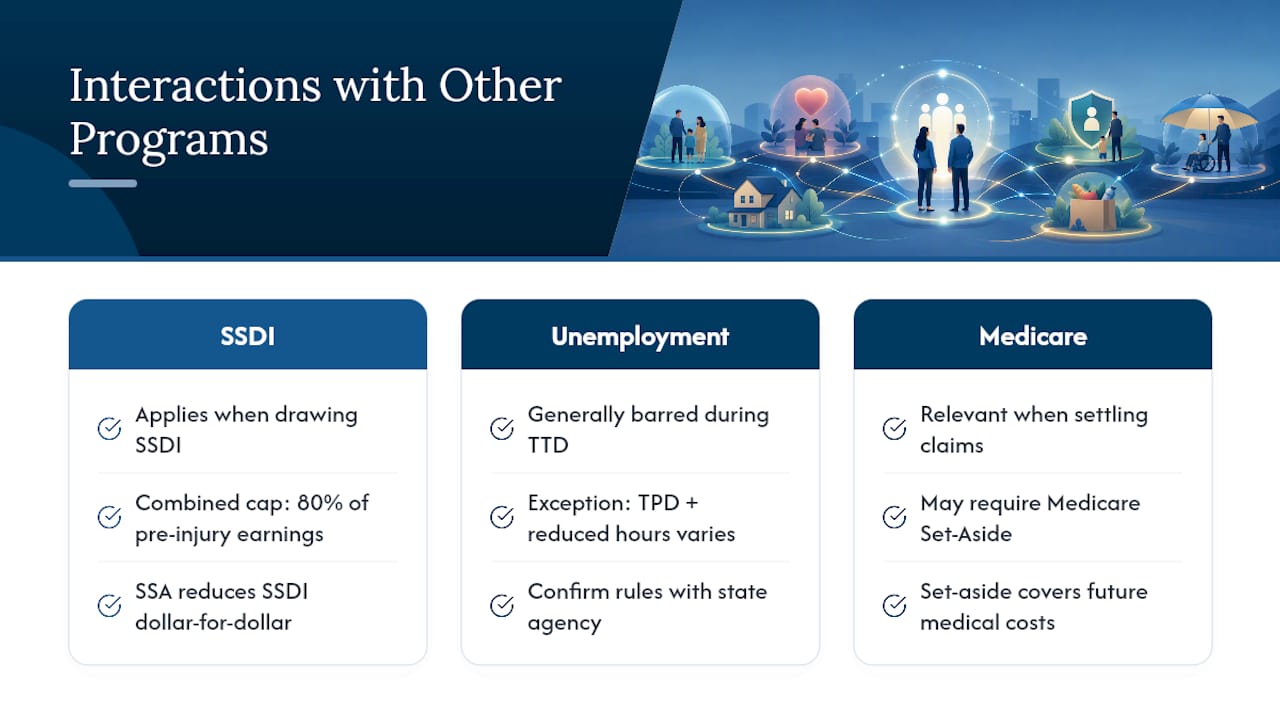
If you’re also drawing Social Security Disability Insurance (SSDI), the combined total of your workers’ comp and SSDI generally can’t exceed 80% of your average current earnings before the injury. Exceed that threshold, and the Social Security Administration will offset your SSDI payment downward, dollar for dollar, until the combined total falls back under the cap. This surprises a lot of people who assumed the two systems ran independently. They don’t.
Unemployment benefits are a different story: most states bar you from collecting unemployment while you’re receiving temporary total disability, on the logic that TTD already assumes you’re unable to work, while unemployment assumes you’re able and searching. The exception tends to show up around partial disability. If you’re on TPD and actively working reduced hours, some states allow a partial unemployment claim to fill the gap, though the rules here vary widely and it’s worth confirming with your state agency before assuming either way.
If a settlement is on the table, Medicare complicates things further. Larger settlements often require a Medicare Set-Aside, a portion of the settlement carved out to cover future injury-related medical costs, so Medicare doesn’t end up paying for care that workers’ comp was supposed to cover. Skipping this step on a settlement that should have included one can create real problems if you’re a Medicare beneficiary or likely to become one soon.
How Long Wage Loss Benefits Last
Duration limits depend entirely on your disability classification, and this is where TTD, PPD, and PTD diverge the most.
Temporary total disability generally continues until you reach maximum medical improvement, meaning your doctor determines your condition has plateaued and further treatment won’t meaningfully change your work capacity. Some states also cap TTD at a set number of weeks regardless of medical status, commonly somewhere in the 104 to 156 week range, though this varies by jurisdiction.
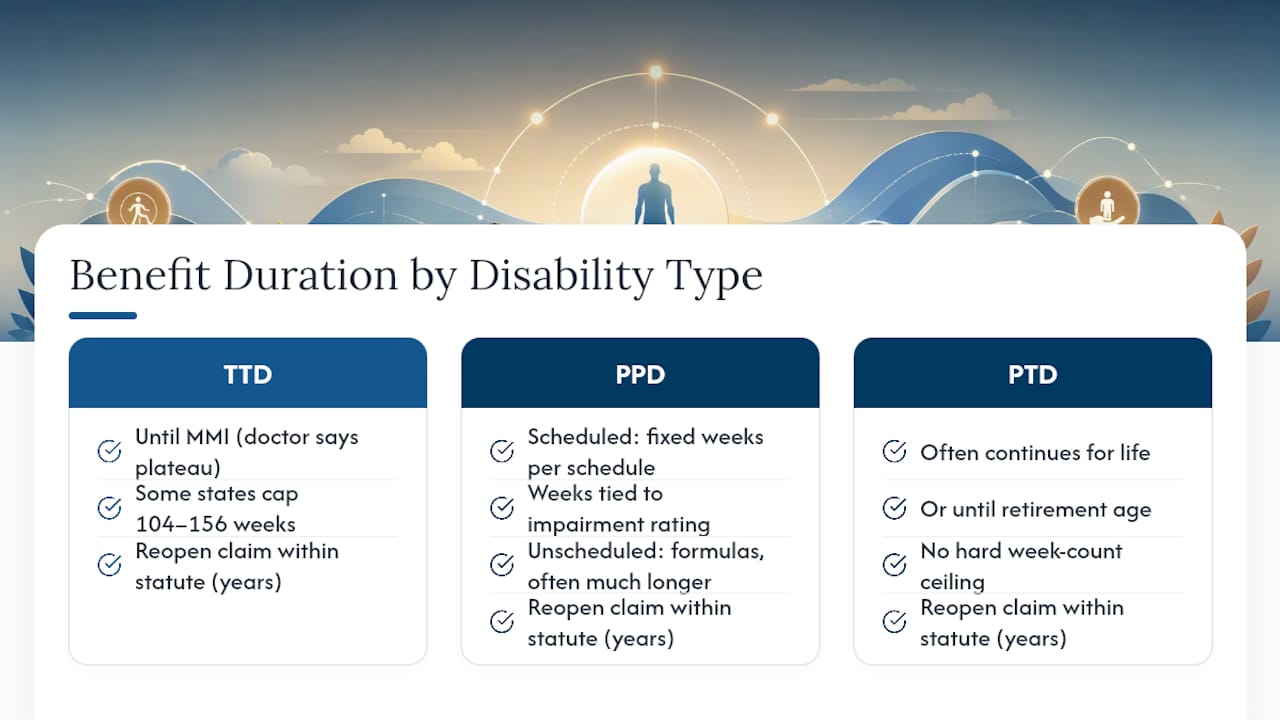
Permanent partial disability benefits get more complicated. If your PPD is based on a scheduled injury (loss of use of a specific body part, like a hand or leg), the state’s schedule dictates a fixed number of weeks tied to the severity of the impairment rating. Unscheduled injuries, affecting the back or the body as a whole, often run on separate formulas that can stretch benefits out over a much longer horizon.
Permanent total disability is the outlier: in many states, PTD benefits continue for life, or until retirement age, without the same hard week-count ceiling that applies to temporary or partial categories.
Extensions do happen. If your condition worsens after benefits were closed out, most states allow you to reopen a claim within a set statute of limitations, often several years from the date of injury or the last payment made. Missing that window is one of the most common, and most avoidable, ways injured workers lose access to benefits they’d otherwise be entitled to.
Why Wage Loss Claims Get Denied
Denials cluster around a handful of recurring issues, and knowing them ahead of time lets you head off most of them before they happen.
The most common reason is a dispute over causation: the insurer argues your injury isn’t work-related, or that it stems from a pre-existing condition rather than the incident you reported. This is especially common with repetitive-motion and cumulative-trauma injuries, where there’s no single dramatic event to point to.
Late reporting is another frequent trigger. Every state sets a deadline for reporting an injury to your employer, often 30 days, and missing it gives the insurer grounds to challenge the entire claim, even if the injury is legitimate.
Insufficient medical documentation sinks more claims than people expect. A work-status note that says “light duty” without specifying exact restrictions (lifting limits, standing time, hours per day) leaves room for the insurer to argue you could have done more than you actually could.
Independent medical exams (IMEs), ordered by the insurer, frequently produce findings that conflict with your treating physician’s opinion. When that happens, the insurer often sides with its own IME doctor unless you push back with additional evidence.
Finally, gaps in treatment or missed appointments get read as evidence you weren’t actually disabled during that stretch, so consistency in your care matters as much as the initial diagnosis.
Appealing a Denied Wage Loss Claim
A denial is not the end of the process. Every state runs a formal appeal system, and injured workers who appeal with solid documentation often see denials reversed or reduced.
The process usually starts with a request for a hearing before a workers’ compensation judge or administrative law judge, depending on the state’s terminology. You’ll want to bring your complete medical file, wage records establishing your AWW, and a written timeline of the injury, treatment, and any communication breakdowns with the insurer.
At the hearing, both sides present evidence. The insurer’s IME findings will likely come up, so it helps to have your treating physician provide a detailed rebuttal, ideally in writing, addressing the specific points where the two medical opinions diverge. Judges weigh treating-physician opinions heavily in most states, particularly when that physician has treated you consistently over time.
If the initial hearing doesn’t go your way, most states allow a further appeal to a workers’ compensation appeals board, and from there, some claims can reach state court. Each level has its own filing deadline, often 20 to 30 days from the prior decision, so missing a deadline at any stage can end your appeal regardless of how strong your case is.
This is the stage where legal representation earns its cost. Workers’ comp attorneys in most states work on contingency, taking a percentage of increased benefits secured rather than an upfront fee, which means the appeal itself typically costs you nothing unless it is successful.
What Settling a Claim Does to Future Benefits
Settling trades your ongoing weekly checks for a lump sum, and that trade is permanent in most cases. Once you sign, you typically waive the right to reopen the claim for additional wage loss benefits related to that injury, even if your condition later worsens.
A full and final settlement closes out both wage loss and, often, future medical treatment tied to the injury, according to guidance on how workers’ comp settlements work. Some states allow you to settle indemnity benefits while leaving medical benefits open, which is worth asking about explicitly, since it changes your risk calculus considerably if you expect ongoing treatment costs.
The math behind a settlement offer should approximate what you’d receive in ongoing weekly benefits over your expected disability duration, discounted for the certainty of a lump sum today versus waiting for checks over months or years. Insurers benefit from closing files, so initial offers frequently undervalue that calculation. Running your numbers through a settlement calculator before you negotiate gives you a benchmark to compare against whatever number lands on the table.
If you’re also on SSDI or approaching Medicare eligibility, a settlement can trigger a Medicare Set-Aside requirement and may affect your SSDI offset calculation, so those interactions deserve attention before you sign anything, not after.
Building the Paper Trail That Wins Your Claim
The strength of a wage loss claim usually comes down to documentation, more than the severity of the injury itself. Insurers and judges alike respond to a clear, consistent paper trail far more than they respond to a compelling story with gaps in it.
Start with the basics: a written injury report filed with your employer on the date of the incident, or as close to it as possible, plus copies of every pay stub for the 52 weeks before your injury to establish your AWW. Keep every work-status note from your treating physician, and make sure each one specifies concrete restrictions rather than vague language.
Track your own treatment timeline independently of what your file shows. Note appointment dates, what was discussed, and any changes to your work restrictions. If you’re pursuing a working or non-working wage loss claim, log your job search activity in detail: employers contacted, positions applied for, and responses received, since several states require this as a condition of continued benefits.
Save every piece of insurer correspondence, especially anything disputing your AWW calculation or your disability status. If a phone call matters, follow up with a confirming email so there’s a written record. This documentation habit costs you almost nothing in the moment and becomes the deciding factor if your claim ever reaches a hearing.
An Injured Worker’s Perspective on Getting Paid Correctly
The biggest mistake injured workers make isn’t misunderstanding their rights; it’s assuming the insurer’s math is automatically correct. It usually isn’t wrong on purpose, but AWW errors, missed overtime, and cap misapplications happen constantly. Get a clear work-status note every visit, run your numbers through a state calculator before any settlement talk, and if a check looks off or stops arriving, contact your state board immediately and keep every document you’ve got.
— Daniel
Get a Real Number Before You Talk to the Insurer
Insurers count on injured workers not knowing what their check should actually be, and that gap is where underpayment happens. The Free Workers’ Comp Calculator closes it: enter your average weekly wage, your state, and your injury type, and you get an estimated weekly TTD or PPD benefit built on 2026 state caps and rate tables, plus a rough settlement range if you’re weighing a lump sum.
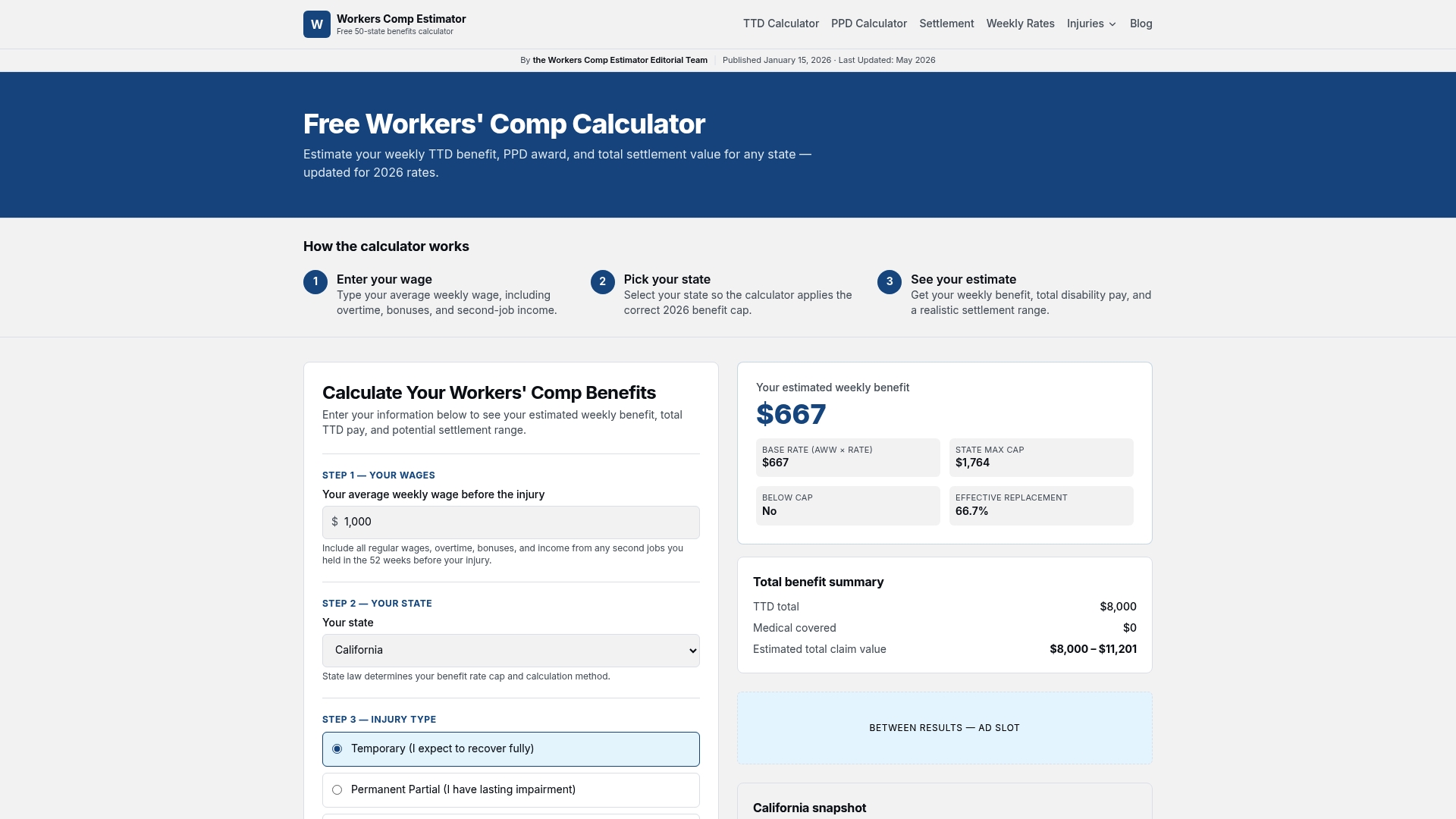
Running your numbers first means you walk into any insurer call, or any settlement conversation, already knowing what your state’s formula should produce. If the number they offer doesn’t match, you’ve got a specific figure to point to instead of a vague feeling that something’s off. Pull your pay stubs for the year before your injury, note any regular overtime, and run the TTD calculator or PPD calculator depending on your disability type. For legal questions specific to your claim, a workers’ comp attorney or your state board is still the right call; the calculator’s job is to make sure you show up to that conversation with real numbers in hand.
This article is general information, not a substitute for advice from a qualified lawyer. Consult a qualified legal professional about your own circumstances before acting on anything here.
Sources
- Workers’ Compensation Lost Wage Benefits (NY WCB)
- Wage-Loss Benefits (U.S. Department of Labor)
- How Is Workers Comp Calculated? A State-by-State Guide (2026) | CalculatorCove
- How work and workers’ compensation affect your Social Security benefits (SSA)
FAQ
How do I get paid for lost wages after a work injury?
File a claim with your employer’s workers’ comp insurer, submit a physician’s work-status note documenting your restrictions, and payments typically begin after a short waiting period, often seven days, once the claim is accepted.
Do you have to pay workers’ comp back if you get a settlement?
No. A settlement is a payment for your claim, not a loan; you don’t repay it, but signing a full and final settlement typically ends your right to future wage loss benefits for that injury.
What is compensation for lost wages called in a workers’ comp claim?
It’s generally called wage loss benefits or income loss compensation, and it typically pays about two-thirds of your average weekly wage, subject to your state’s minimum and maximum caps.
Can I claim compensation for loss of earnings if I’m working reduced hours?
Yes. Under working wage loss rules, most states pay roughly two-thirds of the difference between your pre-injury average weekly wage and what you’re currently earning in a reduced-hours or lower-paying role.
What happens if my average weekly wage was calculated incorrectly?
Request your payroll records and the insurer’s AWW worksheet, then compare them against your actual earnings, including regular overtime, since disputes over included pay components are among the most common wage loss errors.
Recommended
More from the blog
Use the free 50-state estimator that applies 2026 state caps to estimate your workers' comp lump sum. Run your numbers, check SSDI/Medicare impact, and...
Learn how AWW calculations set your workers' comp check, spot common missed pay items, and run a free 50 state estimator showing 2026 caps.
File the correct state claim and collect medical and wage records. Run the free 50 State calculator to see your likely weekly TTD and settlement before...
Free workers' comp calculators
Put the numbers in this article to work on your own claim.
Weekly benefit, PPD, and settlement in one place.
What your weekly temporary disability check should be.
Scheduled weeks and permanent impairment awards.
Light-duty benefit when you earn less while healing.
Federal employee FECA award by body part.
Lump-sum value of your full claim.
Turn a 5%, 10%, or 20% rating into dollars.
Max and min weekly rates for all 50 states.
Typical settlement ranges by injury and state.
Average settlement for fusion, rotator cuff, knee replacement, and more.
Why comp does not pay it, and when a third-party claim does.
When carriers typically make an offer.
What coverage costs by class code and payroll.
Guides, state updates, and claim strategy.