
2026 Caps Cut Your Pay: AWW Calculation and Free 50 State Estimator

Your Average Weekly Wage (AWW) is the gross weekly earnings figure that most states use to set your workers’ comp wage benefits, and it usually determines a payment equal to about 66 2/3% of that number, capped by your state’s maximum. Errors in the AWW calculation affect all subsequent benefit payments and settlement offers. A state-aware calculator can flag a miscalculation in minutes.
TL;DR:
- Most states rely on either a 52-week, 13-week, or hourly method to calculate AWW, significantly affecting weekly benefits depending on the chosen formula.
- Regular wages, overtime, bonuses, tips, and employer-provided benefits typically count toward AWW, while sporadic overtime and second-job income are often overlooked or excluded.
- Errors in AWW calculation can lead to substantial financial loss over time, especially in permanent disability cases where incorrect wages are locked in long-term.
- Using a cap-aware online estimator helps verify if your calculated AWW and benefits are accurate according to your state’s maximum weekly benefit limits.
- Gathering comprehensive pay records and disputing discrepancies early can prevent underpayment and ensure your AWW reflects your true earnings.
Table of Contents
- What Is AWW and Why It Drives Your Entire Claim
- Core Formulas States Use to Calculate AWW
- Which Pay Items Count Toward Your AWW Calculation
- How Special Employment Situations Change the AWW Calculation
- Step-by-Step: How to Calculate Your AWW With a Worked Example
- Checking Your AWW Against the Free 50-State Calculator
- What to Do When Your AWW Looks Wrong
- Why Getting AWW Right Matters More Than People Assume
- Get a Cap-Aware Estimate Before You Talk to the Adjuster
- Where to Verify Your State’s Exact AWW Rules
- Sources
- FAQ
What Is AWW and Why It Drives Your Entire Claim
Average Weekly Wage is the figure insurers use to calculate your Temporary Total Disability (TTD), Temporary Partial Disability, Permanent Partial Disability, and Permanent Total Disability payments. It also informs settlement negotiations, as attorneys and adjusters use it to estimate potential lifetime exposure on a claim.
A small error compounds fast. Shave $50 a week off your true AWW and, over a year of TTD payments, you’ve lost hundreds of dollars, more if the claim runs for years or converts to a permanent award. Every state sets its own exact method, so the state workers’ comp board or agency is always the final word on which formula applies to your claim.
Core Formulas States Use to Calculate AWW
Most states rely on one of three approaches, and which one applies usually depends on how long you’d worked for your employer before the injury.
- 52-week actual earnings method: Add up gross wages from the full year before the injury, then divide by 52.
- 13-week look-back method: Add up gross wages from the 13 weeks before the injury, then divide by 13.
- Hourly conversion method: Multiply your hourly rate by your regularly scheduled hours per week.
New York, for example, bases AWW on gross earnings for the 52 weeks before the injury, collected through an employer’s Form C-240 wage statement. Texas leans on a shorter window, calculating AWW as the average paid over the 13 weeks before injury, and its published examples show how to fold in extra items like the cash value of health insurance premiums.
Here’s how a state typically picks its method:
- Worked a full year or more? Expect the 52-week actual earnings formula.
- Worked less than a year but had steady weeks? Expect the 13-week look-back.
- New hire or irregular hours? Expect an hourly conversion or a substitute formula.
- Seasonal or intermittent work? Expect an annualized or multiplier-based adjustment.
The formula picked can shift your AWW by hundreds of dollars a month, so confirm which one your state actually applies to your work history before accepting an adjuster’s number.
Which Pay Items Count Toward Your AWW Calculation
Insurers calculate AWW off more than your base hourly rate or salary, and this is where a lot of injured workers lose money without realizing it.
Pay that typically counts:
- Gross wages before taxes
- Regularly scheduled overtime
- Recurring bonuses and commissions
- Reported tips
- Shift differentials
- The cash value of employer-provided items like health insurance premiums
Pay that often gets missed or excluded improperly:
- Sporadic, unscheduled overtime
- Income from a second job (concurrent employment)
- Unreported or undercounted tips
- One-time, non-recurring bonuses
Commonly missed items, according to a breakdown of frequent AWW errors, include overtime, tips, bonuses, commissions, and second-job wages. Each state treats these differently, so cross-check your employer’s wage statement against your own pay records rather than assuming the adjuster caught everything.
How Special Employment Situations Change the AWW Calculation
Standard workers don’t always fit the standard formula, and states build in adjustments for exactly that reason.
- New hires: States often substitute the wages of a similar employee in the same job, or shorten the averaging period to match actual tenure.
- Seasonal or part-time workers: Expect annualization or an alternative multiplier so a summer-only lifeguard’s AWW isn’t calculated as if they worked year-round.
- Concurrent employment: Wages from a second job can sometimes be added to your AWW, particularly when both jobs were active at the time of injury.
- Reduced hours or apprentice wages: If your schedule was temporarily cut right before the injury, or you were still on an apprentice pay scale, states typically correct for that distortion rather than locking in the depressed number.
Pro Tip: If you worked two jobs when you got hurt, gather pay stubs from both employers immediately. Concurrent employment wages are one of the highest-yield adjustments an injured worker can document, and adjusters rarely go looking for them on their own.
Step-by-Step: How to Calculate Your AWW With a Worked Example
Checking an insurer’s math takes four steps and a calculator.
- Collect your records. Gather pay stubs, W-2s, the employer’s wage statement, and bank deposit records covering the correct look-back period for your state.
- Total your gross earnings. Add every included pay item across that window, not just base wages.
- Divide by the correct period. Use 52 weeks, 13 weeks, or the hourly conversion, matching whichever formula your state applies to your situation.
- Apply the benefit percentage, then the cap. Multiply AWW by roughly 66 2/3%, then compare that result against your state’s maximum weekly benefit.
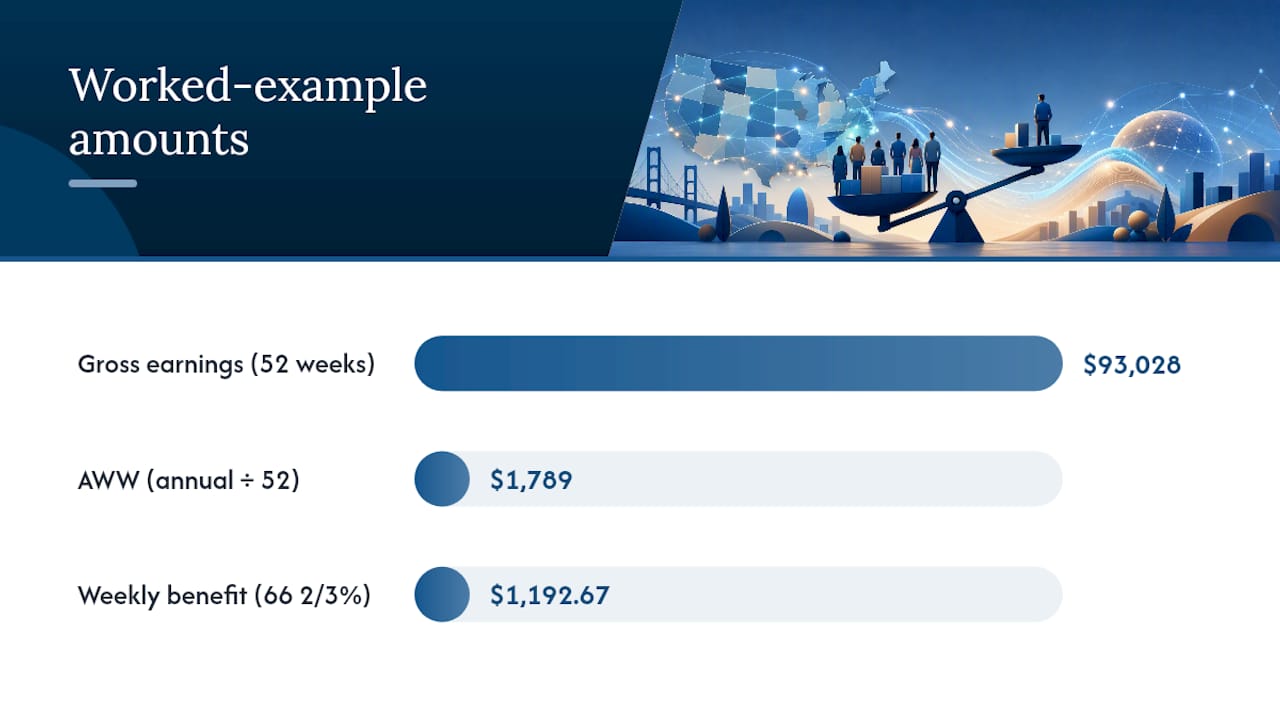
A worked example makes this concrete. Say your gross earnings over the prior 52 weeks totaled $93,028. Divide by 52 and your AWW is $1,789. Multiply by 66 2/3% and your weekly benefit works out to $1,192.67, a number that lands comfortably under most states’ 2026 maximum caps.
Quick stat: Most states set the benefit percentage at about two-thirds of AWW, then apply an annual maximum weekly cap that gets updated on a regular schedule. If your two-thirds figure exceeds the cap, the cap wins, and no amount of extra documented income raises your check past that ceiling.
Checking Your AWW Against the Free 50-State Calculator
Workerscompestimator’s free 50-state estimator takes your average weekly wage, state, and injury type, then returns a cap-aware TTD estimate along with a rough settlement range. Because it’s built around each state’s 2026 maximum weekly benefit, the number you get back reflects the real ceiling on your claim, not just the raw two-thirds math.
The cap differences are significant. For example, Washington, Arizona, and West Virginia each have different maximum weekly benefit caps. A worker with an identical AWW gets a very different check depending on which state’s cap applies.
To use the output in a negotiation:
- Enter your AWW, state, and injury type to generate the estimate.
- Screenshot or save the result showing the cap-aware weekly figure.
- Bring that number into conversations with an adjuster or attorney as a benchmark, not a final offer.
What to Do When Your AWW Looks Wrong
Start by comparing your employer’s wage statement line by line against your own pay stubs and bank records. Look specifically for the items adjusters skip: overtime, bonuses, tips, and any second job that was active when you got hurt.
If you find a gap, put your request in writing. Send the adjuster a corrected calculation with your evidence attached, whether that’s paystubs, a written statement from your second employer, or bank deposits showing tip income. A written record matters more than a phone call, since verbal corrections tend to get lost.
If the adjuster doesn’t budge, your state’s workers’ comp agency has a formal dispute process for exactly this situation, and a workers’ comp attorney can escalate it further when the number matters enough to fight over.
Pro Tip: Keep a simple log of every recurring but easy-to-miss payment, tips, shift differentials, second-job pay, dated and totaled by week. That log becomes your strongest evidence if the AWW calculation ever gets disputed.

Why Getting AWW Right Matters More Than People Assume
Most guides treat AWW as a formality, something the insurer’s software spits out and everyone accepts. That assumption costs injured workers real money. The formula itself is rarely the problem. The problem is that adjusters calculate AWW off whatever wage statement the employer hands them, and employers routinely leave out overtime, tips, and second jobs, not necessarily out of bad faith, but because nobody double checks the math.
The stakes rise fastest in permanent disability cases, where a small AWW error gets locked in and repeated for years. Treatise analysis on AWW disputes makes the same point: the AWW is often the one truly factual input in an otherwise formulaic benefit calculation, which means it’s also the input most worth fighting for when the numbers don’t match your actual paycheck history.
— Daniel
Get a Cap-Aware Estimate Before You Talk to the Adjuster
A certain tool gives you the one number an adjuster’s initial offer usually leaves out: a benefit estimate that already accounts for your state’s 2026 maximum weekly cap, so you know upfront whether you’re being lowballed or actually paid correctly.
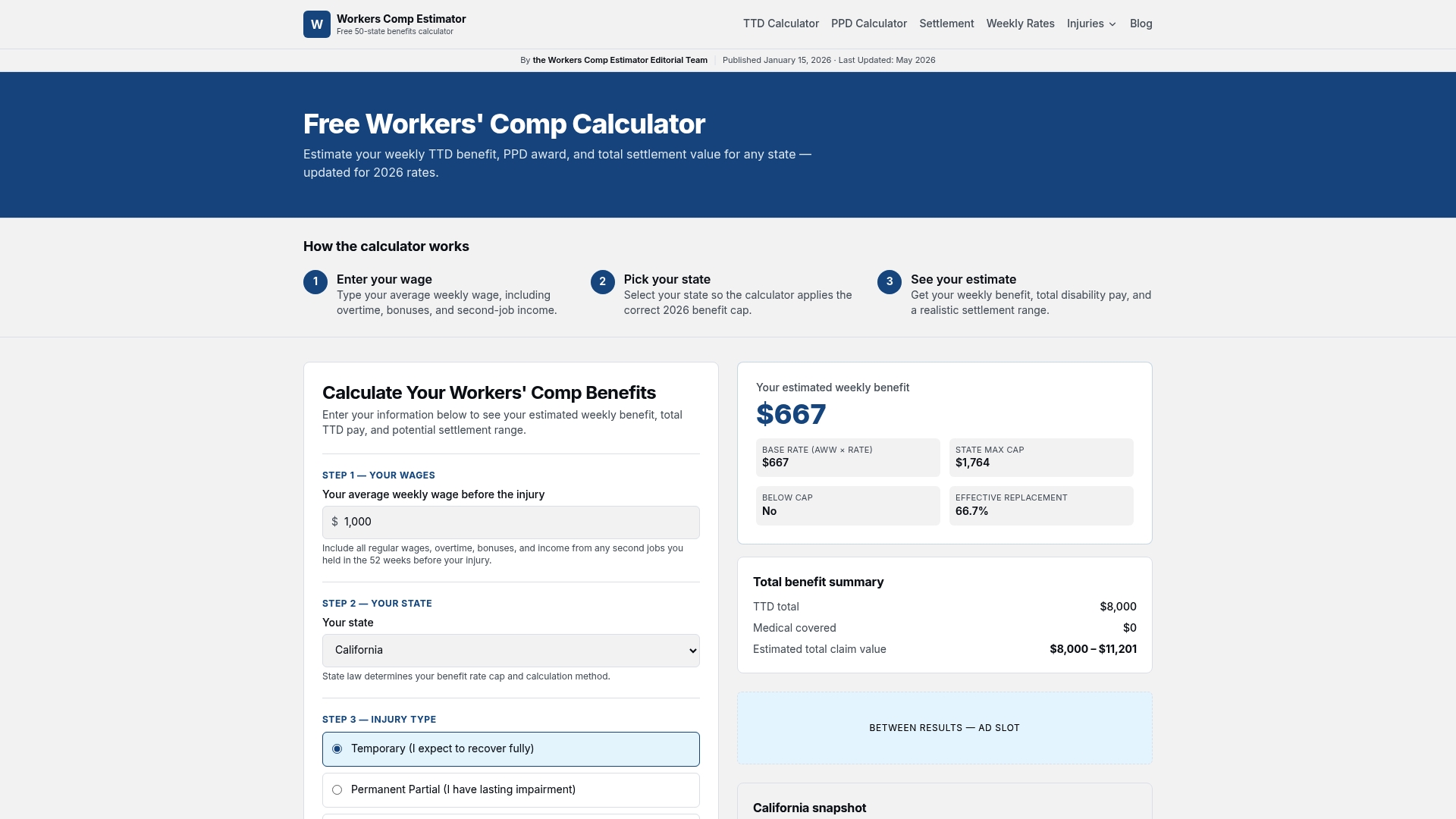
Enter your average weekly wage, your state, and your injury type into the free 50-state estimator, and you’ll get a weekly TTD figure alongside a rough settlement range. If you’re in Texas, the Texas workers’ comp calculator applies the state’s own 13-week formula and current $1,066 weekly cap automatically. Save your result and bring it into your next conversation with an adjuster or attorney as your own benchmark, not theirs.
Where to Verify Your State’s Exact AWW Rules
Confirm your state’s formula directly with its workers’ comp board, such as the New York WCB or Texas Department of Insurance, before relying on any third-party estimate.
This article is general information, not a substitute for advice from a qualified financial advisor. Consult a qualified financial professional about your own circumstances before acting on anything here.
Sources
- Calculating Your Average Weekly Wage — New York WCB
- Workers’ compensation income and medical benefits — Texas Department of Insurance
- How Your Average Weekly Wage Is Calculated (and Why It’s Often Wrong) | Observed
- Treatise: §12.04 Average Weekly Wage: What Counts | Richard
FAQ
What Is the AWW Calculation Used For?
AWW sets the base number for nearly every workers’ comp wage benefit, including TTD, PPD, and PTD payments, as well as settlement negotiations.
What Percentage of AWW Do I Actually Get Paid?
Most states pay roughly 66 2/3% of your AWW, subject to your state’s 2026 maximum weekly benefit cap.
Does Overtime Count Toward My AWW?
Regularly scheduled overtime usually counts, but sporadic or unscheduled overtime is one of the most commonly missed income sources in AWW calculations.
Can I Add a Second Job’s Wages to My AWW?
Many states allow concurrent employment wages to be included if both jobs were active at the time of injury, though the exact rule varies by state.
How Do I Check if My AWW Was Calculated Correctly?
Compare your employer’s wage statement to your own pay stubs and bank records, then run your numbers through a state-specific calculator to see a cap-aware benefit estimate.
Recommended
More from the blog
Use the free 50-state estimator that applies 2026 state caps to estimate your workers' comp lump sum. Run your numbers, check SSDI/Medicare impact, and...
Discover how U.S. workers' comp surveillance works, the legal limits by state, steps to protect benefits. Run a free 50 state 2026 estimate.
See how 2026 state caps, wages, and surgery affect your U.S. hernia workers' comp payout. Run a free 50 state calculator for a realistic estimate.
Free workers' comp calculators
Put the numbers in this article to work on your own claim.
Weekly benefit, PPD, and settlement in one place.
What your weekly temporary disability check should be.
Scheduled weeks and permanent impairment awards.
Light-duty benefit when you earn less while healing.
Federal employee FECA award by body part.
Lump-sum value of your full claim.
Turn a 5%, 10%, or 20% rating into dollars.
Max and min weekly rates for all 50 states.
Typical settlement ranges by injury and state.
Average settlement for fusion, rotator cuff, knee replacement, and more.
Why comp does not pay it, and when a third-party claim does.
When carriers typically make an offer.
What coverage costs by class code and payroll.
Guides, state updates, and claim strategy.