Free 50-State 2026 Caps Calculator for Workers’ Comp Lump Sum

A workers’ comp lump sum, usually called a Compromise & Release, pays you one number today and typically ends your right to future medical treatment and wage benefits on that claim. The trade-off is real cash versus an open file the insurer would otherwise have to keep paying into. It tends to make sense once you’ve hit maximum medical improvement and your future needs are predictable, or when you have an urgent financial reason to close things out now.
TL;DR:
- The settlement amount can vary widely depending on your state’s weekly benefit cap, from around $8,000 in some states to over $18,000 in others, for identical injuries.
- Most states require approval from a judge or workers’ comp board for a lump-sum settlement, and once approved, the agreement is usually final, preventing further claims or reopenings.
- Settling before reaching maximum medical improvement often leads to undervaluing the claim, especially if future medical costs or impairment ratings are uncertain.
- A thorough calculation of your settlement should include unpaid temporary disability, present value of permanent disability, future medical estimates, minus liens and set-asides, tailored to your local regulations.
- Running a personalized estimate using state-specific tools before negotiating can help you determine a fair offer and avoid costly mistakes like accepting a low wage base or rushing settlement before MMI.
Table of Contents
- Lump Sum vs. Structured Settlement: A Quick Comparison
- How Is a Workers Comp Lump Sum Calculated?
- Why Does the Same Offer Work Differently by State?
- How Do You Negotiate a Fair Lump-Sum Settlement?
- Will a Lump Sum Affect My SSDI or Medicare?
- How Do You Estimate Your Own Lump-Sum Offer?
- Author Perspective: What I’ve Seen Go Wrong With Lump Sums
- Try the Free 50-State Workers’ Comp Settlement Calculator
- Where to Verify State Rules and Federal Guidance
- Sources
- FAQ
Lump Sum vs. Structured Settlement: A Quick Comparison
Not every settlement closes the door the same way. Before you sign anything, know which type of agreement is actually on the table.
- Lump sum (Compromise & Release): One payment, case closed, future medical benefits usually end unless you carve out an exception in writing.
- Structured settlement/annuity: Paid out over months or years, which softens the risk of blowing through the money fast but still typically closes medical.
- Stipulation with request for award: Keeps medical benefits open while locking in your disability rating and weekly rate. It’s the closest thing to “settling” without giving up your doctor visits.
Your choice usually hinges on four things: how severe the injury is, how predictable your future treatment looks, your age, and honestly, how disciplined you are with a large check. If your future medical costs are a question mark, a stipulation or structured deal protects you better than cash in hand.
How Is a Workers Comp Lump Sum Calculated?
Every lump-sum offer is built from the same basic ingredients, even when insurers dress up the math differently. Once you know the components, you can check their arithmetic instead of just trusting it.
- Unpaid temporary disability (TTD): any wage-replacement benefits still owed
- Present value of permanent disability (PPD): your impairment rating converted into dollars, discounted to today
- Future medical estimate: what your care would cost if the insurer kept paying, reduced to a present-value figure
- Minus liens and set-asides: Medicare Set-Aside funds, health insurance liens, and unpaid provider bills come off the top
The Average Weekly Wage (AWW) drives the TTD and PPD pieces, and it’s capped by your state’s maximum weekly benefit. In 2026, that ceiling varies enormously. California tops out around $1,764 a week, while Massachusetts runs closer to $1,922. A worker with identical injuries could see wildly different offers depending on which state issued the policy.
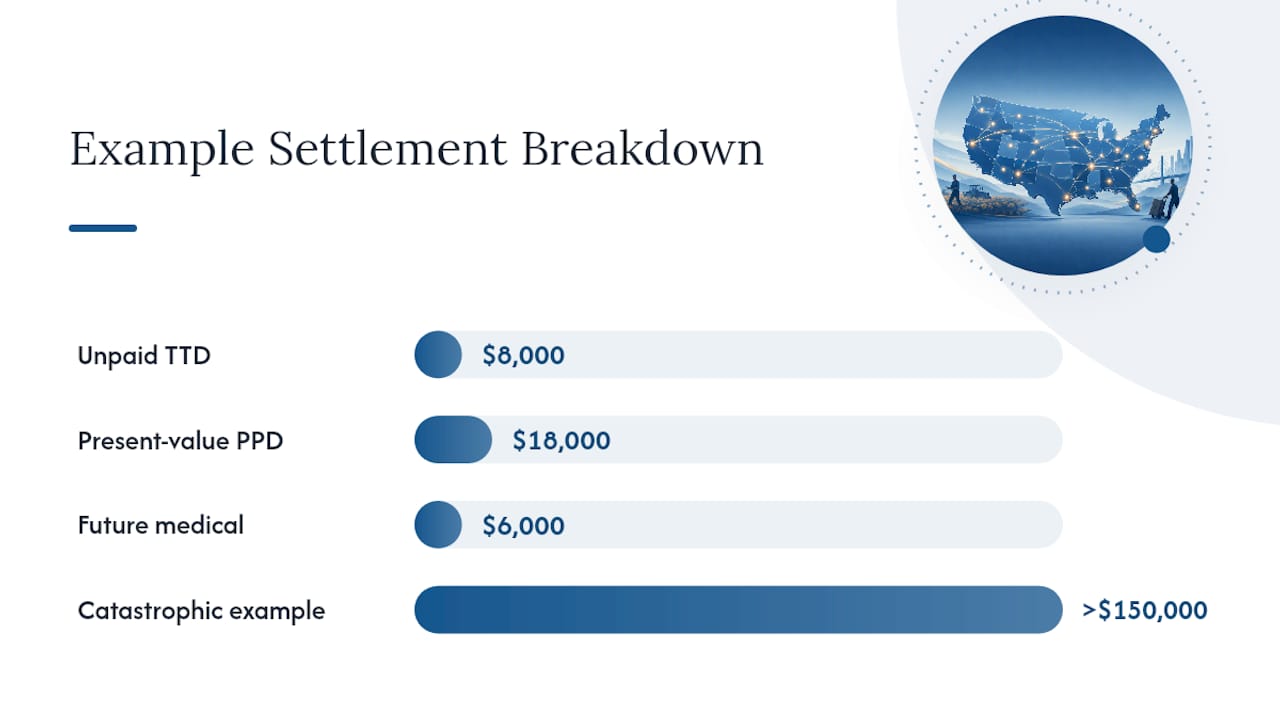
That’s roughly $8,000 (TTD) plus $18,000 (PPD) plus $6,000 (medical), minus any liens, landing somewhere near $32,000 before deductions. Actual settlement ranges swing widely by severity, from a few thousand dollars for a minor sprain to well over $150,000 for catastrophic injuries, so treat any “average” figure with suspicion.
Why Does the Same Offer Work Differently by State?
Two workers with nearly identical injuries and offers can end up in very different positions depending on where they filed. That’s because approval requirements and reopening rules aren’t uniform across the country.
Many states require a workers’ compensation judge or board to review and approve a Compromise & Release before it’s final, and some require the claimant to appear and confirm, on the record, that they understand what they’re giving up. Other states allow more informal sign-off. The 50-state settlement landscape shows meaningful variation in commutation rules, appeal windows, and how hard it is to reopen a case after the fact.
A few things to check with your own state’s workers’ compensation board before you sign anything:
- Whether your state requires judge or board approval for a lump-sum agreement
- What the reopening window looks like, if one exists at all
- Whether your C&R is truly final once approved, which is the norm in most states
That last point matters more than people realize. Once a Compromise & Release gets approved, it’s usually final. If your condition worsens two years later, you generally can’t go back and ask for more, which is exactly why timing and thoroughness matter so much before you agree to anything.
How Do You Negotiate a Fair Lump-Sum Settlement?
Getting a fair number isn’t about being aggressive. It’s about not leaving information on the table that the insurer already knows and isn’t volunteering.
- Wait until MMI whenever possible. Settling before you reach maximum medical improvement is one of the most common ways workers undervalue their own claim, since neither side yet knows the full extent of permanent impairment or future care needs.
- Recalculate your AWW carefully. Overtime, bonuses, tips, and second-job income often get left out of the initial wage calculation, and correcting that omission can meaningfully raise your payout base.
- Get your impairment rating checked twice. Your treating physician’s rating and the insurer’s independent medical exam (IME) can differ sharply. If they conflict, you’re entitled to challenge the lower number.
- Have an attorney review the release language. Skilled legal review correlates with better outcomes, especially in cases involving higher impairment ratings or Medicare Set-Aside instructions buried in the fine print.
Watch for red flags: pressure to sign quickly, vague language about how the money is allocated between medical and disability, or unclear terms about whether you can ever reopen the claim.
Pro Tip: Ask the adjuster to send their settlement calculation in writing before you counter. If they don’t put the number in an email, that alone tells you something about how confident they are in it.
Will a Lump Sum Affect My SSDI or Medicare?
Workers’ comp payments are generally tax-exempt at the federal level, but the settlement can still shrink your monthly Social Security Disability Insurance check. The Social Security Administration applies an offset when combined workers’ comp and SSDI income exceeds a certain percentage of your prior earnings, and it prorates a lump sum over your expected lifetime for that calculation.
The proration method the SSA applies depends heavily on how the settlement agreement itself is worded, meaning the same dollar amount can hit your SSDI check differently depending on whether the release specifies a rate of pay, a lump amount, or an amortization period.
If you’re Medicare-eligible or likely to become eligible, a Medicare Set-Aside is often required to cover future injury-related medical costs, and Medicare can refuse to pay those costs later if the MSA isn’t funded properly. Before you accept anything, get SSA guidance on the offset math and, if Medicare exposure applies, an MSA review specific to your injury.
How Do You Estimate Your Own Lump-Sum Offer?
Running your own numbers before the insurer calls with a figure changes the entire negotiation dynamic. You’re no longer reacting to their math; you’re checking it against yours.
Gather these five things first:
- Your Average Weekly Wage, including overtime and any second job
- Your injury type and treating physician’s impairment rating, if one exists
- The total TTD already paid to date
- Your state of residence
- Any known future medical needs your doctor has flagged
A state-aware settlement calculator applies your state’s 2026 weekly benefit cap automatically, so you’re not comparing your case to a national average that doesn’t apply to your file. That single adjustment, cap versus no cap, can swing an estimate by hundreds of dollars a week depending on where you live.
Pro Tip: Run the numbers twice, once with your treating physician’s impairment rating and once with the insurer’s IME rating, so you can see in dollars exactly what that dispute is worth before you negotiate it.
Once you have a number, bring it to your attorney, ask the insurer to show their own calculation in writing, and weigh a structured payout against a full lump sum if your future care is hard to predict.
Author Perspective: What I’ve Seen Go Wrong With Lump Sums
The two mistakes I see most often are mirror images of each other: workers who accept an offer calculated on a lowball Average Weekly Wage, and workers who settle before MMI because they’re tired of waiting. Both cost real money, and both are avoidable with ten minutes of homework. Run your state’s current caps before you negotiate anything, and get a professional to look at the release language. It’s cheap insurance against an expensive mistake.
— Daniel
Try the Free 50-State Workers’ Comp Settlement Calculator
There are free online calculators covering all 50 states plus DC that incorporate each state’s 2026 weekly benefit caps, so the TTD, PPD, and lump-sum figures reflect your jurisdiction instead of a national average.
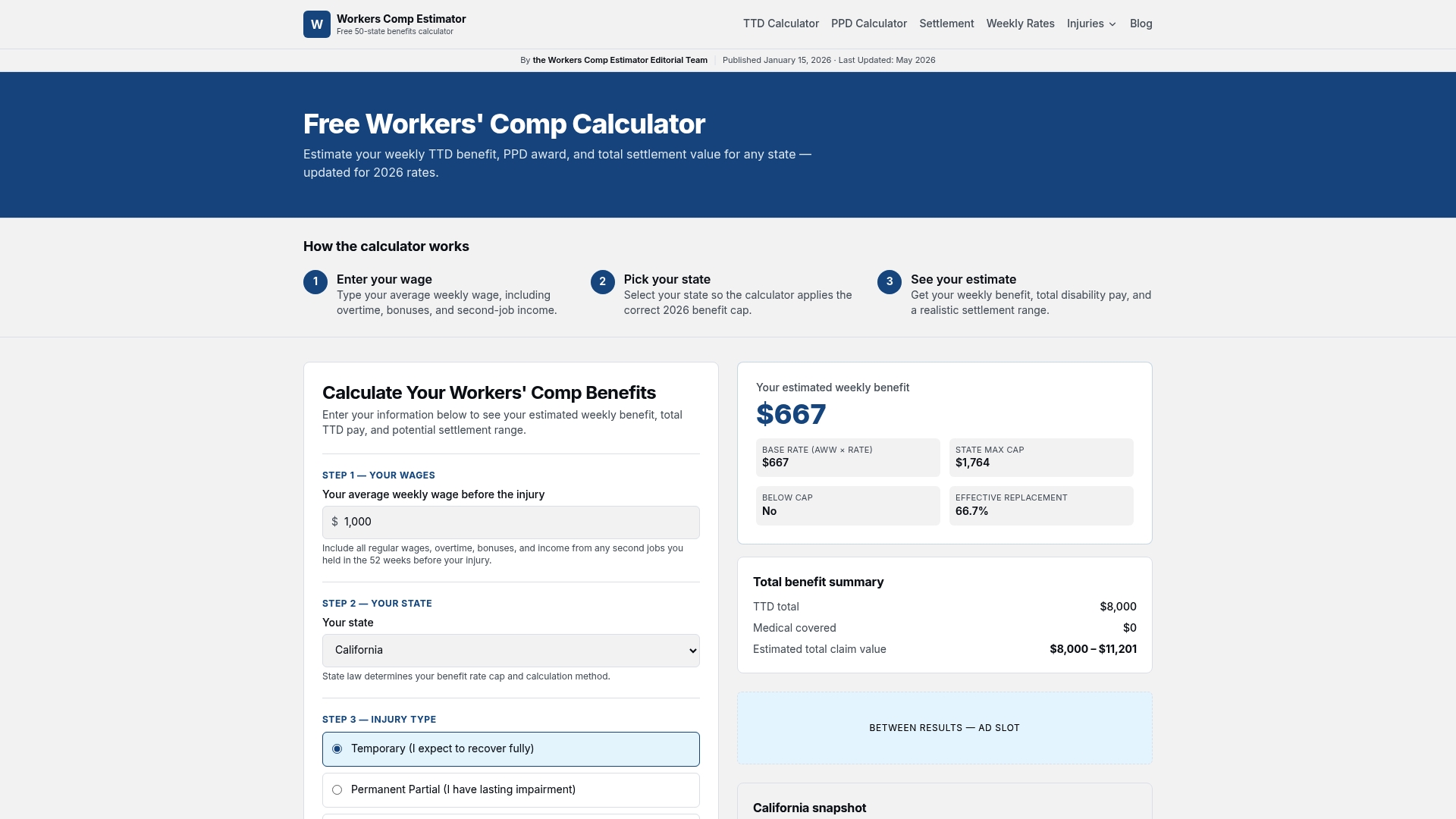
Run your numbers before you respond to any offer. Enter your Average Weekly Wage, injury type, and state, and you’ll get a realistic range you can hand to your attorney or use to question the insurer’s own calculation, including a rough sense of your MSA exposure if Medicare applies to your claim. If you’re in a high-cap state, check the California or Massachusetts calculators for a sense of how much the cap alone can move your number, then head to the settlement calculator to build your full estimate and take it into your next conversation with the insurance company.
Where to Verify State Rules and Federal Guidance
- Your state workers’ compensation board for approval requirements and reopening rules
- The Social Security Administration for SSDI offset and proration guidance
- An attorney familiar with your state’s Compromise & Release process for release language review
This article is general information, not a substitute for advice from a qualified financial advisor. Consult a qualified financial professional about your own circumstances before acting on anything here.
Sources
FAQ
What Does “Workers Comp Lump Sum” Actually Mean?
It’s a single payment, usually structured as a Compromise & Release, that typically settles your unpaid disability benefits and future medical claim in one transaction and closes the case.
Can I Get a Lump Sum and Keep My Medical Benefits Open?
Generally no. A full Compromise & Release closes future medical; if you want to keep medical open, you need a stipulation with request for award instead, which locks your rate but doesn’t close treatment.
Will a Lump-Sum Settlement Reduce My SSDI Payment?
It can. The Social Security Administration prorates the lump sum and applies an offset, and the exact impact depends on how the settlement’s proration language is written.
Is a Workers Comp Lump-Sum Payment Taxable?
Workers’ comp benefits are generally exempt from federal income tax, but the settlement can still indirectly reduce a Social Security Disability Insurance payment through the offset calculation.
How Do I Know if My Offer Is Fair?
Compare it against a state-specific estimate built on your actual Average Weekly Wage and impairment rating, using a tool like Workerscompestimator’s calculator, then have an attorney review the release before signing.
Recommended
More from the blog
Run a state specific 2026 workers' comp settlement calculation. Use the free 50 state calculator to see how state caps change your payout.
Use 2026 U.S. state caps and a free 50‑state calculator to estimate your permanent disability workers' comp pay. Learn P&S/MMI ratings, apportionment, and...
Learn how MMI changes your workers' comp benefits, appeal deadlines, and settlement choices — and run the free 50‑state estimator to estimate your likely...
Free workers' comp calculators
Put the numbers in this article to work on your own claim.
Weekly benefit, PPD, and settlement in one place.
What your weekly temporary disability check should be.
Scheduled weeks and permanent impairment awards.
Lump-sum value of your full claim.
Turn a 5%, 10%, or 20% rating into dollars.
Max and min weekly rates for all 50 states.
Typical settlement ranges by injury and state.
Fusion, rotator cuff, knee replacement, and more.
When carriers typically make an offer.
What coverage costs by class code and payroll.
Guides, state updates, and claim strategy.