
TTD Calculation: How Temporary Total Disability Pay Works

Temporary total disability (TTD) is usually calculated in three steps. First you find your average weekly wage (AWW). Then you multiply it by your state’s percentage, most often two-thirds. Last, you compare the result with your state’s weekly minimum and maximum. If your doctor has taken you off work completely while you recover, that is the number your insurer should be paying. Temporary partial disability (TPD) uses a similar formula, but it is based on the difference between what you earned before and what you earn now.
The steps are simple. The details are where claims go wrong: which wages count, which week the cap applies to, and how many days you wait before the first check. This guide walks through each one with real numbers, so you can check the figure on your insurer’s paperwork.
TL;DR
- TTD is typically 66 2/3% of your average weekly wage, limited by a state minimum and maximum that depend on your injury date. Some states pay differently, and Ohio, for example, starts at 72% for the first 12 weeks.
- Your AWW is the foundation. Most states look at gross, pre-tax earnings over a look-back period, often 52 weeks. Short or irregular work histories use special rules.
- TPD is generally two-thirds of the gap between your old AWW and your new, lower earnings while on restricted duty.
- Waiting periods, caps and duration limits vary by state, so check your state agency’s current rate sheet before you trust any estimate, including ours.
Table of Contents
- The basic TTD formula
- Getting your average weekly wage right
- Waiting periods and when TTD starts
- Temporary partial disability: the calculation
- Why the insurer’s number may differ from yours
- Check the state agency’s figures
- Our perspective
- Run your own numbers
- FAQ
- Sources
The basic TTD formula
Most states follow the same skeleton:
- Calculate AWW. Your gross weekly earnings before taxes, averaged over the period the state specifies.
- Apply the percentage. In Alabama, TTD is 66 2/3% of AWW, subject to the minimum and maximum rates in effect on the date of injury. Utah’s rate is also 66 2/3% of AWW, with a maximum of $1,376.00 per week for the benefit year starting July 1, 2026.
- Check the cap and floor. If the result is above the state maximum, you get the maximum. If it is below the minimum, you may be paid the minimum, depending on state rules.
Not every state uses two-thirds. Ohio’s Bureau of Workers’ Compensation policy pays 72% of the full weekly wage during the first 12 weeks, then 66 2/3% of AWW. Texas calls its temporary benefit “temporary income benefits” and uses 70% of the difference between your average weekly wage and what you can earn after the injury, or 75% if you earned less than $10 an hour. When you are completely off work, that difference is your whole wage.
A worked example
Say your AWW is $900 and your state pays two-thirds.
- $900 × 0.6667 = $600 per week
- If the state maximum is $1,046, as in Alabama’s 2026 calculator, you are under the cap, so $600 is what you get.
Now say your AWW is $2,400.
- $2,400 × 0.6667 = $1,600
- Against a $1,046 cap, you receive $1,046, not $1,600.
That second case surprises higher earners. The cap, not the percentage, decides the check, and it is why two workers with very different salaries can receive the same TTD amount.
In a state with a 72% opening period such as Ohio, the same $900 wage would be $648 for the first 12 weeks, then $600 afterward, again subject to the state’s maximum. That is an illustration of the percentages, not a quote of an actual Ohio award.

Getting your average weekly wage right
AWW is the number most often wrong on an insurer’s first calculation, and every other figure flows from it. A small error here repeats in every weekly check.
What the look-back period usually is
The Illinois Workers’ Compensation Commission explains that AWW is generally based on gross, pre-tax wages during the 52 weeks before the injury. It also notes that multiple jobs, a short employment history or casual work can change the calculation. Other states use different windows, so confirm yours.
Short or irregular work histories
If you had only a few weeks on the job, or your hours moved around, the simple formula breaks down. States handle it in different ways:
- Minnesota uses the prior 26 weeks of wages, days actually worked and average days worked per week for irregular or part-time employees, and weeks not worked are excluded. The same agency cautions that simply adding 26 weeks of pay and dividing by 26 is often inappropriate because it ignores your status on the date of injury.
- Vermont tells adjusters that for workers employed less than four weeks, they must obtain the wages of a comparable employee in the same position at the same rate of pay. The department also says the purpose is to reflect what you were actually earning when you were hurt.
- Virginia guidelines say that if you worked less than 12 months, actual earnings should be used, or the wages of a similar employee if you worked less than 60 days.
- California has several statutory methods. Labor Code Section 4453 includes a catch-all for cases where the standard methods cannot fairly be applied, which calls for an assessment of the worker’s actual earning capacity.
The takeaway: if you started a job nine days ago, do not expect “52 weeks of earnings” to be the method. Ask the adjuster in writing which method they used and why.
Second jobs and other income
If you worked for more than one employer, the extra income may count. In California, concurrent earnings from multiple employers are considered in AWW, though earnings from other jobs cannot be taken at a higher rate than the hourly rate at the job where you were hurt. Rules differ elsewhere. Our guide on concurrent employment and weekly pay shows how a second job can change the figure.
Also gather overtime, shift differentials, bonuses and tips where your state counts them. Insurers often start from base hourly pay and leave these out.
Waiting periods and when TTD starts
Most states make you wait a few days before wage-loss benefits start, then pay the waiting days back if you are out long enough. Alabama is a clear example: a three-day waiting period applies, and if disability lasts 21 days, the first three days are added to the first payment. Other states use longer waits and different payback thresholds. We cover the pattern in our guide to workers’ comp waiting periods and retro pay.

Timing of the first check also depends on paperwork. The Illinois commission suggests that you can speed things up by sending a written demand for TTD benefits along with supporting medical documentation. Keep a copy of everything you send, and keep your off-work notes from your treating doctor current. TTD generally depends on a medical restriction that you cannot work at all.
Temporary partial disability: the calculation
TPD applies when you are back at work, but on light duty or reduced hours, and you earn less than before. The formula is the same style as TTD, applied to a gap.
The Illinois handbook describes TPD as generally a percentage, often 66 2/3%, of the difference between your pre-injury average weekly wage and your lower post-injury earnings while you work with restrictions. Alabama pays TPD at 66 2/3% of the difference between pre-injury and restricted earnings when you return to light-duty or part-time work.
TPD worked example
- Pre-injury AWW: $900
- Current weekly earnings on restricted duty: $500
- Difference: $400
- Two-thirds of $400 = $266.67 per week
Your $500 paycheck plus $266.67 in TPD brings you to $766.67, which is more than the $500 alone but less than your old $900. TPD is designed to cover part of the gap, not all of it.
Two things differ by state. Waiting periods: in Utah, the three-day waiting period does not apply to TPD when a worker returns to light duty at a lower wage. Duration: North Carolina caps TPD at a maximum of 500 weeks, not counting weeks of TTD already paid. Our TPD calculator runs these numbers, and the TTD vs. TPD comparison explains when you move from one to the other.
Why the insurer’s number may differ from yours
When your calculation and the insurer’s do not match, the cause is usually one of these:
- Different AWW method. California, for example, uses statutory methods and sometimes a case-specific earning-capacity assessment, which can produce a different wage than simple past-earnings math.
- Left-out income. Overtime, second jobs, tips or bonuses not counted.
- Wrong cap year. Maximums depend on the injury date. A cap from the wrong year gives the wrong ceiling.
- Wrong percentage. Ohio’s early 72% period is easy to miss.
- Waiting-period handling. The first days may not have been repaid when they should have been.
Line up your pay stubs for the look-back window, then ask the insurer for its wage worksheet. Compare it line by line.
Check the state agency’s figures
Your state workers’ compensation agency publishes the authoritative rates. Florida’s Division of Workers’ Compensation, for instance, has an official TTD benefit calculator that shows the AWW calculation, the 2026 maximum rate and the TTD limit, and points to the Bureau of Employee Assistance and the Ombudsman Office for questions. Most states have a similar rate sheet or employee-assistance line.
When you review any calculation, check these five things against the agency’s current page:
- The injury date and the rate table for that date
- The percentage your state pays
- The weekly maximum and minimum
- The waiting period and the retro threshold
- The maximum number of weeks or the cap on total TTD
Our weekly benefit rates table for all 50 states and DC puts the 2026 figures side by side for a quick comparison.
Our perspective
We built our calculators around one belief: the number most workers see first is the insurer’s, and few have anything to compare it with. A wrong AWW is not dramatic. It is a few dollars a week, every week, for months. That is why we focus on the inputs more than the formula. Include every income source, use the cap for your injury year, and know which waiting period your state applies.
We also think an estimate should be honest about its limits. A calculator can show you what the formula says. It cannot see your medical file, your employer’s payroll records or a disputed claim. Treat the result as a reference point for questions to the adjuster, and for a conversation with a workers’ comp attorney if the gap is large or your benefits are denied or stopped.
— Daniel
Run your own numbers
Enter your average weekly wage, state and situation into our free TTD calculator to see your estimated weekly benefit against your state’s 2026 cap. If you are working light duty, use the TPD calculator. Our state tools, such as the California calculator and the Texas calculator, apply state-specific limits.
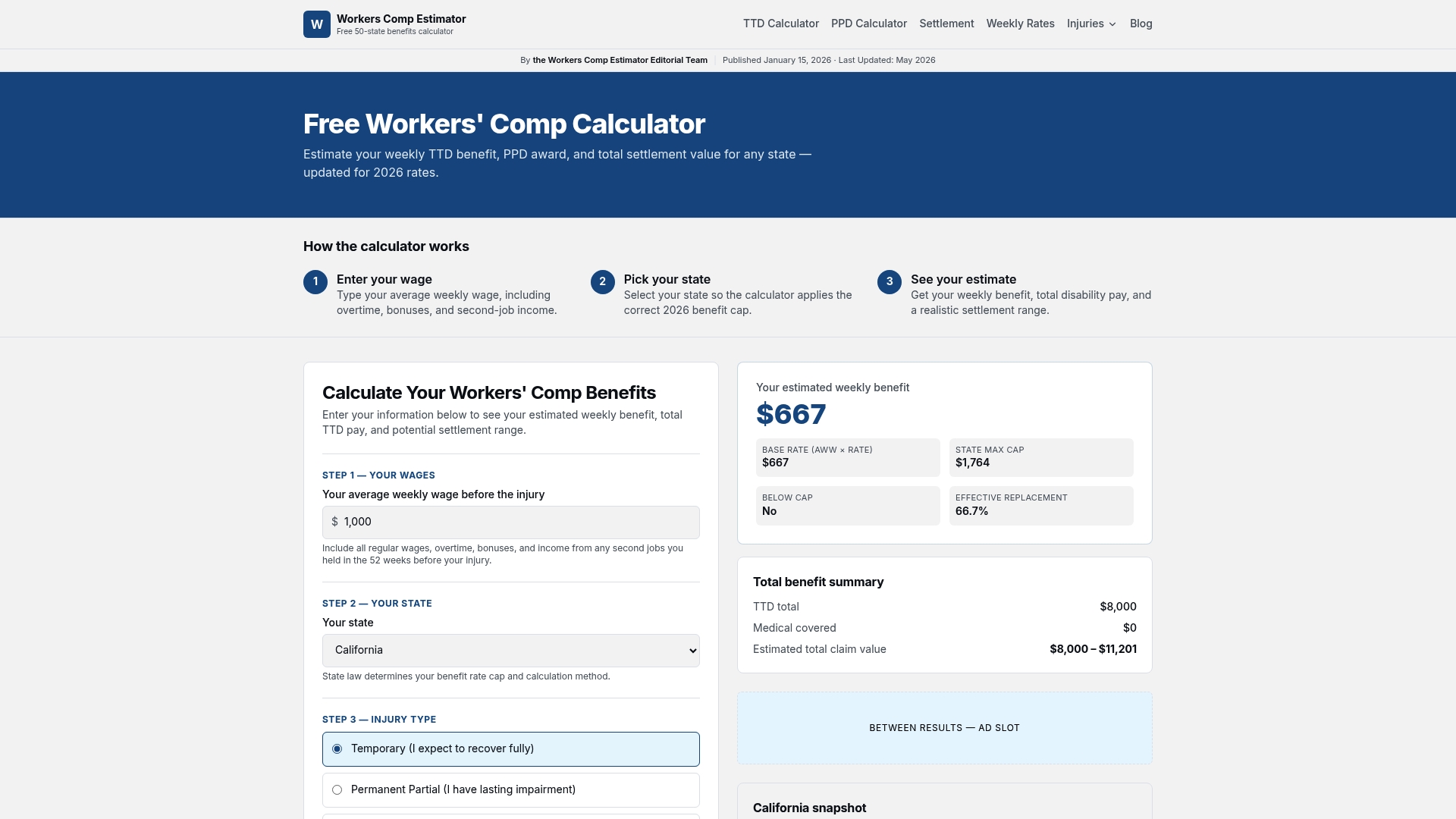
The tools are free for injured workers. Use the result to check your paperwork, and confirm it with your state agency’s current rate sheet.
FAQ
Is TTD calculated on gross or net pay?
Gross. The Illinois commission describes AWW as based on gross, pre-tax wages, and your state’s formula is then applied to that figure. The benefit itself is a separate amount, so ask your state agency how it is treated for tax purposes.
How long do TTD benefits last?
It depends on the state. Some states set a maximum number of weeks or a dollar limit, and others pay while you remain medically unable to work. Check your agency’s rate sheet for the limit that applies to your injury date.
What if I worked at the job for only a few weeks?
States use alternative methods. Vermont uses a comparable employee’s wages for workers employed less than four weeks, and Virginia uses actual earnings or a similar employee’s wages in short-tenure cases. Ask your adjuster which method was used and request the worksheet.
Is TPD the same as partial disability from a permanent impairment?
No. TPD is temporary and tied to reduced earnings while you recover on restricted duty. Permanent impairment benefits are a separate category, paid after you reach maximum medical improvement under your state’s rules.
Do I need a lawyer to check my TTD amount?
Not to run the math. You can compare your pay stubs, your state’s rate and the insurer’s worksheet yourself. If your benefits are underpaid, delayed, denied or cut off, a workers’ comp attorney in your state can review the claim.
Sources
- Alabama Basic Claim Handling Manual
- Ohio BWC Temporary Total Compensation Policy
- Utah Quick Reference Guide to Workers’ Compensation Benefits
- Minnesota DLI average weekly wage guidance
- Illinois Workers’ Compensation Commission handbook
- Vermont indemnity benefits adjusters manual
- Virginia Claims Services Quick Reference Guide
- California average weekly wage calculation guide
- North Carolina return to work and indemnity benefits job aid
- Florida DFS TTD benefit calculator
- Nolo: workers’ comp benefits in Texas
Recommended
More from the blog
Understand U.S. workers comp waiting periods (typically 3–7 days). See state examples, learn how to protect and claim retro pay, and use a free 50 state...
Use 2026 U.S. state caps and a free 50‑state calculator to estimate your permanent disability workers' comp pay. Learn P&S/MMI ratings, apportionment, and...
Learn how PPD is calculated in workers' comp: impairment rating times weeks times weekly rate, with worked examples, state differences and a check on offers.
Free workers' comp calculators
Put the numbers in this article to work on your own claim.
Weekly benefit, PPD, and settlement in one place.
What your weekly temporary disability check should be.
Scheduled weeks and permanent impairment awards.
Light-duty benefit when you earn less while healing.
Federal employee FECA award by body part.
Lump-sum value of your full claim.
Turn a 5%, 10%, or 20% rating into dollars.
Travel reimbursement for medical appointments.
Max and min weekly rates for all 50 states.
Typical settlement ranges by injury and state.
Average settlement for fusion, rotator cuff, knee replacement, and more.
Why comp does not pay it, and when a third-party claim does.
When carriers typically make an offer.
What coverage costs by class code and payroll.
Guides, state updates, and claim strategy.