
U.S. TTD vs TPD: Calculate Your Pay With a Free 50 State Calculator

If your doctor takes you fully off work because of a job injury, you generally qualify for Temporary Total Disability (TTD). If you can return on medical restrictions and earn less than before, you generally qualify for Temporary Partial Disability (TPD) instead. Both are wage-replacement benefits, separate from your medical care, and both depend on your treating physician’s written restrictions and your state’s official rate table.
TL;DR:
- Temporary total disability benefits pay a portion of your pre-injury wages when you cannot work at all, often starting after a waiting period of a few days.
- If you are cleared for restricted work earning less than your usual wages, your benefits switch to temporary partial disability, which covers approximately two-thirds of the wage difference.
- Calculations for benefits depend on your state’s caps, timing rules, and whether your injured wages are based on overtime or regular pay, requiring each claim’s specifics to be verified.
- Disputes often center on whether light-duty work offers are genuinely suitable, with documentation being crucial for avoiding benefit suspension or rejection.
- Benefits end once maximum medical improvement is reached, at which point a permanent disability rating is determined for any long-term impairments.
Table of Contents
- TTD vs TPD: What Temporary Total Disability Means
- TTD vs TPD: What Temporary Partial Disability Covers
- How TTD and TPD Payments Are Actually Calculated
- What You Need to Qualify and Keep Getting Paid
- When Light-Duty Offers and IMEs Create Disputes
- Why TTD and TPD Rules Vary by State
- When Temporary Benefits End and Permanent Disability Begins
- How to Estimate Your TTD or TPD Payment Before Calling Your Attorney
- Appealing a Denied or Disputed TTD or TPD Claim
- Moving From TTD to TPD as You Recover
- Return-to-Work Programs and Vocational Rehabilitation
- A Few Mistakes That Cost Injured Workers Money
- Get a State-Accurate Estimate Before You Negotiate
- Sources
- FAQ
TTD vs TPD: What Temporary Total Disability Means
TTD applies when your treating physician states you cannot do any work during recovery. Not light duty, not part-time. Zero work capacity, at least for now.
The math is usually simple: TTD pays a share of your average weekly wage (AWW), typically a portion of it, subject to your state’s minimum and maximum caps. Most states apply a short waiting period, often a few days, before checks start. Some states pay retroactively after a specific absence duration.
Common situations that trigger TTD include:
- A broken bone requiring surgery and a cast, with no capacity for even desk work
- A herniated disc where the doctor orders complete bed rest or restricted movement
- Post-surgical recovery from a torn rotator cuff or ACL repair
- A concussion with restrictions against any cognitive or physical exertion
TTD applies when you genuinely cannot work in any capacity during recovery.
TTD vs TPD: What Temporary Partial Disability Covers
TPD applies when your doctor releases you to work, but with restrictions that reduce what you can do and what you earn. You’re not on the sidelines. You’re back on the job, just in a diminished capacity, and the benefit fills the gap between your old paycheck and your new one.
The formula insurers use most often:
- Take your average weekly wage before the injury.
- Subtract your current gross earnings under light duty.
- Multiply that wage gap by two-thirds (the replacement rate most states use).
- Compare the result against your state’s weekly cap, since the final number can be reduced if it exceeds your state’s maximum.
Real-world light-duty scenarios that generate TPD claims include a warehouse worker moved to a seated inspection role at lower pay, a nurse restricted from lifting patients and reassigned to charting duties, or a construction worker limited to four-hour shifts instead of eight. In every case, the worker is earning something, just less than before. That’s the line that separates TPD from TTD: partial income versus none at all.
How TTD and TPD Payments Are Actually Calculated
The formulas look almost identical on paper, but the outcomes diverge fast once you plug in real numbers.
- TTD formula: Average Weekly Wage × two-thirds (roughly 66.67%), capped at your state’s maximum.
- TPD formula: (Average Weekly Wage minus current light-duty earnings) × two-thirds, also capped.
Worked example: Say your AWW before the injury was $900. If you’re totally off work, TTD would pay a portion of your average weekly wage, before checking it against your state’s cap. Now say your doctor releases you to light duty at $500 a week. The wage gap is $400 ($900 minus $500), and the replacement rate applied to that gap yields your TPD payment. Notice the difference: the same worker, same wage history, gets $600 under TTD but only $267 under TPD, because TPD only replaces the lost portion of income, not the whole check.
A quick note on caps: if your state’s maximum weekly TTD rate is, say, $550, that $600 theoretical payment gets trimmed to $550 regardless of the formula. Caps change every year, so run your own numbers against the 2026 weekly benefit rate table for all 50 states rather than trusting last year’s figure.
One more thing worth knowing: both TTD and TPD are generally non-taxable wage-replacement benefits, unlike your regular paycheck. That’s one advantage temporary disability has over ordinary income, even though the weekly amount is lower than your full wage.
What You Need to Qualify and Keep Getting Paid
Eligibility for either benefit comes down to paperwork, and the paperwork comes down to your treating physician. Their written restrictions, whether “no work at all” or “light duty, no lifting over 10 pounds,” are what the insurer uses to decide which benefit you get and how much.
Your employer also has to produce a wage statement, usually pulling from a look-back period of the prior 52 weeks, which is how your AWW gets calculated in the first place. Tennessee’s state labor department explicitly notes that AWW calculations include overtime pay, which many injured workers don’t realize until they see their first check come in lower than expected.
Watch for these common timing snags:
- Waiting periods before the first check (often three to seven days, state-dependent)
- Back-pay rules that kick in retroactively once you’re out a certain number of days
- Delays caused by missing wage statements or unsigned medical forms
Pro Tip: Get every light-duty job offer in writing, keep copies of every pay stub after your injury, and request your medical records the same week you’re released to restricted duty. Insurers move slower than injuries heal, and paper trails move faster than phone calls.
When Light-Duty Offers and IMEs Create Disputes
The most common fight in a TTD/TPD claim isn’t about the formula. It’s about whether the job offer was actually suitable.
- Refusing light duty can backfire. Many state statutes, including Iowa’s workers’ compensation code, allow benefits to be suspended if a worker turns down a genuinely suitable light-duty offer without a valid, written reason. The key word is “genuinely.” If the offer violates your doctor’s restrictions, it isn’t suitable, and you have grounds to refuse it in writing.
- An independent medical exam (IME) can override your own doctor. Insurers sometimes send injured workers to a second physician who disagrees with the treating doctor’s restrictions. If that happens, ask your own doctor to respond in writing and address the discrepancy directly.
- Document everything. Save the written job offer, your written refusal reason if you decline it, and any correspondence about the IME. If the dispute doesn’t resolve informally, contact your state workers’ comp board or a workers’ comp attorney before benefits lapse.
Why TTD and TPD Rules Vary by State
The core formulas (two-thirds of AWW, two-thirds of the wage gap) are common across most states, but nearly everything else about the dollar amount is state-specific.
Here’s what changes state to state:
- Weekly maximum and minimum caps, which can swing by hundreds of dollars between states
- Waiting periods before the first check arrives
- Total duration limits on how long TTD or TPD can be paid
- Terminology, since some states use different names for the same benefit categories
Because rates get revised annually, the number you calculated last year, or even six months ago, may already be outdated. Always cross-check your math against your own state’s official agency page and current rate table before you rely on a figure in a negotiation.
When Temporary Benefits End and Permanent Disability Begins
Temporary benefits stop once you reach maximum medical improvement (MMI), the point where your doctor determines your condition has stabilized and further treatment won’t significantly improve it. MMI doesn’t mean you’re fully healed. It means you’ve plateaued.
At that point, the claim usually shifts from temporary disability (TTD or TPD) to a permanent rating: either permanent partial disability (PPD) if you have lasting limitations, or permanent total disability (PTD) in the rarer cases of complete, lasting incapacity. Reaching MMI typically triggers an impairment rating exam, which becomes the basis for a settlement offer or a scheduled award calculation.
How to Estimate Your TTD or TPD Payment Before Calling Your Attorney
Running the numbers yourself before a claims call puts you in a stronger negotiating position, and it takes about two minutes with the right inputs.
A state-accurate TTD calculator needs four things from you:
- Your state, since caps and waiting periods differ everywhere
- Your average weekly wage, pulled from pay stubs or your employer’s wage statement
- Current light-duty earnings, if you’re working restricted hours (this only applies to TPD)
- Injury type, since some calculators refine estimates using injury-specific data, like the back injury settlement calculator
The calculator applies your state’s 2026 caps and replacement rate automatically, so you get a realistic weekly number instead of a raw formula that ignores the ceiling. Once you have an estimate, verify it against your treating physician’s actual restrictions and your employer’s wage statement. A calculator gives you a starting point, not a legal determination.
Appealing a Denied or Disputed TTD or TPD Claim
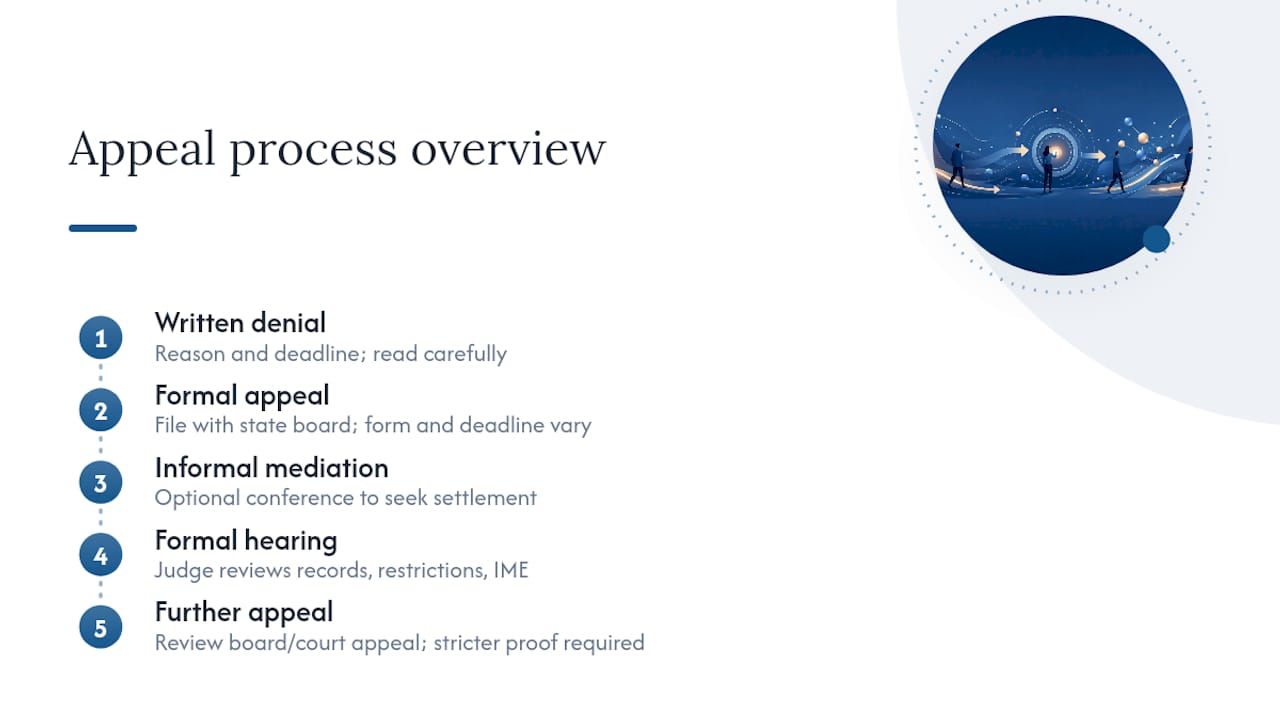
Getting denied doesn’t mean the claim is over. It means you’re entering the dispute resolution phase, and most states follow a similar sequence.
First, you’ll typically receive a written denial from the insurer explaining the reason. Common reasons include a dispute over whether the injury is work-related, disagreement about your degree of disability, or a claim that light-duty work was available and suitable when you declined it. Read this notice carefully. It usually contains a deadline for filing an appeal, and missing that window can cost you the right to contest the decision at all.
Next comes the formal appeal, filed with your state’s workers’ compensation board or industrial commission. Most states require a specific form and give you a window ranging from a few weeks to a year, depending on the state, so check your state agency’s page immediately rather than waiting.
Many states offer an informal conference or mediation before a hearing to try to resolve disputes without a judge. If that fails, the case moves to a formal hearing, sometimes called an arbitration or a workers’ comp trial, depending on your state’s terminology. A workers’ comp judge or hearing officer reviews medical records, the treating physician’s restrictions, and any IME findings before issuing a decision.
If you disagree with the decision, most states allow an appeal to a review board or court, with increasing proof requirements at each level. Throughout this process, medical documentation is your strongest asset. A claim built on a treating physician’s clear, consistent, written restrictions holds up far better than one relying on verbal assurances or gaps in the medical record.
Moving From TTD to TPD as You Recover
Most workers’ comp claims aren’t purely TTD or purely TPD. They’re both, in sequence, as your condition improves.
The typical path looks like this: you’re hurt, your doctor takes you off work entirely, and you draw TTD while your immediate injury stabilizes. Weeks or months later, your doctor clears you for restricted duty, maybe reduced hours, lighter tasks, or no lifting over a set weight, and your claim automatically shifts to TPD the moment you start earning reduced wages under those restrictions. The insurer doesn’t get to choose which benefit applies. Your physician’s restrictions and your actual earnings determine it.

This transition point is where claims most often go sideways. If your employer doesn’t have suitable light-duty work available, you may stay on TTD even after being medically released to restricted duty, since TPD only applies once you’re actually working and actually earning less. If your employer does offer suitable work and you decline it, you risk losing benefits altogether, which is why the “suitable work” question from the light-duty disputes section above matters so much here.
It’s also possible to bounce backward. If light-duty work aggravates your injury and your doctor pulls you off work again, your claim reverts from TPD back to TTD. This isn’t unusual, and it isn’t a sign your claim is being mishandled. It’s simply how the system tracks your actual, current capacity to earn a wage, which can change multiple times over the life of a single injury claim. Keep records at every stage, since insurers sometimes lag in updating payments when your status changes.
Return-to-Work Programs and Vocational Rehabilitation
TTD and TPD status directly shapes whether you enter a formal return-to-work program, and how aggressively your employer pursues it.
While you’re on TTD, most employers can’t put you in a return-to-work program at all, since by definition you have no work capacity. The moment your doctor authorizes any restricted duty, though, employers and insurers have a financial incentive to get you into a light-duty role fast, because TPD payments cost the insurer less than full TTD checks. That incentive cuts both ways: it can genuinely help you stay connected to your job and income, or it can push you toward accepting work that doesn’t truly fit your restrictions.
If no suitable light-duty position exists at your employer, some states offer vocational rehabilitation, retraining for a different role or employer entirely, particularly when your restrictions are permanent enough that you can’t return to your prior occupation. Vocational rehab benefits and eligibility rules vary significantly by state, and they typically only become relevant once your case is trending toward a permanent disability rating rather than a temporary one.
The practical takeaway: engaging honestly with a legitimate return-to-work offer usually protects your benefits and your job. Resisting a genuinely suitable offer risks both, per the same light-duty statutes discussed earlier. The distinction always comes back to whether the offer actually respects your doctor’s written restrictions, not just what your employer calls “light duty” on paper.
A Few Mistakes That Cost Injured Workers Money
The costliest mistakes aren’t legal ones. They’re logistical: no written record of a light-duty offer, no running log of reduced wages, and waiting weeks to request medical records that later become the backbone of a dispute.
In the first 72 hours after an injury, do three things: report the injury in writing, get the first medical evaluation on record, and start a simple log of every job offer, wage stub, and doctor’s note that follows.
— Daniel
Get a State-Accurate Estimate Before You Negotiate
Some online calculators provide estimates of what two-thirds of your wage actually comes out to after your state’s cap trims it down, helping you prepare for a claims call.
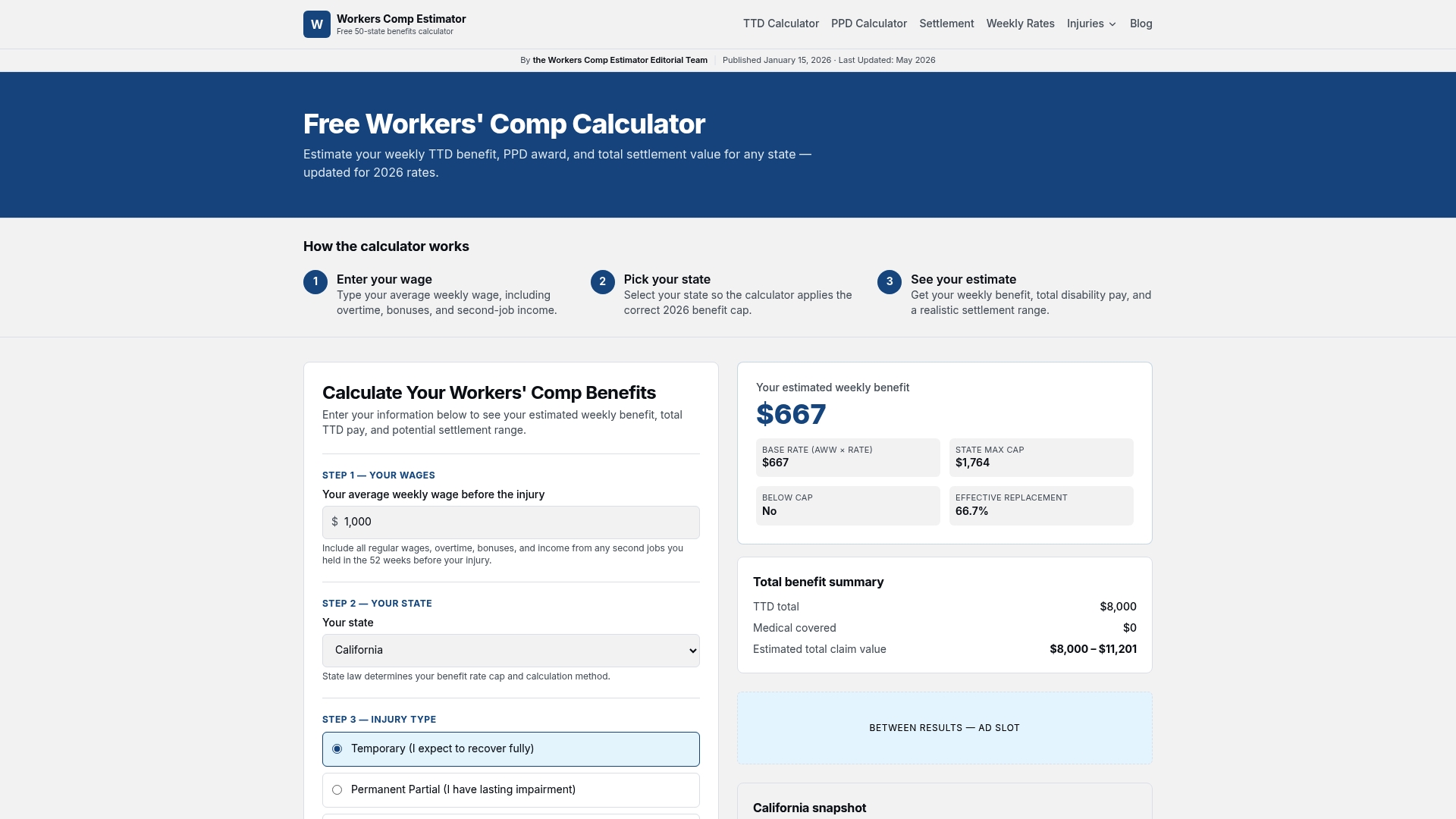
The free 50-state calculator applies 2026 caps automatically, so the weekly figure you see already reflects your state’s maximum rather than a raw textbook formula. Run your numbers before your next call with the adjuster or your attorney, using your actual average weekly wage and, if you’re on light duty, your current reduced earnings. If your injury falls into a specific category, the TTD calculator walks through injury-specific inputs so the estimate reflects your situation rather than a generic average. Pull your numbers, print them, and bring them to your next appointment or adjuster call.
This article is general information, not a substitute for advice from a qualified lawyer. Consult a qualified legal professional about your own circumstances before acting on anything here.
Sources
- Workers’ Compensation: Temporary Disability Benefits — Legal Aid at Work
- What Is TPD in Workers’ Comp: Eligibility and Benefits — LegalClarity
- Temporary disability benefits — Tennessee Department of Labor & Workforce Development
- Iowa Code section on Temporary total and temporary partial disability (85.33)
FAQ
What is the difference between TPD and TTD?
TTD applies when a doctor takes you off work entirely and typically pays two-thirds of your average weekly wage; TPD applies when you’re working with restrictions at reduced pay and typically pays two-thirds of the gap between your old and new wages.
Is there a difference between 100% disabled and 100% P&T?
Yes. “100% disabled” often describes a temporary or partial rating tied to a specific body part or wage loss, while permanent and total (P&T) disability means the worker’s earning capacity is considered permanently and completely lost, a much higher legal bar with different benefits entirely.
How much is the total permanent disability payout?
Permanent total disability payouts depend on your state’s benefit formula, your average weekly wage, and your state’s weekly maximum, so figures vary widely. A PPD calculator built for your state gives a far more accurate range than a national average ever could.
Does permanent disability pay more than Social Security?
It depends on your prior wage and state caps. Some workers’ comp permanent disability payments exceed Social Security Disability Insurance amounts, while others fall below it, and receiving both simultaneously can trigger an offset that reduces one or both payments.
Recommended
More from the blog
File the correct state claim and collect medical and wage records. Run the free 50 State calculator to see your likely weekly TTD and settlement before...
Discover how U.S. workers' comp surveillance works, the legal limits by state, steps to protect benefits. Run a free 50 state 2026 estimate.
See how 2026 state caps, wages, and surgery affect your U.S. hernia workers' comp payout. Run a free 50 state calculator for a realistic estimate.
Free workers' comp calculators
Put the numbers in this article to work on your own claim.
Weekly benefit, PPD, and settlement in one place.
What your weekly temporary disability check should be.
Scheduled weeks and permanent impairment awards.
Light-duty benefit when you earn less while healing.
Federal employee FECA award by body part.
Lump-sum value of your full claim.
Turn a 5%, 10%, or 20% rating into dollars.
Max and min weekly rates for all 50 states.
Typical settlement ranges by injury and state.
Average settlement for fusion, rotator cuff, knee replacement, and more.
Why comp does not pay it, and when a third-party claim does.
When carriers typically make an offer.
What coverage costs by class code and payroll.
Guides, state updates, and claim strategy.