
3–7 Day Workers Comp Waiting Periods: Claim Retro Pay by State

Your state sets the waiting period, and for most workers it runs 3 to 7 calendar days before wage-replacement checks begin. Medical treatment gets covered from day one regardless. If your disability stretches past a retroactive threshold that varies by state, the insurer typically owes you back pay for those initial unpaid days.
TL;DR:
- Waiting periods for wage replacement benefits typically range from 3 to 7 days, with some states using calendar days that include weekends and holidays.
- Many states trigger retroactive payments around 14 days of continued disability, but the exact timing varies between 7 and 42 days depending on the jurisdiction.
- Accurate calculation of retroactive pay depends on knowing your state’s specific benefit cap, weekly rate, and whether waiting days are consecutive or cumulative.
- Prompt reporting, thorough documentation of disability start date, and checking your state’s benefit calculator help ensure correct retroactive payment.
- Differences in state rules mean you should verify your state’s waiting period and retroactive thresholds before contacting the insurer or legal professional.
Table of Contents
- What Is a Workers Comp Waiting Period, Exactly?
- How States Count the Waiting Days (Calendar vs. Work Days)
- State-By-State Patterns: What Your State Probably Says
- Need Money Before Wage Benefits Kick In? Do This
- Doing the Retroactive Pay Math Yourself
- Why the Date Math Matters More Than the Injury Type
- Check Your State’s Waiting Period Math Before You Call the Insurer
- Sources
- FAQ
What Is a Workers Comp Waiting Period, Exactly?
A waiting period is the stretch of days after an injury when wage-replacement benefits don’t yet kick in, even though you’re already off work. It’s separate from the retroactive period, which is the point at which the insurer pays you back for those skipped days if your disability drags on long enough.
States built this rule to filter out short claims that resolve in a day or two, cutting down on paperwork for injuries that never need a wage check. It’s a cost-control mechanism, not a judgment on whether your injury is real.
A few distinctions matter here:
- Medical treatment coverage starts immediately, on day one, with no waiting period attached.
- Wage-replacement benefits, known as temporary total disability (TTD) in most states, are the piece that waits.
- The waiting period applies to income replacement only. Your doctor’s visits, imaging, and prescriptions don’t sit in limbo while you wait for a check.
How States Count the Waiting Days (Calendar vs. Work Days)
Many states count waiting periods in consecutive calendar days, not scheduled workdays, so weekends and holidays often count against you. If you’re hurt on a Friday, your Saturday and Sunday tick down the clock even though you weren’t scheduled to work anyway.
A statistic worth remembering: under Minnesota’s rule, even a partial day of disability counts as a full day toward meeting the waiting period. Miss half a shift because you left for urgent care at noon, and that partial day still counts.
Here’s how the math plays out in practice:
- Standard Monday to Friday worker, injured Friday afternoon. The waiting period clock starts that day. Saturday and Sunday count as days two and three, even with no scheduled shifts.
- Weekend-only or part-time worker. The calendar-day rule still applies, so the waiting period can finish before your next scheduled shift even begins.
- Worker who returns briefly, then relapses. Some states restart the clock or treat the two absences as cumulative rather than consecutive, which changes whether you ever hit the retroactive trigger. Minnesota’s own guidance flags this as one of the trickier scenarios adjusters have to sort through.
That third scenario trips up more claims than people expect, because a short return to work can reset a countdown you thought you’d already cleared.
State-By-State Patterns: What Your State Probably Says

Nationally, the waiting period lands somewhere between 3 and 7 days, and the retroactive trigger, the point where you get paid back for those early days, most often sits near 14 days. That said, some states set the threshold as low as 7 days or as high as 42, so “typical” only gets you so far.
A few real examples show the range:
- Minnesota uses a 3-calendar-day waiting period. If your disability continues to the 10th calendar day, the state pays you retroactively back to day one.
- Wisconsin also runs a 3-day waiting period, but the retroactive trigger there is different: pay kicks in retroactively once you’re off work more than 7 days.
- Kentucky typically applies a 7-day waiting period for TTD. Stay off work more than two weeks, and carriers generally pay back that first week.
- Oregon counts three consecutive calendar days for time-loss benefits, though whether those days get paid depends on how long the disability continues and what your physician documents.
- Texas treats the first seven days, consecutive or cumulative, as the waiting period for state employees. Miss more than 14 days, and the state pays that first week back.
The pattern that jumps out: the waiting period number and the retroactive trigger are two separate settings, and states mix and match them differently. Never assume your state pairs a 3-day wait with a 14-day trigger just because that’s common elsewhere. Check your own state’s labor or workers’ compensation agency page, or run the numbers through a state-specific benefits calculator to see how your state’s formula actually lands.
Need Money Before Wage Benefits Kick In? Do This
Waiting on a check while bills pile up is stressful, but a few moves protect both your cash flow and your eligibility for retroactive pay.
- Report the injury immediately and get a written, date-stamped confirmation from your employer. The date you reported matters as much as the date you got hurt.
- Keep every work-status note from your doctor. These documents establish exactly when your disability started and how long it lasted, which is the central evidence carriers use to decide whether you hit the retroactive threshold.
- Check what your employer offers. Paid time off, sick leave, or short-term disability coverage can bridge the gap while you wait, and none of it should affect your workers’ comp eligibility.
- Contact the insurer, then the state agency, once you have your documentation lined up. If payments run late past your state’s deadline, you can file a complaint with your state’s workers’ compensation board.
- Keep a simple record: your work schedule, the exact dates you missed, copies of every notice you received, and a log of insurer communications.
Pro Tip: Ask your doctor to note the specific date your disability began, not just the date of your appointment. Adjusters count from the disability date, and a vague note can cost you a day of retroactive pay you’re actually owed.
Doing the Retroactive Pay Math Yourself
The formula is simple once you know your weekly benefit rate: divide it by seven to get a daily rate, then multiply by the number of waiting-period days you’re owed. That per-day rate mirrors the same calculation used for your ongoing TTD checks, so there’s no separate formula to learn.

Say your weekly benefit comes out to $700. That’s a $100 daily rate. If your state requires a 7-day retroactive payment once you clear the trigger, you’re looking at a $700 lump sum on top of your regular weekly checks, assuming your wage falls under your state’s maximum benefit cap.
A few things worth knowing about how this plays out:
- Carriers usually issue retroactive pay as a separate check rather than folding it into your first regular payment.
- State maximums can cap your weekly benefit regardless of your actual wage, which changes your daily rate and therefore your retro total.
- Confirm your numbers using a TTD calculator built around your state’s current caps rather than a generic formula, since a flat national average won’t reflect your state’s ceiling.
Why the Date Math Matters More Than the Injury Type
Most explainers focus on how severe an injury is when predicting benefit timing, but severity barely factors into the waiting period at all. What actually determines your timeline is the sequence of dates: when you reported the injury, when your doctor documented disability, and how your state defines “consecutive.”
I’d argue the biggest blind spot for injured workers is assuming their state’s rule matches whatever they read on a generic workers’ comp blog. A 3-day wait with a 10-day trigger and a 7-day wait with a 14-day trigger produce wildly different retroactive totals, even for identical wages. Running your own numbers through a state calculator before you call your insurer gives you a number to check their math against, rather than taking their first offer at face value. If the figures don’t line up, that gap is worth raising with an attorney before you sign anything.
— Daniel
Check Your State’s Waiting Period Math Before You Call the Insurer
Workerscompestimator built its calculators around 2026 state benefit caps specifically because retroactive pay math falls apart fast when you’re guessing at your state’s maximum. Enter your average weekly wage and select your state, and the free 50-state estimator applies the correct cap and formula automatically, so you’re not stuck reverse-engineering a formula from a PDF.
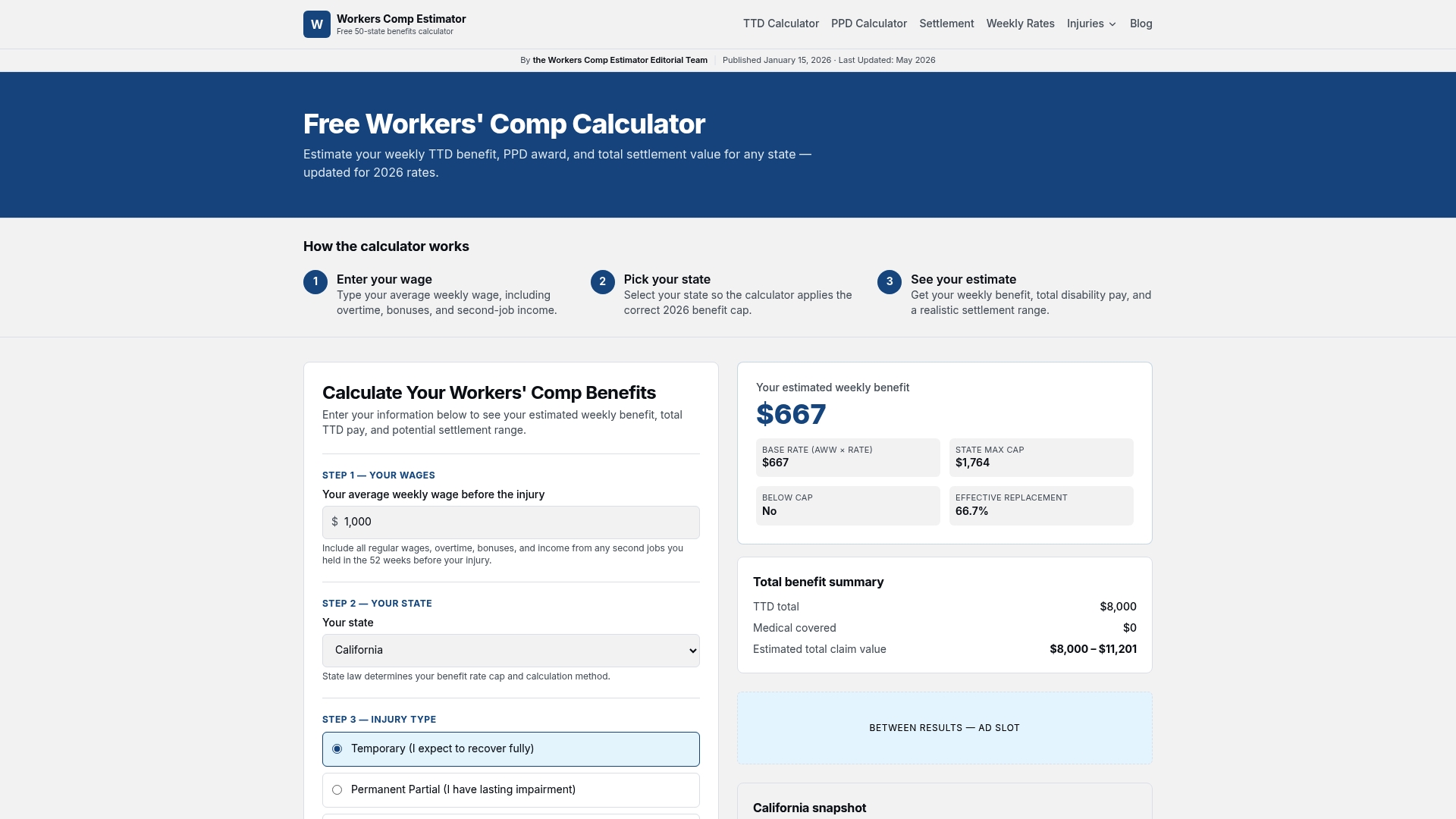
This matters most right when you’re deciding whether an insurer’s retroactive payment looks right. Run your wage through the TTD calculator to see your weekly benefit and daily rate side by side, or pull up your state-specific calculator if you’re in one of the states with its own dedicated page. If the numbers the insurer quotes don’t match what the calculator shows, that’s your cue to ask questions, and if the gap is significant, a conversation with an attorney like the team at Tyler Injury Law can help you sort out whether something’s being miscalculated. Start with your state’s calculator, get your number, then make the call.
Sources
For exact statutory language, check the Minnesota Department of Labor and Industry, the Wisconsin Department of Workforce Development, and the Kentucky Education and Labor Cabinet, each of which publishes plain-language FAQs alongside their statutes.
This article is general information, not a substitute for advice from a qualified lawyer. Consult a qualified legal professional about your own circumstances before acting on anything here.
- Claim process – Waiting period after injury | Minnesota Department of Labor and Industry
- Workers’ compensation: waiting period and FAQs | Wisconsin Department of Workforce Development
- Frequently Asked Questions - Kentucky Education and Labor Cabinet
- Workers’ comp retroactive pay period: how it works - LegalClarity
FAQ
What Is the Workers Comp Waiting Period?
It’s the stretch of days after an injury, typically 3 to 7 calendar days depending on your state, before wage-replacement benefits start, even though medical treatment is covered immediately.
Do You Get Paid for the Waiting Period?
Not right away, but many states pay it back retroactively once your disability continues past a set threshold, commonly around 14 days, though it ranges from 7 to 42 days depending on the state.
What Is the 90-Day Rule for Workers Comp?
This isn’t a universal national rule; it typically refers to state-specific reporting deadlines or medical treatment windows, so check your own state’s workers’ compensation statute rather than assuming a fixed standard applies everywhere.
What Is the 26-Week Rule for Workers Comp?
Some states cap certain temporary disability benefits at a set number of weeks, and durations vary by state, so you should confirm the exact figure with your state’s agency page.
How Long Does It Take for Workers Comp to Start Paying?
Once you clear your state’s waiting period, and assuming your claim is approved, benefit payments usually begin within a few weeks of your injury, depending on claim processing and documentation timing.
Is the 3-Day Waiting Period the Same in Every State?
No. Some states have a 3-day waiting period, others use a longer period such as 7 days. It’s important to check your specific state’s rule rather than assume a uniform national standard.
Recommended
More from the blog
Discover how U.S. workers' comp surveillance works, the legal limits by state, steps to protect benefits. Run a free 50 state 2026 estimate.
See how 2026 state caps, wages, and surgery affect your U.S. hernia workers' comp payout. Run a free 50 state calculator for a realistic estimate.
U.S. guide for Medicare eligible claimants: see the $25,000/$250,000 CMS review triggers, learn funding and admin options, and use free 50 state...
Free workers' comp calculators
Put the numbers in this article to work on your own claim.
Weekly benefit, PPD, and settlement in one place.
What your weekly temporary disability check should be.
Scheduled weeks and permanent impairment awards.
Light-duty benefit when you earn less while healing.
Federal employee FECA award by body part.
Lump-sum value of your full claim.
Turn a 5%, 10%, or 20% rating into dollars.
Max and min weekly rates for all 50 states.
Typical settlement ranges by injury and state.
Average settlement for fusion, rotator cuff, knee replacement, and more.
Why comp does not pay it, and when a third-party claim does.
When carriers typically make an offer.
What coverage costs by class code and payroll.
Guides, state updates, and claim strategy.