
PPD Calculation: How Permanent Partial Disability Is Paid

Most states work out a permanent partial disability (PPD) award with three numbers: your impairment rating, the number of weeks the law assigns to your injury, and your weekly benefit rate. Multiply them together and you have the award. The details change a great deal from state to state, so the same injury can be worth very different amounts depending on where you were hurt. This guide walks through the formula, the pieces that feed it, and the state rules that change the answer.
TL;DR
- The common formula is: impairment percentage × weeks assigned to the body part × weekly PPD rate = total award.
- Your weekly rate usually comes from your average weekly wage (AWW), often two-thirds of it, and then hits a state cap.
- Scheduled injuries (arm, leg, hand, eye) use a fixed week count. Unscheduled injuries (back, neck, head) use a whole-body formula that differs by state.
- Some states do not use impairment alone. They add factors such as age, education or lost earnings, so check your own state’s rules.
- Compare any insurer offer against your own estimate before you sign. A lump sum settles the PPD claim, so it is hard to reopen.
Table of Contents
- What PPD is and when it starts
- The basic PPD formula
- Step 1: Your impairment rating
- Step 2: Scheduled versus unscheduled injuries
- Step 3: Your weekly rate
- Worked examples
- Where the simple formula breaks down
- Weekly payments or lump sum
- How to check an insurer’s PPD offer
- Our perspective: where most people go wrong
- Run your own numbers
- FAQ
- Sources
What PPD is and when it starts
Permanent partial disability benefits compensate for lasting impairment or loss of function after a work injury. The Social Security Administration’s claims manual notes that calculation methods vary significantly by jurisdiction, and groups state systems into four approaches: impairment-based, loss of earning capacity, actual wage loss, and bifurcated systems that combine methods.
PPD normally comes into play after you reach maximum medical improvement (MMI), the point where your doctor says you are unlikely to improve further. Until then you are usually paid temporary disability. At MMI, a physician assigns a permanent impairment rating, and that rating is the first input to the formula.
The basic PPD formula
The most widely used structure has three steps:
- Impairment rating (a percentage) from your doctor.
- Weeks of benefits the statute assigns to the injured body part, or to the whole body for unscheduled injuries.
- Weekly rate, based on your wage and limited by the state maximum.
Wisconsin’s Department of Workforce Development shows the arithmetic plainly. For a non-scheduled injury, a 5% rating is multiplied by 1,000 weeks to give 50 weeks, and that is multiplied by the PPD rate. At a rate of $362 the department’s example comes to $18,100.
North Carolina’s Industrial Commission describes the same logic for scheduled parts: impairment percentage times the set weeks for that body part times the weekly compensation rate.
Step 1: Your impairment rating
The rating is a percentage that expresses how much function you permanently lost. In many states the treating or an evaluating physician assigns it using a medical guide, commonly a version of the AMA Guides, or a state-specific rating guide. North Carolina, for example, points to the Commission’s Rating Guide.
Small changes in the rating move the award a lot. At 200 scheduled weeks and a $600 weekly rate, each percentage point is worth $1,200. That is why a second opinion or an independent medical evaluation can matter more than any negotiating tactic.
The conversion from body-part ratings to whole-person ratings is another place for error. The Idaho Industrial Commission has warned that using the AMA Guides conversion can be mathematically inaccurate and skew benefits, which is why it calls for exact conversions. If your rating was converted, ask how.
If you have more than one injured body part, ratings are usually not simply added. A combined-values method is typically used. Our impairment rating payout calculator lets you test what a given rating is worth in your state, and our guide to how to avoid low impairment-rating offers explains what to look for.
Step 2: Scheduled versus unscheduled injuries
Most states publish a schedule that assigns a number of weeks to each body part, such as an arm, hand, finger, leg, foot or eye. Injuries not on the list, like the back, neck or brain, are unscheduled and are rated against the whole body.
Scheduled injury. You multiply the impairment percentage by the scheduled weeks, then by your weekly rate. Washington’s Department of Labor and Industries explains the policy behind the schedules: the legislature is presumed to have already factored in the general economic impact of specific injuries, so your individual wage loss is not normally reconsidered.
Unscheduled injury. The whole-body week count varies. Wisconsin uses 1,000 weeks, as shown above. Illinois lets employees with non-scheduled injuries receive a percentage of 500 weeks, paid at 60 percent of average weekly wage. Montana multiplies the total of the whole-person rating and certain add-ons by 400 weeks.

For the week counts assigned to each body part in every state, see our 50-state body part values guide.
Step 3: Your weekly rate
The weekly rate begins with your average weekly wage. Many states set it at two-thirds (66⅔%) of AWW. South Carolina, for instance, uses two-thirds of the average weekly wage for scheduled body parts. Illinois uses 60% for its PPD rate, as noted above.
Then the cap applies. Caps can bite hard: Alabama limits PPD to $220 per week, while Wisconsin’s maximum weekly PPD rate rises to $454 for injuries on or after April 1, 2026 and to $462 for injuries on or after January 1, 2027. Because caps depend on the injury date, use the figure in force when you were hurt.
AWW itself is often calculated from the 13 or 52 weeks before the injury, and what counts as wages differs by state. Overtime, bonuses and second jobs may be included or not. Our 2026 weekly benefit rate tables list the maximums for all 50 states and DC.
Worked examples
The numbers below are illustrations of the arithmetic, not a prediction of your claim.
Example 1: A scheduled injury
Suppose your AWW is $900 and your state pays two-thirds of AWW. Your weekly rate is $600, assuming it sits under the state cap. Your hand injury is rated at 10%, and the schedule assigns 200 weeks to the hand.
- 10% × 200 weeks = 20 weeks
- 20 weeks × $600 = $12,000
Example 2: An unscheduled injury under a whole-body formula
Take the Illinois structure described above: 60% of AWW and 500 weeks for non-scheduled injuries. With a $900 AWW, the rate is $540 before any state cap. A 10% whole-person rating gives 50 weeks.
- 10% × 500 weeks = 50 weeks
- 50 weeks × $540 = $27,000
If the cap is lower than your calculated rate, replace the rate with the cap. For Illinois specifics, see our Illinois PPD rates guide.
Example 3: Starting from an annual salary
Many people search for what they would get on a $40,000 salary. Divide by 52 to get an AWW of about $769.23. Two-thirds of that is about $512.82 a week. That is your starting rate in a two-thirds state, before the cap and before the weeks and rating are applied.
Where the simple formula breaks down
Some states do not stop at impairment and weeks. Three patterns show up often.
- Added factors. Montana lets the whole-person rating be increased based on age, education and actual wage loss before multiplying by 400 weeks.
- Two tracks. Oregon has an impairment-only award for workers released to regular work, and a second award that adds work disability factors such as age, education and adaptability when they are not released. See our Oregon calculator.
- Wage differential. Illinois offers wage differential benefits equal to 66⅔ percent of the reduction in earnings for workers who return to work at lower pay.
Hawaii is a reminder that the label does not settle the question. Its Supreme Court held in Ihara v. State that PPD is primarily based on impairment of physical or mental function rather than loss of wage-earning capacity.
Weekly payments or lump sum
PPD is typically paid in weekly installments, but many states let the parties agree to a lump sum. In Alabama, PPD may be paid weekly or as a lump sum agreed by both parties, and only future payments can be discounted.
A lump sum is the same award paid at once, sometimes discounted to present value. Before you accept one, ask whether it also closes your right to future medical care. That is the question to put to your state workers’ compensation agency or a licensed workers’ comp attorney in your state, because the rule on medical benefits is state-specific.
How to check an insurer’s PPD offer
- Get the rating in writing, with the physician’s name and the guide edition used.
- Confirm the week count for your body part in your state’s statute or schedule.
- Verify your AWW, including every income source your state counts.
- Confirm the weekly rate and cap for your injury date.
- Multiply it out and compare with the offer. If the numbers do not match, ask the adjuster to show the math.
- Check what else you give up by settling: future medical care, vocational benefits, and reopening rights.
You can do steps 2 through 5 in minutes with our PPD calculator, and our settlement formula guide explains how PPD fits into a full settlement.
Our perspective: where most people go wrong
We built this site because the formula itself is rarely the hard part. The mistakes we see happen upstream. People use the wrong wage, because a second job or overtime was left out. They use a cap from the wrong year. Or they accept a rating without asking how it was reached.

The second pattern is treating a national rule of thumb as if it applied everywhere. A back injury at 10% is worth very different amounts in Wisconsin, Illinois and Alabama. Our calculators use each state’s 2026 caps and count all income sources in the wage, so the estimate is a realistic one to bring to a negotiation.
Our advice is simple. Estimate first, then read the offer. If the gap is large, talk to a licensed workers’ comp attorney in your state before you sign anything, since many offer free consultations.
— Daniel
Run your own numbers
Our free PPD calculator takes your average weekly wage, state and injury type, applies the state’s 2026 caps, and shows the estimated weekly benefit and total award. It covers all 50 states and DC.
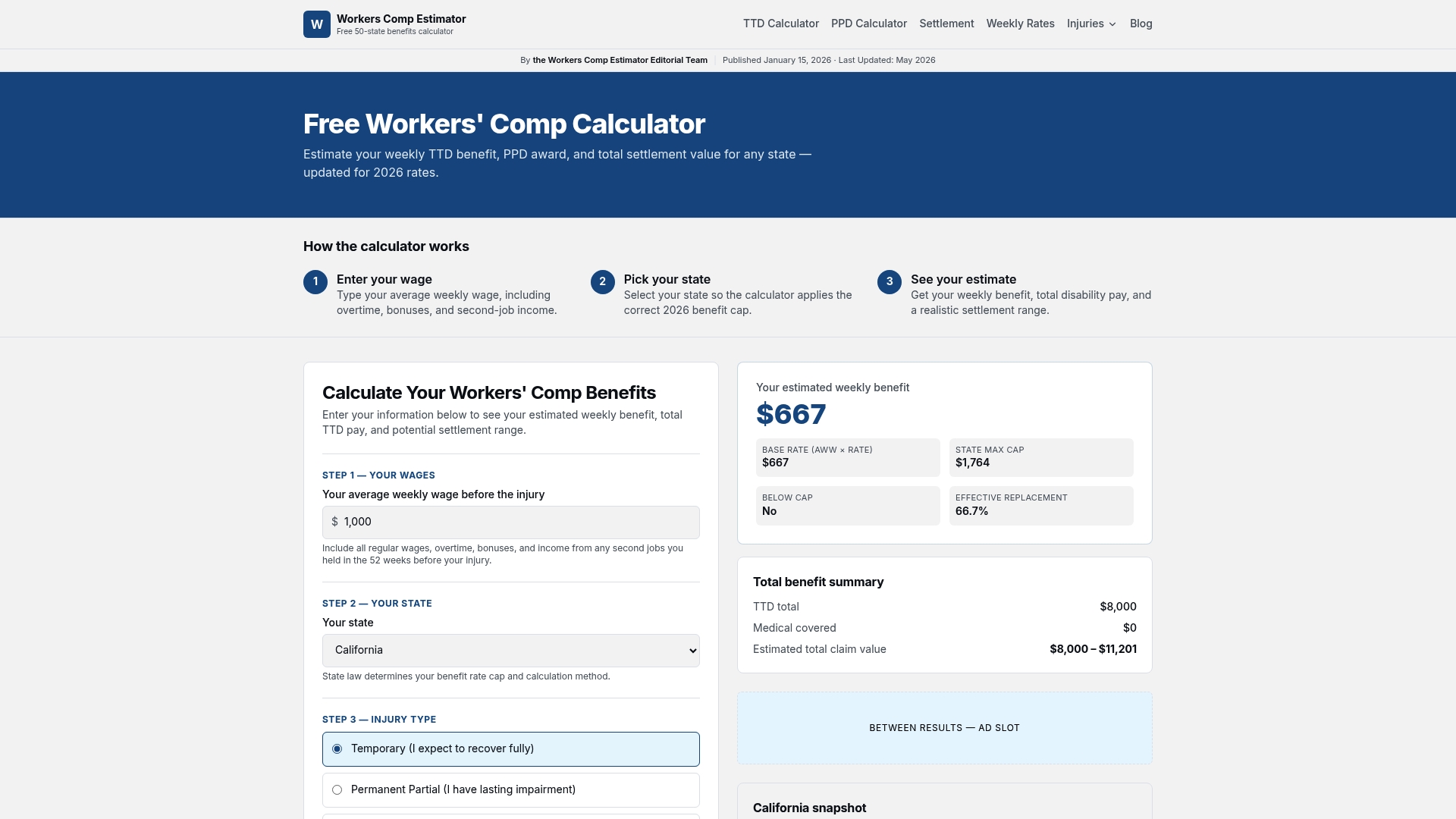
Start with the Workers’ Comp Calculator for a full benefits estimate, or use the settlement calculator if you are already weighing an offer. For a state-by-state view of the caps, see our guide to U.S. permanent disability caps.
FAQ
How is PPD calculated?
In most states, you multiply your impairment rating by the weeks the law assigns to the injury, then multiply by your weekly PPD rate. The rate is usually a share of your average weekly wage, limited by a state maximum. Some states add factors like age, education or lost earnings.
What is the difference between scheduled and unscheduled PPD?
Scheduled injuries are body parts with a fixed week count in state law, such as an arm or a leg. Unscheduled injuries, such as the back or neck, are rated against the whole body and use a state-specific week total. The same rating can produce very different awards under each.
How much will I get if I make $40,000 a year?
Your AWW is about $769.23, and in a two-thirds state your weekly rate would be about $512.82 before the cap. Your total depends on your rating and the weeks for your injury. Use the calculator for your state’s figures.
Can I take PPD as a lump sum?
Many states allow it by agreement. In Alabama, for example, both parties must agree, and only future payments can be discounted. Ask a licensed attorney or your state agency what a lump sum would waive in your state.
Sources
- SSA POMS DI 52120.001: Introduction to State Specific Workers’ Compensation
- Wisconsin DWD: Permanent Partial Disability Schedule and Calculations
- Wisconsin DWD: 2025 Wisconsin Act 145 plain language summary
- North Carolina Industrial Commission: Permanent Partial Disability
- Idaho Industrial Commission: PPI to whole person memo
- Washington L&I: Claim Closures and Permanent Partial Disability
- SSA POMS DI 52120.080: Illinois Workers’ Compensation
- Montana Code 39-71-703
- South Carolina impairment ratings and MMI
- Alabama Basic Claim Handling Manual
- Oregon Laws 2007 Chapter 274
- Ihara v. State, Supreme Court of Hawaii (2017)
Recommended
More from the blog
Use 2026 U.S. state caps and a free 50‑state calculator to estimate your permanent disability workers' comp pay. Learn P&S/MMI ratings, apportionment, and...
Learn how Texas workers’ comp impairment ratings affect benefits, deadlines, and disputes, then use the payout calculator before accepting an offer.
State by state breakdown of scheduled weeks, wage caps, and the weeks times rate, with a 50 state calculator to create a printable estimate.
Free workers' comp calculators
Put the numbers in this article to work on your own claim.
Weekly benefit, PPD, and settlement in one place.
What your weekly temporary disability check should be.
Scheduled weeks and permanent impairment awards.
Light-duty benefit when you earn less while healing.
Federal employee FECA award by body part.
Lump-sum value of your full claim.
Turn a 5%, 10%, or 20% rating into dollars.
Travel reimbursement for medical appointments.
Max and min weekly rates for all 50 states.
Typical settlement ranges by injury and state.
Average settlement for fusion, rotator cuff, knee replacement, and more.
Why comp does not pay it, and when a third-party claim does.
When carriers typically make an offer.
What coverage costs by class code and payroll.
Guides, state updates, and claim strategy.