
Plan for 12 Weeks: Workers’ Comp and FMLA Rights for U.S. Workers

Workers’ compensation pays medical bills and partial wage replacement for work-related injuries. The Family and Medical Leave Act (FMLA) is federal job-protected leave for qualifying serious health conditions, paid or not. They’re separate systems with separate purposes, but when an on-the-job injury meets the FMLA’s medical threshold, both can run at the same time, and often should.
TL;DR:
- If your work injury involves inpatient hospitalization, ongoing treatment, or incapacity longer than three days, your employer can designate the leave as FMLA, starting the 12-week clock.
- Workers’ compensation generally replaces about two-thirds of your wages, but the actual weekly benefit varies significantly by state due to caps that differ widely.
- You must meet specific eligibility criteria for FMLA, including 12 months of employment, 1,250 hours worked, and being within a location with at least 50 employees within 75 miles.
- During concurrent FMLA and workers’ comp leave, your employer is responsible for providing job protection, maintaining health coverage, and giving proper notice, while you need to report your leave promptly and respond to documentation requests.
- After 12 weeks of FMLA, workers’ comp benefits can continue, but your job is no longer guaranteed unless extended through ADA accommodations, state laws, or permanent disability claims.
Table of Contents
- Workers Comp vs FMLA: What Workers’ Compensation Actually Covers
- FMLA vs Workers Compensation: Who Qualifies and What It Protects
- Where Workers Comp and FMLA Overlap: The Serious Health Condition Test
- What Employers and Employees Must Do During Concurrent Leave
- Workers Comp vs Disability: How Pay, PTO, and Light Duty Actually Work
- When FMLA Runs Out but Your Workers’ Comp Claim Doesn’t
- How to Protect Your Rights After a Workplace Injury
- Where Employees Consistently Get This Wrong
- Free Calculators That Help You Plan Around FMLA and Workers’ Comp
- Official Resources for FMLA and Workers’ Comp Questions
- Sources
- FAQ
Workers Comp vs FMLA: What Workers’ Compensation Actually Covers
Workers’ compensation is state-run insurance, not a federal benefit, so the exact numbers shift depending on where you work. But the basic structure is consistent nationwide: your employer’s insurer pays for treatment of a work injury and replaces a portion of your lost wages while you recover.
The core benefits break down into a few categories:
- Medical care — doctor visits, surgery, physical therapy, and prescriptions tied directly to the injury, with no deductible or copay in most states.
- Temporary total disability (TTD) — weekly wage replacement, typically two thirds of your average weekly wage, while you’re fully unable to work.
- Permanent partial disability (PPD) — a payout for lasting impairment, like reduced range of motion in a shoulder, calculated using a state-specific schedule.
- Vocational rehabilitation — retraining or job placement help if you can’t return to your old role.
- Settlements — a lump sum or structured payout resolving some or all of a claim, common in cases with permanent impairment.
Every state caps the maximum weekly TTD payment, and those caps vary widely. A worker in Delaware tops out far lower than one in Missouri, even with identical wages, because each state sets its own maximum independent of federal law.
The claim process itself is fairly mechanical: report the injury to your employer in writing, see an authorized provider (many states require this for the first visit), and the insurer opens a claim file. Most states expect a decision on whether the claim is accepted within a few weeks, though disputed claims can drag on much longer. Missing the reporting deadline, sometimes as short as 30 days, is one of the most common reasons legitimate claims get denied.
FMLA vs Workers Compensation: Who Qualifies and What It Protects
FMLA eligibility depends on three things, and all three have to be true at the same time. You need 12 months of employment with your current employer, at least 1,250 hours worked in the prior 12 months, and your employer needs 50 or more employees within 75 miles of your worksite. Miss any one of those and FMLA doesn’t apply, no matter how serious the injury.
Once eligible, here’s what you actually get:
- Up to 12 workweeks of leave in a rolling 12-month period for your own serious health condition.
- Job protection — your employer must return you to the same or an equivalent position when leave ends.
- Continued group health coverage on the same terms as if you’d kept working, for the duration of the leave.
- Intermittent leave options — for conditions that flare up rather than requiring one continuous absence.
FMLA leave is unpaid by federal law. That surprises a lot of workers who assume “job-protected” means “paid.” The Department of Labor confirms it’s an unpaid entitlement, though employers can require or allow you to use accrued paid leave concurrently, as long as you aren’t already receiving wage-replacement income for the same period.
That last detail matters more than it sounds. If workers’ comp is already replacing part of your wages, your employer generally can’t force you to burn PTO on top of it to make the leave paid, a distinction that trips up a lot of HR departments too.
Where Workers Comp and FMLA Overlap: The Serious Health Condition Test
The connector between the two systems is a single legal phrase: “serious health condition.” If your workplace injury meets that definition, your employer can, and often should, designate the absence as FMLA leave even though it originated as a workers’ comp claim.
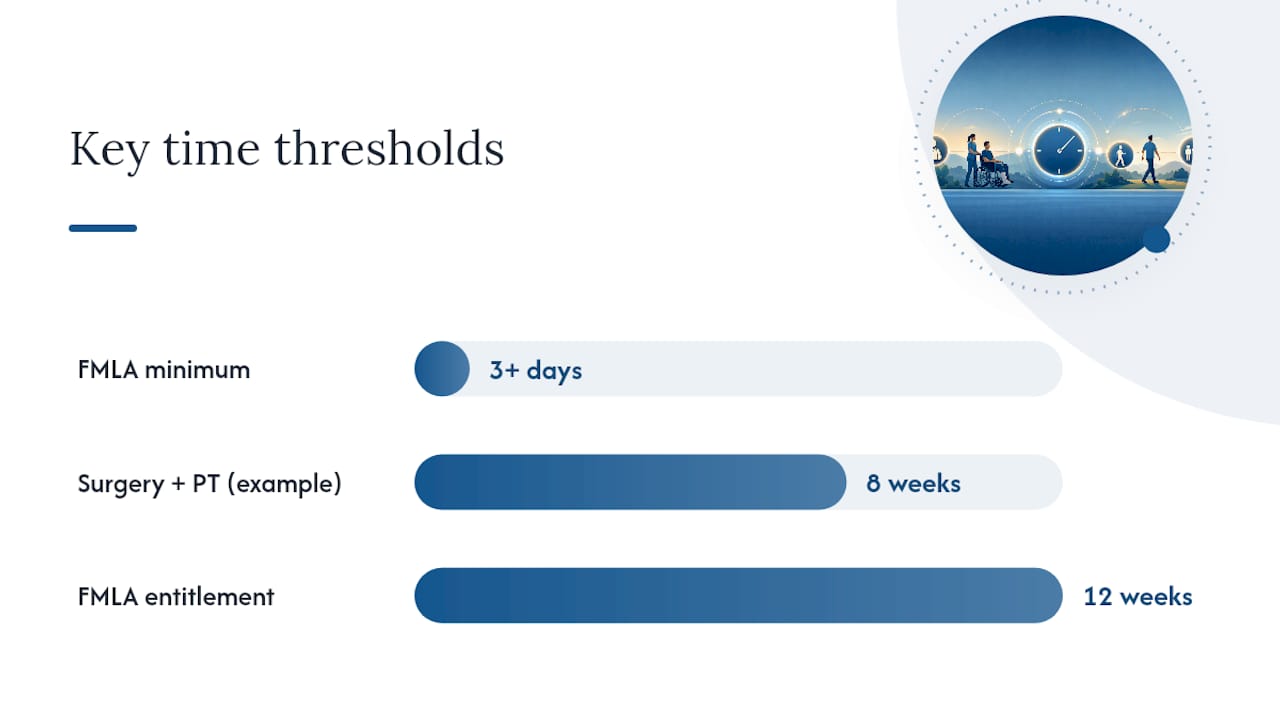
The FMLA defines a serious health condition as one involving either inpatient hospitalization, or incapacity of more than three consecutive days combined with continuing treatment by a health care provider. That’s a lower bar than many employees expect. A broken wrist that needs a follow-up visit and a few weeks of restricted duty can clear it. A same-day ER visit with no follow-up treatment generally doesn’t.
Here’s how that plays out in practice:
- Surgery and physical therapy — a torn rotator cuff requiring surgery and eight weeks of PT almost always qualifies, since it involves both incapacity and ongoing treatment.
- Hospitalization — any inpatient stay, even overnight, automatically satisfies the serious health condition test regardless of how long the recovery takes afterward.
- Intermittent treatment — a back injury that flares up periodically, requiring occasional time off for injections or therapy, can qualify for intermittent FMLA leave, counted in hours or days rather than one continuous block.
On average, a serious health condition under FMLA requires more than three consecutive days of incapacity plus continuing treatment, or a hospital stay, whichever comes first. That single test decides whether your 12-week federal clock starts running the same day your workers’ comp claim opens.
Employers don’t get to sit on this decision. Once they have enough facts to reasonably suspect a serious health condition, they’re expected to notify the employee in writing that the leave is being designated as FMLA, and failing to do so can preserve the employee’s FMLA entitlement rather than let it quietly run out. This is also where a common misconception falls apart. Some employees think they can decline FMLA to “save” their 12 weeks for later. In most cases, they can’t. If the medical facts meet the criteria, the employer can designate the leave as FMLA whether the employee wants that or not, according to DOL guidance on employee notice.
What Employers and Employees Must Do During Concurrent Leave
Once a workplace injury gets designated as FMLA, both sides have specific duties, and skipping them creates real legal exposure on either end.
Employers are on the hook for:
- Written notice that the absence is being designated as FMLA, given promptly once the facts point that way.
- Maintaining group health insurance under the same terms for the full 12-week period, even while the employee draws workers’ comp wage replacement instead of a paycheck.
- Tracking the FMLA clock accurately so the employee isn’t shorted or overcharged on their 12-week entitlement.
Employees, in turn, need to:
- Notify their employer of the need for leave as soon as practical, ideally in writing.
- Provide medical certification when requested, usually within 15 days.
- Respond to reasonable documentation requests without unnecessary delay, since stalling can jeopardize the FMLA designation.
Premium payments get confusing fast. Because FMLA is unpaid and workers’ comp only replaces part of your wages, employers typically arrange for you to pay your share of health insurance premiums directly, or deduct them from your workers’ comp check where state law allows it. Ask HR exactly how they plan to collect your premium share before your first missed paycheck, not after.
Pro Tip: Get the FMLA designation notice in writing, even if HR tells you it’s “obviously covered.” Verbal assurances don’t hold up if a dispute arises later, and a written notice is the only proof that your 12-week clock started on a specific date.
Workers Comp vs Disability: How Pay, PTO, and Light Duty Actually Work
The financial picture is where these two programs diverge sharply, and it’s usually the first thing employees get wrong. Workers’ comp replaces a portion of your average weekly wage, often around two thirds, depending on your state’s rules and caps, subject to your state’s cap. FMLA replaces nothing on its own. It only protects your job and your health coverage while you’re out.
That combination means your take-home pay drops the moment you go on leave, even though your job is legally protected. A worker earning $1,200 a week might see workers’ comp checks land closer to $800, with no employer obligation to top that up unless company policy says otherwise.
PTO substitution has real limits here. Employers generally can’t require you to use accrued vacation or sick time to convert unpaid FMLA into paid leave once you’re already receiving wage-replacement income from workers’ comp, a restriction laid out in recent legal analysis of PTO substitution rules. There are exceptions depending on state law and specific plan language, so check your employee handbook rather than assume.
Light duty is the trickiest fork in the road:
- Accepting a light-duty offer that fits your medical restrictions usually keeps your workers’ comp wage benefits flowing at a reduced or full rate, depending on the pay difference.
- Declining a valid light-duty offer can cut off your workers’ comp wage-replacement checks, even though your FMLA job protection stays intact until the 12 weeks run out.
- The Americans with Disabilities Act may separately require your employer to offer reasonable accommodations, which is a different, and sometimes broader, obligation than either workers’ comp or FMLA imposes.
Providing workers’ compensation benefits does not by itself let an employer off the hook for FMLA obligations. The two run on separate legal tracks, and a company can be fully compliant with one while violating the other.
When FMLA Runs Out but Your Workers’ Comp Claim Doesn’t
FMLA’s 12 weeks are a hard federal ceiling. Workers’ comp has no equivalent cutoff. Your medical and wage-replacement benefits can keep going under state law long after your job protection technically expires, and that gap is where a lot of employees get blindsided.
Once the 12 weeks end, your employer isn’t federally required to hold your position open anymore, though some employers choose to anyway. A few paths can still help:
- ADA reasonable accommodation — if your condition counts as a disability, your employer may need to consider extended leave or a modified role as an accommodation.
- State family or medical leave laws — several states offer leave protections beyond FMLA’s 12 weeks, so check your state labor department’s rules before assuming you’re out of options.
- Permanent disability claims — if you’re not returning to full duty, this shifts your workers’ comp case toward a PPD award or settlement discussion.
If recovery looks likely to stretch past 12 weeks, start that conversation with HR and a workers’ comp adjuster early, not after the clock runs out.
How to Protect Your Rights After a Workplace Injury
The sequence you follow in the first few days after an injury shapes everything that comes after, including whether your FMLA rights survive if your employer drops the ball on paperwork.
- Report the injury in writing immediately, even if it seems minor at first, and see an authorized provider as soon as your state’s rules allow.
- Save copies of every form and message — incident reports, medical notes, claim numbers, and any emails with HR or the insurance adjuster.
- Ask HR directly for a written FMLA designation notice rather than assuming your leave is automatically covered.
- Keep every medical certification and employer notice in one folder, physical or digital, so nothing gets lost if the claim gets disputed later.
- Run your numbers through a wage-replacement estimate before negotiating anything with an adjuster, so you know roughly what you’re owed.
Pro Tip: Before accepting a settlement offer or a light-duty assignment, run your average weekly wage through a state-specific workers’ comp calculator first. Adjusters often anchor low, and knowing your state’s actual cap gives you a real number to push back with.
If your employer disputes the claim or ignores your FMLA request, contact your state workers’ comp agency or a workers’ comp attorney before the deadline to appeal passes.
Where Employees Consistently Get This Wrong
Most people treat workers’ comp and FMLA as competing systems, like you have to pick one. That framing causes real financial damage, because the two aren’t substitutes. Workers’ comp is the paycheck. FMLA is the job security wrapped around it. Losing sight of that distinction is how workers end up either burning PTO they didn’t need to burn or assuming their job is safe past week 12 when it legally isn’t.
The bigger blind spot is the notification obligation. Employees assume silence from HR means they’re not on FMLA yet, so they hold off gathering documentation. That’s backwards. If your injury meets the medical threshold, the clock may already be running whether or not anyone told you. Ask for the written designation the day you report the injury, not the day you start wondering about it.
Plan your finances around 12 weeks of reduced income, not full pay, and treat any estimate as a starting point for negotiation, not a final number.
— Daniel
Free Calculators That Help You Plan Around FMLA and Workers’ Comp
Once you know your leave is running on both tracks, the next question is almost always financial: how much will actually land in your bank account each week? Free online workers’ compensation calculators can help estimate your likely temporary total disability payment, permanent partial disability award, and settlement range based on state, average weekly wage, and injury type.
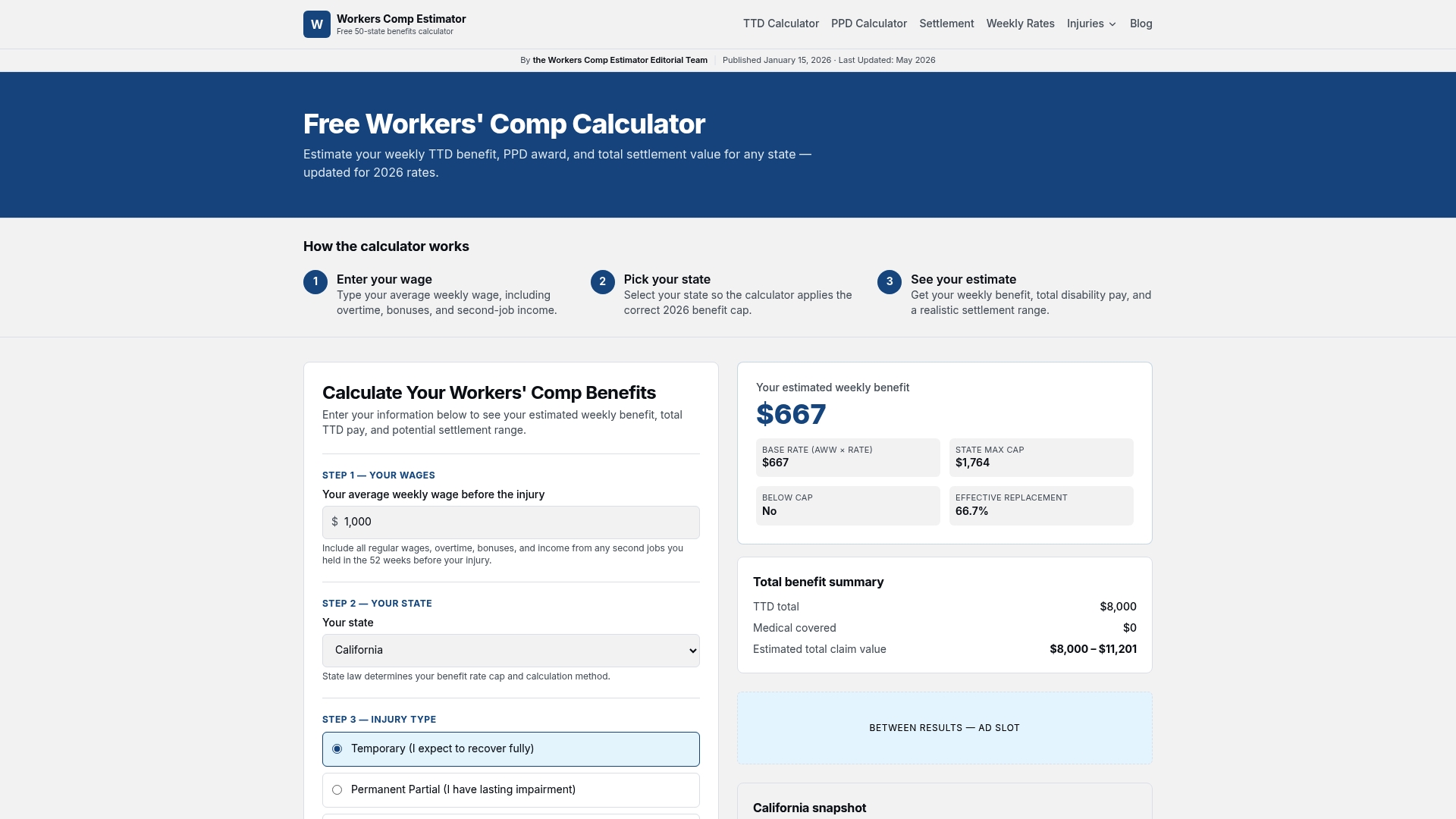
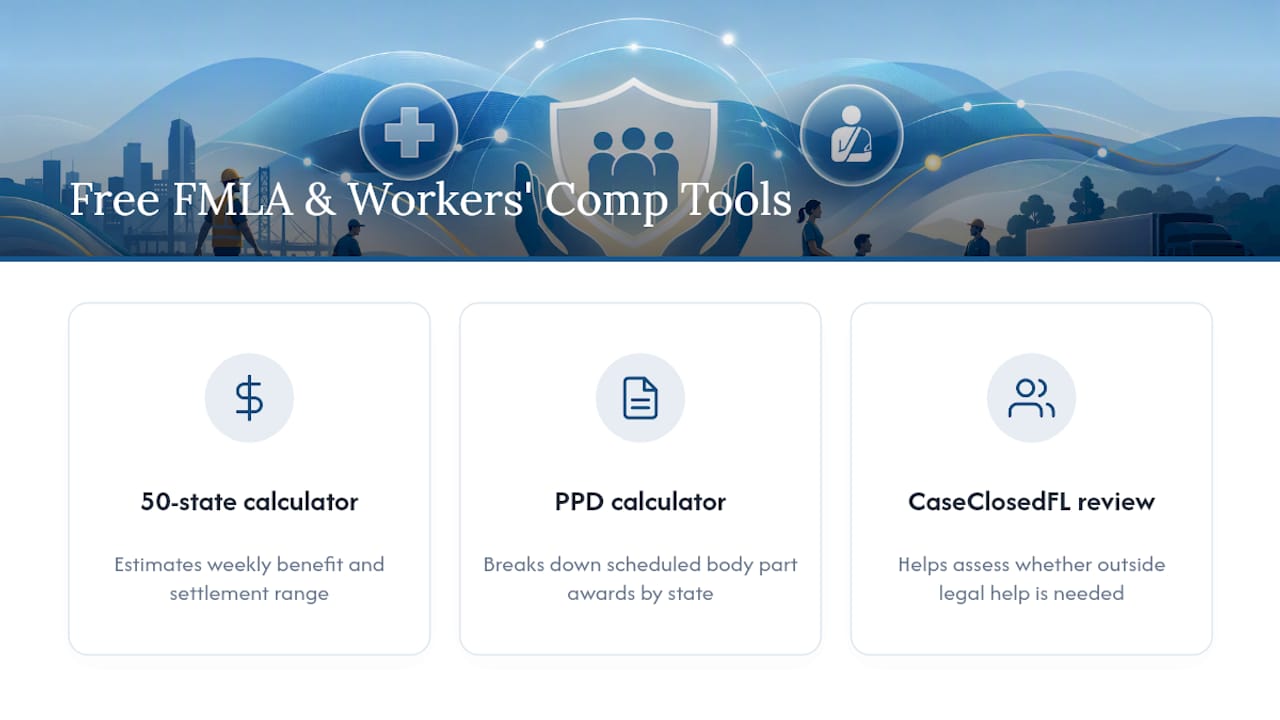
The tool factors in each state’s 2026 weekly benefit rate caps, so the number you get reflects your actual state’s maximum rather than a generic average that overstates what you’ll receive. That matters most in the exact scenario this article covers: budgeting for the gap between your old paycheck and your workers’ comp check while your FMLA clock ticks down, or building a realistic counter-offer if an adjuster’s settlement proposal seems low. If your injury involves lasting impairment, the PPD calculator breaks down how scheduled body part awards get calculated in your state.
Start with the free 50-state workers’ comp calculator to see your estimated weekly benefit and settlement range before your next conversation with HR or the insurance adjuster. If your recovery gets complicated or your claim gets disputed, resources like CaseClosedFL’s accident intake review can help you figure out whether outside legal help makes sense.
Official Resources for FMLA and Workers’ Comp Questions
For rules straight from the source, not secondhand summaries, bookmark these:
- DOL — Family and Medical Leave Act (FMLA) for eligibility rules and employee protections.
- WHD Fact Sheet 28D for employer notice and designation duties.
- Your state’s workers’ comp agency directory for benefit caps, forms, and filing deadlines specific to where you work.
Save the contact information for your state agency now, before you need it during a dispute.
This article is general information, not a substitute for advice from a qualified lawyer. Consult a qualified legal professional about your own circumstances before acting on anything here.
Sources
- DOL — Family and Medical Leave Act (FMLA)
- Department of Labor (WHD) — FMLA: Employer Notification and Rights
FAQ
Should I File Workers’ Comp or Take FMLA?
They’re not either/or. File the workers’ comp claim to get medical care and wage replacement, and separately confirm with HR whether the same absence qualifies for FMLA job protection. Most serious workplace injuries end up covered by both at once.
What Pays More, FMLA or Disability?
FMLA itself pays nothing since it’s unpaid job protection by federal law. Workers’ comp and other disability benefits provide the actual wage replacement, typically around two thirds of your average weekly wage up to your state’s cap.
What Is the Disadvantage of FMLA?
FMLA leave is unpaid and capped at 12 workweeks in a 12-month period, so it offers no income on its own and no protection once that window closes, even if your medical recovery isn’t finished.
Do I Have to Use FMLA While on Workers’ Comp?
In most cases, you don’t get to opt out. If your injury meets the FMLA’s serious health condition threshold, your employer can designate the leave as FMLA regardless of your preference, and that time counts against your 12-week entitlement whether you wanted it to or not.
Can My Employer Force Me to Use PTO During Workers’ Comp Leave?
Generally no, not once you’re already receiving wage-replacement income from workers’ comp for that same period. Some plan-specific exceptions exist, so check your employer’s leave policy for the details.
Recommended
More from the blog
File the correct state claim and collect medical and wage records. Run the free 50 State calculator to see your likely weekly TTD and settlement before...
Discover how U.S. workers' comp surveillance works, the legal limits by state, steps to protect benefits. Run a free 50 state 2026 estimate.
See how 2026 state caps, wages, and surgery affect your U.S. hernia workers' comp payout. Run a free 50 state calculator for a realistic estimate.
Free workers' comp calculators
Put the numbers in this article to work on your own claim.
Weekly benefit, PPD, and settlement in one place.
What your weekly temporary disability check should be.
Scheduled weeks and permanent impairment awards.
Light-duty benefit when you earn less while healing.
Federal employee FECA award by body part.
Lump-sum value of your full claim.
Turn a 5%, 10%, or 20% rating into dollars.
Max and min weekly rates for all 50 states.
Typical settlement ranges by injury and state.
Average settlement for fusion, rotator cuff, knee replacement, and more.
Why comp does not pay it, and when a third-party claim does.
When carriers typically make an offer.
What coverage costs by class code and payroll.
Guides, state updates, and claim strategy.