Use 2026 State Caps to Estimate Your U.S. Hernia Workers’ Comp Pay

A hernia qualifies for workers’ compensation when it’s caused or aggravated by a work incident, and most claims settle for somewhere between $5,000 and $25,000, according to practitioner guidance from McHargue Law. Complex cases involving mesh complications, recurrence, or permanent restrictions can climb into six figures. Your wages, surgical outcome, and state of residence decide where in that range you land.
TL;DR:
- Workers’ compensation settlements for hernias typically range from $5,000 to $25,000, but complex cases with complications can exceed six figures.
- Settlement amounts are influenced by weekly wages, surgical complexity, permanent restrictions, and state-specific disability formulas.
- Many states require approval from workers’ comp authorities before finalizing a settlement, especially if future medical benefits are involved.
- Waiting until maximum medical improvement and receiving a formal impairment rating can significantly affect the settlement value.
- Using a state-specific calculator based on current caps provides a more accurate estimate for negotiations than generic or national averages.
Table of Contents
- What a Hernia Workers Comp Settlement Actually Pays For
- What Drives Your Settlement Number Up or Down
- How State Rules Change the Settlement Process
- Should You Settle Now or Wait for MMI?
- Estimating Your Hernia Claim With 2026 State Caps
- Does a Pre-Existing Hernia Hurt Your Claim?
- Where Hernia Claims Get Disputed
- Are Hernia Settlements Taxed?
- What Happens After You Settle
- A Practical Take on Hernia Claims
- Get a Real Number Before You Negotiate
- Sources
- FAQ
What a Hernia Workers Comp Settlement Actually Pays For
A hernia settlement isn’t one number pulled from a chart. It’s a sum of several distinct pieces of your claim, each calculated differently, then negotiated into a lump figure or structured payout.
- Medical expenses: surgery, hospitalization, physical therapy, and any follow-up care for complications like mesh infection or recurrence.
- Temporary Total Disability (TTD): paid while you’re out of work recovering, typically around two-thirds of your average weekly wage, subject to your state’s weekly cap.
- Permanent Partial Disability (PPD): based on an impairment rating assigned once you reach maximum medical improvement, converted to dollars through your state’s formula.
- Future medical costs: projected treatment if your hernia claim stays open or gets factored into a lump-sum buyout.
- Liens and costs: health insurers or Medicare may claim reimbursement from your settlement, and attorney fees typically come off the top.
The math starts with adding documented medical costs to the present value of lost wages, then layering in the PPD award before negotiating a final number, according to LegalClarity’s breakdown of hernia settlement valuation. Structured settlements spread that total over time instead of paying it all at once, which sometimes matters if you’re worried about managing a lump sum or preserving eligibility for other benefits.
What Drives Your Settlement Number Up or Down
Two workers with nearly identical hernias can walk away with very different checks. The gap usually comes down to four factors.
Your average weekly wage (AWW) sets the ceiling for both TTD and PPD math, since most states calculate benefits as a percentage of what you earned before the injury. A higher wage earner hitting the state cap actually loses proportionally more of their real income than someone paid at the low end, which is part of why cap amounts matter so much in negotiations.
Surgical complexity moves the needle fast. A straightforward inguinal hernia repair with a clean recovery settles differently than a case involving mesh complications, a second surgery, or recurrence months later. Each additional procedure adds medical costs and often extends your TTD period, which compounds the total.
Permanent restrictions change the entire conversation. If your doctor limits lifting weight or standing time after recovery, and that restriction affects your ability to return to your prior occupation, you’re not just looking at a PPD percentage. You’re looking at a loss-of-earning-capacity argument that can substantially increase the offer.
- Longer TTD periods mean more weeks of wage-replacement payments before any PPD math even starts.
- Occupation matters: manual labor jobs with heavy lifting requirements tend to produce stronger loss-of-occupation claims than desk jobs.
- Age and remaining work-life expectancy sometimes factor into future earning-capacity arguments in states that allow them.
Because permanent disability formulas vary so much by state, two claimants with the same impairment rating can end up with PPD awards that differ by thousands of dollars purely based on where they filed. That’s exactly why running a state-specific estimate matters more than reading a generic national average.
How State Rules Change the Settlement Process
Workers’ comp is state law, not federal law, and that shows up nowhere more clearly than in hernia claims. Some states apply special evidentiary rules to hernias that don’t exist for other injuries.
South Carolina is the clearest example. Under South Carolina Code § 42-9-40, a hernia is only compensable if it appeared suddenly, was accompanied by pain, immediately followed a specific accident, and didn’t preexist the incident. The statute also directs the worker toward surgical treatment and conditions compensation on proof of each of those elements. If your hernia developed gradually over weeks of heavy lifting rather than in one identifiable moment, that state’s statute makes your claim considerably harder to prove.
Other states treat hernias like any other workplace injury, with no special “sudden onset” requirement. That difference alone can determine whether a claim gets approved or denied outright.
Settlement approval also varies widely:
- Some states require workers’ comp commission or judicial signoff before a settlement becomes final, particularly when future medical benefits are being closed out.
- Others allow settlements to proceed with far less oversight.
- The 50-state workers’ compensation settlement chart breaks down which states require this approval and whether a settlement can permanently close future medical care.
Before you sign anything, check your state workers’ comp board’s specific rules. Approval requirements exist to protect you, and skipping that step in your own research means you might not realize a settlement offer is unusually low for your jurisdiction.
Should You Settle Now or Wait for MMI?
Timing is often the single biggest lever you control in a hernia claim, and insurers know it. Adjusters frequently push for early settlement while you’re still healing, because your case looks cheaper before an impairment rating exists on paper.
- Confirm you’ve reached Maximum Medical Improvement (MMI). This is the point where your doctor says further treatment won’t meaningfully improve your condition. Settling before MMI usually means settling before anyone knows your real impairment level.
- Get a formal impairment rating. This number, assigned by your treating physician, becomes the basis for your PPD calculation. Without it, you’re negotiating blind.
- Weigh early settlement only for minor, low-wage-impact cases. A medical-only hernia claim with a short recovery and no lasting restrictions is a reasonable candidate for a faster resolution.
- Understand what closing future medical means. Many settlements permanently end your right to claim additional treatment for that hernia, even if complications surface years later.
- Ask before you sign: Has my doctor declared MMI? Do I have I written impairment rating? Does this settlement close future medical? Does my state require commission approval, and has that happened?
Pro Tip: Never sign a release the same day you receive it. Take it to a workers’ comp attorney or at least sit with the numbers for a few days. Insurers rarely sweeten an offer after you’ve signed, but they’ll often revise a first offer if you push back with documentation.
Estimating Your Hernia Claim With 2026 State Caps
Guessing at your settlement range is how workers leave money on the table. Running actual numbers through a calculator built on current state caps gives you something concrete to bring into negotiations.
Workerscompestimator’s Free Workers’ Comp Calculator needs four inputs to generate an estimate:
- Your average weekly wage before the injury
- Your state of residence
- Injury type (hernia, plus surgical details if applicable)
- Weeks off work and an assumed impairment rating, once you have one
State caps swing the math substantially. New Hampshire’s 2026 maximum weekly benefit sits at $1,641, while Hawaii’s caps out at $1,048, based on the 2026 weekly benefit rate table covering all 50 states and DC. A worker earning $1,500 a week in New Hampshire gets a very different TTD check than the same earner in Hawaii, purely because of where they live.
Run the numbers, save or screenshot the output, and bring that estimate to your adjuster or attorney as a negotiation baseline. A realistic, state-specific figure carries more weight than a vague sense that “this feels low.”
Does a Pre-Existing Hernia Hurt Your Claim?
Prior hernia history is one of the fastest ways insurers try to deny or shrink a claim, and it’s worth understanding exactly how that fight plays out.
Insurance adjusters routinely dig into medical records for any mention of a prior hernia, even an old one that never required treatment. If they find one, they’ll argue the current hernia is a recurrence of a pre-existing condition rather than a new work injury, which shifts the burden onto you to prove the work incident caused a new or materially worsened problem.
Honesty here isn’t optional. Prior hernia history invites extra scrutiny, and getting caught concealing it can tank your credibility on every other part of the claim, not just the pre-existing-condition argument. The better strategy is disclosure paired with a clear medical opinion connecting the work incident to a new or aggravated injury.
This is where a treating physician’s causation opinion becomes critical. A doctor who documents that the specific work event caused a new hernia, or substantially worsened a previously asymptomatic one, gives your claim the medical backbone it needs to survive an insurer challenge. Without that opinion, a pre-existing condition can become the insurer’s easiest excuse to deny the claim outright or discount the settlement significantly. States that require “sudden onset” proof, like South Carolina’s statute, make this disclosure even more important, since a documented prior hernia directly conflicts with the “didn’t preexist the incident” requirement.
Where Hernia Claims Get Disputed
Hernia claims draw more insurer pushback than many other injury types, largely because the underlying medical picture is genuinely harder to pin to a single moment.
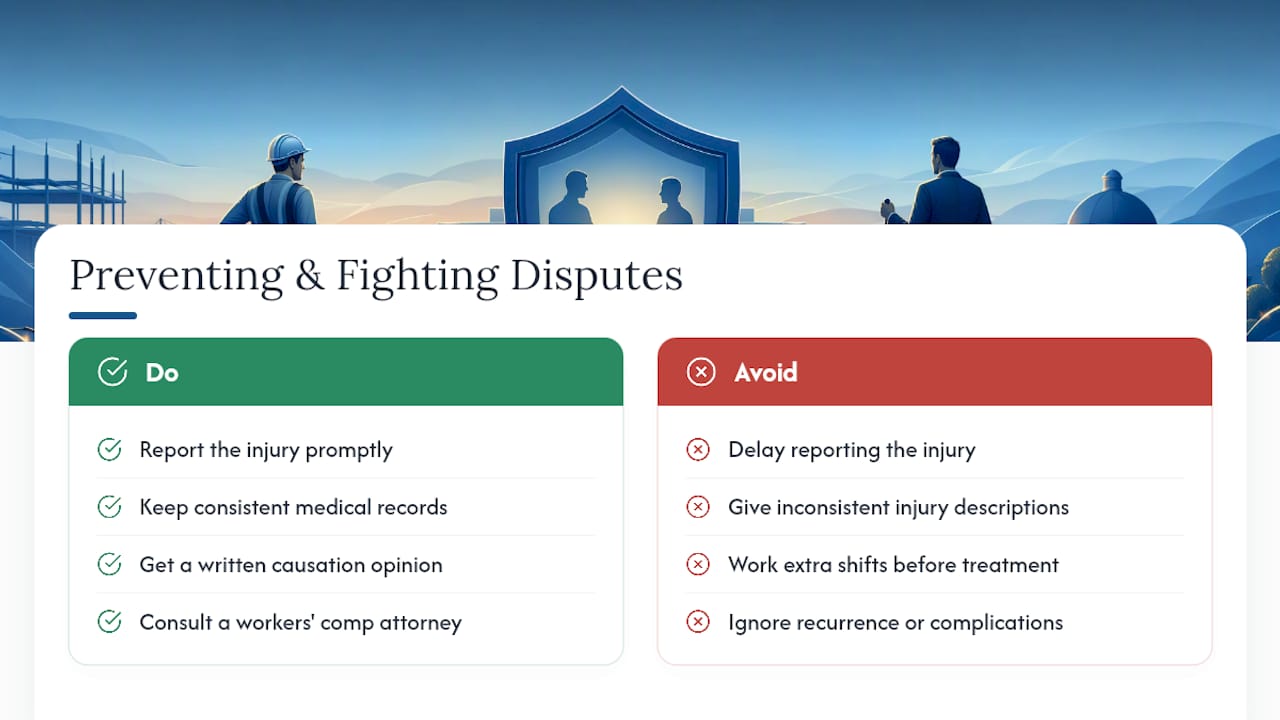
Causation is the most common battleground. Unlike a broken bone from a documented fall, a hernia can develop gradually from repeated strain, making it easy for an insurer to argue it resulted from years of non-work activity rather than a specific shift on the job. Prompt reporting and consistent medical record entries matter enormously here, because delayed reporting or inconsistent descriptions of how the injury happened give adjusters an opening to deny the claim.
Timing of symptoms creates a second flashpoint. If you worked several more shifts before seeking treatment, expect the insurer to question whether the hernia truly happened at work or showed up afterward for unrelated reasons.
Impairment rating disputes show up once you reach MMI. Insurers sometimes push their own independent medical examiner to assign a lower rating than your treating physician did, since even a few percentage points of impairment can swing a PPD award by thousands of dollars.
Recurrence and complication disputes matter too. If your hernia comes back after surgery, or mesh complications require additional procedures, the insurer may argue the recurrence is a new, unrelated condition rather than a continuation of the original claim.
Solid documentation from day one, consistent medical visits, and getting a written causation opinion from your treating doctor address most of these disputes before they escalate. A workers’ comp attorney can also help push back when an insurer’s independent exam produces a rating that doesn’t match your actual limitations, and resources like Jose A Loayza Law’s guidance on surgery and disability factors walk through how these negotiations typically unfold.
Are Hernia Settlements Taxed?
Workers’ compensation settlements, including hernia claims, are generally not subject to federal or state income tax. This holds true whether you receive a lump-sum payment or a structured settlement paid out over time, and it applies to the portions covering medical expenses, TTD, and PPD alike.
There’s one wrinkle worth knowing. If you also receive Social Security Disability Insurance (SSDI) benefits, your workers’ comp settlement can trigger an “offset,” reducing your SSDI payment. The IRS treats the offset portion as taxable in some circumstances, since it’s technically replacing what would have been taxable SSDI income. This mostly affects workers whose combined benefits exceed a threshold tied to their prior earnings, so it’s worth flagging to a tax professional if you’re drawing both benefits at once.
Attorney fees, typically taken as a percentage of your settlement, reduce what actually lands in your pocket but don’t change the tax-free nature of the underlying award. Medical liens, including Medicare reimbursement claims, work the same way. They come out of your settlement before you see the check, which is why understanding how liens affect net recovery matters just as much as the headline settlement number.
What Happens After You Settle
Signing a settlement release doesn’t necessarily end your relationship with the workers’ comp system, and what happens next depends heavily on what kind of settlement you signed.
If your settlement closed future medical benefits entirely, you’re on your own for any hernia-related treatment going forward, including recurrence or mesh complications that surface years later. This is the single biggest reason MMI and a documented impairment rating matter so much before you sign. Once that door closes, it’s closed for good in most states.
If your settlement left medical benefits open, or only closed the indemnity portion, you retain the right to seek treatment for the same hernia if problems resurface. Keep copies of your settlement agreement, medical records, and impairment rating documentation indefinitely. If complications appear later, you’ll need to prove they trace back to the original work injury, and old records are your best evidence.

Watch for recurrence symptoms specifically: new bulging at the surgical site, pain during lifting or straining, or any sign the repair has failed. Report new symptoms to a doctor immediately and reference your original claim number if your medical benefits remain open. Waiting to see if it “goes away” is the same mistake that weakens claims at the front end, and it weakens them just as much after settlement.
A Practical Take on Hernia Claims
Most workers underestimate how much documentation timing matters in a hernia claim. Report the injury the day it happens, not the day it starts really hurting, and write down exactly what you felt and when. That single habit does more to protect your claim than almost anything else.
Be honest about prior hernias. Insurers find old records anyway, and a caught omission costs you more credibility than the disclosure ever would. Push to get a formal impairment rating before agreeing to close out a substantial claim. And bring real numbers, not guesses, into every negotiation. A state-specific estimate built on current caps is the difference between accepting a lowball offer and knowing exactly why you’re rejecting one.
— Daniel
Get a Real Number Before You Negotiate
This tool gives you a state-specific alternative to guessing at your hernia settlement based on secondhand stories from coworkers or forum posts. It uses each state’s actual 2026 benefit caps, so the range you calculate reflects the real formula your adjuster is working from, not a national average that doesn’t apply to your case.
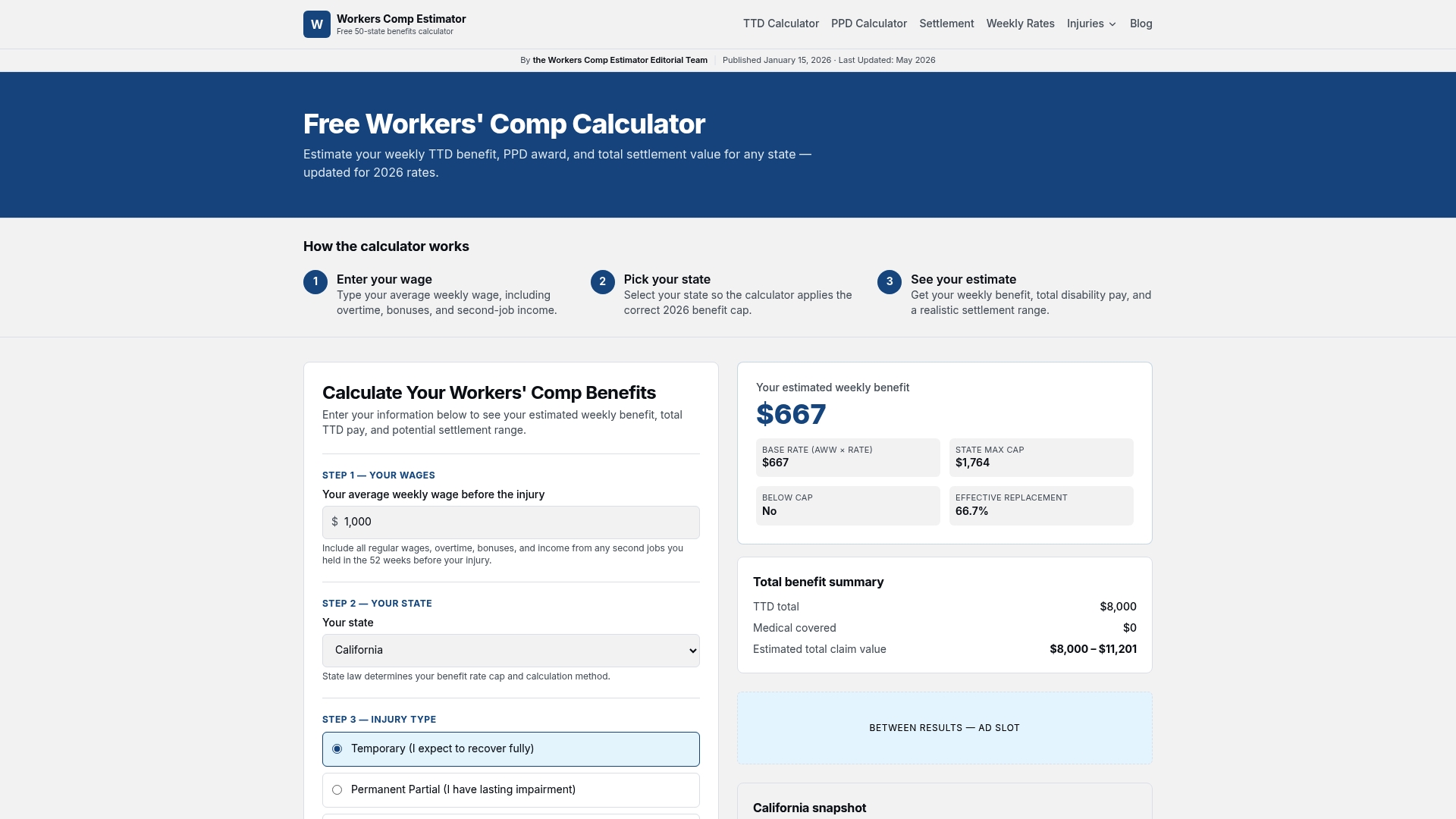
Run your average weekly wage, state, and injury details through the Workers’ Comp Settlement Calculator to get a TTD estimate, a PPD projection, and a settlement range built specifically for your situation. If you want to double-check the weekly cap for your state before you calculate anything, the 2026 weekly benefit rates page lists every state and DC side by side. Save your results and bring them to your adjuster or attorney as your opening number, not theirs.
Sources
- 24 South Carolina Code § 42-9-40 (2024)
- 50-state workers’ compensation settlement chart
- What Is a Hernia Settlement Worth in Illinois Workers’ Comp? — McHargue Law
This article is general information, not a substitute for advice from a qualified financial advisor. Consult a qualified financial professional about your own circumstances before acting on anything here.
FAQ
Is a Hernia Always Covered by Workers’ Comp?
Not automatically. A hernia is compensable when it’s caused or aggravated by a work incident, and some states, like South Carolina, require proof it appeared suddenly and immediately followed a specific accident under SC Code § 42-9-40.
How Much Is a Typical Hernia Workers’ Comp Settlement?
Routine hernia claims commonly settle in the $5,000 to $25,000 range, while cases involving multiple surgeries, mesh complications, or permanent work restrictions can reach six figures. Your actual number depends on wages, medical costs, and your state’s PPD formula.
Should I Settle Before or After MMI?
Wait for Maximum Medical Improvement and a written impairment rating whenever your case involves more than minor treatment. Settling before MMI usually means settling before your real disability level is documented on paper.
Do I Need a Lawyer for a Hernia Settlement?
You’re not required to have one, but an attorney becomes valuable once causation is disputed, a pre-existing hernia is in your history, or the insurer’s independent medical exam produces a lower impairment rating than your own doctor’s. Many workers’ comp attorneys work on contingency, taking a percentage only if you recover money.
Will My Hernia Settlement Be Taxed?
No, workers’ compensation settlements are generally tax free at the federal and state level, whether paid as a lump sum or structured over time. The one exception involves workers also drawing Social Security Disability Insurance, where a benefit offset can create a taxable portion.
How Do I Get a Realistic Estimate for My Own Case?
Run your average weekly wage, state, and injury details through a free settlement calculator built on current state caps rather than relying on national averages that don’t reflect your jurisdiction’s actual formula.
Recommended
More from the blog
Run a state specific 2026 workers' comp settlement calculation. Use the free 50 state calculator to see how state caps change your payout.
Use the free 50-state estimator that applies 2026 state caps to estimate your workers' comp lump sum. Run your numbers, check SSDI/Medicare impact, and...
Use 2026 U.S. state caps and a free 50‑state calculator to estimate your permanent disability workers' comp pay. Learn P&S/MMI ratings, apportionment, and...
Free workers' comp calculators
Put the numbers in this article to work on your own claim.
Weekly benefit, PPD, and settlement in one place.
What your weekly temporary disability check should be.
Scheduled weeks and permanent impairment awards.
Lump-sum value of your full claim.
Turn a 5%, 10%, or 20% rating into dollars.
Max and min weekly rates for all 50 states.
Typical settlement ranges by injury and state.
Fusion, rotator cuff, knee replacement, and more.
When carriers typically make an offer.
What coverage costs by class code and payroll.
Guides, state updates, and claim strategy.