Surveillance Can Cut U.S. Workers’ Comp Pay, Use a 50 State Estimate

Insurance carriers routinely hire investigators to watch injured workers, and they scan social media almost as a matter of course. Most of this is legal because it happens in public, but the rules narrow fast once you cross into trespass, hidden audio, or GPS tracking without consent. If you suspect you’re being watched, your best moves are simple: follow your doctor’s restrictions to the letter, think twice before posting anything physical online, and call a workers’ comp attorney the moment something feels off.
TL;DR:
- Surveillance is limited to public spaces, and investigators cannot trespass, secretly record inside private areas, or use illegal tracking methods.
- Social media activity showing physical exertion or contradictions to medical restrictions can be used against claimants, even if posted publicly.
- Investigators commonly use long stakeouts, hidden cameras, social media scraping, neighbor interviews, and public record checks to build evidence.
- Raw, unedited surveillance footage and investigator notes are crucial for contesting claims, especially if footage is selectively edited or taken out of context.
- Claimants should strictly follow medical restrictions, minimize revealing online activity, and contact a workers’ compensation attorney at the first signs of surveillance.
Table of Contents
- What Counts as Workers Comp Surveillance?
- What Tactics Do Workers Comp Investigators Actually Use?
- How Does Social Media Factor Into Surveillance Workers Comp Cases?
- What Are the Legal Limits on Workers Comp Surveillance Tactics?
- Can Surveillance Footage Actually Hurt Your Workers Comp Claim?
- How Can You Protect Your Workers Comp Claim Right Now?
- When Should You Call a Workers Comp Attorney About Surveillance?
- A 50-State Tool That Helps You Prepare for Negotiations
- Should You Be Worried About Surveillance in Your Claim?
- Plan Your Next Move With a Free Benefits Estimate
- Where to Verify These Rules for Yourself
- Sources
- FAQ
What Counts as Workers Comp Surveillance?
Workers comp surveillance covers four main categories, and understanding which one you’re dealing with helps you gauge how much it can actually hurt your claim.
- Physical surveillance: An investigator parked near your home or workplace, watching and recording your movements in public spaces.
- Video surveillance: Telephoto and hidden-in-plain-sight cameras documenting activity like lifting, driving, or exercising.
- Digital and social media monitoring: Reviewing your public posts, photos, check-ins, and even friends’ tags for anything that contradicts your stated limitations.
- Neighborhood canvassing and records checks: Investigators knocking on doors, asking neighbors questions, and pulling public records like property filings or business licenses.
Anything you do in a public space, from a grocery store parking lot to your own front yard visible from the street, is generally fair game. Your medical records, private conversations inside your home, and anything behind a locked door are not.
What Tactics Do Workers Comp Investigators Actually Use?
Private investigators working workers compensation investigation cases follow a fairly predictable playbook. Knowing it in advance takes away a lot of its power.
- Stakeouts near your home or job site, often lasting several hours across multiple days, timed to catch you leaving for appointments or errands.
- Telephoto video from unmarked vehicles, sometimes parked a block or more away, capturing you carrying groceries, mowing the lawn, or loading a car.
- Social media scraping, where investigators build a profile of your activity from public posts, tagged photos, and check-ins at gyms, restaurants, or events.
- Neighborhood canvass interviews, asking neighbors or coworkers casual questions about what they’ve seen you doing.
- Public record pulls, checking for a side business, a second job, or property records that hint at physical capability.
Once collected, investigators compile everything into a report for the claims adjuster, complete with timestamps, screenshots, and video clips selected to support the insurer’s theory of the case. That packaging matters more than most claimants realize, because a few seconds of video rarely tells the whole story.
How Does Social Media Factor Into Surveillance Workers Comp Cases?
Your online footprint is often the easiest evidence for an insurer to gather, since it requires no stakeout at all. A single photo at a birthday party, a friend’s geotagged post, or a check-in at a hiking trail can end up in a claims file within days.
- Public posts and photos you share directly.
- Geotags and location check-ins attached to posts, even ones you didn’t intend to share widely.
- Friends’ or family members’ posts that tag you or show you in the background.
- Comments describing physical activities, even sarcastic or exaggerated ones.
Not every post is dangerous. A photo of you sitting at a family dinner isn’t the same as a video of you lifting a couch. The line is whether the post shows physical activity that contradicts your documented medical restrictions.
Pro Tip: Set your accounts to private, ask friends not to tag you in photos while your claim is open, and avoid posting anything that shows physical exertion, even innocent activities like carrying a child or bending to garden.
What Are the Legal Limits on Workers Comp Surveillance Tactics?
Private investigators can legally film you in public, but they cannot trespass on your property, enter your home, or use illegal recording methods to get their footage, according to Nolo’s legal guidance. Courts evaluating these disputes generally weigh a claimant’s reasonable expectation of privacy against the circumstances, a balancing test that traces back to the reasoning in O’Connor v. Ortega.
State law adds another layer, and it varies more than most claimants expect:
- Audio recording consent rules differ by state; some allow one-party consent, others require everyone on the recording to agree, which matters if an investigator records conversations.
- Trespass and hidden cameras are restricted in nearly every state when it comes to your home, backyard, or other private areas.
- GPS tracking on your personal vehicle without consent can be a criminal offense in some states, not just a civil violation, according to analysis from Insurance Curator.
Massachusetts, for example, has its own detailed recording consent rules that investigators working in-state must follow. Evidence gathered in violation of these rules can be excluded from your hearing, and in some cases can expose the insurer or investigator to a civil claim.
Can Surveillance Footage Actually Hurt Your Workers Comp Claim?
Surveillance footage carries real weight at hearings, but it’s far from bulletproof. Judges look at chain of custody, context, and whether the footage was edited before it reaches the record.
Courts have pushed back on selectively edited surveillance before. In litigation reviewed by the Alaska Supreme Court, edited video became a central issue precisely because footage stripped of context can misrepresent what actually happened. A ten-second clip of you reaching for a high shelf looks very different without the eight minutes before it showing you wincing in pain.
Insurers frequently pair surveillance with an independent medical exam (IME), using the footage to challenge your credibility during the exam or afterward in a hearing. Attorneys counter this by subpoenaing the raw, unedited footage and the investigator’s original field notes, then cross-examining on gaps, splices, or missing timestamps.

How Can You Protect Your Workers Comp Claim Right Now?
Protecting your claim comes down to consistency between what you say, what your doctor documents, and what shows up in public.
- Follow your doctor’s restrictions exactly, and keep copies of every appointment note, work-status form, and treatment record.
- Limit and clean up your social media, tightening privacy settings and pausing posts that show physical activity of any kind.
- Document anything that looks like surveillance, including a photo of an unfamiliar parked vehicle or a stranger asking your neighbors questions, but never approach or confront the person directly.
- Notify your attorney immediately if you believe you’re being watched, so they can build a record and flag anything improper.
Pro Tip: Keep a simple daily log of your pain levels, activity limits, and medication. It’s harder for an insurer to argue you’re exaggerating when your own contemporaneous notes match your medical file.
When Should You Call a Workers Comp Attorney About Surveillance?
Contact an attorney the moment you suspect you’re being followed, notice a stranger asking questions in your neighborhood, or get scheduled for a surprise IME. Waiting until after a benefits denial makes the fight harder.
- An attorney can subpoena raw surveillance footage and investigator notes rather than relying on the insurer’s edited highlight reel.
- They can challenge chain of custody if the footage’s timeline or handling looks inconsistent.
- They can push back on IME conclusions that lean too heavily on a few seconds of ambiguous video.
Most workers’ comp attorneys work on contingency, taking a percentage of your settlement or award rather than charging upfront fees, so early contact costs you nothing and closes gaps the insurer might otherwise exploit.
A 50-State Tool That Helps You Prepare for Negotiations
Before you sit down with an adjuster or an attorney, it helps to know roughly what your claim is worth. Free online calculators estimate weekly Total Temporary Disability (TTD) and Permanent Partial Disability (PPD) benefits, plus potential settlement ranges, using each state’s 2026 benefit caps.
- Enter your average weekly wage, state, and injury type to get a personalized weekly benefit estimate.
- Compare that number against any settlement offer before you agree to anything.
- Bring the printed estimate into your attorney consult as a starting point for discussion, especially if surveillance evidence has complicated your case.
If surveillance footage has led to a lowball settlement offer, an estimate grounded in your actual state’s caps gives you a concrete number to push back with, rather than guessing whether the offer is fair.
Should You Be Worried About Surveillance in Your Claim?

Here’s the honest read: most injured workers who follow their doctor’s orders and stay reasonably careful online never have a surveillance problem. Investigators aren’t looking for people icing a sore back on the porch. They’re looking for the gap between what a claimant says they can’t do and what a camera catches them doing anyway.
Anxiety about being watched is normal, but it shouldn’t run your life. Document your condition honestly, keep your treatment consistent, and let your attorney handle anything that looks improper. If surveillance was gathered unlawfully, it can be challenged and thrown out. The claimants who protect their benefits aren’t the ones who hide. They’re the ones who stay consistent.
— Daniel
Plan Your Next Move With a Free Benefits Estimate
Free calculators provide an estimate of what a claim may be worth using each state’s 2026 benefit caps rather than generic national averages.
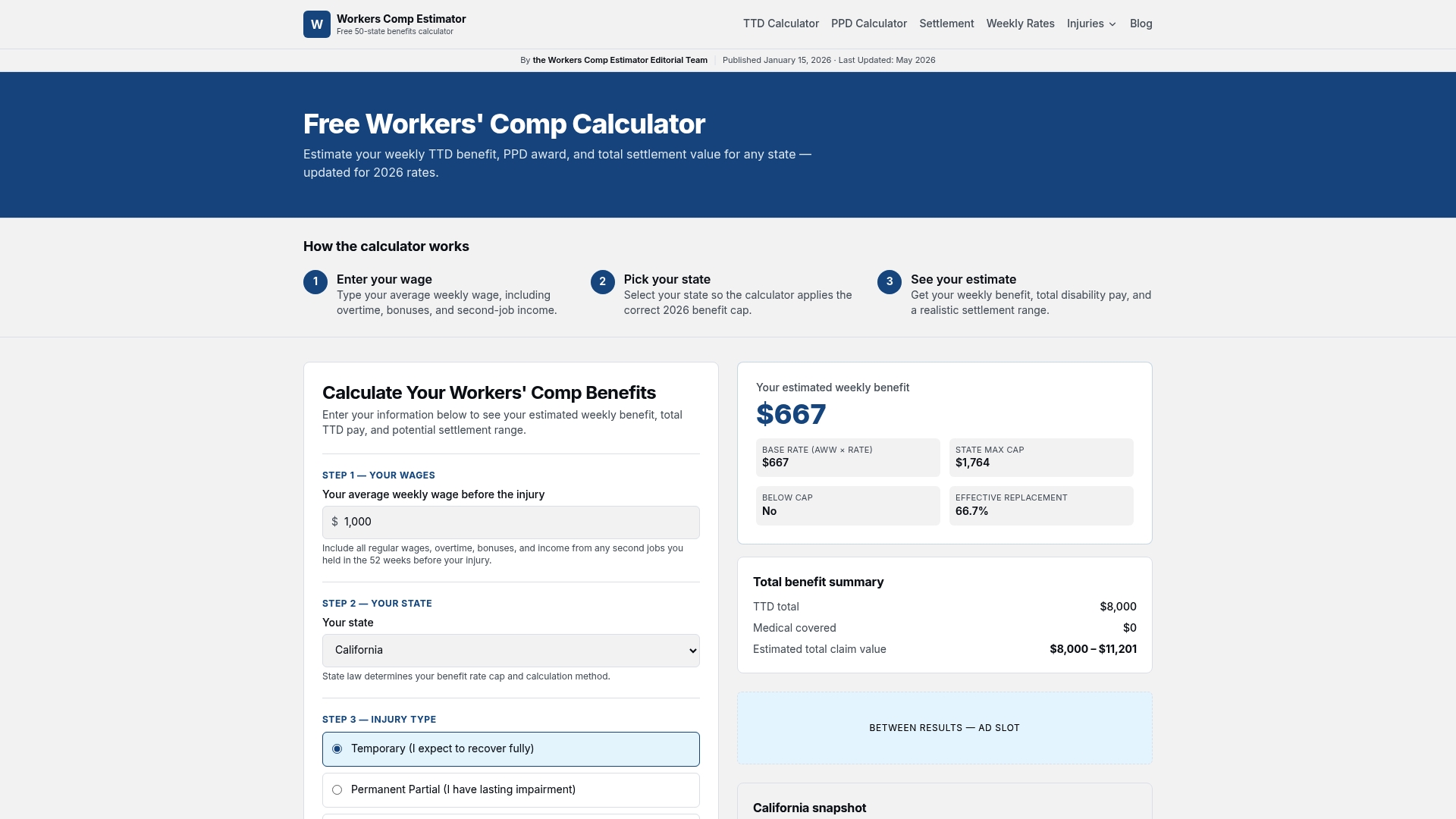
That matters most right when surveillance or an IME complicates your case and an adjuster floats a settlement figure that feels low. Enter your average weekly wage, your state, and your injury type, and the free 50-state calculator returns an estimate of your weekly TTD benefits alongside a potential settlement range. Workers dealing with a back injury can check the dedicated back injury calculator for scheduled award context, while anyone weighing a lump-sum offer can run the numbers through the settlement calculator first. Get your estimate before your next call with the adjuster or your attorney, so you’re negotiating from a number instead of a guess.
Where to Verify These Rules for Yourself
State workers’ comp boards publish the rules that actually govern your claim, and they vary enough that a national guide can only take you so far. Start with your state workers’ comp board for local procedure, and review the O’Connor v. Ortega opinion for the legal framework courts use on privacy questions. California readers facing compliance questions can also check state-specific requirements relevant to their claim.
This article is general information, not a substitute for advice from a qualified lawyer. Consult a qualified legal professional about your own circumstances before acting on anything here.
Sources
- Workers’ compensation fraud: what you need to know — Concentra
- Can the insurance company hire a private investigator to follow me? — Nolo
- O’Connor v. Ortega — Supreme Court opinion (Cornell Law)
FAQ
Can Workers Comp Spy on You Legally?
Yes, insurers can legally hire investigators to observe and film you in public spaces, since there’s no reasonable expectation of privacy there. They cannot trespass on private property, enter your home, or use illegal recording methods, and evidence gathered that way can be excluded under established legal guidance.
How Long Does Workers Comp Surveillance Typically Last?
There’s no fixed timeframe. Surveillance can happen over a single day or stretch across weeks, often timed around medical appointments or hearing dates when investigators expect you to be out and about.
Does Social Media Count as Workers Comp Surveillance?
Yes. Public posts, geotags, and even friends’ tagged photos are commonly reviewed by investigators as part of workers compensation fraud checks, and anything showing physical activity that contradicts your stated restrictions can end up in your claim file.
Will Surveillance Automatically End My Benefits?
No. A single clip rarely tells the full story, and courts have recognized that edited footage can misrepresent what actually happened, as seen in the Cornelison litigation. An attorney can subpoena raw footage and challenge context before any benefits are cut.
How Much Might My Workers Comp Claim Be Worth?
That depends on your state, wage, and injury type, since every state sets its own 2026 benefit caps. Workerscompestimator’s free 50-state calculator gives you a personalized weekly benefit and settlement estimate in a couple of minutes at no cost.
Recommended
More from the blog
See how 2026 state caps, wages, and surgery affect your U.S. hernia workers' comp payout. Run a free 50 state calculator for a realistic estimate.
Learn how MMI changes your workers' comp benefits, appeal deadlines, and settlement choices — and run the free 50‑state estimator to estimate your likely...
Use 2026 U.S. state caps and a free 50‑state calculator to estimate your permanent disability workers' comp pay. Learn P&S/MMI ratings, apportionment, and...
Free workers' comp calculators
Put the numbers in this article to work on your own claim.
Weekly benefit, PPD, and settlement in one place.
What your weekly temporary disability check should be.
Scheduled weeks and permanent impairment awards.
Lump-sum value of your full claim.
Turn a 5%, 10%, or 20% rating into dollars.
Max and min weekly rates for all 50 states.
Typical settlement ranges by injury and state.
Fusion, rotator cuff, knee replacement, and more.
When carriers typically make an offer.
What coverage costs by class code and payroll.
Guides, state updates, and claim strategy.