
50 State Calculator: Workers Comp vs Personal Injury Payouts

Workers’ compensation pays your medical bills and part of your wages no matter who caused your injury, but it won’t touch pain and suffering. A personal injury claim can recover both, plus full lost wages, but only if you can prove someone else’s negligence caused the harm. If a third party was involved, you can often pursue both at once, coordinating the two so the workers’ comp system covers your immediate needs while the injury claim goes after the rest.
TL;DR:
- Workers’ comp covers only medical bills and partial wages, never pain and suffering, and benefits are capped and limited in scope.
- Personal injury claims require proving negligence and can include full medical costs, lost wages, pain, and punitive damages, often resulting in higher payouts.
- Filing deadlines for workers’ comp typically range from 1 to 3 years, while personal injury statutes of limitations usually span 2 to 4 years, starting from the injury date.
- When a third party causes the injury, both claims can be filed simultaneously, with workers’ comp benefits continuing until the personal injury case settles or goes to trial.
- A workers’ comp subrogation lien usually applies to any personal injury recovery, reducing the net payout but often still resulting in a higher total recovery overall.
Table of Contents
- Workers Comp vs Personal Injury: Key Takeaways
- Workers Comp vs Personal Injury: The Legal Differences That Decide Your Payout
- Filing Deadlines You Cannot Afford to Miss
- How Much Each System Actually Pays
- Filing Both Claims at Once: How Coordination Works
- Where These Cases Actually Get Decided
- When to Call a Lawyer, and What It Costs
- Which Injuries Typically Trigger Which Claim
- Proving Your Case: A Much Lower Bar in Workers’ Comp
- Pre-Existing Conditions: How Each System Treats Them
- The Defenses You’ll Actually Face
- Do You Owe Taxes on Any of This?
- Why Running the Numbers First Changes Everything
- Get a Real Number Before You Negotiate Anything
- Sources
- FAQ
Workers Comp vs Personal Injury: Key Takeaways
Before diving into statutes and settlement math, here’s what actually matters if you’re hurt on the job right now:
- Workers’ comp covers medical treatment and a percentage of lost wages, but it never pays for pain and suffering.
- A personal injury lawsuit requires proving someone was at fault, but the payout can include non-economic damages workers’ comp never touches.
- Deadlines differ sharply: report your injury to your employer immediately, then confirm your state’s workers’ comp filing window separately from any civil statute of limitations for a personal injury suit.
- When a third party is involved (a driver, a subcontractor, a defective machine manufacturer), both claims frequently run in parallel, and the workers’ comp carrier will usually assert a lien against whatever you recover from the other case.
- Photograph the scene, save medical records, get witness names, and request any police or incident reports before memories fade.
- Talk to a lawyer early, even for a quick consultation, so you don’t miss a third party or sign away rights you didn’t know you had.
Workers Comp vs Personal Injury: The Legal Differences That Decide Your Payout
Workers’ compensation is a no-fault trade-off. States built these systems so injured employees get guaranteed medical care and partial wage replacement without having to prove their employer did anything wrong, and in exchange, employers get protection from most lawsuits over workplace injuries. It doesn’t matter if you tripped over your own feet or if a coworker left a wet floor unmarked. If the injury happened on the job, the benefits generally apply.
Personal injury law works the opposite way. You have to show that another party, not your employer, acted negligently and that negligence caused your injury. That could be a driver who ran a red light while you were making a delivery, a property owner who ignored a broken staircase, or a manufacturer that sold a defective tool. Win that case, and the damages available are far broader than anything workers’ comp offers.
Workers’ comp benefits are capped by statute and typically limited to medical expenses, a percentage of your average weekly wage, and scheduled awards for specific body-part impairments. Personal injury damages can include full past and future medical costs, complete lost earnings (not a percentage), lost future earning capacity, pain and suffering, loss of consortium, and in rare cases involving egregious conduct, punitive damages.
This is where the exclusive remedy doctrine comes in. Because workers’ comp is a guaranteed, no-fault system, most states bar injured employees from suing their employer directly for the same injury. You get benefits automatically, but you generally give up the right to sue your employer in civil court.
The exceptions are narrow. Intentional torts (an employer who deliberately harmed you), certain extreme conduct courts treat as functionally intentional, and situations where an employer illegally failed to carry workers’ comp coverage at all can open the door to a direct lawsuit. These exceptions are fact-specific and hard to win. Don’t assume one applies to your situation without a lawyer reviewing your state’s specific case law first.
Filing Deadlines You Cannot Afford to Miss
Two clocks start running the moment you’re hurt, and they run on completely different tracks. The first is your duty to notify your employer, which in most states must happen within days, not weeks. Waiting can jeopardize your entire workers’ comp claim regardless of how legitimate your injury is.
Notifying your employer isn’t the same as filing your claim. After you report the injury, you (or your employer’s insurer) still have to file the actual claim paperwork with your state’s workers’ comp board or commission. New Jersey, for example, uses Form WC-373 as part of that formal process, and every state has its own version.
Here’s the deadline reality:
- Workers’ comp filing deadlines commonly range from 1 to 3 years depending on the state, sometimes measured from the injury date and sometimes from the last benefit payment.
- Personal injury statutes of limitations commonly range from 2 to 4 years, and this clock is entirely separate from your workers’ comp deadline.
- Occupational disease and repetitive-injury cases often follow a “discovery rule,” where the clock starts when you knew or reasonably should have known about the condition, not when you were first exposed.
- Some states allow tolling (pausing the clock) for minors, certain disabilities, or fraud by the employer, but you should never count on tolling saving a late claim.
Write down your injury date today. File your workers’ comp paperwork immediately, and check your state board’s website or call a workers’ comp attorney to confirm your exact personal injury deadline before you assume you have plenty of time.
How Much Each System Actually Pays
Workers’ comp calculates your weekly benefit as a percentage of your average weekly wage (AWW), usually somewhere around two thirds, subject to your state’s maximum cap. If your AWW is $900 and your state pays 66.67% up to a cap of $1,300, your temporary total disability (TTD) benefit would run around $600 a week. Permanent injuries to a specific body part get a scheduled award based on an impairment rating, while other permanent conditions get an unscheduled award calculated differently depending on the state.
Personal injury damages don’t work off a formula. A jury or settlement negotiation looks at your actual medical bills, projected future treatment, your real lost income (not a capped percentage), diminished earning capacity if you can’t return to your old job, and pain and suffering, which has no statutory ceiling in most states. Loss of consortium and punitive damages come into play in specific circumstances, though punitive damages remain rare and require proof of especially reckless conduct.
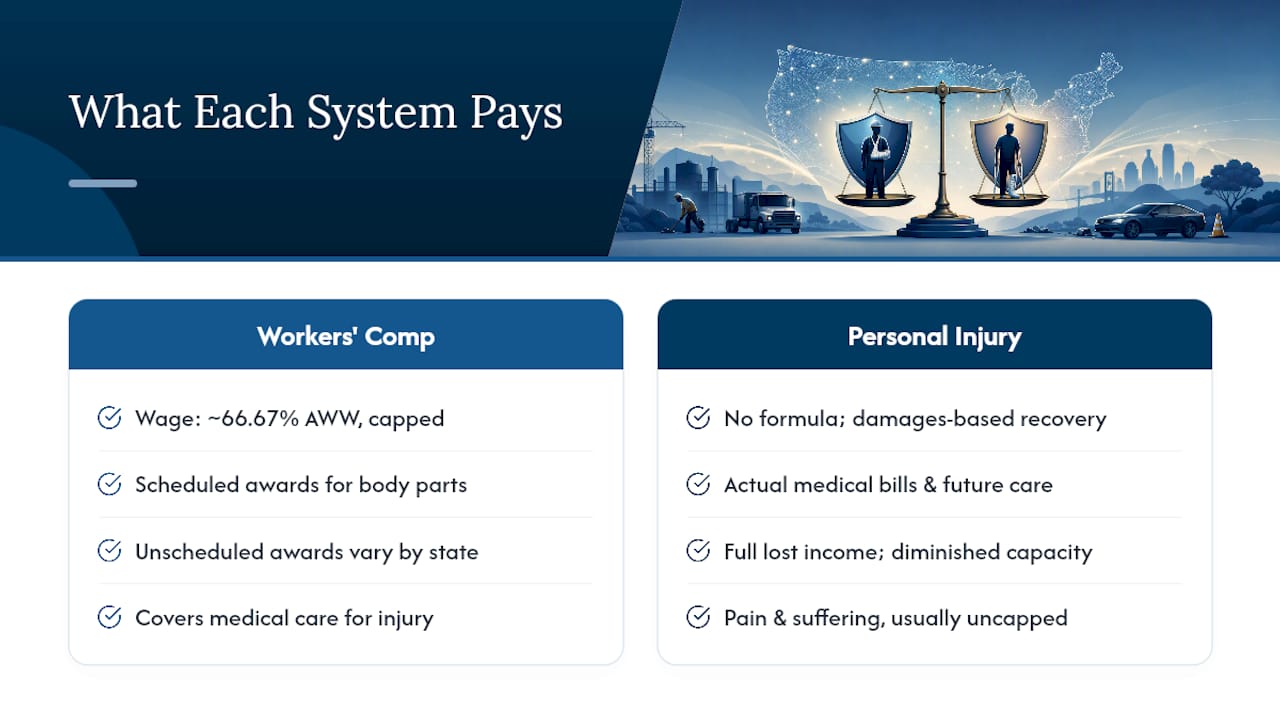
This is why personal injury settlements, when a valid third-party claim exists, tend to dwarf workers’ comp benefits for comparable injuries. Workers’ comp was never designed to make you whole. It was designed to keep you afloat.
There’s a catch. If you receive workers’ comp benefits and later win a personal injury settlement or verdict for the same injury, the workers’ comp carrier typically has a subrogation lien against your PI recovery. The carrier gets reimbursed for what it already paid out before you see the rest. In practice, injured workers usually still net more money pursuing both claims than they would from workers’ comp alone, even after the lien and attorney fees, but exactly how much depends on your state’s lien reduction rules and how your attorney negotiates the payoff. Running your numbers through a settlement calculator before you negotiate gives you a realistic floor to work from.
Filing Both Claims at Once: How Coordination Works
Certain fact patterns create both a workers’ comp claim and a personal injury claim simultaneously. A delivery driver hit by a negligent motorist while on a route. A construction worker injured by defective scaffolding manufactured by a third party. A warehouse employee hurt by a malfunctioning forklift built by an outside company. In each case, the workplace connection triggers workers’ comp, and the outside party’s negligence opens the door to a separate personal injury lawsuit.
Here’s how the two typically move together:
- File your workers’ comp claim immediately to start medical coverage and wage replacement, regardless of whether a third party is involved.
- Identify every potentially liable third party before you sign anything, since missing one early can mean losing that claim entirely.
- Let your workers’ comp benefits continue while your personal injury attorney builds the liability case, gathers evidence, and negotiates with the third party’s insurer.
- Expect the workers’ comp carrier to file a lien against any personal injury settlement, and have your attorney negotiate that lien down before you finalize anything.
- Never sign a release or settlement in either case without your attorney reviewing how it affects the other claim.
Pro Tip: Flag any third party involvement in your very first workers’ comp injury report, even if you’re not sure yet whether you’ll pursue a lawsuit. Naming the driver, the equipment manufacturer, or the property owner on record early preserves your right to bring that claim later, and insurers have been known to argue a late-named defendant was “waived” when it wasn’t mentioned upfront.
Where These Cases Actually Get Decided
Workers’ comp claims move through an administrative system, not a courtroom in the traditional sense. You file with your state’s workers’ comp board or commission, the insurer approves or disputes medical treatment, you may be sent for an independent medical examination (IME), and once you reach maximum medical improvement (MMI), your impairment rating determines your permanent benefit. Disputes go before an administrative law judge, not a jury, and the process moves faster than civil litigation, often resolving within months.
Personal injury cases follow the civil court track: a complaint, formal discovery with depositions and expert witness reports, settlement negotiations, and if no settlement is reached, trial. This process routinely takes one to three years, sometimes longer for catastrophic injury cases with disputed liability. Evidence rules are stricter, appeals work differently, and both sides typically retain medical experts to argue about causation and prognosis.
When both claims exist, your medical records and IME findings from the workers’ comp side often get pulled directly into the personal injury case as evidence, which is one more reason accurate documentation matters from day one.
When to Call a Lawyer, and What It Costs
Certain situations call for immediate legal help rather than a wait-and-see approach: your workers’ comp claim gets denied, you’re facing a permanent impairment rating you think undervalues your injury, the injury is catastrophic, a clear third party caused the accident, or your employer doesn’t carry workers’ comp coverage at all.
Fee structures differ sharply between the two tracks:
- Workers’ comp attorney fees are usually capped by statute or set on a state-approved fee schedule, often a modest percentage of your recovered benefits.
- Personal injury attorneys typically work on contingency, commonly around 33% of the settlement or verdict, meaning you pay nothing upfront and nothing if you lose.
- When both claims exist, the same attorney (or coordinated firms) often negotiates the workers’ comp lien down as part of the personal injury settlement, directly affecting your net payout.
Before your first consultation, bring your accident report, medical records, wage stubs, any denial letters, and a written timeline of what happened. Ask how many combined workers’ comp and personal injury cases the attorney has handled and how they typically negotiate liens.
Which Injuries Typically Trigger Which Claim
Most workplace injuries never involve a third party. A warehouse worker who strains their back lifting a box, an office employee who slips on a wet floor, a factory worker with repetitive strain from an assembly line: these are textbook workers’ comp claims with no outside party to sue. The employer or coworker’s role doesn’t matter because fault is irrelevant to eligibility.
Personal injury claims (often layered on top of a workers’ comp claim) show up when someone outside the employment relationship caused the harm. A traffic accident during a work errand, involving a driver who wasn’t your coworker. A subcontractor’s faulty wiring that electrocutes an employee on a job site. A defectively designed piece of machinery that maims a worker’s hand or causes a traumatic brain injury. Toxic exposure from a chemical supplied by an outside vendor.
The dividing line isn’t the severity of the injury. It’s who caused it. A severe back injury from lifting incorrectly stays purely in the workers’ comp lane. A moderate injury caused by a negligent delivery truck driver opens a personal injury lane too, even though the first injury might be objectively worse.
Proving Your Case: A Much Lower Bar in Workers’ Comp
Winning a workers’ comp claim requires showing your injury arose “out of and in the course of” your employment. You don’t have to prove anyone was careless, reckless, or negligent. You simply have to show the injury happened while you were doing your job, supported by medical documentation connecting the injury to the work activity.
Personal injury claims demand far more. You have to establish four elements: the other party owed you a duty of care, they breached that duty, the breach directly caused your injury, and you suffered actual damages as a result. Each element can be contested, and insurance companies routinely dispute causation even when liability seems obvious.
This difference in burden explains why workers’ comp claims get approved (even if benefits are modest) far more often than personal injury claims succeed in full. It also explains why insurers fight personal injury claims harder. They know a strong negligence defense can eliminate the payout entirely, while a workers’ comp denial usually just delays benefits rather than erasing them.
Pre-Existing Conditions: How Each System Treats Them
A pre-existing condition doesn’t automatically disqualify you from either claim, but it changes how each system evaluates your case. Workers’ comp generally covers the aggravation or worsening of a pre-existing condition, as long as work activity contributed to that worsening. A worker with mild pre-existing arthritis whose knee is further damaged by a fall on the job can typically still recover benefits for the portion attributable to the workplace incident.
The insurer will often try to attribute as much of your impairment as possible to the pre-existing condition rather than the new injury, which lowers your scheduled award or impairment rating. Getting a doctor to clearly document what portion of your current limitation is new versus pre-existing matters enormously here.
Personal injury cases face a similar fight but through a different lens. Defendants often argue your damages should be reduced because you were already predisposed to injury. Most states apply some version of the “eggshell plaintiff” rule, meaning a defendant is still liable for the full extent of harm they caused, even if a healthier plaintiff would have suffered less. That legal principle doesn’t stop insurers from arguing about it, but it does give your attorney solid ground to push back on lowball offers tied to your medical history.
The Defenses You’ll Actually Face
Insurers and employers don’t just pay claims because you asked. In workers’ comp cases, common defenses include arguing the injury didn’t happen at work, claiming you failed to report it within the required window, asserting the injury stems entirely from a pre-existing condition, or alleging you were intoxicated or violating a clear safety rule at the time.
Personal injury defendants raise a different set of arguments. Comparative or contributory negligence claims that you share some fault for the accident, which can reduce or eliminate your recovery depending on your state’s rule. Assumption of risk, arguing you knowingly accepted a danger. Disputing causation entirely, especially in cases involving pre-existing conditions or delayed symptom onset. And straightforward disputes over the value of your damages, particularly pain and suffering, which has no fixed formula.
Both systems also use independent medical examinations as a defense tool. An IME ordered by an insurer sometimes produces a more conservative diagnosis than your treating physician’s, and that gap becomes the centerpiece of the dispute in either track.
Do You Owe Taxes on Any of This?
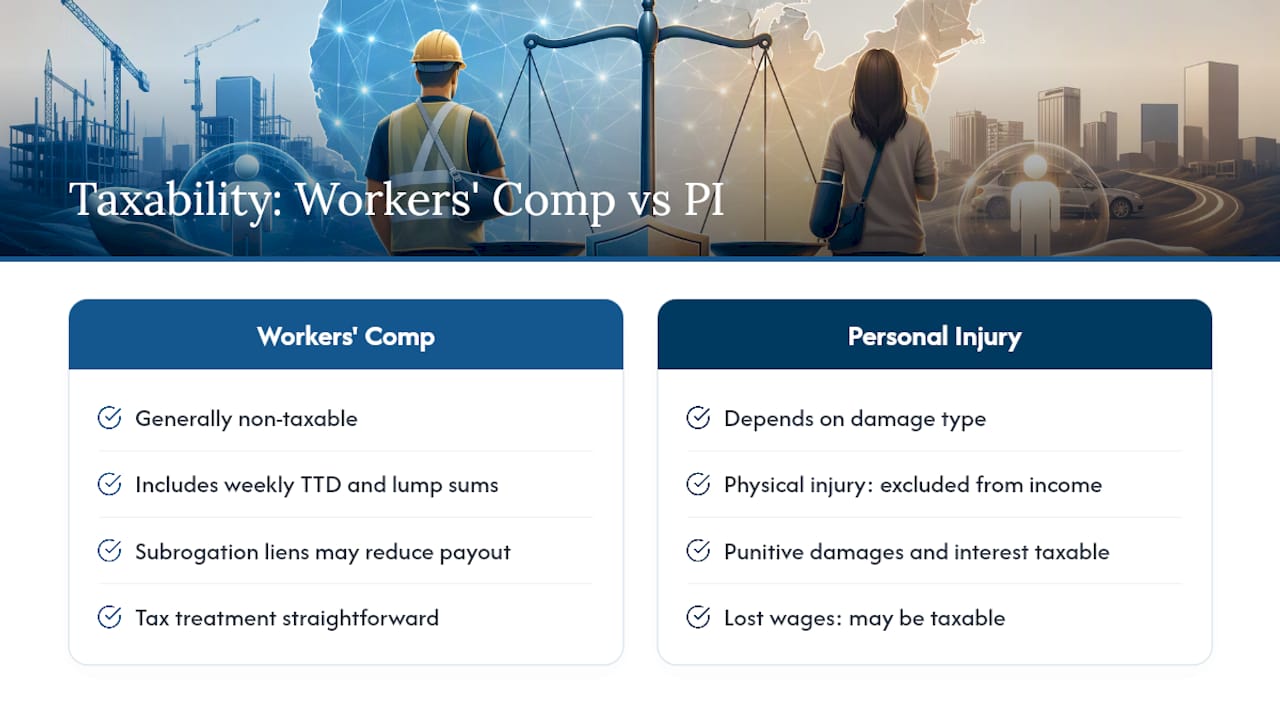
Workers’ compensation benefits are generally not taxable at the federal or state level, whether you’re receiving weekly TTD payments or a lump-sum settlement. That’s one of the more reader-friendly aspects of the system: what you’re quoted is typically what you keep, aside from any subrogation lien deducted before you receive a related personal injury settlement.
Personal injury settlements get taxed differently depending on what the money represents. Compensation for physical injuries or physical sickness is generally excluded from taxable income, covering your medical expenses and pain and suffering tied to a physical injury. Punitive damages, however, are typically taxable regardless of the underlying injury, and interest on a settlement is taxable as well. Amounts specifically allocated to lost wages can sometimes be treated differently than amounts allocated to physical injury, depending on how the settlement is structured.
Because these lines get complicated fast, especially when a settlement bundles multiple types of damages together, it’s worth asking your attorney to structure the settlement agreement with clear allocations, and confirming the tax treatment with an accountant before you file.
Why Running the Numbers First Changes Everything
Most injured workers never see a real dollar estimate until an adjuster hands them a lowball number. That’s backward. Knowing your state’s benefit caps, your likely weekly TTD, and a rough PPD range before you talk to anyone puts you in a completely different negotiating position.
A calculator can’t tell you what a jury might award for pain and suffering, and it shouldn’t try. What it can do is give you a defensible baseline: the medical and wage-replacement numbers workers’ comp actually owes you under your state’s formula. That baseline matters because it tells you what you’re walking away from if you’re weighing whether a personal injury claim is worth pursuing on top of it.
Treat any online estimate as a planning tool, not legal advice. The moment your case involves a denial, a permanent injury, or a possible third party, get a lawyer’s read on the actual numbers before you sign anything.
— Daniel
Get a Real Number Before You Negotiate Anything
Insurance adjusters count on injured workers not knowing their state’s actual benefit caps, and that gap is exactly where lowball offers happen. Workerscompestimator’s free 50-state calculator fixes that by plugging in your state, average weekly wage, and injury type to generate your projected weekly TTD and an estimated settlement range using each state’s 2026 benefit caps.
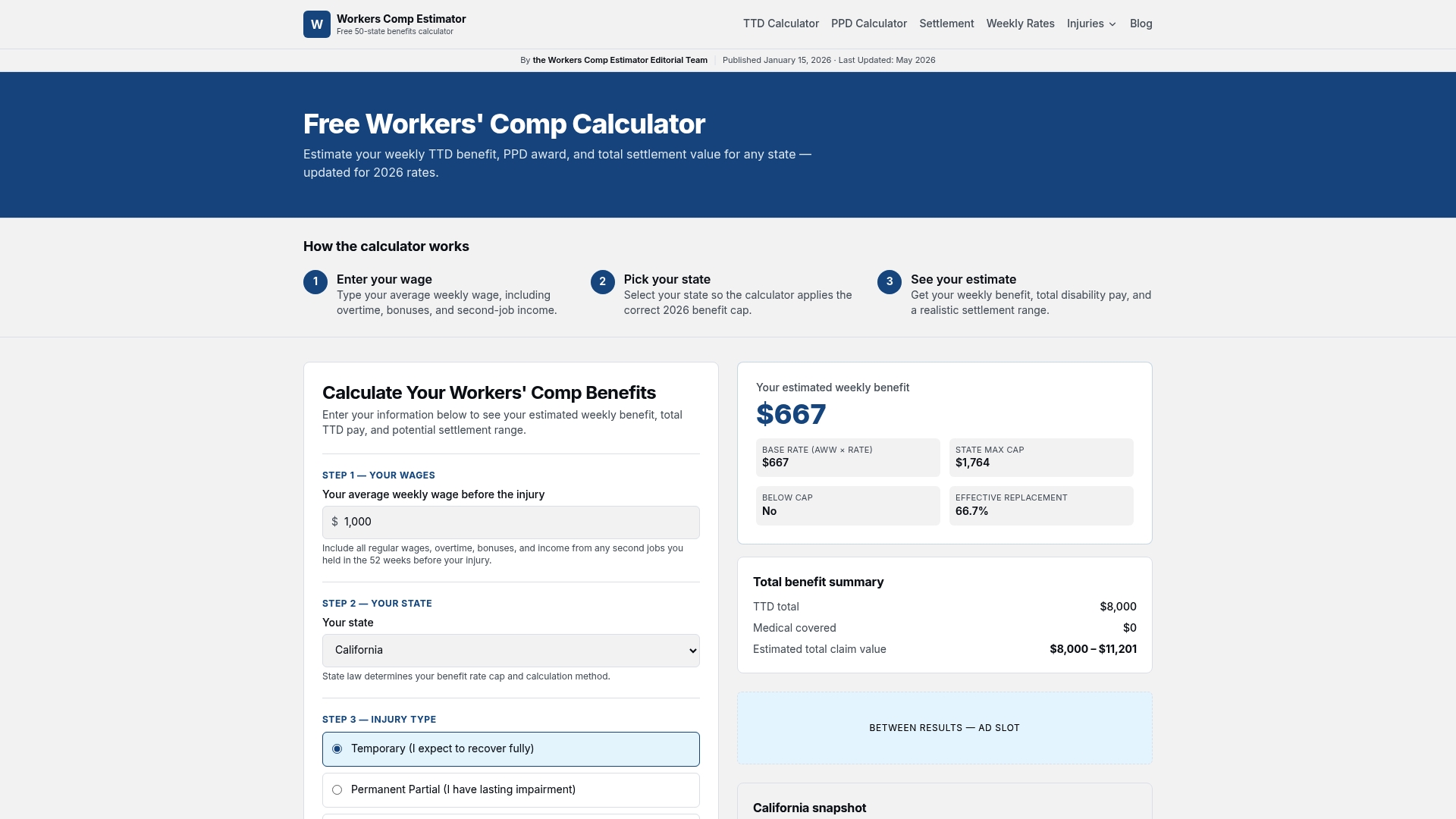
The process takes three steps: enter your state, wage, and injury type; review your weekly TTD estimate and settlement range; then save or print the results to bring to any conversation with an adjuster or attorney. If you’re in Texas, the Texas workers’ comp calculator shows your specific weekly caps for 2026. Whatever state you’re in, run your numbers on the main calculator before you accept anything from an insurance company.
This article is general information, not a substitute for advice from a qualified lawyer. Consult a qualified legal professional about your own circumstances before acting on anything here.
Sources
- Can you file both workers’ comp and a personal injury claim in New York City? — Greenstein & Pittari, LLP
- Workers’ compensation as the exclusive remedy for injuries — FindLaw
FAQ
Are Personal Injury and Workers’ Comp the Same Thing?
No. Workers’ comp is a no-fault benefit system for job-related injuries, while personal injury is a fault-based civil claim against a party whose negligence caused your harm.
What Is the Average Payout for a Personal Injury Claim in the USA?
Payouts vary enormously based on injury severity, liability strength, and state law, since damages include medical costs, lost wages, and pain and suffering with no fixed formula. There’s no single reliable national average, which is why getting your own case evaluated matters more than any generic figure.
What Are the Disadvantages of Workers’ Compensation?
Workers’ comp benefits are capped, exclude pain and suffering entirely, and generally bar you from suing your employer directly due to the exclusive remedy doctrine, even when the injury was severe.
Is It Worth Suing for Personal Injury?
If a third party’s negligence contributed to your workplace injury, pursuing a personal injury claim alongside workers’ comp can recover damages the comp system never pays, though a workers’ comp subrogation lien will typically reduce your net settlement.
Can I File Both a Workers’ Comp Claim and a Personal Injury Lawsuit?
Yes, when a third party caused or contributed to your workplace injury, both claims often proceed together, with workers’ comp covering immediate medical and wage needs while the personal injury case pursues broader damages.
Recommended
More from the blog
Use the free 50-state estimator that applies 2026 state caps to estimate your workers' comp lump sum. Run your numbers, check SSDI/Medicare impact, and...
Run a state specific 2026 workers' comp settlement calculation. Use the free 50 state calculator to see how state caps change your payout.
Learn what drives U.S. hip workers' comp settlement value. Use the $66,634 benchmark, avoid WCMSA mistakes, meet state deadlines, and run a 50 state...
Free workers' comp calculators
Put the numbers in this article to work on your own claim.
Weekly benefit, PPD, and settlement in one place.
What your weekly temporary disability check should be.
Scheduled weeks and permanent impairment awards.
Light-duty benefit when you earn less while healing.
Federal employee FECA award by body part.
Lump-sum value of your full claim.
Turn a 5%, 10%, or 20% rating into dollars.
Max and min weekly rates for all 50 states.
Typical settlement ranges by injury and state.
Average settlement for fusion, rotator cuff, knee replacement, and more.
Why comp does not pay it, and when a third-party claim does.
When carriers typically make an offer.
What coverage costs by class code and payroll.
Guides, state updates, and claim strategy.