
Knee Injury Workers’ Comp: Settlement Ranges and Next Steps

A knee injury workers comp settlement typically lands somewhere between $5,000 for a minor sprain and $100,000 or more for a total knee replacement with permanent impairment. Where you fall in that range depends on three things: whether you needed surgery, your permanent impairment rating, and your state’s maximum weekly benefit. Most cases involving arthroscopy or a meniscus repair settle in a moderate settlement range, while ACL reconstructions and multi-ligament injuries often result in higher settlements.
Before any of that math matters, protect the claim itself:
- Report the injury to your employer in writing the same day it happens, or as soon as you notice it, and keep a copy.
- Get medical care immediately and tell the provider explicitly it happened at work, so it’s documented as work-related from the first visit.
- Preserve evidence: photos of the hazard, names of coworkers who saw it happen, and your own written timeline of symptoms.
- Avoid signing any settlement paperwork until you’ve reached maximum medical improvement (MMI), because signing early usually locks in a lower number.
Every state calculates benefits differently, so run your numbers through a knee injury settlement calculator before you talk settlement with an adjuster.
Key Takeaways
Knee injury settlements depend on three variables you can check yourself: your impairment rating, your state’s weekly benefit cap, and whether the case closes future medical care.
| Point | Details |
|---|---|
| Report immediately | Written notice the same day protects your claim against later disputes over timing. |
| Wait for MMI | Never accept a settlement number before your doctor documents maximum medical improvement. |
| Know your state’s cap | Weekly benefit maximums and scheduled-loss weeks vary by state and directly change your total payout. |
| Get a causation opinion | A written percentage from your treating doctor limits insurer apportionment arguments on pre-existing arthritis. |
| Run your own numbers | Compare a calculator estimate against any insurer offer before signing a release. |
Table of Contents
- Common Knee Injuries at Work and Why Severity Matters
- What Workers’ Compensation Pays for a Knee Injury
- How Knee Injury Settlements Are Actually Calculated
- Average Settlement Ranges and Realistic Examples
- The Step-by-Step Claim Process and Deadlines
- State Differences That Change Your Payout
- Common Insurer Tactics and How to Push Back
- Estimating Your Knee Claim With Workerscompestimator
- Why Numbers Beat Guesswork in a Knee Claim
- Sources
- FAQ
Common Knee Injuries at Work and Why Severity Matters
Knee injuries on the job generally split into two buckets: acute trauma and cumulative wear. Acute injuries come from a single event, a fall from a ladder, a twist while carrying material, a direct blow from equipment. Cumulative injuries build over months or years from repetitive kneeling, squatting, or climbing, and they’re harder to prove because there’s no single incident date.
The specific diagnosis drives much of the valuation math later on:
- Meniscus tears are the most common workplace knee injury and often heal with arthroscopic surgery and a moderate impairment rating.
- ACL, MCL, or PCL tears usually require reconstruction, months of physical therapy, and carry higher permanent impairment ratings than a meniscus repair.
- Patella fractures range from hairline cracks that heal with bracing to comminuted fractures requiring surgical fixation.
- Degenerative arthritis aggravated by work is compensable in most states when a job duty (like years of kneeling on concrete) accelerates an existing condition, though insurers frequently dispute how much of the damage was already there.
BLS data shows falls and overexertion are consistently among the leading causes of days-away-from-work injuries, and knees absorb a disproportionate share of that damage. The injury type, whether surgery gets involved, and how close you get to full function all shape the impairment percentage a doctor eventually assigns at MMI, and that number is the single biggest lever on your final payout.
What Workers’ Compensation Pays for a Knee Injury
Workers’ comp for knee injuries covers more than the hospital bill. Four categories of benefits typically apply, and missing any one of them in a settlement negotiation costs you money.
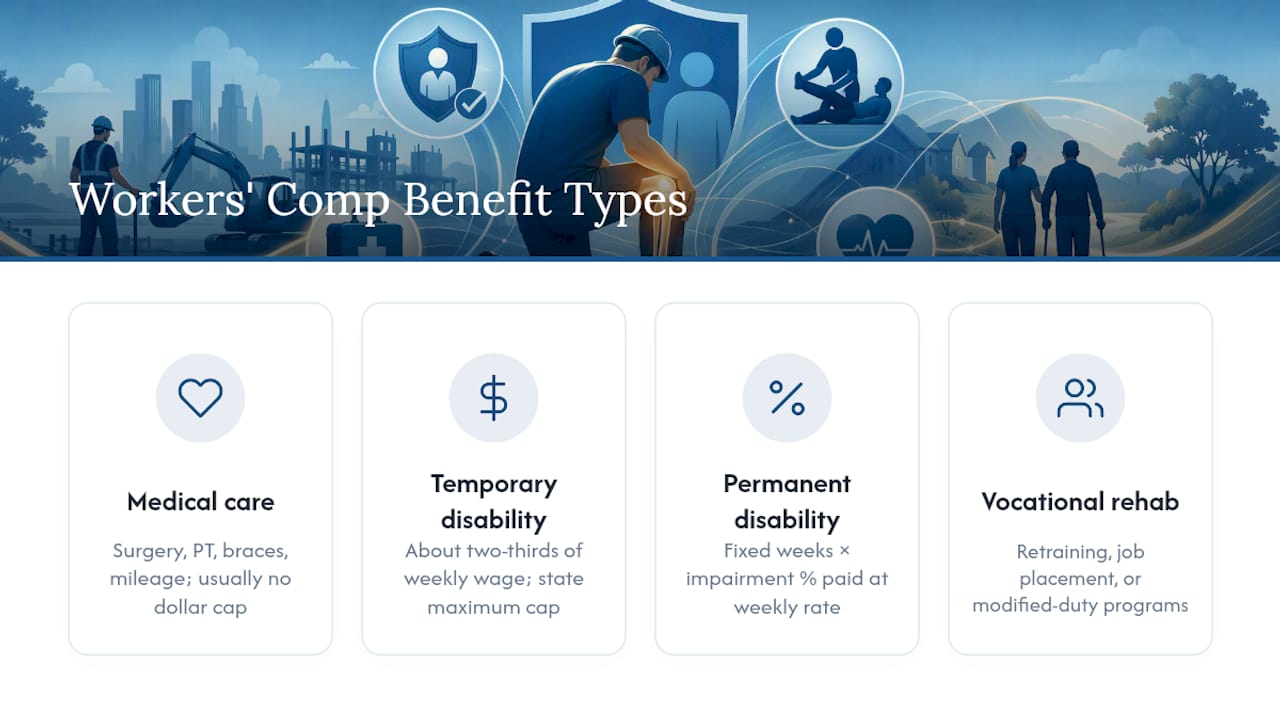
Medical care covers surgery, physical therapy, durable medical equipment like braces or crutches, and mileage reimbursement for travel to appointments. This benefit has no dollar cap in most states as long as treatment is tied to the injury and deemed medically necessary.
Temporary disability (TTD) replaces lost wages while you’re out of work and not yet at MMI. The standard formula is about two-thirds of your average weekly wage, subject to your state’s maximum weekly benefit. That cap matters enormously: a worker earning $1,500 a week in a state with a $900 cap gets $900, not $1,000, regardless of what the two-thirds math suggests.
Permanent disability (PPD), sometimes called a scheduled loss award, compensates for lasting impairment after you reach MMI. States assign the leg a fixed number of compensable weeks, and your impairment percentage determines how many of those weeks you actually collect, converted at your weekly rate.
Vocational rehabilitation kicks in if your knee injury prevents you from returning to your prior job. This can include retraining, job placement assistance, or a modified-duty transition program, depending on state rules.
Nolo’s guidance on filing for workers’ comp benefits confirms these four categories form the backbone of nearly every state’s system, even though the specific dollar amounts and eligibility triggers vary.
How Knee Injury Settlements Are Actually Calculated
Insurers won’t discuss a real settlement number until you hit MMI, the point where your doctor determines your knee has healed as much as it’s going to. That’s the moment a permanent impairment rating gets assigned, and that rating drives everything that follows.
Here’s the calculation sequence adjusters and attorneys actually use:
- Confirm MMI status. No legitimate settlement offer should arrive before your treating physician documents MMI, because the impairment percentage can’t be finalized before then.
- Get the impairment rating. A doctor rates permanent knee impairment as a percentage, often using the AMA Guides to the Evaluation of Permanent Impairment. A 10% rating means a minor residual limitation; 30% or higher usually reflects reconstructive surgery with lasting instability.
- Convert the rating to scheduled-loss weeks. States assign the leg a fixed number of weeks for total loss. LegalClarity’s breakdown notes a commonly used federal reference point of 288 weeks for total leg loss; your state’s own schedule may differ.
- Multiply by your weekly rate. Your weekly comp rate, roughly two-thirds of your average weekly wage capped at your state’s maximum, gets multiplied by the number of weeks your impairment percentage earns you.
- Subtract benefits already paid. Any TTD checks you’ve already received get deducted from a lump-sum settlement offer, since you’re not paid twice for the same period.
At a weekly rate of about $533 (two-thirds of $800, assuming it’s under the state cap), that’s close to $30,900 in permanent disability value before medical costs or TTD are factored in.
Settlements generally take one of two structures. A compromise and release closes the entire claim, including future medical care, for one lump sum, higher upfront but riskier if you need a knee revision surgery in ten years. A stipulated award pays the scheduled amount but leaves medical benefits open, lower upfront value but ongoing coverage if complications resurface.
One more wrinkle: apportionment. If you had pre-existing arthritis or a prior knee injury, insurers will argue part of your current impairment predates the work incident, and they’ll try to reduce the settlement by that percentage.

Pro Tip: Ask your treating physician for a written causation opinion stating what percentage of your current impairment is attributable to the work injury versus any pre-existing condition. A vague chart note gives the insurer’s apportionment argument room to grow; a specific percentage from your own doctor limits it.
Average Settlement Ranges and Realistic Examples
Settlement amounts for knee injuries vary by a factor of twenty or more depending on severity, and treating any single number as a universal benchmark will set the wrong expectation. Some published figures put the reported average knee settlement around $32,000 to $35,000, but that average blends minor sprains with total knee replacements, so it tells you less than it seems to.
Realistic bands look more like this:
- Minor soft-tissue injuries (sprains, bruising, mild strains without surgery): roughly $5,000 to $15,000.
- Meniscus tears requiring arthroscopy: roughly $15,000 to $40,000.
- ACL reconstructions or complex multi-ligament tears: roughly $40,000 to $80,000, depending on the resulting impairment rating.
- Total knee replacement or cases with long-term permanent disability: often exceeds $100,000, particularly for younger workers whose life expectancy means multiple future revision surgeries.
Three quick examples show why the range is so wide. A 58 year old machine operator needing a total knee replacement, with a 40% impairment rating and ongoing future medical needs left open through a stipulated award, could realistically exceed $100,000 once you account for the replacement’s typical 15 to 20 year lifespan and the likelihood of a revision surgery.
Age matters more than most workers expect: a younger claimant with the same injury as an older worker sometimes gets a lower settlement, because insurers assume fewer remaining working years affected, but a higher future-medical exposure, because they’ll likely need a replacement revised decades sooner.
The Step-by-Step Claim Process and Deadlines
Filing correctly the first time avoids the single most common reason legitimate claims get denied: procedural mistakes made in the first 48 hours.
- Report the injury in writing immediately. Verbal reports get disputed later; a written notice, even a text message with a timestamp, doesn’t.
- Get medical treatment right away, and check your state’s rules on whether you or your employer chooses the treating provider, this varies significantly.
- File the formal claim with your employer’s insurance carrier or your state’s workers’ comp board, depending on state procedure.
- Wait for insurer review. Carriers typically have about 14 to 30 days to investigate and respond, and FFVA Mutual’s data shows roughly 89% of claims nationally get accepted, with an average decision time of about 18 days.
- Receive your claim number and initial benefits, if approved, and begin tracking every dollar paid so you can verify it against your own calculations later.
Two timeline traps catch workers off guard. First, notice deadlines (often 30 to 60 days depending on the state) are separate from filing deadlines (often one to three years), and missing either can bar your claim entirely. Second, for cumulative injuries like degenerative knee wear from years of kneeling, many states apply a “discovery rule,” meaning the clock starts when you knew or should have known the condition was work-related, not the day you started the job.
Pro Tip: If your employer disputes when they were notified, a dated text message or email you sent reporting the injury is worth more than a verbal conversation you can’t prove happened.
State Differences That Change Your Payout
No two states calculate a knee injury settlement the same way, and that variation alone can double or triple the same injury’s value depending on where you happen to work.
- Weekly benefit caps vary widely. A worker in a state with a $1,900 weekly maximum keeps far more of their two-thirds wage calculation than one in a state capped near $900, even with identical wages and injuries.
- Scheduled-loss weeks for the leg differ by state, so the same impairment percentage converts to a different total payout depending on the schedule your state uses.
- Notice and filing windows differ, with some states requiring notice within 30 days and others allowing 60, and statutes of limitations for filing that range from one to three years.
- The discovery rule for cumulative injuries applies differently across states, which matters heavily for degenerative knee conditions tied to years of physical labor.
Because these figures update annually, check your state’s current weekly benefit rate table before assuming a national average applies to your case.
Common Insurer Tactics and How to Push Back
Insurance carriers have a limited playbook, and recognizing it early saves you from accepting a number that’s lower than your claim deserves.
- Independent medical exams (IMEs) are frequently used to produce a lower impairment rating than your own treating physician assigned, specifically to justify a smaller offer.
- Apportionment arguments claim part of your impairment predates the work injury, common with knee arthritis, even when the job clearly aggravated it.
- Delayed utilization review stalls approval for surgery or physical therapy, sometimes long enough to pressure a worker into accepting a quick, lower settlement.
Respond by getting a written causation opinion from your treating doctor, documenting how your symptoms progressed since the incident, and requesting your prior medical records to counter apportionment claims directly. If your claim gets denied outright, the offer seems disconnected from your impairment rating, or you’re facing a knee replacement with decades of future medical needs, that’s the point to consult a workers’ comp attorney rather than negotiate alone.
Pro Tip: Most workers’ comp attorneys work on contingency and take a percentage only if they recover more than the insurer’s original offer, so a consultation rarely costs you anything even if you decide not to hire one.
Estimating Your Knee Claim With Workerscompestimator
Running your own numbers before you accept anything from an adjuster is the single fastest way to know if an offer is fair. Workerscompestimator’s settlement calculator asks for five inputs and turns them into a personalized estimate in under a minute.
- Your state determines which weekly benefit cap and scheduled-loss table apply, since these differ on every state page.
- Your average weekly wage sets the baseline for the two-thirds TTD calculation.
- Injury type and severity (sprain, meniscus tear, ACL, replacement) tells the calculator which impairment range to model.
- Days lost from work factors into your temporary disability total.
- Impairment rating, if you already have one from a doctor, sharpens the estimate from a range to a specific number.
The tool applies each state’s 2026 benefit caps automatically, so a Kansas worker capped near $869 a week gets a realistic number instead of a generic national average that doesn’t apply to them.
A calculator can’t replace a signed medical record or a lawyer’s negotiation, but it gives you a number to hold an insurer’s offer against, and that’s often the difference between accepting the first offer and countering it.
Once you have an estimate, gather your medical records, your wage stubs, and your impairment rating documentation, then compare the total against whatever the insurer proposes. If your estimate runs meaningfully higher than their offer, that gap is worth a conversation with an attorney before you sign anything.
Why Numbers Beat Guesswork in a Knee Claim
Most advice on knee injury settlements stops at “it depends,” which is technically true and practically useless to someone deciding whether to sign a release this week. The variables that actually move the number, impairment rating, state cap, and settlement structure, are knowable before you talk to an adjuster, not after.
The conventional wisdom oversells the lawyer as the first call and undersells the paperwork. A causation opinion written the week of MMI is worth more than a rushed attorney consultation six months into a dispute you could have prevented. Insurers count on workers not knowing their own state’s scheduled-loss weeks or wage cap, because a vague opinion is easy to argue down.
Prioritize documentation first: written injury notice, a clear causation statement, and an impairment rating you understand well enough to check the math yourself. Legal help matters most when a denial or a lowball number shows up despite that groundwork, not as a substitute for it.
— Daniel
This article is general information, not a substitute for advice from a qualified lawyer. Consult a qualified legal professional about your own circumstances before acting on anything here.
Sources
- 7 steps of the workers’ comp claims process — FFVA Mutual
- Employer-reported workplace injuries and illnesses (BLS SOII)
- How Workers’ Comp Knee Injury Settlements Are Calculated — LegalClarity
- How to get workers’ comp benefits for a knee injury — Nolo
FAQ
What is the average workers’ comp settlement for a knee injury?
Reported averages fall around $32,000 to $35,000, but that blends minor sprains with major surgeries, so realistic ranges run from about $5,000 for soft-tissue injuries to over $100,000 for a total knee replacement.
How much compensation will I get for a knee injury?
Your compensation depends on your impairment rating, your average weekly wage, and your state’s benefit cap; meniscus tears requiring arthroscopy typically settle between $15,000 and $40,000, while ACL reconstructions often reach $40,000 to $80,000.
How much can I get for a knee injury at work?
Total value combines medical coverage, temporary disability at roughly two-thirds of your wage up to your state’s cap, and a permanent disability award based on your impairment percentage converted into scheduled-loss weeks.
What is a good settlement offer for a knee injury?
A fair offer matches or exceeds your impairment rating converted to scheduled-loss weeks at your correct weekly rate, minus any TTD already paid; running your numbers through a knee injury calculator before responding tells you if an offer falls short.
Recommended
More from the blog
Unlock the secrets of the workers comp settlement formula. Learn how to calculate your payout and maximize your benefits effectively.
Understand how an impairment rating impacts your workers' comp payout. Learn key steps to maximize your settlement before signing any documents.
Discover how to claim workers comp mileage reimbursement in 2026. Learn about state rates, necessary documentation, and useful tips.
Free workers' comp calculators
Put the numbers in this article to work on your own claim.
Weekly benefit, PPD, and settlement in one place.
What your weekly temporary disability check should be.
Scheduled weeks and permanent impairment awards.
Light-duty benefit when you earn less while healing.
Federal employee FECA award by body part.
Lump-sum value of your full claim.
Turn a 5%, 10%, or 20% rating into dollars.
Max and min weekly rates for all 50 states.
Typical settlement ranges by injury and state.
Average settlement for fusion, rotator cuff, knee replacement, and more.
Why comp does not pay it, and when a third-party claim does.
When carriers typically make an offer.
What coverage costs by class code and payroll.
Guides, state updates, and claim strategy.