
Third-Party Settlement and Workers’ Comp: How Liens Work

A third-party settlement is money you recover from someone other than your employer who caused your work injury, such as a negligent driver, an equipment maker or a property owner. You can generally pursue it while still collecting workers’ comp, but your comp insurer usually has a right to be repaid from the settlement. That repayment right is called subrogation or a lien, and it decides how much of the settlement you actually keep.
This guide explains who can be a third party, what a settlement can cover that comp does not, how the lien works, how it can be reduced, and what to check before you sign anything.
TL;DR
- A third-party claim is a separate lawsuit or settlement against someone other than your employer whose negligence or defective product caused your injury.
- It can generally run alongside your workers’ comp claim, and it can cover damages comp does not, such as pain and suffering.
- Your comp carrier typically holds a lien (subrogation right) on the settlement for benefits it already paid. State law decides the size and priority of that lien.
- Fees and costs are often shared with the carrier, which can shrink the lien. The rules differ sharply by state.
- Before you settle, find out what the carrier has paid, whether it must approve the deal, and how the settlement is allocated.
Table of Contents
- What counts as a third-party claim
- What a third-party settlement can cover that comp does not
- Can you collect comp and settle a third-party claim at once?
- Subrogation and the workers’ comp lien, explained
- How state law changes what you keep
- Allocation matters: how the settlement is labeled
- Before you accept a third-party settlement
- Our perspective
- Estimate your benefits before you negotiate
- Frequently asked questions
- Sources
What counts as a third-party claim
Workers’ comp is a no-fault system against your employer. A third-party claim is different: it is a legal action against an entity other than your employer whose negligence caused the injury. Washington’s Department of Labor & Industries describes liable parties as including, besides employers, manufacturers of defective equipment, property owners and contractors.
Common examples:
- Vehicle crashes. A delivery driver, field technician or sales rep hit by a negligent driver can usually claim against that driver, even though comp covers the injury too.
- Defective equipment. A press, ladder, forklift or power tool that fails because of a design or manufacturing flaw points to the maker or distributor. If you want to understand how product liability exposure works from the business side, this overview of product liability coverage shows why manufacturers and sellers carry it.
- Multi-employer worksites. On a construction site, a subcontractor or general contractor who is not your employer may owe you a duty of care.
- Staffing arrangements. Depending on state law, a client company that is not your direct employer may be treated as a third party.
- Someone else’s property. A fall at a customer’s building, caused by a hazard the owner ignored, can support a claim against the owner.
These claims generally require you to prove negligence: a duty of care, a breach, causation and damages. Justia’s overview notes that defective-product claims may proceed under strict liability instead, which can make them easier to bring.
The one party you generally cannot sue is your employer, because comp is the exclusive remedy in most situations. If you are wondering about the exceptions, see our guide on whether you can sue your employer.
What a third-party settlement can cover that comp does not
Workers’ comp is built to pay medical bills and a portion of lost wages. A third-party claim is an ordinary injury case, so it can reach further. According to Shea & Culgin, comp generally does not cover pain and suffering, while a third-party claim can recover it. The same firm notes that comp typically replaces a percentage of wages, often in the range of 60 to 66.67%, whereas a third-party suit can seek full lost earnings.
Broadly, a third-party recovery may include:
- Pain and suffering and emotional distress
- Full lost wages, not just the comp percentage
- Loss of future earning capacity
- Loss of consortium for a spouse
- Medical expenses beyond what comp pays or approves
For serious injuries, the gap can be large. If you want to see what that might look like in your state, our pain and suffering calculator and the workers’ comp vs. personal injury comparison are good places to start, and our piece on pain and suffering beyond comp goes deeper.
Can you collect comp and settle a third-party claim at once?
Generally yes. Shea & Culgin explains that an injured worker can pursue a third-party negligence claim while receiving comp for the same injury, as long as the two are coordinated. Drazin & Warshaw adds the catch: the comp carrier typically holds a subrogation lien on the settlement to prevent a double recovery of the same economic damages.
In practice that means three things:
- Keep your comp claim active. Do not let the third-party case replace it.
- Tell the carrier and the adjuster that a third party may be responsible.
- Do not settle the outside claim without first understanding what it does to your comp rights.
Subrogation and the workers’ comp lien, explained
Subrogation is the statutory right of an employer or its insurer to be reimbursed from a third-party settlement or judgment for the comp benefits already paid to you. The Tennessee Court of Appeals has described this as a statutory subrogation lien on the employee’s third-party recovery, and in that case the benefits at stake included indemnity payments, medical expenses and case-management costs.
The reasoning is simple. Without it, you could collect comp for your medical bills and then collect the same bills again from the at-fault party. Courts often point to a legislative policy favoring insurer reimbursement, as in the California decision Construction Inc. v. Universal Plumbing. The carrier may also have its own right to act against the defendant, as attorney Tal Rubin notes in the Advocate.
The lien is usually based on what the carrier has actually paid, which commonly includes:
- Medical bills and treatment costs
- Weekly wage-replacement benefits (TTD, and in some cases PPD)
- Other costs the statute lets the carrier recover
You can estimate those weekly wage benefits with our TTD calculator, which helps you see roughly what the carrier has paid, and therefore the size of the lien you may face.
How state law changes what you keep
There is no single national rule. The same settlement can leave you with very different amounts depending on where you were hurt.
Make-whole versus first-monies
A quick reference guide from Weil sorts states into two broad camps. In make-whole states, such as Arkansas and Georgia, the insurer’s reimbursement is restricted until the injured worker is fully compensated for the loss. In first-monies states, the carrier gets priority over the recovery. If your damages exceed the settlement, which is common in serious injuries, that difference can decide your net.

Sharing the cost of the lawsuit
Many states make the carrier bear part of the cost of producing the recovery.
- New York. A court may apportion reasonable litigation expenses, including counsel fees, equitably between claimant and lienholder under Workers’ Compensation Law § 29, as the Third Department explained in Rorapaugh.
- Washington. Under RCW 51.24.060, costs and reasonable attorney fees are paid proportionately by the injured worker and the department or self-insurer.
- Texas. The Texas Department of Insurance explains that a carrier’s subrogation interest is limited to the benefits paid or assumed, less the amount the court reduces the judgment for the employer’s percentage of responsibility.
- California. Labor Code 3852 contains special limits for employer recovery involving certain local peace officers and firefighters.
If you live in Washington, our Washington settlement chart and Washington benefits calculator put the state’s numbers in context.
A simple worked example
This is an illustration, not a prediction for your state or case. Suppose a third-party case settles for $300,000, the attorney’s fee is one-third ($100,000) and the carrier has paid $60,000 in benefits. In a state that makes the carrier share fees proportionately, the carrier’s reimbursement is reduced by its share of the fee, so the lien shrinks before it is paid. In a state where the carrier is repaid in full first, the whole $60,000 comes out. The difference between those two outcomes is money in your pocket, which is why the state matters. Ask your attorney to run the numbers under your own state’s statute.
Our guide to what 10 to 25% in attorney fees costs you helps you weigh fee arrangements against the lien.
Allocation matters: how the settlement is labeled
The way a settlement is divided can change the result. In an unpublished opinion, the Washington Court of Appeals observed that when a settlement does not distinguish between general and special damages, the entire amount may be subject to the statutory distribution formula, potentially leaving less for the injured worker. A settlement document that clearly identifies pain and suffering separately from economic loss may protect you better in states that treat them differently. Ask your attorney how your state treats the two categories, and make sure the paperwork reflects the real nature of your damages.
Before you accept a third-party settlement
A settlement can be hard to undo, and it can affect your comp benefits. Go through this list first.
- Get the lien figure in writing. Ask the carrier for an itemized total of what it has paid and what it expects to recover.
- Check whether the carrier must approve. Washington L&I tells workers to contact it before settling and to obtain written approval if the settlement would leave it with less than the benefits it has paid or estimates it will pay. In New York, a third-party settlement requires the carrier’s written consent or a court-issued compromise order, as Porter Law Firm explains.
- Ask about future benefits. Some states let the carrier take credit against your future comp benefits from the net recovery. Know whether that applies to you.
- Confirm the fee split. Find out whether the carrier shares attorney fees and costs, and by what formula.
- Review the allocation. See how the settlement divides pain and suffering, wages and medical costs.
- Check the deadlines. Third-party claims are ordinary injury suits with their own filing deadlines, which differ by state. Do not assume your comp timeline governs them.
- Talk to a licensed attorney in your state. Lien law is technical, and a mistake in how you settle can cost real money.
Our perspective
We built this site because injured workers keep meeting the same problem: they are handed numbers by an insurer and have no way to check them. A third-party case adds another layer. Most people know what they were paid in comp, but few can say what the carrier has paid on their behalf, which is the number the lien starts from.
Our view is that you negotiate better when you know your own baseline. If you can estimate your weekly wage benefits under your state’s 2026 caps, you can see roughly what the carrier has spent and how that compares with what a third-party recovery could add. That is the idea behind our state calculators: they use each state’s current benefit caps and count all income sources, so the estimate is a realistic starting point rather than a generic average.
A third-party settlement is often the largest sum a seriously injured worker will see, so the lien decides far more than people expect. Treat the lien as a number to question, not a bill to accept.
— Daniel
Estimate your benefits before you negotiate
To understand a lien, you need to know what comp has paid and will pay. Our free calculator estimates your weekly TTD benefit and settlement ranges using each state’s 2026 caps, for all 50 states and DC.
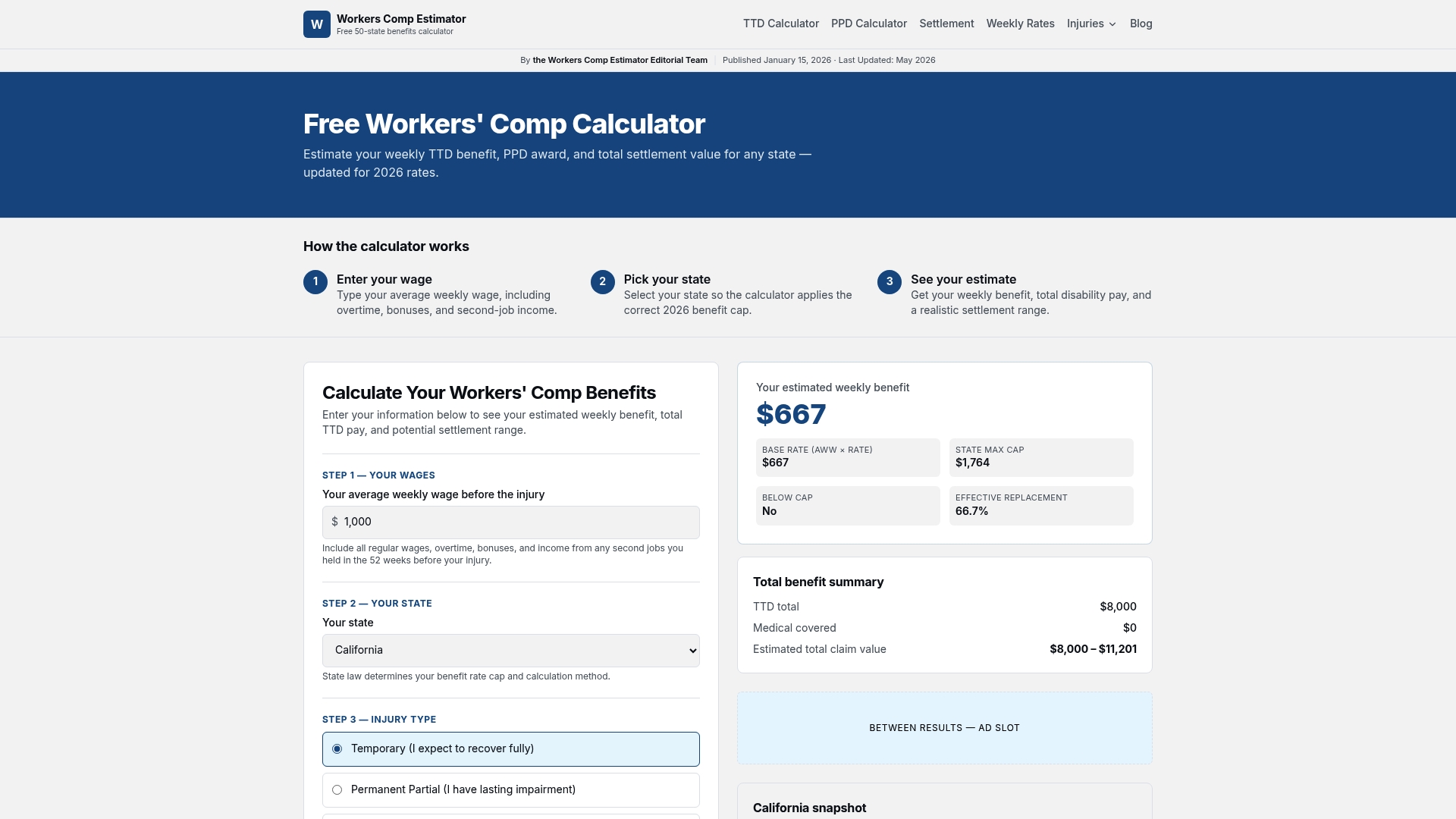
Start with the Workers’ Comp Settlement Calculator, or pick your state’s weekly maximum in our 2026 weekly benefit rates table. If you have a permanent impairment, the impairment rating payout calculator shows how your rating translates to dollars. The tools are free and give estimates only, not legal advice.
Frequently asked questions
Can I get workers’ comp and a third-party settlement for the same injury?
Generally yes. The two claims run separately, and the third-party case can recover damages comp does not pay. The catch is that the comp carrier typically has a lien on the third-party recovery to prevent double payment for the same economic losses. Keep both claims coordinated and tell your attorney about each.
What is subrogation in workers’ comp?
It is the legal right of your employer or its insurer to be repaid from your third-party settlement or judgment for the comp benefits already paid. State statutes set how it works. In some states the carrier gets paid first, while others delay repayment until you are made whole.
Can the lien be reduced?
Often, yes. Many states require the carrier to share the attorney fees and costs of getting the recovery, which shrinks the lien. New York and Washington both have such rules, and a court may apportion expenses equitably. The exact formula depends on your state, so ask your attorney to calculate it.
Do I need the insurer’s approval to settle?
In some states, yes. Washington expects written approval when a settlement would leave the department with less than benefits paid or estimated future benefits, and New York requires carrier consent or a court compromise order. Check your state’s rule before signing.
Does a third-party settlement affect my future comp benefits?
It can. Depending on the state, the carrier may be entitled to credit against future benefits from your net recovery. Ask for this to be addressed in writing before you settle.
Sources
- Injured by a Third Party? Washington L&I
- Third-Party Liability in Work Injury Lawsuits, Justia
- Workers’ Comp Third Party Claims, Shea Culgin Law
- How Third-Party Claims Can Supplement Your NJ Workers’ Compensation Benefits, Drazin & Warshaw
- Court of Appeals of Tennessee, Ryder Integrated opinion
- Construction Inc. v. Universal Plumbing, FindLaw
- Litigating, managing and settling workers’ comp liens, Advocate Magazine
- Weil quick reference guide to subrogation
- Rorapaugh decision, New York Workers’ Compensation Board
- RCW 51.24.060, Washington Legislature
- Advisory 2004-02, Texas Department of Insurance
- California Labor Code 3852
- Washington Court of Appeals unpublished opinion
- Third-Party Claim Lawyer, Porter Law Firm
Recommended
More from the blog
Learn how the 80% SSDI offset works, how lump sum settlements affect payments, and what U.S. workers should check before signing a workers’ comp agreement.
Learn how Texas workers’ comp impairment ratings affect benefits, deadlines, and disputes, then use the payout calculator before accepting an offer.
Unlock the secrets of the workers comp settlement formula. Learn how to calculate your payout and maximize your benefits effectively.
Free workers' comp calculators
Put the numbers in this article to work on your own claim.
Weekly benefit, PPD, and settlement in one place.
What your weekly temporary disability check should be.
Scheduled weeks and permanent impairment awards.
Light-duty benefit when you earn less while healing.
Federal employee FECA award by body part.
Lump-sum value of your full claim.
Turn a 5%, 10%, or 20% rating into dollars.
Travel reimbursement for medical appointments.
Max and min weekly rates for all 50 states.
Typical settlement ranges by injury and state.
Average settlement for fusion, rotator cuff, knee replacement, and more.
Why comp does not pay it, and when a third-party claim does.
When carriers typically make an offer.
What coverage costs by class code and payroll.
Guides, state updates, and claim strategy.