
Get Up to 3–10x More Than Workers’ Comp: See Your U.S. State Gap

Workers’ compensation does not pay for pain and suffering. It covers medical bills and a portion of lost wages on a no-fault basis, but non-economic damages are outside the deal. The main way to recover pain and suffering after a workplace injury is a separate claim against someone other than your employer, an intentional-tort case, or a bad-faith insurer dispute. State rules and reimbursement obligations shape how much of that money you actually keep.
TL;DR:
- Workers’ compensation only covers medical bills and a portion of wages, excluding pain and suffering, which typically requires a separate third-party claim.
- Lawsuits against third parties or for intentional employer misconduct can recover full damages, including pain and suffering, but are limited by state rules and claims conditions.
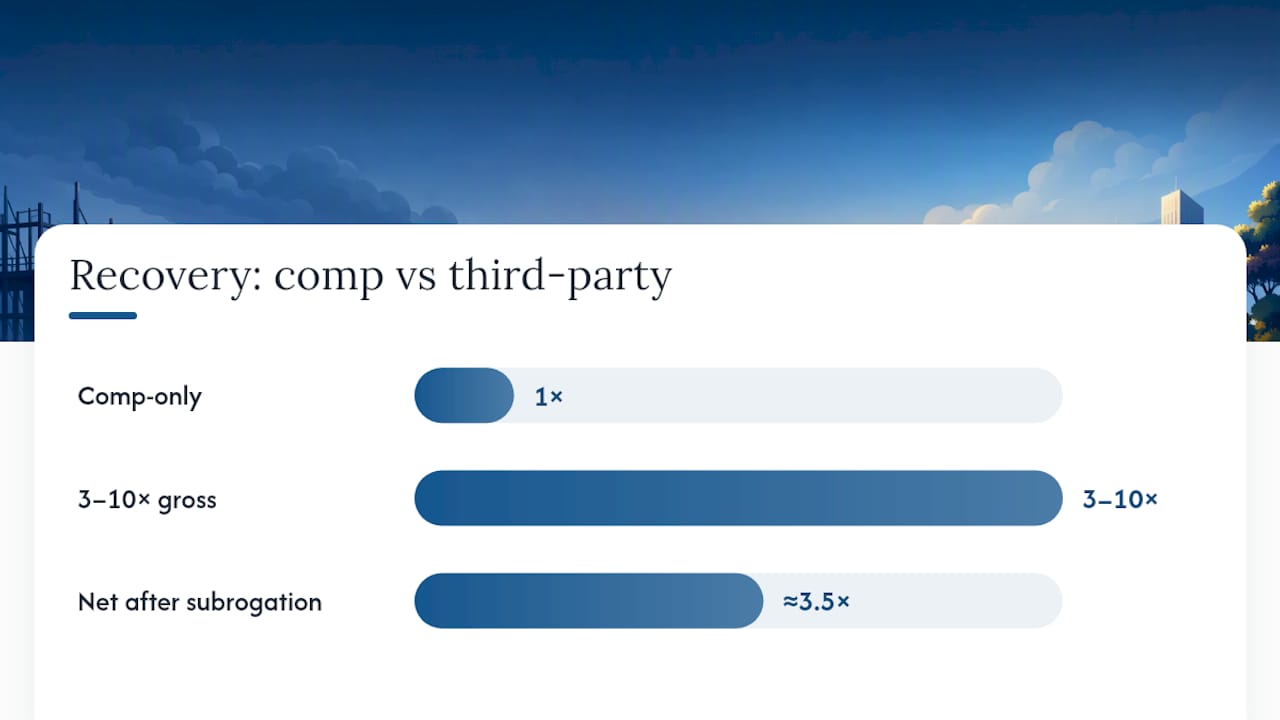
- Third-party recoveries are often significantly higher—up to ten times greater—than workers’ comp benefits for similar injuries, though liens are deducted from settlements.
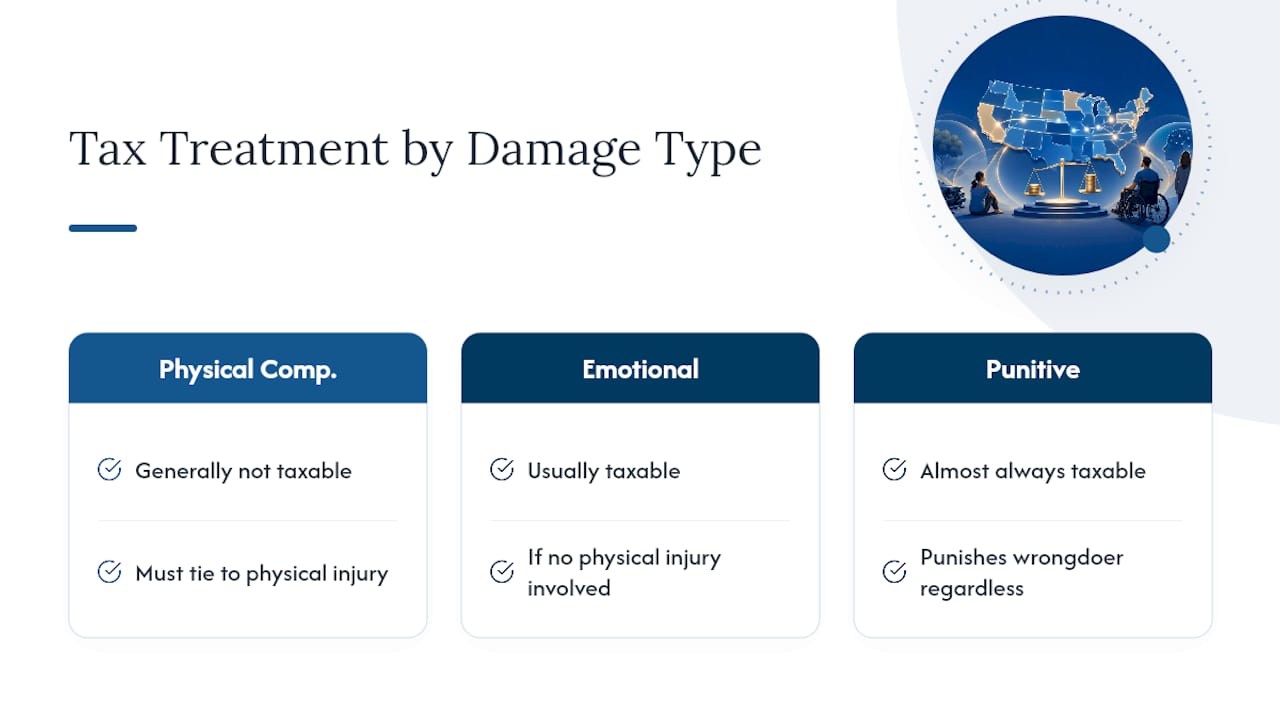
- Settlement damages for pain and suffering are generally tax-free unless they involve emotional distress without physical injury or punitive damages, which are taxable.
- Knowing the estimated workers’ comp benefits and potential third-party recovery can help determine if pursuing additional claims is financially justified before consulting a lawyer.
Table of Contents
- What Workers’ Comp Pain and Suffering Coverage Actually Looks Like
- When You Can Actually Recover Pain and Suffering
- How a Third-Party Lawsuit Affects Your Comp Benefits
- Will You Owe Taxes on a Pain and Suffering Settlement?
- How Pain and Suffering Gets Calculated
- When to Bring in a Lawyer and What to Do Right Now
- Estimating Your Comp Gap With a 50-State Calculator
- The Real Tradeoff Behind Every Workers’ Comp Decision
- Run the Numbers Before You Call an Attorney
- Where to Verify the Rules in Your State
- Sources
- FAQ
What Workers’ Comp Pain and Suffering Coverage Actually Looks Like
Workers’ compensation trades your right to sue your employer for guaranteed benefits, regardless of fault. That’s the whole system in one sentence, and it explains why pain and suffering never enters the picture.
Here’s what you actually get:
- Medical treatment for the work injury, paid directly by the insurer
- Wage replacement, typically around two-thirds of your pre-injury average weekly wage, capped by state maximums
- Permanent partial disability (PPD) awards for lasting impairment to a body part, calculated by schedule
- Death benefits for dependents in fatal cases
This is called the “exclusive remedy” doctrine. You gave up the right to sue your employer for negligence, and in exchange, you don’t have to prove anyone did anything wrong to get paid. Scheduled loss awards and PPD ratings are the closest thing comp offers to compensating for a lasting injury, but they’re calculated off a rate table, not a jury’s sense of your suffering.
When You Can Actually Recover Pain and Suffering
The exceptions aren’t rare edge cases. They come up more often than most injured workers realize, especially in construction, trucking, and manufacturing settings where multiple parties are typically on site.
- Third-party liability claims. If someone other than your employer contributed to your injury, you can generally pursue a separate personal injury lawsuit against them. Common scenarios: a defective machine or tool caused the injury, a subcontractor on a job site acted negligently, another driver caused a work-related car crash, or a property owner ignored a hazard. These claims can recover full damages, including pain and suffering, and often produce far larger totals than comp benefits alone.
- Intentional acts by your employer. If you can show your employer deliberately caused harm, not just negligence, but intent, you may be able to step outside the workers’ comp system entirely. This is a high bar. Courts generally require proof the employer knew injury was substantially certain to occur and did nothing.
- Uninsured employers. In states where carrying workers’ comp coverage is mandatory, an employer who skips it can sometimes be sued directly in civil court, opening the door to non-economic damages.
- Bad-faith insurance handling. If an insurer denies a valid claim without reasonable basis, delays payments improperly, or misrepresents policy terms, some states allow a separate bad-faith claim that can include additional damages beyond the original comp benefits.
Pro Tip: Don’t assume you only have a comp claim just because your employer’s insurer is the one calling you. Ask early whether equipment, a vehicle, or another company’s crew was involved. That single question is often the difference between a comp-only outcome and a case worth six figures more.
State law varies significantly on all four exceptions, so what qualifies in Texas may not fly in Oregon. A quick consultation early in the process costs you nothing in most cases and can prevent you from closing off options you didn’t know existed.
How a Third-Party Lawsuit Affects Your Comp Benefits
Running a third-party lawsuit alongside a workers’ comp claim is common, and often the smartest financial move available. But it comes with a catch: the comp insurer that paid your medical bills and wage benefits typically has a right to be reimbursed from whatever you win in the lawsuit.
This is called subrogation, and it works through a lien on your settlement or verdict.
- The comp carrier tracks everything it has paid out: medical costs, wage benefits, and any PPD award
- When your third-party case resolves, the carrier claims reimbursement first, before you see a dollar
- State rules vary widely on exactly what percentage the carrier can claim, and some states let a court reduce the lien if your attorney negotiates it down
A simplified example: say a third-party lawsuit settles for $150,000. The comp carrier has paid $40,000 in medical and wage benefits and asserts a lien for that full amount. Your attorney negotiates the lien down to $30,000 and takes a one-third contingency fee off the remaining recovery. After the lien and legal fees, you might net somewhere in the $75,000 to $85,000 range, still well above what comp alone would have paid, but noticeably less than the headline settlement number.
Comparative case guides suggest third-party recoveries can run three to ten times larger than a comp-only payout for a similar injury, once pain and suffering is factored in. The gap is real even after subrogation eats into it.
Will You Owe Taxes on a Pain and Suffering Settlement?
Compensatory damages tied to a physical injury, including pain and suffering connected to that injury, are generally excluded from your taxable income under IRS guidance. That’s the good news for most third-party settlements.
Two exceptions matter. Emotional distress damages with no underlying physical injury are usually taxable. Punitive damages, meant to punish the wrongdoer rather than compensate you, are almost always taxable, regardless of what caused the case. The way your settlement agreement allocates funds between these categories affects your tax bill, so this is not a section to skip when your attorney drafts the release.
How Pain and Suffering Gets Calculated
Two methods dominate real-world negotiations, and knowing them helps you sanity-check any number an insurance adjuster throws at you.
- The multiplier method. Add up your economic damages (medical bills, lost wages) and multiply by a factor, typically 1.5 to 5, depending on injury severity. A sprained wrist with a full recovery lands near the low end. A herniated disc requiring surgery and permanent restrictions pushes toward the higher end.
- The per diem method. Assign a daily dollar value to your suffering, often tied to your daily wage, and multiply by the number of days you’re expected to endure the effects.
Catastrophic injuries, amputation, severe burns, traumatic brain injury, can blow past standard multiplier ranges entirely. What actually moves these numbers isn’t the formula. It’s the evidence: detailed medical records, consistent treatment history, and sometimes expert testimony connecting the injury to ongoing pain or conditions like PTSD tied to the physical trauma.
When to Bring in a Lawyer and What to Do Right Now
Not every workplace injury needs an attorney. But certain signals mean you’re leaving money on the table if you handle it alone.
- A third party (equipment maker, driver, subcontractor, property owner) plausibly contributed to your injury.
- You’ve been given a permanent impairment rating or expect lasting restrictions.
- The comp carrier’s lien or subrogation demand seems inflated or poorly documented.
- The insurer is delaying, denying, or lowballing your claim without clear justification.
Most workers’ comp and personal injury attorneys work on contingency, meaning no upfront fee, and they collect a percentage (commonly around a third) only if they recover money for you. That arrangement means it typically costs nothing to at least ask.
Pro Tip: Report the injury in writing the same day it happens, even if it feels minor. Photograph the scene, get witness names, and keep every medical bill and note. Adjusters and defense attorneys look for gaps in the paper trail more than almost anything else.
Estimating Your Comp Gap With a 50-State Calculator
Before you decide whether a third-party case or legal consultation is worth pursuing, it helps to know exactly what workers’ comp alone will pay. Workerscompestimator’s free calculators use each state’s 2026 benefit caps to generate a realistic TTD, PPD, or total settlement estimate based on your wage, state, and injury type.
Take a back injury as an example. Plug your average weekly wage into the back injury settlement calculator, and you’ll see your comp-only estimate, PPD award range, and total settlement projection side by side. If that number looks small next to the severity of your injury, that’s often the signal a third-party claim or attorney consultation is worth exploring.
These tools are informational, not legal advice. Bring your results to an attorney so they can weigh them against the specifics of your case.
The Real Tradeoff Behind Every Workers’ Comp Decision
Workers’ comp gives you certainty: guaranteed medical care and a wage check without proving fault. That security is worth something, especially early on when bills are due and litigation feels distant. But for serious, permanent injuries where someone else’s negligence played a role, walking away from a third-party claim purely for speed usually costs more than it saves. Gather evidence fast, get a lawyer’s opinion before you sign anything, and let the numbers, not the timeline, drive the decision.
— Daniel
Run the Numbers Before You Call an Attorney
Workerscompestimator gives you a concrete number to walk into that consultation with, instead of a guess. Every one of the 50 state calculators, plus DC, is built on 2026 benefit caps, so the weekly figure you see reflects what your state actually allows rather than a national average that doesn’t apply to your case.
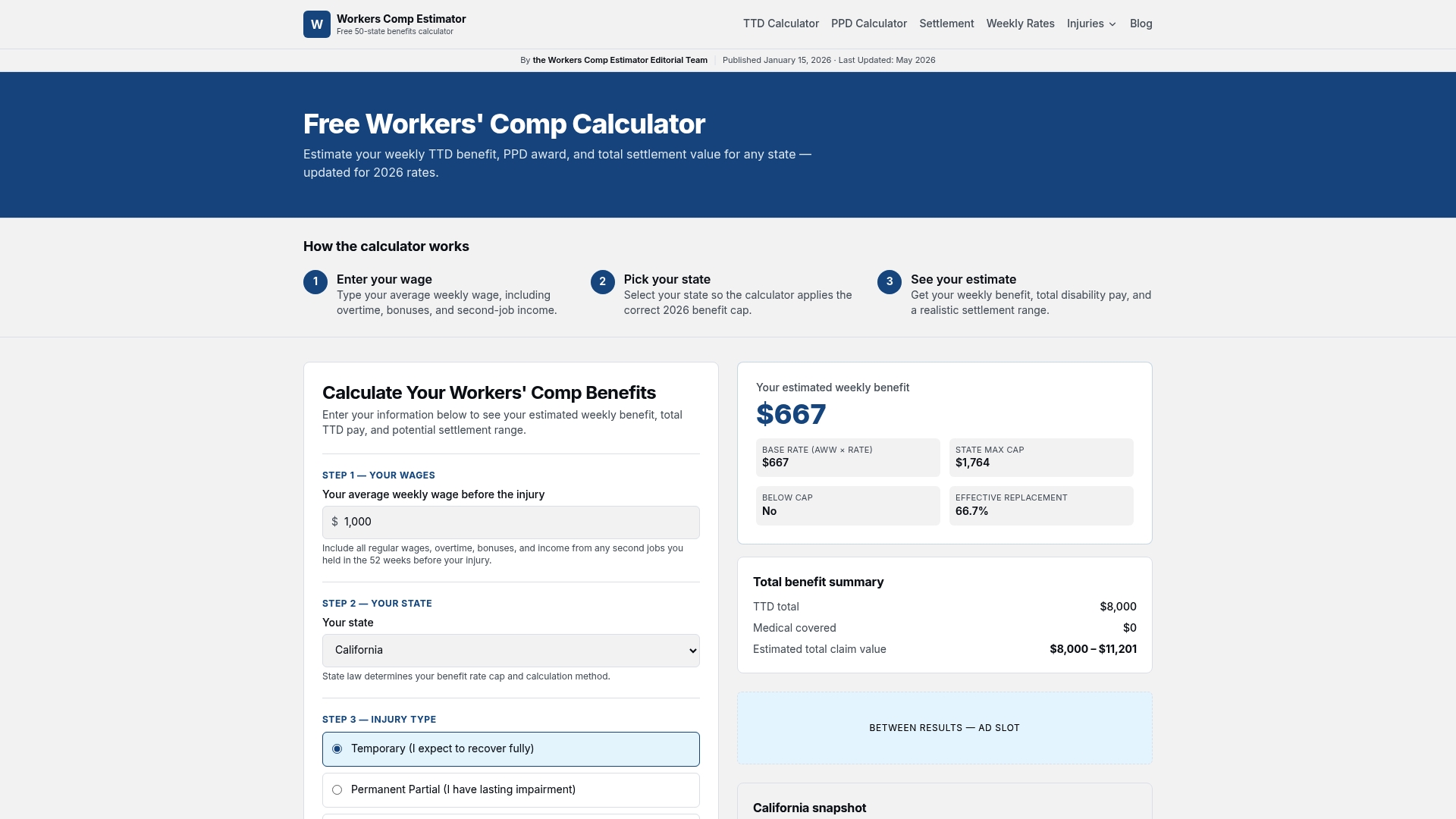
Start with the free 50-state workers’ comp calculator to see your estimated TTD and PPD benefits based on your wage and injury. If the injury involves a body part with a scheduled award, the PPD calculator breaks that down further, and the settlement calculator projects a total range you can compare against any third-party recovery your attorney discusses with you. No account, no personal identifying information required, just wage, state, and injury type. Run your numbers first, then take them into your legal consultation.
Where to Verify the Rules in Your State
For statutes and program details, check the U.S. Department of Labor’s workers’ compensation overview, the IRS guidance on settlement taxation, and your state’s own workers’ compensation agency for local filing rules.
This article is general information, not a substitute for advice from a qualified lawyer. Consult a qualified legal professional about your own circumstances before acting on anything here.
Sources
- U.S. Department of Labor — Workers’ Compensation
- Todoroff Law — Third-party liability
- IRS — Tax implications of settlements and judgments
- Justia — Third-party liability overview
- Cornell Law School — Pain and suffering
FAQ
How much is a good settlement for pain and suffering?
There’s no fixed number. Attorneys typically use the multiplier method, applying a factor of 1.5 to 5 times your economic damages, with severity, permanence, and evidence quality driving where in that range your case lands.
Can I sue for pain and suffering after a workers’ comp settlement?
Yes, if a third party other than your employer contributed to your injury, you can generally still file that separate lawsuit even after settling your comp claim, though the carrier’s subrogation lien will apply to any recovery.
Is it worth suing for pain and suffering?
For serious or permanent injuries with a viable third-party defendant, it’s often worth it, since combined recoveries can run several times higher than comp alone even after liens and legal fees. For minor injuries with no third party involved, there may be no separate claim to bring.
What is a lump sum payment for pain and suffering?
It’s a one-time settlement payment covering non-economic damages, usually paid at the close of a third-party personal injury case rather than through workers’ compensation, which does not include this category of damages.
Does workers’ comp pay for emotional distress?
Generally no. Emotional distress connected to a workplace physical injury is sometimes addressed through medical treatment covered by comp, but it isn’t compensated as a separate non-economic damage the way it would be in a third-party lawsuit.
Recommended
More from the blog
File the correct state claim and collect medical and wage records. Run the free 50 State calculator to see your likely weekly TTD and settlement before...
Run a state specific 2026 workers' comp settlement calculation. Use the free 50 state calculator to see how state caps change your payout.
Learn how MMI changes your workers' comp benefits, appeal deadlines, and settlement choices — and run the free 50‑state estimator to estimate your likely...
Free workers' comp calculators
Put the numbers in this article to work on your own claim.
Weekly benefit, PPD, and settlement in one place.
What your weekly temporary disability check should be.
Scheduled weeks and permanent impairment awards.
Light-duty benefit when you earn less while healing.
Federal employee FECA award by body part.
Lump-sum value of your full claim.
Turn a 5%, 10%, or 20% rating into dollars.
Max and min weekly rates for all 50 states.
Typical settlement ranges by injury and state.
Average settlement for fusion, rotator cuff, knee replacement, and more.
Why comp does not pay it, and when a third-party claim does.
When carriers typically make an offer.
What coverage costs by class code and payroll.
Guides, state updates, and claim strategy.