U.S. Light Duty Workers’ Comp: Estimate Your 2026 Pay Before You Accept

Light duty is work your doctor clears you to do while you’re still recovering, and whether it changes your paycheck depends on two things: what you earn doing it and what your state’s law says. If your light-duty pay matches or beats your old wages, your wage-loss checks usually stop. If it’s lower, you may qualify for temporary partial disability. Either way, get the offer and your medical restrictions in writing before you say yes or no.
TL;DR:
- Most states stop temporary total disability payments if your light-duty pay matches or exceeds your pre-injury wages, but lower pay may qualify you for partial disability benefits.
- Employers can offer but generally cannot force you into a light-duty job that exceeds your medical restrictions, and refusing a compliant offer may suspend benefits.
- Get a detailed, written job offer with specific duties and measurable limits from your employer, and obtain a clear, limit-based note from your doctor before accepting.
- Disputes often arise from job duties gradually expanding beyond the original written offer, so log any changes or additional tasks with dates and sources.
- Using online calculators to estimate your benefits based on your state and injury can strengthen your negotiating position before signing any light-duty agreement.
Table of Contents
- What Light Duty Workers Comp Actually Covers
- Does Light Duty Reduce Your Workers’ Comp Check?
- Can Your Employer Deny or Force Light Duty?
- What Paperwork You Should Demand Before Starting
- Does the ADA Change What Employers Have to Offer?
- Your Next Steps if You’re Offered Light Duty
- An Editorial Take on Light Duty Disputes
- Estimate Your Benefits Before You Sign Anything
- Sources
- FAQ
What Light Duty Workers Comp Actually Covers
“Light duty” is a workplace label, not a medical one, and that gap causes most disputes. OSHA’s recordkeeping rule treats any job that keeps you from performing your routine functions or working a full shift as “restricted work,” regardless of what your employer calls it. A doctor’s note that just says “light duty” without numbers is close to useless when a dispute lands on an adjuster’s desk.
Real light-duty assignments usually look like one of these:
- A lifting cap, often 10 to 25 pounds, replacing your normal physical load
- Shorter shifts, such as four hours instead of eight, while you rebuild stamina
- Desk work, monitoring, or inspection tasks swapped in for physical labor
- A modified workstation, like a stool at a line job that normally requires standing all day
Your treating provider sets the restrictions, not your employer and not the insurance adjuster. When a note is vague, OSHA’s own guidance says to go back and get clarification rather than guess. That single step prevents most of the fights that follow.
Does Light Duty Reduce Your Workers’ Comp Check?
Your wage-loss benefit is tied directly to the gap between what you made before the injury and what you’re earning now. That comparison, not the “light duty” label itself, decides whether your check shrinks, stops, or keeps flowing.
Statistic to know: Usa confirms these programs are run state by state, so the exact formula for calculating your reduced benefit changes depending on where you live and work.
If your light-duty pay is close to or higher than your pre-injury average weekly wage, most states stop temporary total disability (TTD) payments entirely, since you’re no longer losing wages. If the light-duty job pays less, many states shift you to temporary partial disability, which covers a portion of the difference. Oregon and Florida both run this kind of gap-filling calculation, though the percentage and formula vary. Some federal claims under the OWCP system keep paying full TTD if your employer never actually offers compliant work that matches your restrictions.

Run the numbers before you assume anything. A TTD calculator that uses your state’s current caps can show you the real dollar difference between staying on disability and taking the light-duty offer, which matters more than guessing.
Can Your Employer Deny or Force Light Duty?
Employers can offer light duty, but they generally can’t force you into a job that ignores your doctor’s restrictions, and you can’t be denied a light-duty option just because you’d prefer to stay home. Refusing an offer that genuinely fits your restrictions carries real risk, though. Here’s how that risk typically plays out:
- Benefits can pause or stop. If a light-duty offer matches your medical restrictions and you turn it down without a valid reason, many states suspend your wage-loss checks until the dispute is resolved.
- Overpayment recovery is possible in federal claims. OWCP guidance notes that refusing a medically appropriate offer after your doctor clears you can trigger recovery of benefits already paid, or termination of continuation-of-pay.
- Timelines are short and vary by state. Some states, like Nevada, give injured workers as little as seven days to accept or contest an offer in certain situations, so sitting on a written offer is its own risk.
- You can push back if the offer is wrong. If the duties, hours, or pay in the offer don’t match what your doctor actually wrote, put that mismatch in writing immediately and ask your claims administrator or an attorney to review it before you accept or refuse anything.
What Paperwork You Should Demand Before Starting
Every dispute over light duty comes down to a paper trail, and the workers who protect themselves best are the ones who insist on specifics instead of taking a verbal offer at face value.
From your employer, ask for a written job offer spelling out the exact duties, hours, location, pay rate, and a supervisor’s name and contact information. Federal employees under OWCP should recognize this as Form CA-17, the standard duty-status form used to document exactly what a light-duty job requires and confirm it against your medical restrictions.
From your treating provider, ask for numbers, not phrases. A useful note reads something like: no lifting over 10 pounds, sitting up to 7 hours, standing up to 2 hours, walking up to 1 hour, with a review date in two weeks. Anything vaguer invites a fight later.
- Written job offer with duties, hours, pay, and supervisor contact
- Doctor’s note with measurable limits and a review date
- Daily notes on what tasks you actually performed versus what was offered
- Copies of every email or text where duties or hours changed
Pro Tip: If your supervisor quietly expands your duties beyond the written offer, write down the date, the task, and who told you to do it. That log is often the single piece of evidence that reopens a wrongly closed claim.
Does the ADA Change What Employers Have to Offer?
Workers’ comp and disability discrimination law solve different problems, and both can apply to the same injury at the same time. Workers’ comp governs your wage-loss benefits. The ADA and Pregnant Workers Fairness Act, enforced by the EEOC, govern whether your employer must accommodate a disability, including a pregnancy-related condition, regardless of whether it came from a work injury.
A company policy that reserves light duty only for people hurt on the job doesn’t automatically get the employer off the hook for accommodating a disability that didn’t happen at work. If your employer waves off a request for modified duties by pointing to a “light duty is for workplace injuries only” policy, that alone doesn’t satisfy their separate ADA or PWFA obligations. If you suspect you were denied lawful accommodation for that reason, contact the EEOC or your state’s fair employment agency.
Your Next Steps if You’re Offered Light Duty
Protecting your benefits after a light-duty offer comes down to four moves, done in order and documented as you go.
- Get the offer in writing and compare every duty listed against your doctor’s actual restrictions, line by line.
- Ask your treating provider for measurable limits and a review date; if the note is vague, request a clarified version in writing before you start.
- Keep a running log of your actual hours, tasks, and pay, and save every message where your employer changes what was originally offered.
- Estimate the financial impact before you decide anything.
Quick math worth doing: if your pre-injury average weekly wage was an amount similar to typical earnings and your state caps temporary partial disability at a significant portion of the wage gap, a light-duty job paying less could still leave you owed supplemental benefits, depending on your state’s formula. A 50-state benefits estimator built around current caps gets you closer to your actual number than back-of-napkin math. If a light-duty dispute threatens to cut off your benefits entirely, a workers’ comp attorney can usually intervene faster than you’d expect.
An Editorial Take on Light Duty Disputes
Most articles on this topic treat light duty like a simple yes-or-no decision. It isn’t. The real fight almost never happens over whether light duty exists. It happens over whether the job on paper matches the job you’re actually doing three weeks in, after a supervisor has quietly added tasks or stretched your hours back toward full time.
That’s the part injured workers underestimate. A written offer that looks fair on day one can drift into something your doctor never approved, and if you don’t have dated notes showing that drift, you’re relying on your memory against your employer’s paperwork. I’d rather see workers spend ten minutes running numbers through a calculator before accepting anything than spend months later trying to reconstruct what actually happened on the shop floor.
State-specific caps built into workers’ comp calculators exist because generic advice can’t tell you what a 2026 cap in Illinois versus Indiana actually means for your check. Try the numbers before you sign anything, and treat a lawyer as your next call the moment the paperwork stops matching the job.
— Daniel
Estimate Your Benefits Before You Sign Anything
An alternative to guessing your way through a light-duty decision is to use an online workers’ comp calculator that lets you plug in your average weekly wage, your state, and your injury type, and get an estimate based on current 2026 benefit caps.
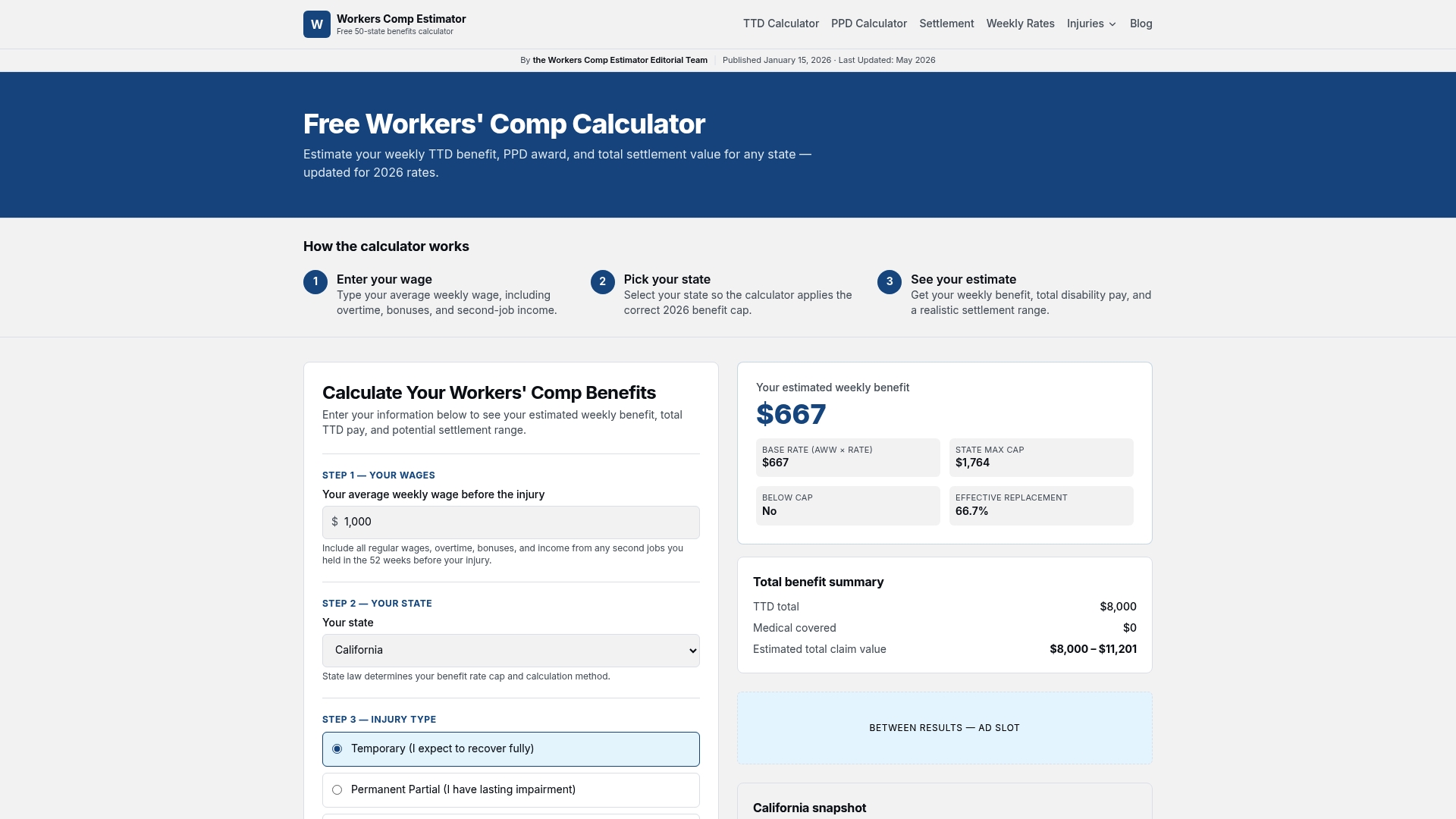
The free 50-state estimator is built for exactly the situation this article covers: comparing what you’d earn on light duty against what your temporary partial disability or TTD would pay instead. If your injury involves your back or knee, the back injury settlement calculator and knee injury calculator go further, estimating potential settlement ranges specific to that body part. Workers in states with unusual caps, like the Massachusetts calculator or the California calculator, can check their state’s actual maximum before agreeing to anything.
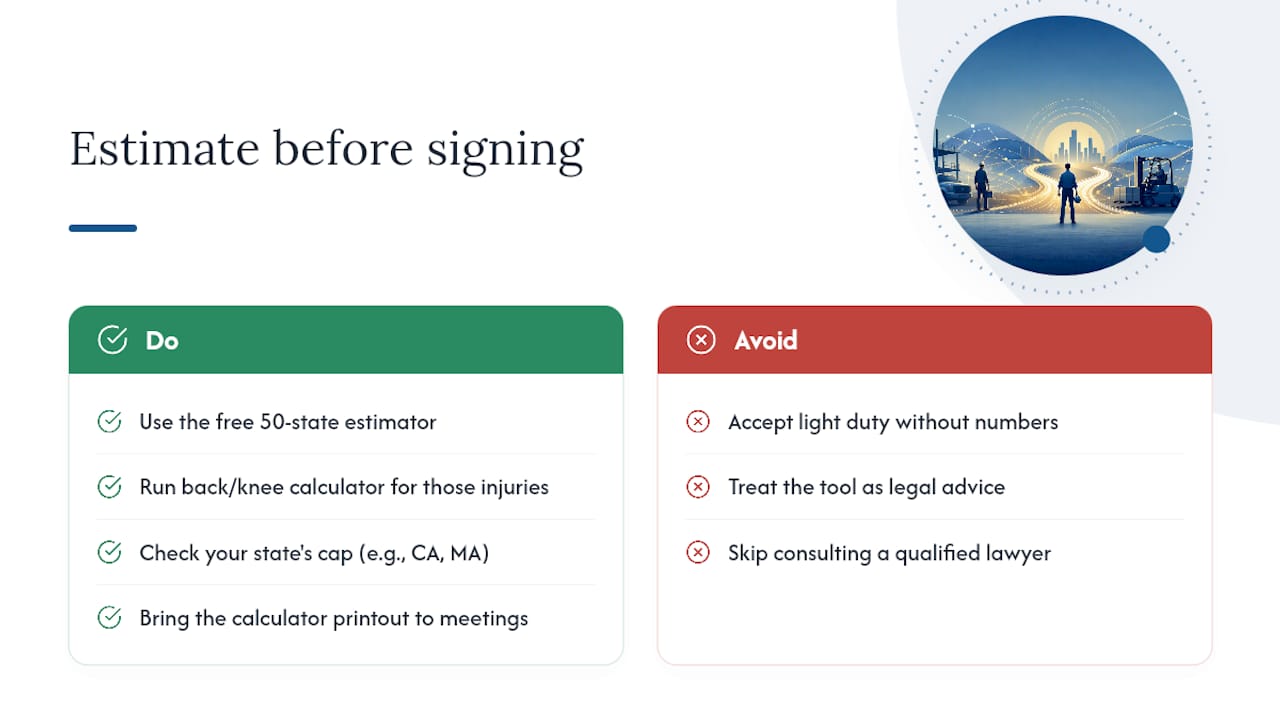
None of this is legal advice, and it isn’t a substitute for your attorney or claims adjuster. But walking into that conversation with a real number in hand changes the leverage in your favor. Run your numbers now and bring the printout to your next conversation with your employer or adjuster.
This article is general information, not a substitute for advice from a qualified lawyer. Consult a qualified legal professional about your own circumstances before acting on anything here.
Sources
- 1904.7 - General recording criteria. | Occupational Safety and Health Administration
- Workers’ compensation | USAGov
- OWCP/FECA return-to-work procedures (DOL)
- Enforcement Guidance: Workers’ Compensation and the ADA | U.S. Equal Employment Opportunity Commission
FAQ
How Long Can You Be on Light Duty at Work?
There’s no fixed federal limit. Light duty typically lasts until your treating provider releases you to full duty or determines your condition has plateaued, which is why your doctor’s note should always carry a review date. Some employers cap light-duty assignments at a set number of weeks under internal policy, but that cap doesn’t override your medical restrictions.
What Are Examples of Light Duty Work?
Common examples include reduced lifting limits, shorter shifts, desk or monitoring tasks, and modified workstations that limit standing or repetitive motion. The specific duties should always trace back to a measurable restriction from your treating provider, not a general label.
How Many Pounds Is Considered Light Duty?
There’s no single legal weight threshold that defines light duty nationwide. Lifting limits are set case by case by your treating provider based on your specific injury, and requests like “no lifting over 10 pounds” are the kind of measurable limit OSHA’s guidance recommends over vague terms like “take it easy.”
Can My Employer Deny Me Light Duty?
Employers aren’t generally required to create a light-duty position if one doesn’t already exist, but if they do offer one, it has to match your medical restrictions. If you believe you were wrongly denied a reasonable accommodation, especially for a disability unrelated to your work injury, EEOC’s ADA and PWFA guidance may give you separate legal grounds to pursue.
Does Accepting Light Duty Lower My Workers’ Comp Settlement?
It can, depending on your state and how your case value is calculated. Since settlement value often reflects lost earning capacity and ongoing wage-loss exposure, earning close to your pre-injury wage on light duty may reduce that portion of a settlement. A settlement calculator built around your state’s rules can help you see that trade-off before you negotiate.
Recommended
More from the blog
See how 2026 state caps, wages, and surgery affect your U.S. hernia workers' comp payout. Run a free 50 state calculator for a realistic estimate.
Learn how MMI changes your workers' comp benefits, appeal deadlines, and settlement choices — and run the free 50‑state estimator to estimate your likely...
Use 2026 U.S. state caps and a free 50‑state calculator to estimate your permanent disability workers' comp pay. Learn P&S/MMI ratings, apportionment, and...
Free workers' comp calculators
Put the numbers in this article to work on your own claim.
Weekly benefit, PPD, and settlement in one place.
What your weekly temporary disability check should be.
Scheduled weeks and permanent impairment awards.
Lump-sum value of your full claim.
Turn a 5%, 10%, or 20% rating into dollars.
Max and min weekly rates for all 50 states.
Typical settlement ranges by injury and state.
Fusion, rotator cuff, knee replacement, and more.
When carriers typically make an offer.
What coverage costs by class code and payroll.
Guides, state updates, and claim strategy.