
Workers Comp Mileage Reimbursement: 2026 State Rates and Claims

Yes, if you’re driving to a doctor’s appointment, physical therapy, or an independent medical exam for a work injury, you’re almost always entitled to mileage reimbursement under workers’ compensation. The rate depends on your state: some peg it to the IRS standard mileage rate, which is 72.5 cents per mile for the first half of 2026 and 76 cents per mile effective July 1, 2026, while others, like California, publish their own binding table through the Division of Workers’ Compensation.
Before you file anything, do these three things:
-
Look up your specific state workers’ comp board page for the current rate and effective date.
-
Save every receipt, from parking tickets to toll records, alongside a mileage log.
-
Ask your claims adjuster which travel reimbursement form they require and where to send it.
Pro Tip: Take a photo of your odometer before and after each medical trip. It’s a small habit that eliminates disputes about mileage later.
Key Takeaways
Mileage reimbursement for workers’ comp medical travel is mandatory in nearly every state once a valid trip is claimed, but the exact rate depends on whether your state follows the IRS figure or publishes its own.
| Point | Details |
|---|---|
| Check the right rate source | Some states follow the IRS rate (76 cents per mile after July 1, 2026); others set their own table. |
| Log every trip | Save dates, destinations, purpose, and receipts for parking and tolls separately from mileage. |
| Confirm trip eligibility first | Preauthorization may be required for long-distance travel or lodging before you drive. |
| Escalate delayed payments | File a written dispute, then contact your state board if the insurer misses the deadline. |
| Pair mileage with a benefits estimate | Use the Workers’ Comp Calculator to estimate weekly benefits alongside your travel reimbursement. |
Authoritative Pages to Bookmark
Check the IRS standard mileage rates page for the current national rate, and California’s Division of Workers’ Compensation benefits page as an example of a state-published table. Your own state board’s official site is the binding authority, always confirm the number there before submitting a claim.
Table of Contents
-
2026 Mileage Rates: What Changed and What It Means for Your Trips
-
Personal Vehicle vs. Company Vehicle: Does It Change Your Claim?
How Workers Comp Mileage Reimbursement Actually Works
Medical mileage reimbursement covers the cost of driving to and from care tied directly to your work injury. That includes doctor visits, physical therapy, diagnostic imaging, pharmacy runs for prescribed medication, and independent medical exams (IMEs) ordered by the insurer. It does not cover a stop at the grocery store on the way home or a detour for anything unrelated to treatment.
Coverage typically includes:
-
Authorized medical appointments and follow-ups
-
Physical therapy, chiropractic care, or rehab sessions
-
Pharmacy trips for prescriptions tied to the claim
-
Vocational rehabilitation appointments connected to the case
Where states diverge is the rate itself. Many simply adopt the IRS standard mileage rate each year, while a handful of states set their own cents-per-mile figure and effective dates that override the federal number entirely.
Pro Tip: If a single trip requires an overnight stay or long-distance travel, call your adjuster before you go. Preauthorization for lodging can mean the difference between full reimbursement and a fight later.
2026 Mileage Rates: What Changed and What It Means for Your Trips
The IRS bumped its standard mileage rate midyear in 2026, from 72.5 cents per mile to 76 cents per mile effective July 1. If your state ties its workers’ comp mileage rate to the IRS figure, that increase applies automatically to trips taken after the effective date. States with their own published schedules, like California, set independent numbers that may not match the federal rate at all.
| Rate Source | Cents Per Mile | Effective Date |
|---|---|---|
| IRS standard rate | 72.5¢ | January 1, 2026 |
| IRS standard rate | 76¢ | July 1, 2026 |
| California DWC table | Varies by table | Published separately by DWC |
Quick math: A 20-mile round trip to physical therapy at 76 cents per mile comes to $15.20. Do that twice a week for a month, and you’re looking at roughly $121.60 in reimbursable travel, before parking or tolls.
Parking fees and highway tolls are almost always reimbursed on top of mileage, not folded into the per-mile rate. Keep those receipts separate from your mileage log so nothing gets lost in the math.
How to Find Your State’s Binding Rate and the Right Form
Don’t rely on a blog post for the exact number you’ll get paid. Follow this sequence instead:
-
Locate your state workers’ comp board’s official page. Search “[your state] workers compensation mileage reimbursement” and confirm you’re on a .gov or state agency domain.
-
Confirm the effective date. Rates change annually or midyear; make sure the number you’re using applies to the date you actually traveled.
-
Download the correct form. Many boards, and insurers, publish a standardized travel reimbursement form. Using the wrong one is a common cause of delay.
-
Note the submission deadline and contact info. Some states require submission within a set number of days after the trip.
Watch for state-specific quirks: minimum distance thresholds before a trip qualifies, annual reimbursement caps, and preauthorization requirements for trips over a certain mileage.
Pro Tip: When possible, use your state board’s official PDF form rather than an insurer’s version, and send it by certified mail with tracking if you’ve had payment delays before. It creates a paper trail that’s hard to argue with.
Calculating Your Expected Reimbursement
The math is straightforward once you have the right rate. Multiply your round-trip mileage by the current applicable cents-per-mile figure, then add any parking or tolls on top.
-
Local trip example: A 12-mile round trip to your orthopedist at 76 cents per mile equals $9.12. Add a $4 parking fee, and your total claim for that visit is $13.12.
-
Long-distance referral example: A 180-mile round trip to a specialist, plus one night’s authorized lodging, comes to $136.80 in mileage alone at 76 cents per mile, on top of the preapproved lodging cost and any tolls.
Save these documents as you go so your claim packet is complete the first time:
-
A mileage log with dates, destinations, and purpose of each trip
-
Appointment confirmation notes from the provider’s office
-
Parking and toll receipts
-
Written preauthorization for any lodging or long-distance travel
Insurers process complete submissions faster, and standardized, well-documented forms are consistently cited as the fastest path to payment.
When Your Mileage Reimbursement Is Delayed or Denied
Start by checking two things: did the insurer confirm this specific trip was covered, and did you submit before the deadline? A surprising number of denials trace back to a missed form field or a late submission rather than an actual dispute over eligibility.
If the carrier still won’t pay:
-
File a written dispute directly with the insurer and request a formal explanation of benefits.
-
Escalate to your state’s workers’ comp board or commission if the insurer doesn’t respond within a reasonable window.
-
Resubmit with complete documentation attached, since incomplete paperwork is the single most common reason claims stall.
Pro Tip: Many states impose interest or financial penalties on insurers who pay late. When you follow up, cite your state’s specific penalty rule by name. It tends to get faster attention than a general complaint.
Verifying You Have the Right Rate
Secondary guides are useful for context, but the number that actually pays your claim comes from two places: the IRS mileage rate announcement and your state board’s own published table.
-
Check the IRS page for the current national business mileage rate and its effective date.
-
Check your state workers’ comp board page for a state-specific schedule, if one exists.
-
Confirm which number controls: if your state publishes its own rate, that figure overrides the IRS number, regardless of what a search result says.
Bookmark both. States that set independent schedules, rather than following the IRS, update them on their own calendar, so the number can shift without matching the federal change at all.
Is Mileage Reimbursement Mandatory or Optional by State?
This is where a lot of injured workers get confused, and understandably so. In the overwhelming majority of states, mileage reimbursement for medical travel tied to a workers’ comp claim is not optional. It’s a statutory right built into the state’s workers’ comp code, meaning the insurer is legally obligated to pay it once you submit a proper claim for authorized travel.
That said, “mandatory” doesn’t mean “automatic.” You typically have to request it. Insurers don’t proactively calculate your mileage and cut a check without a submitted log or form. The obligation is mandatory on the insurer’s side once you’ve made a valid claim, but the process itself is claimant-initiated.
Where states genuinely differ is in the details layered around that core obligation: minimum trip distances before reimbursement kicks in, whether you need preauthorization for certain travel, and how quickly the insurer must pay after you submit. A few states also treat reimbursement differently depending on whether the injury claim itself is still contested versus already accepted.
If you’re unsure whether your state treats this as a hard requirement, the fastest way to confirm it is to check your state board’s own rules on covered travel expenses rather than assume it works the same way it did in a state you used to live in. Workers’ comp law is state-specific by design, and mileage rules are one of the areas where that variation actually matters for your wallet.
Are There Caps on How Much Mileage You Can Claim?
Most states don’t cap the total dollar amount of mileage reimbursement you can receive over the life of a claim. If your treatment requires frequent travel over months, the reimbursement generally keeps accruing at the applicable cents-per-mile rate for each qualifying trip, with no overall ceiling on the total.
Where caps show up more often is at the trip level, not the claim level. Some states require preauthorization once a single trip exceeds a certain mileage or requires overnight lodging, effectively capping what gets paid without prior approval. Others set minimum distance thresholds, meaning very short trips close to home might not qualify for reimbursement at all, even though longer trips to the same type of appointment would.
The practical takeaway: don’t assume there’s a ceiling on total travel reimbursement across your claim, but also don’t assume every trip qualifies automatically. A long-distance referral to a specialist two hours away is exactly the kind of trip that can trigger a distance-based preauthorization requirement, so it’s worth confirming with your adjuster before you drive rather than after.
Because these thresholds vary by state and sometimes by insurer policy on top of the state rule, the safest move is asking your claims adjuster directly: “Does this specific trip need preapproval given the distance?” That one question prevents most of the disputes that come up over trip-level caps.

Personal Vehicle vs. Company Vehicle: Does It Change Your Claim?
Mileage reimbursement under workers’ comp is built around the assumption that you’re using your own personal vehicle to get to treatment. That’s the standard scenario, and it’s what the cents-per-mile rate is designed to compensate you for: gas, wear, and the general cost of running your car for injury-related travel.
If you drive a company vehicle to a medical appointment, the calculation changes. You generally can’t claim standard mileage reimbursement for a vehicle you don’t personally own or lease, since the cents-per-mile rate is meant to offset your out-of-pocket ownership costs, not a vehicle your employer already pays to maintain and fuel. In that situation, your actual fuel cost or a different reimbursement arrangement negotiated with your employer may apply instead.

There’s a middle scenario worth knowing about: if a family member or friend drives you because your injury prevents you from driving yourself, most states still reimburse the mileage for that trip, sometimes at the same rate, since the expense of getting you to treatment is what’s being compensated, not who happened to be behind the wheel. Some states also allow reimbursement for the driver’s return trip if they had to make a special trip solely for that purpose.
If your situation involves anything other than a straightforward personal-vehicle trip, don’t guess. Ask your adjuster how that specific scenario is handled under your state’s rules before you submit the claim, so you’re not stuck reworking documentation after the fact.
Do You Owe Taxes on Workers Comp Mileage Reimbursement?
Here’s good news buried in an otherwise frustrating process: mileage reimbursement paid through your workers’ comp claim is generally not taxable income. It’s treated as reimbursement for an expense you already incurred, not as compensation or wages, so you typically don’t report it on your federal tax return.
This tracks with how the IRS treats mileage reimbursement more broadly under an accountable plan structure, where reimbursements tied to substantiated expenses at or below the standard rate aren’t counted as taxable wages. Workers’ comp mileage payments follow that same basic logic: you’re being made whole for a cost you paid to get medical care for a work injury, not receiving extra income.
Where it can get more complicated is if your total workers’ comp settlement includes a lump sum that isn’t broken out clearly between wage-replacement benefits, medical costs, and travel reimbursement. If your documentation is vague, it’s worth asking your claims examiner or a tax professional to help you understand how any lump-sum settlement is categorized, since the mileage portion itself should remain non-taxable regardless of how the rest of the settlement is taxed.
A note on why this guide exists
I built this guide because injured workers deserve a straight answer about mileage reimbursement, not a maze of conflicting blog posts. The calculators on this site estimate your weekly benefits and settlement ranges, but mileage itself still has to be claimed directly through your insurer or state board using their forms.
How the Free Workers’ Comp Calculator Fits Into Your Claim
Mileage reimbursement covers your travel costs, but it’s only one slice of what you’re owed. The Workers’ Comp Calculator estimates your weekly Total Temporary Disability benefits and potential settlement value using your state’s 2026 caps, so you know the bigger numbers while you’re tracking the smaller ones.
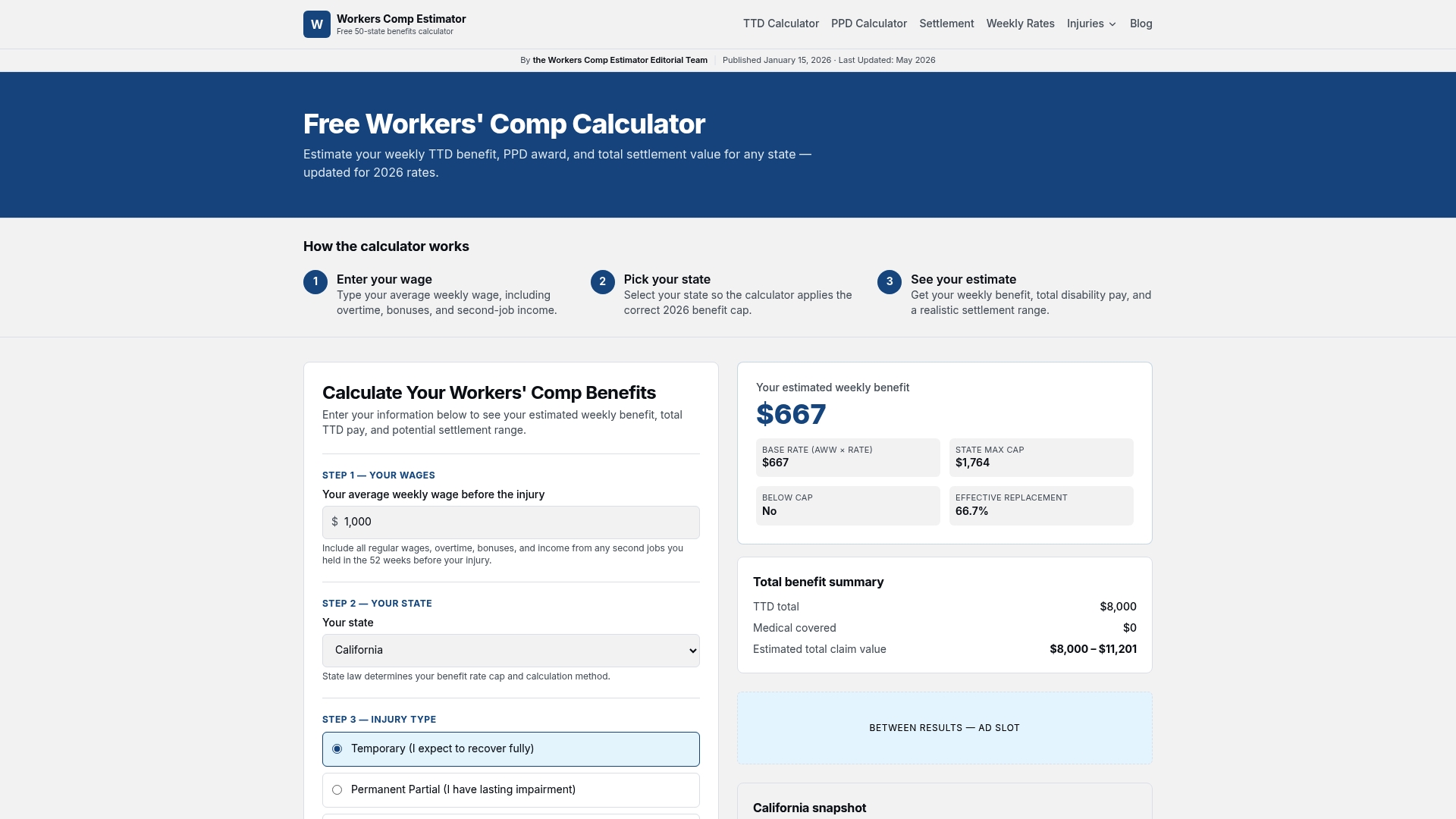
Start by selecting your state to confirm your benefit cap and get an estimate of your weekly TTD payment. If you’re in Michigan or Minnesota, for example, the Michigan Workers’ Comp Benefits Calculator and Minnesota Workers’ Comp Benefits Calculator already reflect this year’s maximums. Then handle your mileage reimbursement separately, using the state rate and forms covered in this guide.
The calculator gives you an estimate for negotiating and planning purposes; it doesn’t file your mileage claim or your benefits claim for you. That still goes through your insurer or state board directly. Run your numbers now on the free 50-state calculator so you walk into your next conversation with your adjuster knowing what you should actually be paid.
Frequently Asked Questions
Does workers’ comp always pay for mileage to medical appointments? In nearly every state, yes, as long as the trip is for authorized treatment tied to your claim. You typically need to submit a mileage log or form to actually receive payment.
What’s the workers’ comp mileage rate in 2026? It depends on your state. Many follow the IRS rate of 72.5 cents per mile through June, rising to 76 cents per mile from July 1 onward. States with independent schedules, like California, publish their own figures.
Can I get reimbursed if someone else drives me to my appointment? Usually, yes, if your injury prevents you from driving yourself. Most states still reimburse the trip’s mileage regardless of who’s behind the wheel.
Do I have to pay taxes on mileage reimbursement from workers’ comp? No. It’s treated as reimbursement for an expense, not taxable income, in almost all cases.
What should I do if my insurer denies my mileage claim? Confirm the trip was covered and your paperwork was complete, then file a written dispute and request an explanation of benefits. If that doesn’t resolve it, contact your state workers’ comp board.
This article is general information, not a substitute for advice from a qualified lawyer. Consult a qualified legal professional about your own circumstances before acting on anything here.
Sources
-
DWC workers’ compensation benefits (California Division of Workers’ Compensation)
-
Mileage Reimbursement for Travel in a Workers’ Comp Case (Nolo)
-
IRS Mileage Rates Increased Again on July 1 (HRWatchdog / CalChamber)
Recommended
More from the blog
Understand U.S. workers comp waiting periods (typically 3–7 days). See state examples, learn how to protect and claim retro pay, and use a free 50 state...
Prepare for a workers comp deposition with a six step checklist and free 50-state 2026 caps calculators to estimate your U.S. claim value.
File the correct state claim and collect medical and wage records. Run the free 50 State calculator to see your likely weekly TTD and settlement before...
Free workers' comp calculators
Put the numbers in this article to work on your own claim.
Weekly benefit, PPD, and settlement in one place.
What your weekly temporary disability check should be.
Scheduled weeks and permanent impairment awards.
Light-duty benefit when you earn less while healing.
Federal employee FECA award by body part.
Lump-sum value of your full claim.
Turn a 5%, 10%, or 20% rating into dollars.
Max and min weekly rates for all 50 states.
Typical settlement ranges by injury and state.
Average settlement for fusion, rotator cuff, knee replacement, and more.
Why comp does not pay it, and when a third-party claim does.
When carriers typically make an offer.
What coverage costs by class code and payroll.
Guides, state updates, and claim strategy.