2026 Wrist Injury Settlement Estimates by State and Injury Date (U.S.)

There is no single “wrist injury settlement” figure because state law, not a national formula, sets the number. A realistic estimate combines your state’s weekly compensation rate on your date of injury with either the scheduled weeks or impairment percentage that state assigns to wrist loss of use, plus temporary disability and medical costs calculated separately. Lump-sum offers add another layer, since state approval rules can change both the timing and finality of what you receive.
TL;DR:
- Your state’s available scheduled weeks or impairment formula heavily influence your wrist settlement, often more than the state’s maximum benefit cap.
- The specific diagnosis, such as a fracture or ligament tear, significantly impacts your impairment rating and, consequently, your settlement amount.
- A lump-sum settlement can include past benefits, future PPD, medical costs, and attorney fees, all subject to state approval and varying rules.
- Use a state-aware settlement calculator with your injury date and wage details to generate accurate estimate ranges before negotiations.
- Medical evidence, including detailed impairment ratings and documentation, plays a critical role in determining the value of your workers’ compensation settlement.
Table of Contents
- How Workers’ Comp Classifies Wrist Injury Settlements
- What Actually Moves Your Wrist PPD Number
- How Lump-Sum Wrist Settlements Actually Work
- Worked Example: Calculating a Wrist PPD Settlement
- Building a Reliable Estimate Range Before You Negotiate
- Common Wrist Injuries and Their Typical Impairment Ratings
- How Medical Evidence Shapes What Your Settlement Is Worth
- Are Wrist Injury Settlements Taxable?
- How a Pre-Existing Wrist Condition Affects Your Settlement
- An Editor’s Take on Getting Ready to Negotiate
- Model Your Wrist Claim With a 2026 State-Aware Calculator
- Sources
- FAQ
How Workers’ Comp Classifies Wrist Injury Settlements
Every wrist claim splits into two distinct phases, and confusing them is the fastest way to misjudge your case. Temporary Total Disability (TTD) covers your healing period, when you can’t work at all, and pays a percentage of your average weekly wage until you reach maximum medical improvement (MMI) or return to work. Permanent Partial Disability (PPD) kicks in after MMI, once a doctor assigns a permanent impairment rating to the wrist.
States handle that PPD calculation two different ways. Some use “scheduled” awards, where the law assigns a fixed number of compensable weeks to a specific body part regardless of your actual wage loss. Others use “unscheduled” formulas tied more directly to impairment percentage, wage loss, or vocational disability. Wisconsin, for example, places “hand at the wrist” on its PPD schedule at 400 weeks, a fixed anchor point regardless of your job title or salary.
The rate that applies to either calculation depends entirely on your date of injury, not the date you settle or the date you file. This matters because states raise their maximum weekly rates annually, sometimes tied to the state’s average weekly wage, as Oregon’s Bulletin No. 111 shows for 2026 computation rules.
-
TTD replaces lost wages during active recovery, usually two thirds of your average weekly wage up to a state cap.
-
PPD compensates for permanent loss of function after MMI, using either scheduled weeks or an impairment formula.
-
The SSA’s chart of state maximum benefits lists the correct weekly cap once you know your date of injury and state.
-
Rates published for 2026 may not apply to an injury that occurred in an earlier year.
Check your own state’s weekly benefit rate against your actual date of injury before assuming this year’s cap governs your claim.
What Actually Moves Your Wrist PPD Number
A high state maximum doesn’t guarantee a high wrist award. The impairment rating and the state’s scheduling method matter far more than the cap itself, since most wrist injuries settle well below the maximum anyway.
Three variables drive the real number:
- The specific diagnosis, not just “wrist.” A distal radius fracture, a scapholunate ligament tear, carpal tunnel syndrome, and a wrist fusion can all produce very different impairment ratings even when they sound similar to a layperson. A calculator or adjuster who only logs “wrist injury” without the diagnosis and rating is guessing.
- The math connecting rating to dollars. Under a scheduled system like Wisconsin’s, you take your impairment percentage, multiply it by the 400 weeks assigned to the wrist, then multiply those compensable weeks by your state’s weekly PPD rate. A 15% impairment rating means 60 weeks (15% of 400) at your weekly rate, not 15% of the full 400 weeks’ worth of pay in one lump calculation shortcut.
- Offsets and credits. Some states deduct certain previously paid TTD from the scheduled award, particularly when healing time overlaps with the rating period. Iowa’s statute ties PPD commencement directly to MMI and expects use of the AMA Guides for rating, which affects how and when offsets apply.
Pro Tip: Get the exact impairment percentage in writing from your treating physician before you plug numbers into any calculator. A vague “moderate impairment” note from a chart can cost you thousands compared to a specific percentage backed by AMA Guides criteria.
How Lump-Sum Wrist Settlements Actually Work
A lump-sum offer isn’t just your remaining PPD weeks multiplied by your rate. It can bundle future indemnity payments, disputed compensability, and sometimes future medical treatment into one number, which is exactly why two offers with similar totals can leave you in very different positions.
Approval rules vary sharply by state, and that variance has real consequences. Ohio’s procedural rules show that once a lump-sum settlement gets approved, it can trigger a waiting period and suspend ongoing weekly compensation and medical benefits entirely, according to Ohio’s lump-sum procedure materials. Other states require a hearing officer or commission sign-off before any lump sum becomes final, and some allow limited buyback of medical benefits while others require closing them out completely.
Before you sign anything, separate the offer into its actual components:
- Past-due TTD or PPD you’re already owed
- Future PPD still to be paid out
- Future medical treatment, and whether it’s being closed or kept open
- Vocational retraining exposure if you can’t return to your old job
- Attorney fees, which typically come out of the gross settlement, not on top of it
Ask the insurer directly what’s being settled and get the answer in writing.
Worked Example: Calculating a Wrist PPD Settlement
Here’s a step-by-step template using Wisconsin’s published schedule as an illustration, since it makes the math transparent. This is a state-specific example, not a national formula.
- Confirm the date-of-injury rate. Pull the weekly PPD rate that was in effect on your actual injury date, not today’s rate.
- Find the scheduled weeks. Wisconsin assigns 400 weeks to a hand at the wrist.
- Apply the impairment percentage. A 20% impairment rating means 80 compensable weeks (20% of 400).
- Multiply weeks by rate. Eighty weeks at a hypothetical $420 weekly PPD rate produces a $33,600 PPD estimate, calculated separately from any TTD already paid during healing.
That $33,600 is a PPD figure alone. If you also received 10 weeks of TTD at two thirds of your average weekly wage while off work, that amount gets added on top, not folded into the PPD math. A lump-sum offer converting this into a present-value payment may apply a discount rate or require the state’s approval before it becomes final, which is why the raw arithmetic and the actual check you receive can differ.
Building a Reliable Estimate Range Before You Negotiate
Run your numbers as a range, not a single figure. Model conservative, median, and high scenarios using the low end and high end of plausible impairment ratings, since your treating physician and any independent medical examiner may disagree by several percentage points.
- Enter your actual date of injury, average weekly wage, and specific diagnosis into a state-aware calculator rather than a generic estimator.
- Run PPD and TTD as separate outputs, since combining them into one number hides which part of the offer is negotiable.
- Cross-check whatever the calculator returns against your state’s own published bulletin or rate table before treating it as reliable.
- Before accepting any settlement, confirm in writing whether medical benefits continue afterward and whether a state agency has to approve the deal for it to be final.
The Free Workers’ Comp Calculator applies 2026 state caps and injury-specific inputs so you’re not stuck guessing which schedule or rate table applies to your wrist claim. Treat every output as a starting point for discussion, not a guaranteed check amount.
Common Wrist Injuries and Their Typical Impairment Ratings
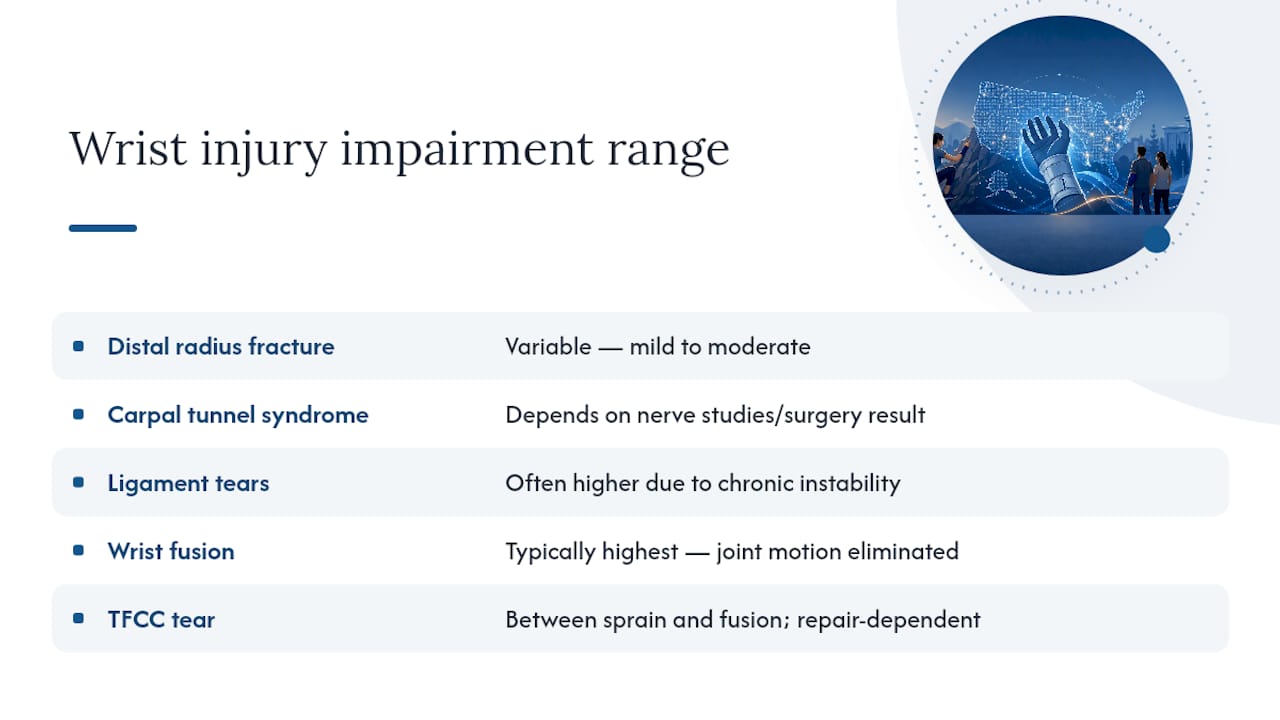
Not every wrist injury carries the same weight in a claim, and the diagnosis code on your medical chart matters more than most workers realize. Distal radius fractures, one of the most common workplace wrist injuries, often rate anywhere from mild to moderate impairment depending on whether the bone healed with normal alignment or left a permanent range-of-motion deficit.
Carpal tunnel syndrome behaves differently from a fracture because it’s a nerve compression injury rather than a structural one. Ratings hinge on nerve conduction study results and whether surgery resolved the symptoms or left residual numbness and grip weakness. Scapholunate ligament tears and other ligamentous injuries frequently rate higher than a straightforward fracture because they tend to produce chronic instability, and instability is what physicians weigh heavily under the AMA Guides.
Wrist fusion, or arthrodesis, represents the more severe end of the spectrum. Fusing the bones eliminates the joint’s motion entirely, and impairment ratings for a fused wrist typically run well above those for a healed fracture with full range of motion. Triangular fibrocartilage complex (TFCC) tears sit somewhere in between, often rating lower than a fusion but higher than a simple sprain, depending on whether the tear required arthroscopic repair.
The lesson across all of these: two workers with a “wrist injury” on their intake form can have radically different settlement values because the underlying diagnosis, not the body part label, drives the number.
How Medical Evidence Shapes What Your Settlement Is Worth
Your medical file is the evidence an insurer uses to challenge or support your claim, and gaps in that file cost workers money every day. The impairment rating that determines your PPD award comes from a physician’s exam at MMI, and that single number often becomes the anchor point for every negotiation that follows.
Insurers frequently send injured workers to an independent medical examiner (IME) whose rating tends to run lower than the treating physician’s. When the two ratings conflict, states generally allow either side to request a third opinion or a hearing, and the gap between those numbers is often exactly where negotiation happens. A well-documented file, imaging results, surgical reports, physical therapy notes showing persistent limitations, and a clear MMI date, gives your attorney or your own negotiating position something concrete to point to instead of relying on the adjuster’s initial number.
Consistency matters too. Missed appointments, gaps in treatment, or vague notes that don’t specify functional limitations all give the insurer room to argue for a lower rating. A physician who documents specific grip strength measurements, range-of-motion degrees, and pain-limited activities builds a rating that’s harder to challenge than one built on general descriptions.
Are Wrist Injury Settlements Taxable?
Workers’ compensation benefits for a wrist injury, including weekly TTD, PPD payments, and lump-sum settlements, are generally not subject to federal income tax under the workers’ compensation laws that govern the claim. This holds true whether you receive the money as ongoing weekly checks or as a single lump-sum payout.
There’s one common exception worth knowing about. If you also receive Social Security Disability Insurance (SSDI) alongside your workers’ comp benefits, a portion of your workers’ comp payment can become taxable through what’s called the SSDI offset, since the combined benefit amount is capped and the excess can shift the tax treatment. This situation is specific enough that it’s worth a conversation with a tax professional rather than guessing, especially if your combined monthly benefits are pushing against SSDI limits.
Attorney fees paid out of your settlement don’t create a separate taxable event for the portion covering workers’ comp benefits, since the underlying benefit itself is untaxed. If your settlement includes any component unrelated to the workers’ comp claim, a separate wage claim or a different type of payment folded into the same check, that portion could be treated differently, so pay attention to how a settlement agreement itemizes each part of the payout.
How a Pre-Existing Wrist Condition Affects Your Settlement
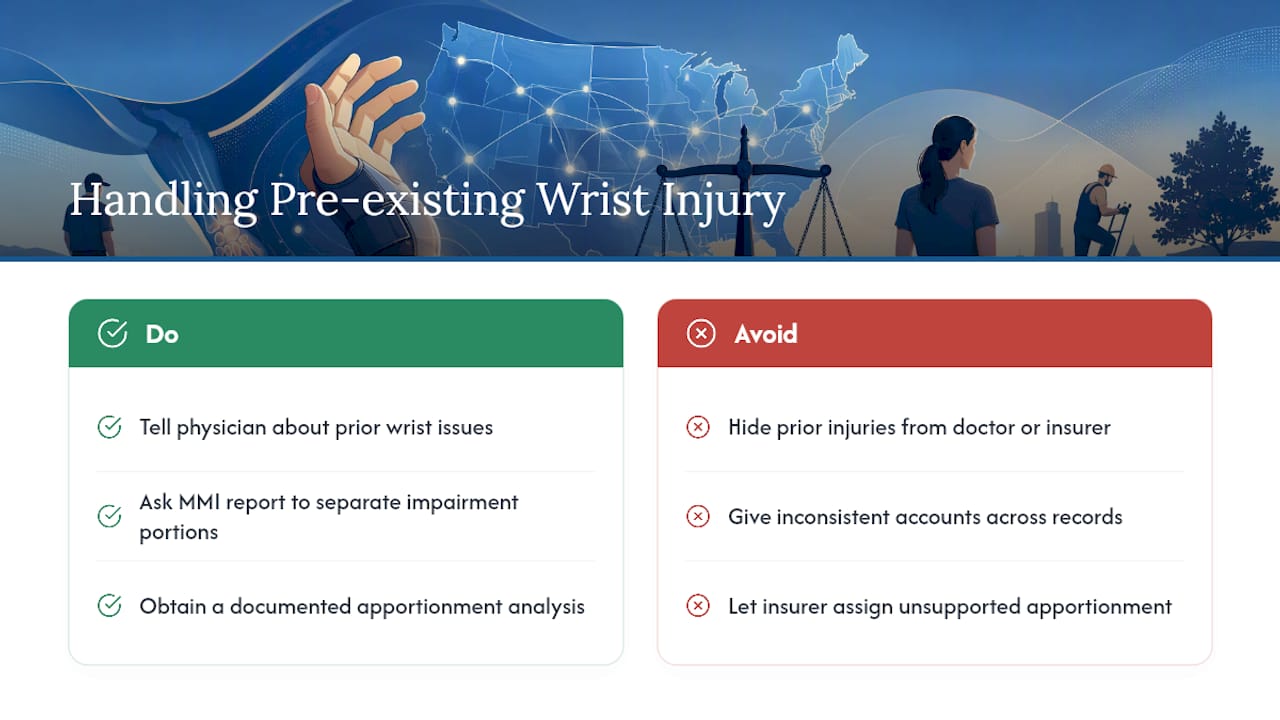
A prior wrist injury doesn’t disqualify you from a new claim, but it does complicate the math insurers use to calculate your award. States generally only compensate for the impairment caused by the new workplace injury, not for impairment that already existed from an old fracture, prior surgery, or a degenerative condition like arthritis.
This creates what’s often called an “apportionment” problem. If a physician rates your current impairment at 25% but determines that 10% of that was already present before the work incident, some states will only compensate the remaining 15% tied to the new injury. Other states apply different rules depending on whether the prior condition was previously rated and compensated, or whether it was simply present but never formally assessed.
The practical takeaway: don’t hide a prior wrist issue from your treating physician or the insurer, because it will surface in medical records anyway, and inconsistency damages your credibility far more than the prior injury itself does. Instead, make sure the physician’s report at MMI clearly separates what portion of your current impairment stems from the new injury versus any pre-existing condition. A well-documented apportionment analysis protects you from an insurer trying to attribute more of your impairment to the old injury than the medical evidence actually supports.
An Editor’s Take on Getting Ready to Negotiate
Before any settlement conversation, get your ducks in a row: wage records, your MMI date, the impairment rating in writing, medical bills, and any work restrictions. Then ask the insurer directly how they calculated the offer, whether medical benefits continue afterward, and whether your state’s agency has to approve the deal.
If any of that feels uncertain, run the numbers yourself first and get a short attorney review before you sign.
— Daniel
Model Your Wrist Claim With a 2026 State-Aware Calculator
There’s no shortage of ways to guess at a wrist settlement, from asking around online forums to eyeballing a friend’s old payout, but neither approach accounts for your actual state’s schedule or your specific date-of-injury rate. Workerscompestimator built its tools around exactly that gap: enter your state, your wage, and your injury type, and the calculator applies the current 2026 caps instead of a generic national average that doesn’t reflect any real claim.
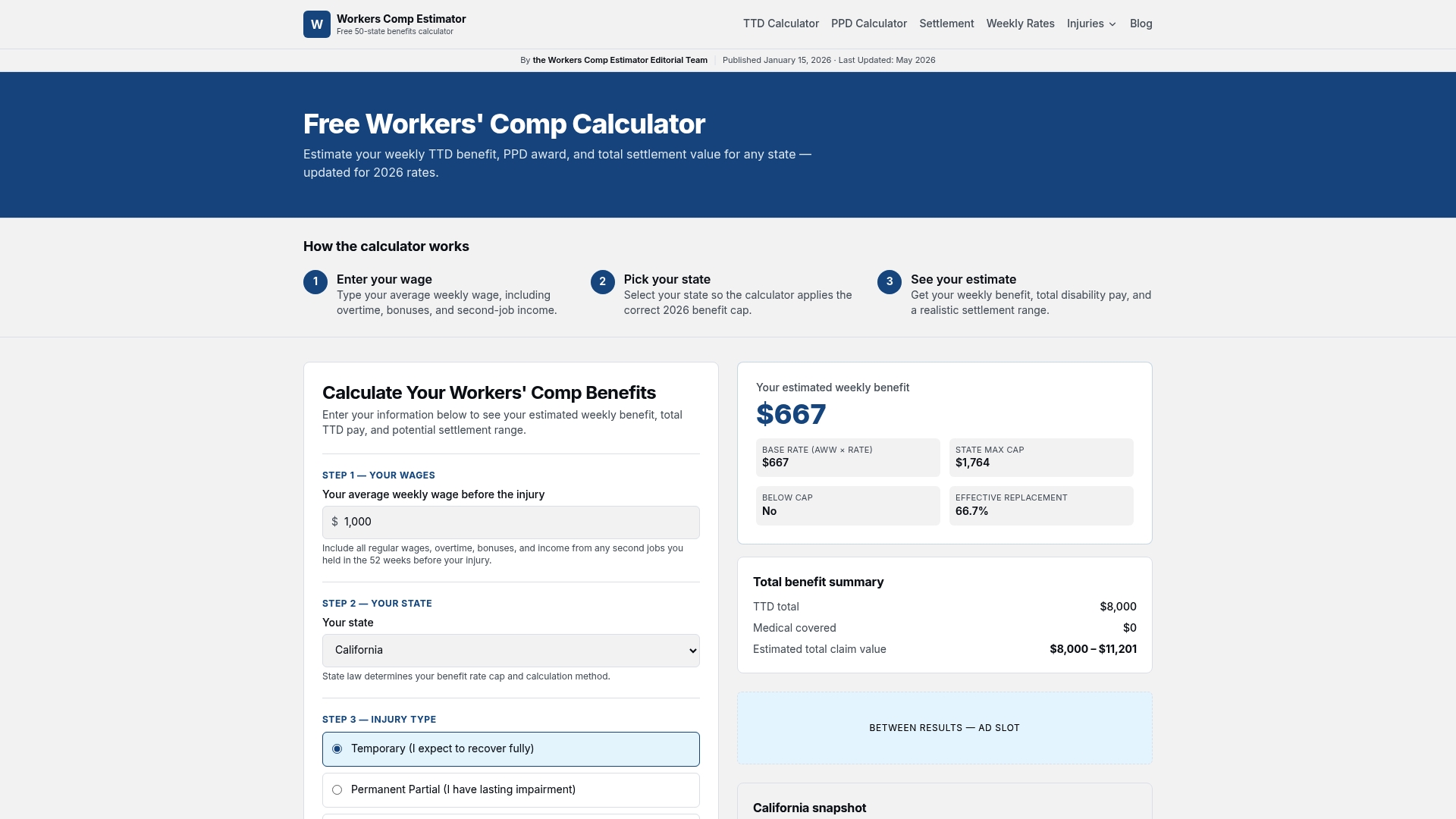
Start with the Workers’ Comp Settlement Calculator to model TTD, PPD, and lump-sum scenarios side by side, or use the PPD Calculator if you want to isolate the permanent impairment math from your healing-period benefits. If your injury involves the hand or wrist specifically, the hand and wrist injury calculator walks through how scheduled awards convert into compensable weeks for that body part. Run a few scenarios, print the results, and bring them to your next conversation with the insurer or your attorney.
Sources
- SSA - POMS: DI 52150.045 - Chart of States’ Maximum Workers’ Compensation (WC) Benefits - 07/22/2026
- Wisconsin PPD schedule and examples
- Iowa Code §85.34 — Permanent disabilities
- BULLETIN NO. 111 (Revised): Computation of temporary disability, permanent disability, and death benefits — May 4, 2026
- Ohio rule and materials on lump-sum settlement procedure
- Arkansas Advisory 2000-1 CY26 — 2026 weekly WC rates
This article is general information, not a substitute for advice from a qualified financial advisor. Consult a qualified financial professional about your own circumstances before acting on anything here.
FAQ
What Is a Typical Wrist Injury Workers’ Comp Settlement?
There’s no typical amount, since state law, your specific impairment rating, and your date of injury all determine the number independently. A fair estimate multiplies your state’s scheduled weeks or impairment formula by the weekly rate in effect when you were injured, which is why two workers with similar wrist injuries in different states can see very different totals.
How Is TTD Different From PPD for a Wrist Injury?
TTD replaces lost wages while you’re actively healing and unable to work, paid weekly until you reach MMI or return to your job. PPD compensates for permanent loss of function after MMI, calculated through either scheduled weeks or an impairment percentage formula depending on your state.
Does Wrist Surgery Increase a Workers’ Comp Settlement?
Surgery itself doesn’t automatically raise your settlement, but it often results in a higher impairment rating if it leaves residual stiffness, reduced grip strength, or limited range of motion. The rating your physician assigns at MMI, not the fact that surgery occurred, is what drives the PPD calculation.
Can I Negotiate a Wrist Injury Lump-Sum Offer?
Yes, and you should separate the offer into its parts first: past-due benefits, future PPD, future medical, and attorney fees, since insurers sometimes bundle these to make a low offer look larger. Running your own estimate with a settlement calculator before responding gives you a concrete number to counter with.
How Do State Caps Affect My Wrist Injury Settlement?
Your state’s maximum weekly rate on your date of injury sets a ceiling on both your TTD and PPD weekly payments, regardless of how high your actual wages were. Rates differ significantly by state, as shown in Arkansas’s 2026 advisory listing separate TD and PPD maximums for that year.
Recommended
More from the blog
Get a state-accurate 2026 estimate for your U.S. burn injury settlement. Use the free 50-state calculator with your AWW, MMI date, impairment rating, and...
Use your state’s 2026 weekly caps and the AWW×scheduled‑weeks×impairment math to estimate a realistic workers comp shoulder settlement. Run the free 50...
File the correct state claim and collect medical and wage records. Run the free 50 State calculator to see your likely weekly TTD and settlement before...
Free workers' comp calculators
Put the numbers in this article to work on your own claim.
Weekly benefit, PPD, and settlement in one place.
What your weekly temporary disability check should be.
Scheduled weeks and permanent impairment awards.
Lump-sum value of your full claim.
Turn a 5%, 10%, or 20% rating into dollars.
Max and min weekly rates for all 50 states.
Typical settlement ranges by injury and state.
Fusion, rotator cuff, knee replacement, and more.
When carriers typically make an offer.
What coverage costs by class code and payroll.
Guides, state updates, and claim strategy.