How 2026 State Caps Can Cut a Shoulder Settlement by $12,000

Most shoulder injury workers’ comp settlements often fall in a moderate range, with surgical rotator cuff repairs and complications tending to result in significantly higher payouts. The actual number depends almost entirely on two things: your state’s 2026 weekly benefit cap and your permanent impairment rating multiplied against your pre-injury wage. Before you sign anything, confirm you’ve reached maximum medical improvement and pull your state’s current cap, or run a free calculator to see where your specific numbers fall.
TL;DR:
- Settlements for surgical shoulder repairs and complications can exceed $150,000, especially when future medical needs and permanent restrictions are included.
- The final payout depends heavily on your state’s weekly benefit cap, impairment rating, and whether your injury involves revision surgery or ongoing limitations.
- A higher impairment rating usually results in more scheduled weeks and a larger settlement, with surgery and delayed reporting significantly increasing the value.
- Proper documentation, early MRI imaging, and waiting until maximum medical improvement are crucial for maximizing settlement value and avoiding undervaluation.
- Running a state-specific settlement calculator before negotiations helps claimants understand realistic payout ranges based on actual rules and caps.
Table of Contents
- Typical Workers Comp Shoulder Settlement Ranges, From Strain to Surgery
- How Is a Shoulder Settlement Actually Calculated?
- What Factors Push Your Shoulder Settlement Higher or Lower?
- When Do Shoulder Settlements Get Proposed, and Who Approves Them?
- Should You Accept the Offer? A Pre-Signature Checklist
- Getting a Real Estimate Before You Negotiate Anything
- Common Challenges and Disputes in Shoulder Settlements
- How Return-to-Work Status Shapes Settlement Negotiations
- Do Dislocations and Fractures Settle Differently Than Rotator Cuff Tears?
- Structured Settlements vs. Lump-Sum Payments for Shoulder Injuries
- What Daniel Gets Right About Shoulder Settlement Timing
- Run Your Free 2026 Shoulder Settlement Estimate Now
- Where to Verify State Rules and Rates
- Sources
- FAQ
Typical Workers Comp Shoulder Settlement Ranges, From Strain to Surgery
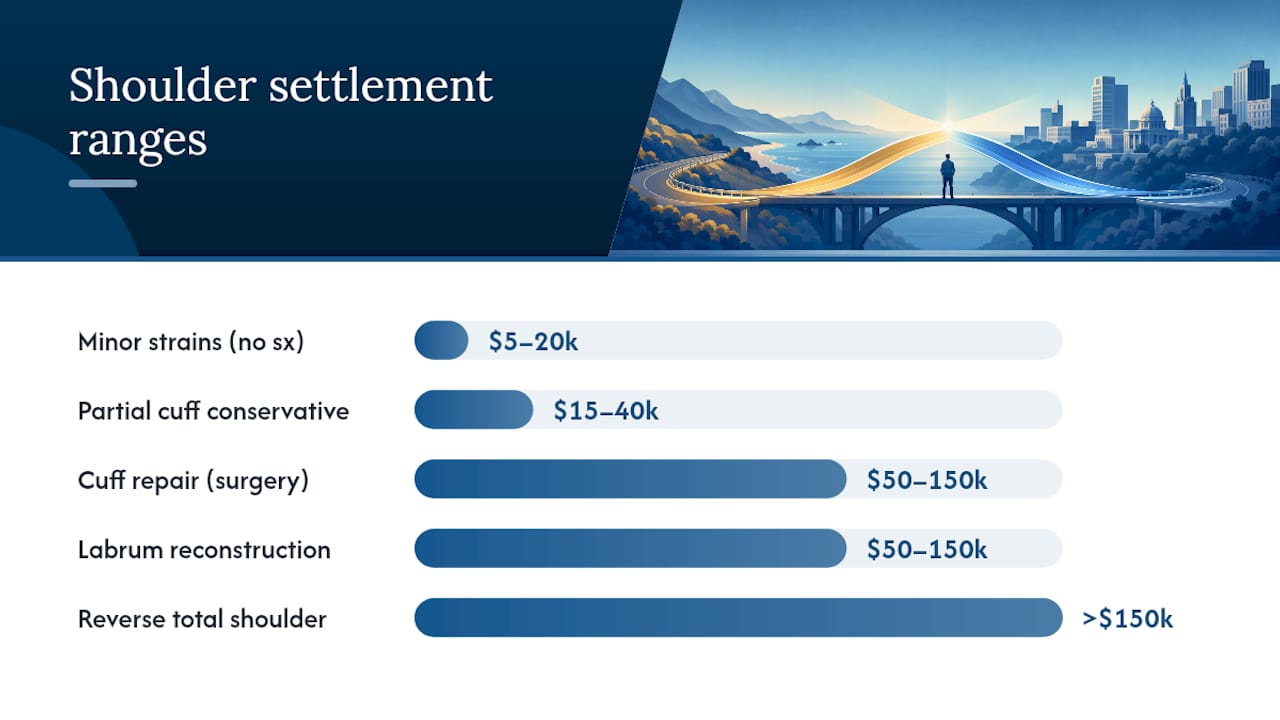
Not every shoulder claim is worth the same money, and the gap between a strained muscle and a reverse total shoulder replacement is enormous. Breaking the numbers into bands gives you a much better read on your own case than any single “average” figure ever will.
- Minor strains and sprains, no surgery: often $5,000 to $20,000, mostly covering lost wages during recovery and a small impairment rating.
- Partial rotator cuff tears treated conservatively: roughly $15,000 to $40,000, depending on how much function returns.
- Surgical rotator cuff repairs: commonly $50,000 to $150,000 once you factor in surgery, physical therapy, and a higher impairment rating, according to legal guides covering rotator cuff settlements.
- Labrum tears requiring reconstruction: frequently in the same $50,000 to $150,000 band, sometimes higher if instability persists after surgery.
- Reverse total shoulder replacement or revision surgery: can exceed $150,000, particularly when future medical care and permanent restrictions are baked into the number.
Statistic Callout: Shoulder injuries show up often enough in workplace injury data that insurers have entire playbooks for handling them, according to the Bureau of Labor Statistics injury and illness data. That volume is exactly why national averages get quoted so casually and why they mislead people who assume their case will land in the middle.
Here’s the catch with every range above: they blend cases with wildly different wages, states, and impairment ratings into one bucket. A warehouse worker earning $600 a week in a state with a $900 cap will never settle for the same amount as a construction supervisor earning $1,400 a week in a state capping benefits at $1,764. Use these bands to orient yourself, not to predict your own outcome.
How Is a Shoulder Settlement Actually Calculated?
The math behind every legitimate settlement number comes down to one formula: your compensation rate, multiplied by the scheduled weeks assigned to your body part, multiplied by your impairment percentage. Everything else, the surgery, the therapy, the arguments with the adjuster, exists to influence one of those three variables.
- Average weekly wage (AWW) becomes your compensation rate. Most states pay two-thirds of your AWW as your weekly comp rate, but every state caps that rate at a maximum figure that resets annually, according to SSA guidance on workers’ compensation formulas.
- Scheduled weeks convert your impairment rating into a payout period. States assign a fixed number of weeks to the arm or shoulder (often 200 to 400 weeks depending on the state’s schedule), and your impairment percentage determines how many of those weeks you actually collect.
- Multiply the two, adjusted for the cap. A 20% impairment rating on a 300 week schedule equals 60 weeks of benefits at your capped compensation rate.
Here’s a worked example. In a state with a $1,300 weekly cap, that worker collects the full $600 rate across 60 weeks, roughly $36,000 in PPD value. In a state with a $700 cap but a smaller 200 week arm schedule, the same impairment rating produces only 40 weeks at $600, closer to $24,000. Identical injury, identical wage, a $12,000 gap driven entirely by which state’s rules apply. Checking your state’s weekly benefit rate table before you negotiate anything is not optional.
What Factors Push Your Shoulder Settlement Higher or Lower?
Surgery is the single biggest lever in most shoulder claims. A surgical repair typically raises the impairment rating, which raises the scheduled weeks owed, which raises the settlement, sometimes by a factor of two or three compared to a conservatively treated tear. Revision surgery compounds that further, since a second procedure signals more permanent damage and often a higher final rating.
Beyond surgery, a handful of factors consistently move the number:
- Permanent work restrictions. A shoulder that can’t lift above chest height closes off entire job categories, especially for manual labor occupations, and that lost earning capacity gets factored into negotiations.
- Occupation-dependent value. The same impairment rating is worth more to a roofer than to a desk-based analyst, because vocational impact differs.
- Pre-existing conditions. Insurers routinely argue that degeneration, not the workplace incident, caused your tear. Strong causation documentation, imaging comparisons, and a clear medical narrative are what overcome that defense, according to attorney commentary on aggravation claims.
- Delayed care or reporting. Waiting weeks to see a doctor, or missing your state’s injury-reporting deadline, gives insurers an opening to dispute the entire claim.
Pro Tip: Get an MRI as close to the injury date as possible. A clean, early image comparing pre-injury and post-injury shoulder anatomy is the strongest tool your case has against a pre-existing condition defense.
When Do Shoulder Settlements Get Proposed, and Who Approves Them?
Settlements almost never happen before you reach maximum medical improvement, the point where your doctor says your shoulder has recovered as much as it’s going to. MMI matters because it’s the formal trigger for assigning a permanent impairment rating, and that rating anchors the entire PPD portion of your settlement math. Settling before MMI usually means settling on incomplete information, which almost always favors the insurer.
Impairment ratings themselves come from a physician applying a standardized evaluation, most commonly some version of the AMA Guides to the Evaluation of Permanent Impairment, though adoption and edition vary by state. That percentage then feeds directly into the scheduled-weeks calculation covered above.
Once both sides agree on a number, most states require a judge or workers’ comp board to review and approve the settlement before it’s final. Reviewers typically check:
- Whether the future medical buyout realistically covers anticipated care, not just what’s needed today.
- Whether the settlement language is clear enough to avoid disputes later.
- Whether Medicare’s interests are properly addressed if you’re a Medicare beneficiary or reasonably expect to become one.
Courts have pushed back on inadequate agreements before, as shown in a Minnesota appellate case where settlement language and future medical closure were closely scrutinized.
Should You Accept the Offer? A Pre-Signature Checklist
Before you sign anything, verify these five items in order:
- Confirm MMI documentation exists. No settlement should be finalized before your treating physician has formally declared MMI in writing.
- Get the impairment rating report. Read the actual percentage and the body part schedule used to calculate it, not just the settlement total.
- Ask for the itemized math. Request the compensation rate, scheduled weeks, and impairment percentage used to reach the number, so you can check it against your state’s cap.
- Read every word about future medical care. Vague or absent language about ongoing treatment is a red flag that can close out care you’ll need later, according to guidance on future treatment disputes.
- Understand the judge approval process. Know what your state requires and whether you can withdraw before final approval.
Statistic Callout: Attorneys who negotiate on a claimant’s behalf commonly push final settlements 50% to 100% above the insurer’s opening offer, mainly by challenging low impairment ratings and documenting future medical needs more aggressively, according to analysis from a workers’ comp law firm.
If you’re a Medicare beneficiary, or reasonably expect to be one soon, ask whether a Workers’ Compensation Medicare Set Aside applies. Voluntarily establishing a WCMSA can protect your future Medicare coverage even when formal review isn’t strictly required, according to analysis of shoulder settlement value.
Getting a Real Estimate Before You Negotiate Anything
Guessing at your settlement value from a chart you found online puts you at a disadvantage the moment negotiations start. Before you talk numbers with an adjuster, gather your average weekly wage, your surgery history, any known impairment rating, and a rough sense of expected future care.
Run those inputs through the shoulder injury settlement calculator, which applies your state’s 2026 weekly benefit cap directly to the math instead of relying on a generic national figure. The output gives you a weekly benefit estimate, a scheduled-weeks valuation, and a PPD range grounded in your actual state’s rules.
- Save or print the calculator’s output as a reference document.
- Bring it into any settlement counter-offer conversation with the adjuster.
- Hand it to your attorney at your first consultation so they’re working from real numbers, not assumptions.
Having your own state-grounded figure changes the tone of negotiations. Adjusters expect claimants to accept the first number offered; showing up with a calculated range built on your state’s actual 2026 caps signals you’ve done the homework.
Common Challenges and Disputes in Shoulder Settlements
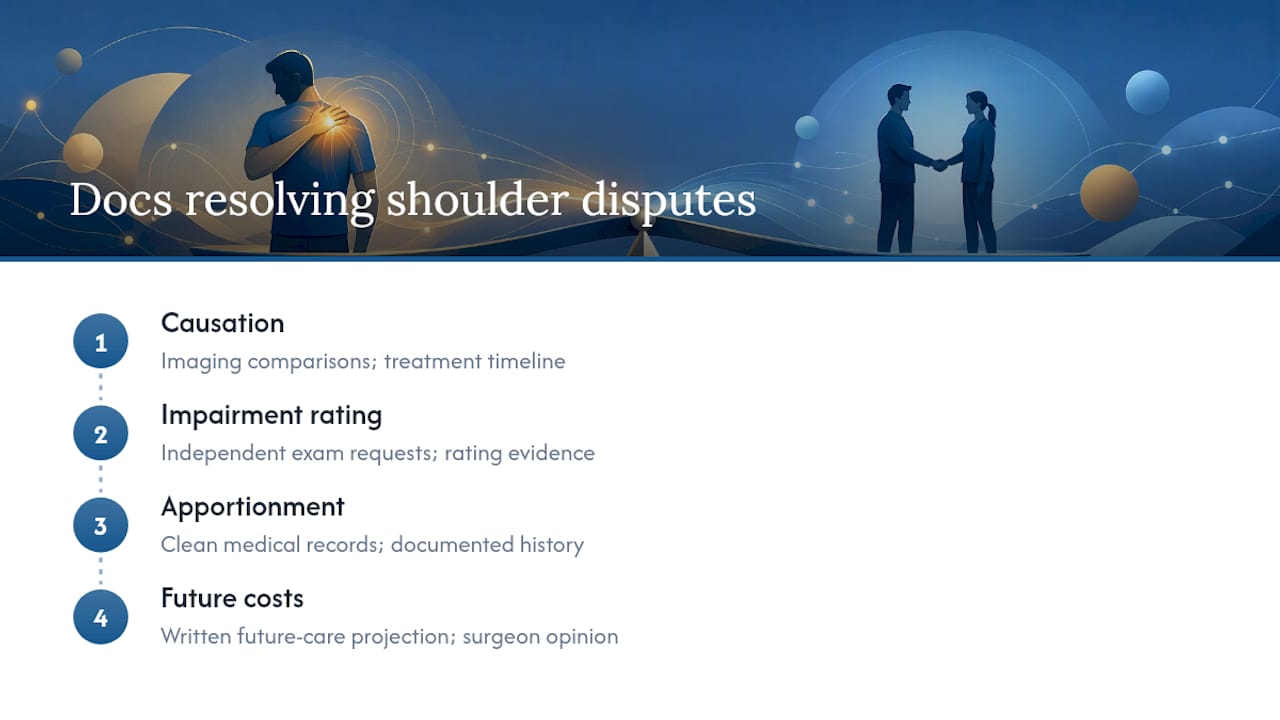
Shoulder claims generate more disputes than most other body parts, largely because the shoulder is a complex joint with overlapping structures, the rotator cuff, labrum, and joint capsule, that make causation arguments easy to raise. Insurers frequently dispute whether a torn labrum came from the workplace incident or from years of wear.
The second common battleground is the impairment rating itself. Insurance-appointed doctors sometimes assign lower percentages than independent examiners would, since a lower rating directly reduces scheduled weeks and total payout. Requesting an independent medical exam, where your state allows it, is one of the most effective ways to challenge a rating you believe undervalues your injury.
A third recurring dispute involves apportionment, where an insurer tries to attribute part of your impairment to a prior injury or unrelated condition to shrink their share of the payout. This is where clean medical records and a documented history matter most.
Finally, disputes over future medical costs surface constantly in shoulder cases because hardware, revision surgery risk, and ongoing physical therapy needs are harder to project than a one-time treatment cost. Getting a written projection from your treating surgeon, not just the insurer’s reviewing physician, strengthens your position considerably.
Most of these disputes resolve faster with documentation than with argument. The claimant who shows up with imaging comparisons, a clear treatment timeline, and a written future-care projection settles faster and for more than one who relies on verbal assertions.
How Return-to-Work Status Shapes Settlement Negotiations
Whether you’ve returned to work, and in what capacity, changes the settlement conversation more than almost any other single factor after your impairment rating. A worker who returns to their exact pre-injury job with no restrictions has a fundamentally different negotiating position than one who can’t return to that occupation at all.
If you’ve returned to work at full duty, insurers often argue your settlement should skew toward the impairment rating alone, since ongoing wage loss isn’t part of the equation anymore. That’s a reasonable argument when it’s true, but it doesn’t account for permanent restrictions that might surface later, like reduced overhead lifting capacity that only becomes a problem during a future job change.
If you’re on permanent restrictions or can’t return to your prior occupation, that opens the door to arguing for vocational rehabilitation costs or a higher settlement reflecting diminished earning capacity, particularly in physically demanding trades where a shoulder restriction effectively ends a career path.
Ongoing disability, meaning you’re still receiving temporary benefits and haven’t reached MMI, generally means it’s too early to settle at all. Settling while still disabled and before your final impairment rating is assigned almost always undervalues the claim, because nobody yet knows the true extent of permanent loss. Patience here has a real dollar value attached to it.
Do Dislocations and Fractures Settle Differently Than Rotator Cuff Tears?
Rotator cuff tears get most of the attention in shoulder injury discussions, but dislocations and fractures follow the same scheduled-weeks formula with some notable differences in typical outcomes. A shoulder dislocation that resolves without recurring instability often settles on the lower end, closer to the minor strain range, because impairment ratings for a single successfully treated dislocation tend to be modest.
Recurrent dislocations are a different story. Once a shoulder dislocates repeatedly, doctors typically assign a meaningfully higher impairment rating reflecting chronic instability, and surgical stabilization procedures push the claim into surgical-repair territory, similar to rotator cuff cases.
Fractures involving the humerus, clavicle, or scapula introduce hardware considerations, plates, screws, or pins, that surgeons sometimes remove in a second procedure. Each surgical event adds to the impairment calculation and to future medical projections. Complex fractures requiring joint replacement, like a proximal humerus fracture treated with shoulder arthroplasty, often land in the same high range as reverse total shoulder replacement cases, sometimes exceeding $150,000 when future medical needs are properly documented.
The practical takeaway: the injury type matters less than the final impairment percentage and the surgical history behind it. A fracture with full recovery and a low rating can settle for less than a rotator cuff tear that never fully healed.
Structured Settlements vs. Lump-Sum Payments for Shoulder Injuries
Most shoulder workers’ comp settlements resolve through a Compromise and Release, a full closure that trades your right to future medical care and additional benefits for a single lump-sum payment. This is by far the more common outcome, and it works well when future medical needs are modest and clearly projected.
A structured settlement, where payments arrive over time rather than all at once, shows up less often in shoulder cases but can make sense in specific situations, particularly when a claimant worries about managing a large lump sum or when future medical costs are genuinely difficult to predict due to hardware complications or revision surgery risk.
The core tradeoff comes down to risk. A lump sum gives you control and immediate certainty, but it also means you’re responsible for covering any future shoulder-related treatment out of that money, forever. For injuries with hardware or a real chance of revision surgery, future medical often represents the single largest financial risk in the entire settlement, according to analysis of maximum medical improvement and settlement timing.
Before choosing either structure, get a written projection of future medical costs from your treating surgeon, not just a generic estimate. That number should directly inform whether a lump sum properly compensates you or whether structured payments protect you better against an uncertain recovery.
What Daniel Gets Right About Shoulder Settlement Timing
The biggest mistake I see claimants make is settling too early because an adjuster made the process sound urgent. It almost never is. Waiting for MMI before you finalize any number consistently produces better outcomes, because impairment ratings assigned too early routinely undercount the true extent of a shoulder injury.
State caps change outcomes more than most claimants realize, which is exactly why we built calculators covering all 50 states plus DC rather than one generic national tool. A shoulder injury worth $36,000 in one state’s schedule can be worth $24,000 in another with the exact same wage and impairment rating. Knowing your own state’s number before you negotiate is the single highest-leverage thing you can do.
— Daniel
Run Your Free 2026 Shoulder Settlement Estimate Now
An online calculator service offers an alternative to guessing your settlement value from a national chart that has nothing to do with your state. Our calculators build in each state’s actual 2026 weekly benefit caps, so the number you get back reflects your wage, your impairment rating, and your state’s real formula, not a rough average pulled from unrelated cases.
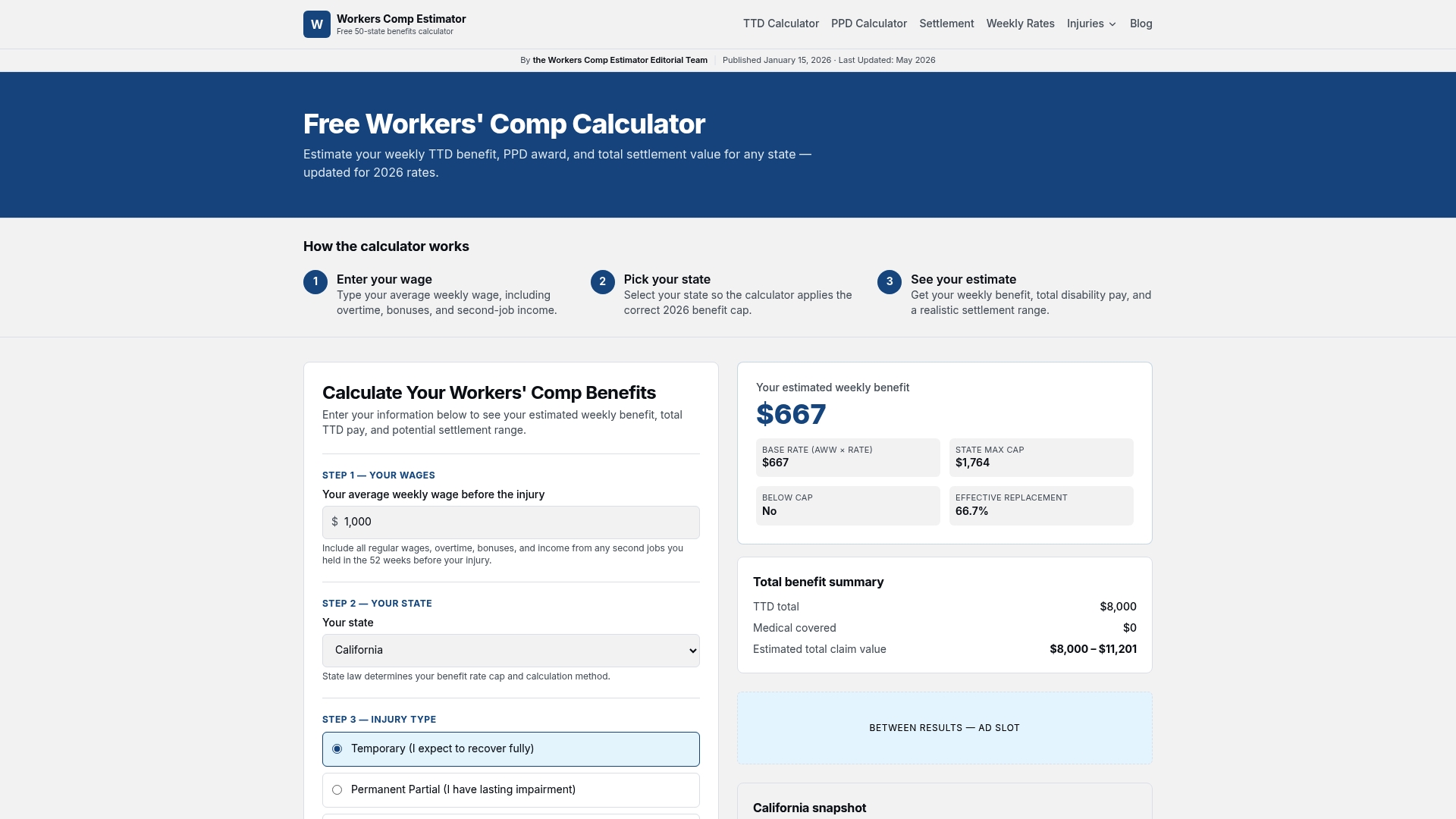
Start with the shoulder injury settlement calculator if you know your injury type, or use the general settlement calculator to run the full rate times weeks times rating math from scratch. If you already have an impairment rating in hand, the PPD calculator will translate it into a scheduled-weeks value using your state’s cap.
Once you have a number, save it. Print the output, bring it to your attorney consultation, or use it as a benchmark the next time an adjuster puts a settlement offer in front of you. If you’re weighing whether to negotiate the impairment rating itself, strategies for disputing low ratings are worth reviewing before your next call with the insurer.
Where to Verify State Rules and Rates
- Your state’s workers’ comp board publishes official 2026 weekly benefit caps and scheduled-weeks tables for the arm and shoulder.
- The Bureau of Labor Statistics tracks injury frequency and wage-loss context for shoulder claims nationally.
- CMS publishes guidance on Workers’ Compensation Medicare Set Asides for claimants with Medicare interests at stake.
This article is general information, not a substitute for advice from a qualified lawyer. Consult a qualified legal professional about your own circumstances before acting on anything here.
Sources
- SSA POMS: Workers’ compensation guidance (example formula context)
- Dahl v. AG Processing, Inc. — Minnesota workers’ comp appellate summary
- Bureau of Labor Statistics — Injury and Illness data
FAQ
What is the average settlement for a shoulder injury?
Most shoulder injury settlements fall between $25,000 and $80,000, though surgical rotator cuff repairs commonly reach $50,000 to $150,000 once impairment ratings and future medical costs are factored in. The exact figure depends on your state’s weekly benefit cap, your wage, and your impairment percentage, which is why running a state-specific calculator gives a far more accurate picture than a national average.
What is the typical impairment rating for a shoulder injury in workers’ compensation?
That rating directly determines how many scheduled weeks of benefits you receive.
What is the typical workers’ comp settlement for reverse total shoulder replacement?
Reverse total shoulder replacement cases frequently settle above $150,000, since these injuries carry high impairment ratings and substantial future medical needs, including possible revision surgery. Getting a written future-care projection from your surgeon before settling is essential, since future medical buyouts represent the largest financial risk in these cases.
How much disability will I get for shoulder injury?
Your disability payment depends on multiplying your compensation rate, generally two-thirds of your average weekly wage up to your state’s maximum cap, by the scheduled weeks tied to your impairment percentage. Two workers with identical wages and ratings can receive different amounts simply because their states set different caps and scheduled-weeks tables.
Recommended
More from the blog
See how 2026 state caps, wages, and surgery affect your U.S. hernia workers' comp payout. Run a free 50 state calculator for a realistic estimate.
Run a state specific 2026 workers' comp settlement calculation. Use the free 50 state calculator to see how state caps change your payout.
Use the free 50-state estimator that applies 2026 state caps to estimate your workers' comp lump sum. Run your numbers, check SSDI/Medicare impact, and...
Free workers' comp calculators
Put the numbers in this article to work on your own claim.
Weekly benefit, PPD, and settlement in one place.
What your weekly temporary disability check should be.
Scheduled weeks and permanent impairment awards.
Lump-sum value of your full claim.
Turn a 5%, 10%, or 20% rating into dollars.
Max and min weekly rates for all 50 states.
Typical settlement ranges by injury and state.
Fusion, rotator cuff, knee replacement, and more.
When carriers typically make an offer.
What coverage costs by class code and payroll.
Guides, state updates, and claim strategy.