
Texas Workers’ Comp Benefits: What You Can Collect in 2026

If you were hurt at work in Texas, workers’ comp pays your reasonable medical care and replaces part of the wages you lose. Most income benefits equal 70% of your average weekly wage (AWW), capped at a weekly maximum that the state resets every October 1. For injuries from October 1, 2026 through September 30, 2027, the maximum weekly temporary income benefit is $1,314 and the minimum is $197. Below is how each benefit works, how to run the math yourself, and where claims usually go wrong.
TL;DR
- Texas has four income benefits (temporary, impairment, supplemental and lifetime), plus medical, death and burial benefits.
- Temporary and impairment benefits pay 70% of your wage figure, subject to a weekly cap. The cap for temporary benefits is $1,314 for the benefit year that began October 1, 2026.
- Report your injury to your employer within 30 days and file a claim with the Division of Workers’ Compensation (DWC) within one year.
- A settlement is final on income issues, but it cannot end your medical benefits.
- Your own estimate and the insurer’s number can differ, usually because of how average weekly wage is built.
Table of Contents
- The benefits Texas workers’ comp provides
- How your average weekly wage is calculated
- Temporary income benefits (TIBs)
- Impairment income benefits (IIBs)
- Supplemental income benefits (SIBs)
- Lifetime income benefits (LIBs)
- Medical benefits
- Death and burial benefits
- Deadlines and how a claim moves
- Settlements
- Why the insurer’s number may differ from yours
- Our perspective
- Get your Texas estimate
- FAQ
- Sources
The benefits Texas workers’ comp provides
The Texas Department of Insurance (TDI) describes workers’ comp as a state-regulated insurance program that pays medical bills and replaces some lost wages for employees hurt at work or made ill by work. It is no-fault, so you do not have to prove your employer did anything wrong. You do have to show the injury is work-related.
Texas has four types of income benefits: temporary (TIBs), impairment (IIBs), supplemental (SIBs) and lifetime (LIBs). Medical benefits sit alongside them. Families can receive death benefits, and whoever paid for the funeral can receive burial benefits.
| Benefit | Who it is for | Rate | Weekly cap (Oct 2026 to Sept 2027) |
|---|---|---|---|
| Temporary income (TIBs) | Workers who cannot earn their usual wage while recovering | 70% of the gap between AWW and what you can earn now | $1,314 |
| Impairment income (IIBs) | Workers with a permanent impairment rating, after maximum medical improvement | 70% of AWW | $920 |
| Supplemental income (SIBs) | Workers with a rating of 15% or more who still earn much less | 80% of the gap between 80% of AWW and current wages | $920 |
| Lifetime income (LIBs) | Workers with specific catastrophic injuries | 75% of AWW | $1,314 |
| Death benefits | Eligible family members | 75% of AWW | $1,314 |
Caps and minimums come from TDI’s maximum and minimum benefits table. The rates are explained below, each with its source.
How your average weekly wage is calculated
Every income benefit starts with AWW. TDI says it is the average your employer paid you each week in the 13 weeks before your injury. You add up everything earned in those weeks, overtime and special pay included, and divide by 13. Non-cash items your employer pays for, such as health insurance or a car allowance, count too.
If you had not worked for the employer for 13 weeks, your AWW may be based on a worker in a similar job. School district employees use a different formula: wages from the past 12 months divided by 50.
This step matters more than any other. A missed overtime shift or an uncounted employer-paid health premium lowers every benefit that follows.
Temporary income benefits (TIBs)
TIBs cover the stretch when you are healing and cannot earn your full wage. They equal 70% of the difference between your AWW and what you earn after the injury. The rate rises to 75% for the first 26 weeks if you earned under $10 an hour (the threshold was $8.50 for injuries before September 1, 2015).
Two worked examples, using simple numbers:
- Off work completely. AWW of $900, no earnings. 70% × $900 = $630 a week.
- Back on light duty. AWW of $900, now earning $400. The gap is $500, and 70% of it is $350 a week.
- High earner hits the cap. AWW of $2,500. 70% is $1,750, but the temporary cap is $1,314, so the check is $1,314 a week.
TIBs generally stop when you reach maximum medical improvement (MMI), meaning a doctor finds you have recovered as much as you are likely to. The law also sets an end point: the 104th week from when income benefits began to accrue, if you have not reached MMI earlier.
To run your own numbers, use our Texas workers’ comp benefits calculator or the general TTD calculator. If you are working reduced hours, the temporary partial disability calculator fits that situation.

The waiting period
Weekly income benefits generally carry a seven-day waiting period, paid retroactively if you are off work 14 days or more. A short absence can therefore pay nothing, while a longer one pays back to day one. Our guide to waiting periods and retro pay by state shows how Texas compares.
Impairment income benefits (IIBs)
Once you reach MMI, a doctor assigns an impairment rating using the American Medical Association’s guides. IIBs are 70% of your AWW and begin when you reach MMI. Unlike TIBs, you can receive them while back at work.
The length depends on the rating. According to a TDI presentation to the Texas Senate, employees receive three weeks of IIBs for each percentage point of impairment. With an AWW of $900:
- A 10% rating gives 30 weeks × $630 = $18,900.
- A 20% rating gives 60 weeks × $630 = $37,800.
Because the rating drives the total, it is the number to scrutinize. Read our guide to Texas impairment ratings before you accept one.
Supplemental income benefits (SIBs)
SIBs pay monthly after your IIBs end. TDI lists four requirements: an impairment rating of 15% or more, no return to work (or earnings below 80% of your pre-injury AWW because of the injury), a documented job search, and no lump-sum payment of your impairment benefits.

The amount is 80% of the difference between 80% of your AWW and your post-injury wages. That last requirement deserves care: taking a lump-sum IIB payment can end your eligibility for SIBs.
Lifetime income benefits (LIBs)
LIBs are reserved for specific severe injuries and pay 75% of AWW with a 3% increase each year. They are paid for life, which is why the statute limits them to a defined list of injuries.
Medical benefits
The insurance carrier pays for treatment that is compensable, reasonable and necessary, and providers must follow the state fee guidelines or network contracts. In practice: keep every bill and every explanation of benefits, and tell each provider the injury is work-related so they bill the carrier, not your health plan. Our overview of what workers’ comp covers lists common inclusions and exclusions.
Death and burial benefits
When a work injury or occupational disease kills a worker, eligible family members receive weekly death benefits equal to 75% of the worker’s AWW, subject to a weekly cap. Burial benefits repay funeral costs up to a set amount. Our page on who qualifies for death benefits covers eligibility.
Deadlines and how a claim moves
Two clocks start at the injury. TDI says you must report the injury to your employer within 30 days and file a claim with DWC within one year. Missing either can cost you the claim, so do both in writing and keep copies. Our statute of limitations guide compares Texas with other states.
An injury is compensable if the carrier accepts liability or DWC decides it is. If the carrier disputes the claim, the burden shifts to you: the same TDI page says you must prove why it should be paid, including that the injury is work-related and was reported and filed on time.
If the insurer disputes your claim
Disputes can move through a Benefit Review Conference, a Contested Case Hearing and an Appeals Panel review, according to a DWC report on the dispute process. The division tries to resolve disputes at the lowest level and encourages the parties to talk first. Medical fee disputes are split by size: $2,000 or less can be heard by a DWC hearing officer, and larger ones may go to the State Office of Administrative Hearings.
If you are sorting out bills while a claim is pending, this explainer on medical bills and injury claims walks through what claimants commonly face. Good habits during a dispute: answer every letter by its deadline, keep a log of calls, and get your treating doctor’s work restrictions in writing.
Settlements
Texas lets parties resolve a disputed claim by agreement. The settlement must be in writing on DWC Form-025, signed by all parties and submitted for approval. It is a final resolution of the issues in the claim, but it cannot limit or end your medical benefits. A party may withdraw acceptance before the effective date.
Before signing, compare the offer with what the weekly benefits would pay over the same period. A quick way is to add up the TIBs you would receive until MMI, then the IIBs from your expected rating, and see what the offer implies. Our settlement calculator, the Texas settlement chart and the page on a Texas shoulder injury settlement show how those figures are built.
Why the insurer’s number may differ from yours
When the carrier’s check does not match your estimate, check these in order:
- Average weekly wage. The carrier may have used fewer weeks, left out overtime or special pay, or missed employer-paid benefits that TDI says count toward AWW.
- Post-injury earnings. TIBs shrink as your earnings rise. Hours on light duty reduce the check.
- The cap or minimum. The cap is set by injury date. An injury from last benefit year uses that year’s table, not the current one.
- The waiting period. The first seven days may be unpaid until you pass 14 days off work.
- The impairment rating. A different doctor can assign a different percentage, and each point is worth three weeks of IIBs.
If the gap persists, ask the adjuster for the wage statement and the calculation in writing. That is often enough to reveal an error. If it is not, the dispute process above is the formal route, and a Texas workers’ comp attorney can review the numbers.
Our perspective
Most injured workers we hear from are not trying to win anything. They want to know whether the check in front of them is right. In Texas that question is harder than it looks, because the answer depends on a wage figure built from 13 weeks of pay, a cap that changes every October, and an impairment rating that can swing the total by weeks of income.
We built our calculators around the current state caps and around all income sources in the wage figure, because a rough guess is worse than no guess when you are about to sit across from an adjuster. Our view is simple: you should walk into that conversation with your own number, your own worksheet and the right questions. A realistic estimate is the strongest preparation a claimant can have, and it costs nothing.
Use the numbers as a starting point, check them against the official TDI tables, and bring them to a qualified Texas attorney if the gap is large.
Daniel
Get your Texas estimate
Enter your average weekly wage and injury details in our free calculator to see your weekly benefit under the current Texas caps, then compare it with what the insurer has told you.
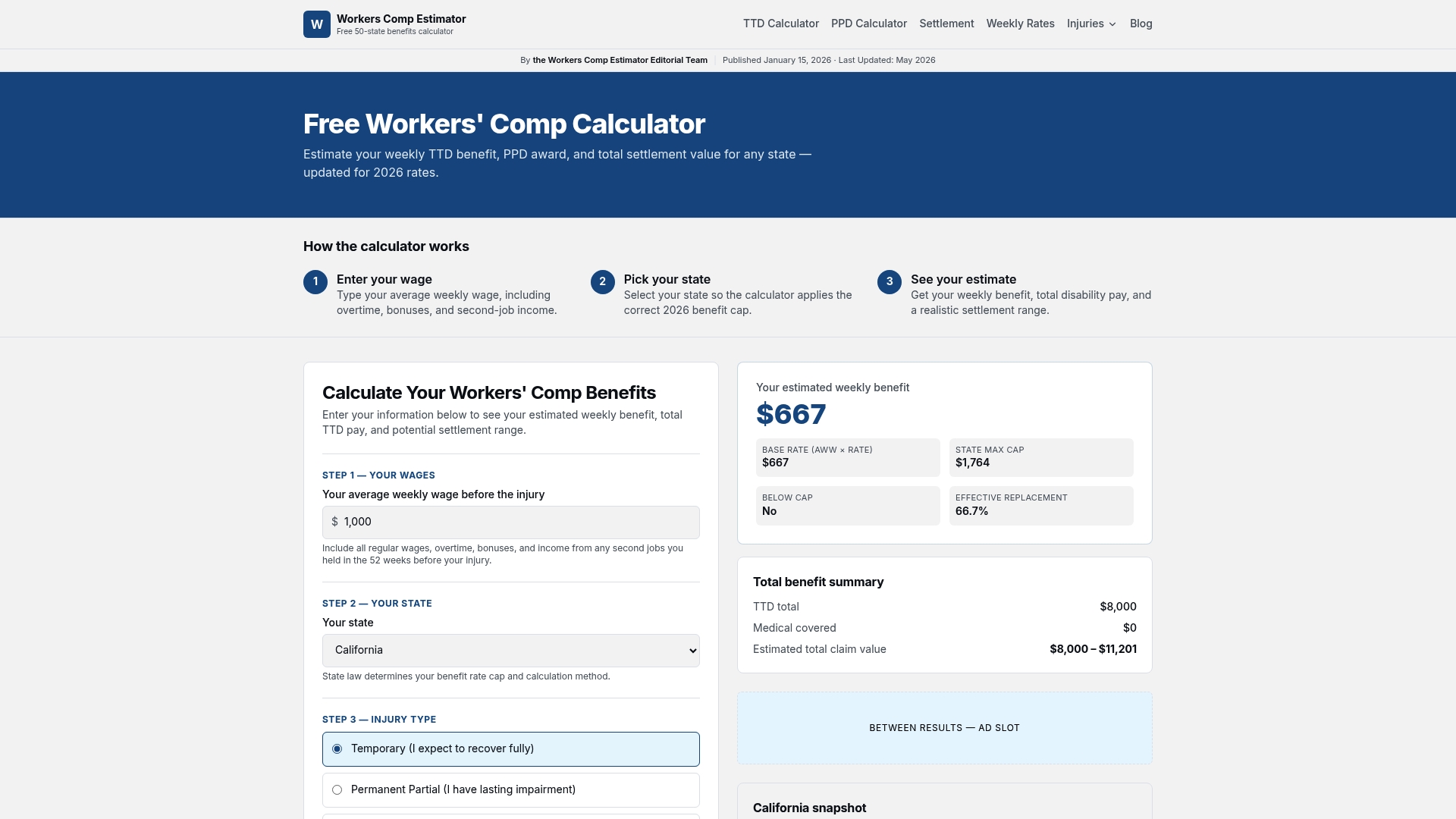
Start with the Texas workers’ comp calculator, or try the free 50-state estimator if you want to compare states. You can also check the weekly benefit rates for every state.
FAQ
How much does workers’ comp pay in Texas?
Most weekly income benefits are 70% of your average weekly wage or of the gap between that wage and your current earnings. Temporary benefits are capped at $1,314 a week and impairment benefits at $920 for the benefit year that began October 1, 2026. Medical care is paid separately when it is reasonable and necessary.
How does workers’ comp work in Texas, step by step?
You report the injury to your employer within 30 days, get treated, and file a claim with DWC within one year. The carrier accepts or disputes the claim. If accepted, you receive income benefits after the waiting period while it pays your medical bills. Disputes go through DWC’s hearing process.
Can I settle my Texas workers’ comp claim?
Yes, through a written agreement on DWC Form-025 that all parties sign and DWC approves. It settles the income issues for good, but it cannot cut off your future medical benefits. Compare the offer against your expected weekly benefits before you sign.
What is the most I can get from workers’ comp in Texas?
There is no single total. Each benefit has a weekly cap and a duration: temporary benefits up to about two years, impairment benefits by rating, and lifetime benefits for qualifying injuries. Your wage and rating decide where you land under those limits.
Sources
- Maximum and minimum weekly benefits, Texas Department of Insurance
- What is workers’ compensation?, Texas Department of Insurance
- Workers’ compensation income and medical benefits, Texas Department of Insurance
- 2025 Income Benefits in the Texas Workers’ Compensation System, Texas Department of Insurance
- Income benefits presentation, Texas Senate committee
- Claims Coordinator Handbook for Texas State Agencies, FY 2026
- Supplemental income benefits, Texas Department of Insurance
- Lifetime income benefits, Texas Department of Insurance
- Workers’ Comp 101, TDI InsurED
- Lifetime income and death benefits handout, Texas Legislature
- About compensability disputes, Texas Department of Insurance
- DWC dispute resolution report
- Medical fee dispute hearings, Texas Department of Insurance
- DWC Form-025, Benefit Dispute Settlement
Recommended
More from the blog
Understand U.S. workers comp waiting periods (typically 3–7 days). See state examples, learn how to protect and claim retro pay, and use a free 50 state...
Learn how Texas workers’ comp impairment ratings affect benefits, deadlines, and disputes, then use the payout calculator before accepting an offer.
See how TTD is calculated in workers' comp: average weekly wage, the two-thirds rule, state caps, waiting periods and how TPD differs, with worked examples.
Free workers' comp calculators
Put the numbers in this article to work on your own claim.
Weekly benefit, PPD, and settlement in one place.
What your weekly temporary disability check should be.
Scheduled weeks and permanent impairment awards.
Light-duty benefit when you earn less while healing.
Federal employee FECA award by body part.
Lump-sum value of your full claim.
Turn a 5%, 10%, or 20% rating into dollars.
Travel reimbursement for medical appointments.
Max and min weekly rates for all 50 states.
Typical settlement ranges by injury and state.
Average settlement for fusion, rotator cuff, knee replacement, and more.
Why comp does not pay it, and when a third-party claim does.
When carriers typically make an offer.
What coverage costs by class code and payroll.
Guides, state updates, and claim strategy.