
Who Qualifies for Workers’ Comp Death Benefits

If a spouse, partner, or parent has died from a work-related injury or illness, workers’ comp death benefits typically go to the surviving spouse, minor children, and other financial dependents through two separate payments: a weekly wage-replacement check and a lump-sum burial reimbursement. The weekly amount usually runs at two-thirds (66.67%) of the deceased worker’s average weekly wage, though Texas pays 75% in many cases.
That gap between 66.67% and 75% is not a rounding difference. On a typical average weekly wage, the difference in payment between two-thirds and 75% is significant, resulting in noticeably different weekly benefit amounts over time. Burial coverage varies even more: some states cap reimbursement in relatively low amounts, while others allow up to around $10,000 or more depending on when the injury occurred.
Do three things right now if you’re in this situation:
- Notify the deceased worker’s employer or its insurance carrier immediately, in writing if possible.
- Request a certified copy of the death certificate. You will need several originals.
- Gather recent pay stubs, tax returns, and any medical records connecting the death to the job.
Key Takeaways
| Point | Details |
|---|---|
| Two benefit types exist | Weekly wage-replacement (usually 66.67%, or 75% in Texas) and a separate burial reimbursement with its own cap. |
| Beneficiary order matters | Spouses and minor children typically qualify automatically; other dependents must document financial reliance. |
| File within 12 months when unsure | Deadlines commonly run one to two years, but filing early protects your claim if your state’s window is shorter. |
| Remarriage changes the math | Many states convert a spouse’s future benefits into a lump sum equal to roughly two years of payments. |
| Get a state-specific number | The Free Workers’ Comp Calculator applies each state’s 2026 caps to produce a real weekly estimate and burial figure. |
Where to Verify Your State’s Exact Rules
Confirm the details here against your own state’s primary sources before filing. Start with the Texas Department of Insurance death and burial benefits page or Ohio Revised Code Section 4123.59 if either applies to you, alongside Nolo’s general death benefits explainer and Reuters’ coverage of how these claims work in practice.
- Use your state’s official workers’ comp agency page for exact forms and deadlines.
- Cross-check burial caps and percentages against the date of injury, not just the date of death.
This article is general information, not a substitute for advice from a qualified financial advisor. Consult a qualified financial professional about your own circumstances before acting on anything here.
Table of Contents
- Workers Comp Death Benefits: Who Actually Qualifies
- How Death Benefit Amounts Are Calculated
- Burial and Funeral Expense Reimbursement
- How Long Benefits Last and How They’re Divided
- How to File a Workers Comp Death Benefits Claim
- Death Benefits by State: What Actually Changes
- What Happens After You File: Disputes and Appeals
- Turning State Rules Into a Real Dollar Estimate
- Get a State-Specific Death Benefit Estimate Today
- Sources
- FAQ
Workers Comp Death Benefits: Who Actually Qualifies
Every state builds its own hierarchy of eligible beneficiaries, but the underlying logic is the same everywhere: benefits go to the people who depended on the deceased worker’s income. A surviving spouse sits at the top of that list in virtually every state, followed by children, then other dependents who can prove financial reliance.
The typical beneficiary order
- Surviving spouse. Married partners generally qualify automatically, with no separate proof of financial dependency required in most states.
- Minor children. Biological and legally adopted children under 18 typically qualify without having to prove dependency, similar to a spouse.
- Full-time students. Many states extend benefits to children up to ages 23 to 25 if they remain enrolled in school full time.
- Disabled dependent children. A child with a qualifying disability can often continue receiving benefits indefinitely, regardless of age.
- Dependent grandchildren. If a grandchild lived with and relied on the deceased worker for support, some states recognize them as eligible dependents.
- Dependent parents. Parents who relied on the worker’s income, often because they lived in the same household, can qualify in many states.
- Other dependents. Siblings, in-laws, or other relatives who can document financial dependency sometimes qualify, though this varies significantly by state.
Ohio’s statute is a useful reference point because it spells out dependency mechanics in unusual detail. Under Ohio Revised Code Section 4123.59, wholly dependent persons receive two-thirds of the average weekly wage, and the law lays out exactly how that amount gets apportioned when there are multiple dependents with different levels of reliance on the deceased worker’s income.
Proving eligibility
Spouses and minor children rarely need to prove much beyond a marriage certificate or birth certificate. Everyone else usually has to build a paper trail:
- Death certificate listing the cause of death
- Marriage certificate (for spouses) or birth certificate (for children)
- Joint tax returns or bank statements showing financial interdependence
- School enrollment records for students claiming extended eligibility
- Medical documentation for a dependent claiming a qualifying disability
Stepchildren, unmarried domestic partners, and adult parents who were not full dependents occupy a legal gray area. Some states treat stepchildren identically to biological children if they lived in the household; others require proof of legal adoption. Unmarried partners generally have the weakest claim unless the state explicitly recognizes domestic partnerships for workers’ comp purposes, which most do not. If your situation falls into one of these categories, check your state’s specific code language before assuming you’re excluded, because the definitions differ more than most people expect.
How Death Benefit Amounts Are Calculated
The math behind a workers comp death benefit starts with the deceased worker’s average weekly wage, or AWW, then applies a fixed percentage set by state law. Texas is a notable exception at 75%, and a handful of other states use slightly different fractions depending on the number of dependents.
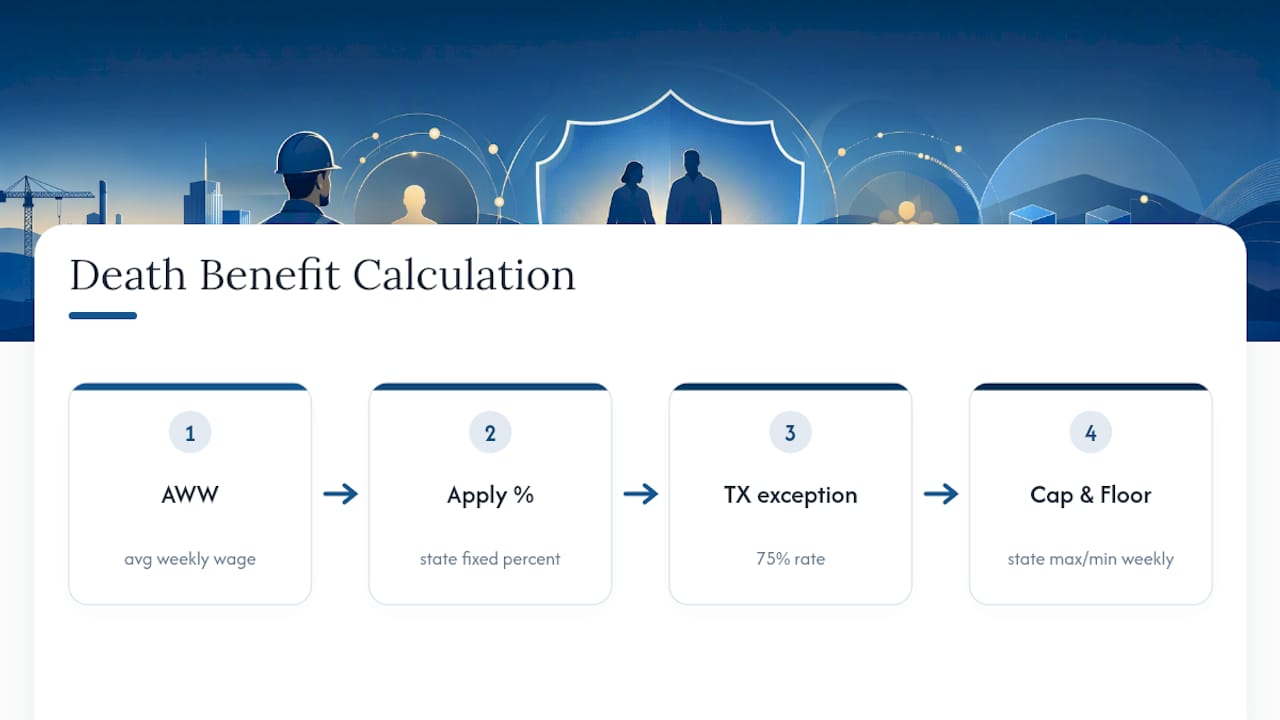
Every state also sets a maximum weekly benefit, usually tied to that state’s average weekly wage for all workers, recalculated annually. A worker with a very high salary won’t have benefits calculated on their full wage. Instead, the payout gets capped at the state maximum. Minimum benefit floors exist too, protecting families of lower-wage workers from receiving an unlivably small check.
A worked example
Take a worker earning $900 per week at the time of death, leaving a spouse and two minor children.
- In a two-thirds state: $900 × 66.67% = $600.03 per week
- In Texas at 75%: $900 × 75% = $675 per week
Multiply either figure out and the totals compound quickly. At $600 a week, that’s roughly $31,200 a year, and many states pay this for years or decades depending on how long dependency lasts. A surviving spouse who never remarries and stays alive for 30 years could theoretically receive nearly $1 million in cumulative benefits, though very few claims run that long without some change in circumstances.
Statistic: Burial reimbursements alone range from roughly a few thousand dollars up to $12,500 or more depending on the state, which shows how much the total value of a death claim can shift based purely on geography.
Offsets and aggregate caps
A few complications affect the final number. If the worker received temporary total disability, or TTD, payments between the injury and the death, those are typically treated as a separate benefit period and don’t reduce the death benefit calculation, since a death claim is legally distinct from any disability claim filed before death. Some states also apply an aggregate cap when there are multiple dependents, meaning the total weekly payment across all beneficiaries combined can’t exceed a set ceiling, even if the math on paper would suggest a higher number.
Social Security survivor benefits occasionally interact with workers’ comp death benefits too, though this coordination is far less standardized than the disability-benefit offset rules you may have heard about for injured (living) workers. Because the exact formula and caps depend entirely on your state, running your numbers through a free 50-state estimator gives you a realistic dollar figure faster than working through statutory language by hand.
Burial and Funeral Expense Reimbursement
Burial benefits function separately from the weekly wage-replacement payment, and nearly every state offers some level of reimbursement for funeral costs. The amounts vary enormously. Some states cap reimbursement at a few thousand dollars, while Texas’s schedule reaches up to $10,000 depending on the date of the injury, and other states’ maximums climb past $12,500.
- Reimbursement typically goes to whoever actually paid the funeral home, whether that’s a spouse, adult child, or the estate.
- You’ll need itemized receipts, the funeral home contract, and proof of payment, such as a bank statement or canceled check.
- Most states require the claim submitted within 12 months of the funeral, though some insurers move faster once they receive a complete request.
Because the injury date can change which burial schedule applies, don’t assume your state’s current maximum automatically applies. Confirm the rate tied to the actual date of injury, not the date of death.
How Long Benefits Last and How They’re Divided
A surviving spouse generally keeps receiving weekly benefits until death or remarriage, which makes this one of the longer-running obligations in the entire workers’ comp system. Children typically remain eligible until age 18, or up to 23 to 25 if they stay enrolled as full-time students, and a child with a qualifying disability can often continue receiving payments for life.
Remarriage is where a lot of surviving spouses get caught off guard. Many states don’t simply cut off the weekly check the moment a spouse remarries. Instead, they convert the remaining entitlement into a lump sum, commonly calculated as two years’ worth of benefits paid out at once. That structure exists so remarriage doesn’t leave a spouse with nothing after years of relying on that income, but it does mean the ongoing weekly payments stop for good.
When multiple dependents share one benefit
If a worker leaves behind a spouse and two or three children, states generally don’t multiply the benefit for each person separately. Instead, they set a combined household benefit, often built around that same two-thirds or 75% wage-replacement rate, then divide it among the eligible dependents according to a formula in the state code.
Things shift again when one dependent ages out or otherwise loses eligibility. Say a family has a surviving spouse and two children receiving a combined benefit, and the older child turns 18 and isn’t in school. In most states, that child’s share doesn’t just disappear into the insurer’s pocket. It typically gets redistributed among the remaining eligible dependents, meaning the spouse and younger child may see their individual payments increase even though the total household benefit stays roughly the same.
Public-safety workers sometimes get different treatment entirely. Some states extend survivor benefits for firefighters, police officers, and emergency responders beyond the standard timelines, or skip the remarriage lump-sum conversion altogether, treating these families under separate statutory provisions.
How to File a Workers Comp Death Benefits Claim
Filing quickly and correctly matters more here than almost anywhere else in the workers’ comp system, because missing a deadline can permanently forfeit a family’s right to compensation.
- Notify the employer and insurer immediately. Most states require this within days or weeks of the death, not months.
- Request the state-specific death benefit claim form from the workers’ comp board or the insurance carrier directly.
- Collect the death certificate, ideally several certified originals, since multiple parties will need copies.
- Assemble wage records covering the weeks or months before the injury to establish the average weekly wage.
- Gather proof of relationship and dependency, including marriage or birth certificates, tax returns, and school enrollment records for older children.
- Submit the claim to the state agency or insurer within the statutory deadline, which commonly falls within one to two years of the death depending on the state.
- Respond promptly to any request for additional documentation from the insurer or state board.
Insurers often respond within a few weeks of receiving a complete claim, though contested cases involving unclear cause of death or disputed dependency can stretch on much longer. Nolo’s overview of the process notes that survivors often lose ground simply by underestimating how much documentation matters, which tracks with what most claims adjusters will tell you privately: incomplete files are the single biggest cause of delay.
Pro Tip: Keep a simple log of every phone call, letter, and email exchanged with the employer, insurer, or state board, noting the date and who you spoke with. If your claim gets disputed later, that log becomes evidence that you acted promptly and in good faith.
When the filing window is unclear, treat 12 months as your working deadline and file well before it. If your state’s rule turns out to be longer, you’ve lost nothing. If it turns out to be shorter, that early filing may be the only thing standing between your family and a denied claim.
Death Benefits by State: What Actually Changes
The core structure of a death benefit claim, wage-replacement plus burial reimbursement, stays consistent nationwide. What changes dramatically is the math behind each piece. Five variables drive almost all of the state-to-state differences you’ll encounter:
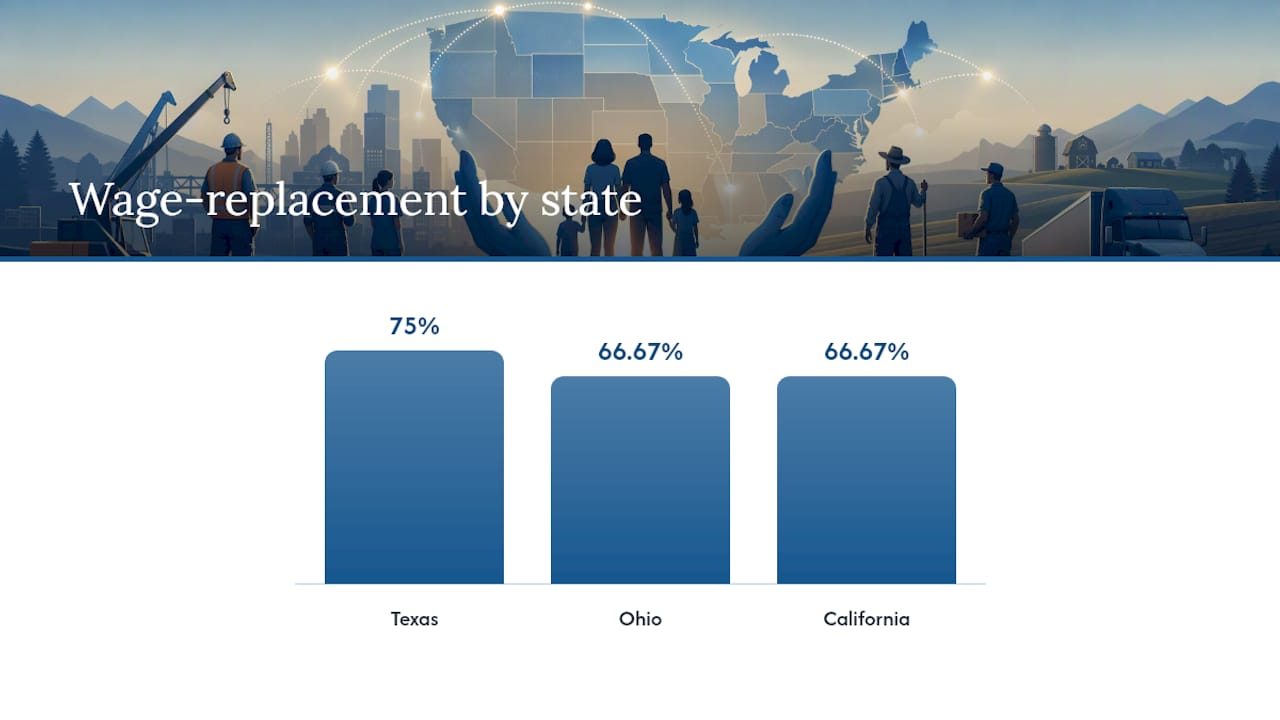
- The wage-replacement percentage (66.67% is standard; a few states, including Texas, use 75%)
- The weekly dollar cap tied to that state’s average wage, recalculated annually
- The burial expense maximum, which can differ by a factor of five or more between states
- The filing deadline, ranging from months to a couple of years
- Special provisions for firefighters, police officers, and other public-safety workers
Here’s how three commonly cited states illustrate that spread:
| State | Wage-Replacement Rate | Burial Benefit Range | Notable Rule |
|---|---|---|---|
| Texas | 75% of AWW | Up to $10,000 (varies by injury date) | Higher-than-average wage-replacement percentage |
| Ohio | 66.67% of AWW | Set by statute, apportioned per dependent | Detailed dependency and apportionment formula under ORC 4123.59 |
| California | 66.67% of AWW | Statutory burial and per-dependent caps | Combines a wage-replacement percentage with fixed per-dependent maximums |
Texas stands out for its 75% wage-replacement rate, which is meaningfully higher than the two-thirds standard used in most of the country. Its burial schedule also scales with the date of injury, so an older claim may fall under a lower cap than a claim filed today. Anyone estimating a Texas claim should run the numbers through the Texas Workers’ Comp Benefits Calculator rather than assuming the national two-thirds standard applies.
Ohio uses the two-thirds standard but backs it with one of the more detailed statutory frameworks for dependency and apportionment in the country. If multiple dependents have varying levels of financial reliance on the deceased worker, Ohio’s code lays out exactly how the total benefit gets split. Readers dealing with an Ohio claim can plug their numbers into the Ohio Workers’ Comp Benefits Calculator to see a state-specific weekly estimate rather than working through statutory language line by line.
The California Workers’ Comp Benefits Calculator reflects the state’s current 2026 caps if you need a fast estimate.
Beyond these three, every state sets its own combination of these five variables, and even neighboring states can differ substantially. A worker’s family in Minnesota, for instance, faces a different weekly maximum entirely from a family in Wyoming, even if both states nominally use the same two-thirds formula. The safest approach is to treat the two-thirds/75% distinction as a starting point, then confirm the exact cap and burial maximum for your specific state using either the 2026 Weekly Benefit Rates table or a state-specific calculator before making any decisions about a claim or settlement negotiation.
What Happens After You File: Disputes and Appeals
Not every death benefit claim gets approved on the first pass. Insurers and state boards commonly push back on claims for a few recurring reasons: insufficient proof that the death actually resulted from a work-related injury or illness, weak documentation of a claimed dependent’s financial reliance, or a claim filed after the statutory deadline has already passed.
When a claim gets denied or disputed, the appeal process generally follows a predictable sequence:
- Request an internal review from the insurer, laying out the missing or disputed evidence
- File a formal appeal with the state workers’ compensation board if the insurer’s review doesn’t resolve the dispute
- Attend a hearing before an administrative law judge or board panel, where both sides present evidence
- Pursue a court appeal in the rare cases where the administrative decision gets challenged further
Timelines for this process vary widely by state, running anywhere from a couple of months for a straightforward dispute to well over a year for contested dependency cases that require hearings and expert testimony.
Consider hiring an attorney when the disputed benefit amount is substantial, when dependency facts are genuinely complicated (blended families, stepchildren, or informal financial support arrangements), or when you’ve already received one denial and are filing a second appeal. Most workers’ comp attorneys in death benefit cases work on contingency, meaning there’s no upfront cost to at least get an opinion on whether your denied claim is worth appealing.
Turning State Rules Into a Real Dollar Estimate
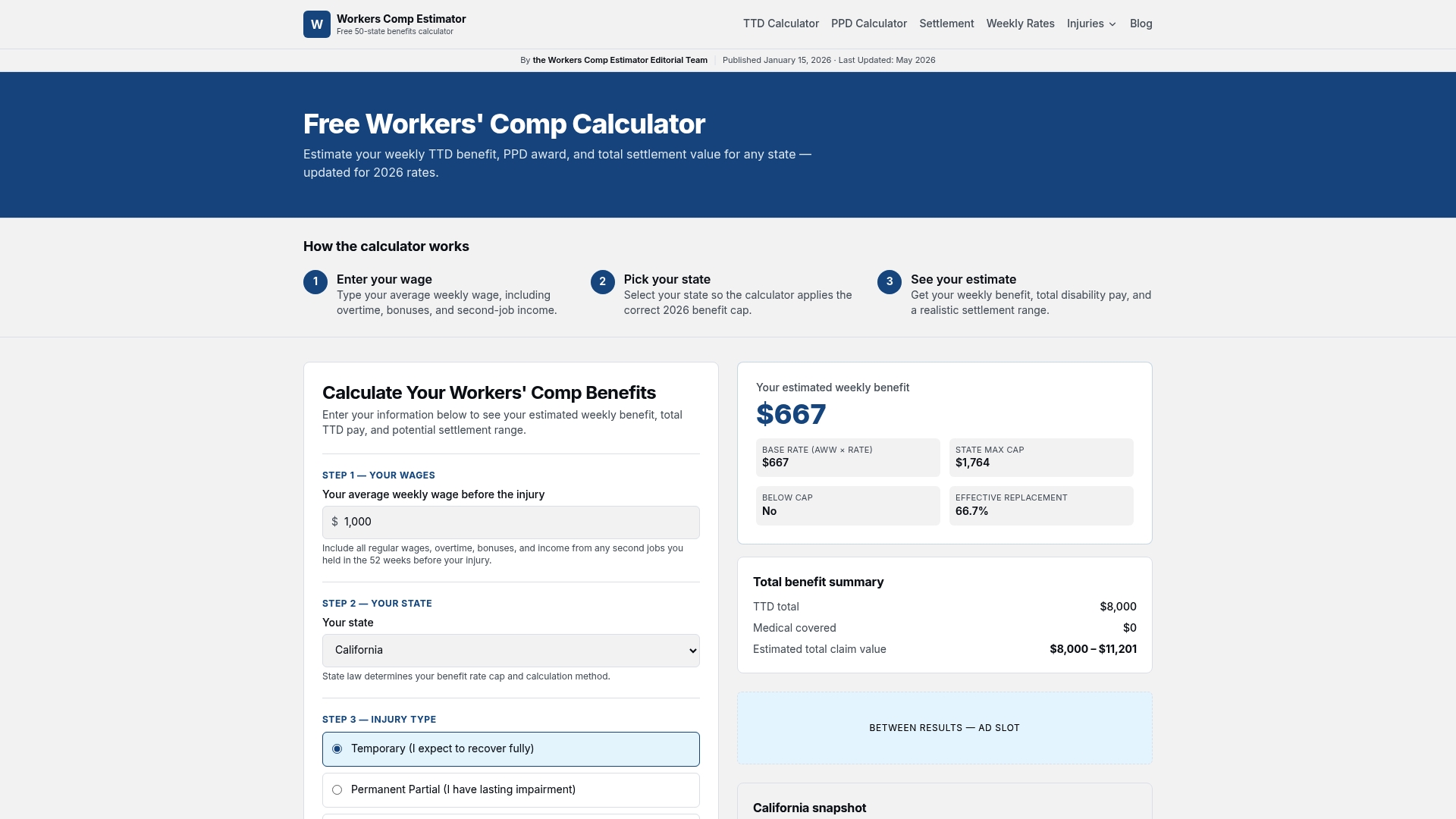
Reading through statutory percentages and burial caps tells you the framework, but it doesn’t tell you what your family will actually receive. That’s the gap the Free Workers’ Comp Calculator is built to close, using each state’s 2026 benefit caps so the number you see reflects current law rather than a rough national average.
- Select your state from the dropdown menu.
- Enter the deceased worker’s average weekly wage, or your best estimate based on recent pay stubs.
- Enter the date of injury or death, since that date determines which burial schedule and rate table apply.
- Enter the number of dependents, which affects how the total household benefit gets divided.
- Review your results: an estimated weekly benefit, the applicable burial reimbursement cap, and a potential settlement range if a lump-sum negotiation becomes relevant.
- Save or screenshot the results to bring to an attorney consultation or to reference when discussing your claim with the insurer.
A clear, state-specific dollar figure changes the conversation with an insurance adjuster. Instead of asking “is this fair,” you’re asking “why is this number lower than what the state formula produces.”
Pro Tip: Run the calculator twice, once with the exact average weekly wage from your pay records and once with a slightly conservative estimate. If the insurer’s offer falls below your conservative number, that’s a clear signal to push back or consult an attorney.
Statistic: Because burial caps alone swing from a few thousand dollars to $12,500 or more depending on the state, a generic national average is nearly useless for planning purposes. A state-specific number is the only figure worth acting on.
A short note on how this article was built
helped shape this explainer, drawing on statutory language from Texas and Ohio alongside legal industry reporting on how claims actually move through the system.
— Daniel
Get a State-Specific Death Benefit Estimate Today
Workerscompestimator gives surviving families something most law firm blog posts and government pages don’t: an actual dollar figure, built from each state’s 2026 caps, instead of a percentage you have to calculate yourself. The Free Workers’ Comp Calculator takes your state, average weekly wage, and dependent count and returns an estimated weekly benefit along with the applicable burial reimbursement cap, so you walk into a conversation with an insurer or attorney already knowing what the state formula says you’re owed.
If a lump-sum settlement is on the table instead of ongoing weekly payments, the Workers’ Comp Settlement Calculator estimates a realistic range based on your state’s rules, which gives you a benchmark before any negotiation starts. Families also frequently ask about covering funeral costs beyond what the state reimburses. If that gap concerns you, East Two West’s funeral insurance and annuity quotes are worth a look as a separate layer of protection alongside your workers’ comp claim.
Start by entering your state and average weekly wage into the calculator now. Having that number in hand before your first call with the insurer puts you in a stronger position from the start.
Sources
- Death and burial benefits - Texas Department of Insurance
- Understanding workers’ compensation death benefits — Reuters
FAQ
Who Qualifies for the $2,500 Death Benefit?
The $2,500 figure comes from specific state burial reimbursement schedules, such as Texas’s tiered burial benefit tied to the injury date; it is not a universal amount, so check your state’s exact burial cap rather than assuming this figure applies everywhere.
Who Are the Most Common Beneficiaries of Workers’ Compensation Death Benefits?
Surviving spouses and minor children are the most common beneficiaries in every state, followed by full-time student children up to a state-set age limit, disabled dependent children, and other proven dependents like parents or grandchildren.
How Much Is a Death Benefit Payout?
The payout depends on the deceased worker’s average weekly wage, the state’s wage-replacement percentage (typically 66.67% or 75%), and that state’s weekly maximum cap; a free 50-state calculator can turn those variables into an actual dollar estimate.
Can Workers’ Comp Death Benefits Be Garnished?
Garnishment rules for workers’ comp benefits, including death benefits, vary by state and by the type of debt involved, with many states offering strong protections against general creditor garnishment but allowing exceptions for obligations like child support; check your state’s exemption statute for the specific rule that applies to your situation.
How Long Do Survivor Benefits Last?
A surviving spouse typically receives benefits until death or remarriage, while children usually remain eligible until age 18, or up to 23 to 25 if enrolled as full-time students, with disabled dependent children sometimes qualifying indefinitely.
Recommended
More from the blog
Apportionment can cut your permanent disability award. Learn how states split benefits between work and pre-existing causes, and how to challenge the split.
Compare California workers’ comp lawyers with five criteria, verify State Bar standing, and estimate 2026 benefits before your first consultation.
See what workers’ compensation may cover after an eye injury, from treatment and lost wages to vision loss awards, with a free 2026 estimate by state.
Free workers' comp calculators
Put the numbers in this article to work on your own claim.
Weekly benefit, PPD, and settlement in one place.
What your weekly temporary disability check should be.
Scheduled weeks and permanent impairment awards.
Light-duty benefit when you earn less while healing.
Federal employee FECA award by body part.
Lump-sum value of your full claim.
Turn a 5%, 10%, or 20% rating into dollars.
Max and min weekly rates for all 50 states.
Typical settlement ranges by injury and state.
Average settlement for fusion, rotator cuff, knee replacement, and more.
Why comp does not pay it, and when a third-party claim does.
When carriers typically make an offer.
What coverage costs by class code and payroll.
Guides, state updates, and claim strategy.