
Can You Reopen a Workers’ Comp Claim After It’s Closed?

You can reopen a workers’ comp claim if your injury has objectively worsened, if the insurer committed fraud, or if the original decision contained a legal or factual mistake. The path forward is filing a petition to reopen with your state’s workers’ compensation board, backed by new medical evidence. Deadlines vary by state, so preserve your medical records now. Run the numbers through the Free Workers’ Comp Calculator before deciding whether it’s worth pursuing.
TL;DR:
- Reopening a workers’ comp claim generally requires objective medical evidence proving your condition has worsened since settlement, especially imaging or test results.
- Filing deadlines vary by state and are measured from injury date, last payment, or the original award, so it’s vital to check your specific jurisdiction quickly.
- A full-and-final settlement usually prevents reopening, whereas agreements reserving future medical rights or structured settlements may still allow it.
- Insurers typically respond with an Independent Medical Examination, so preparing a strong medical comparison report and rebuttal strategy is essential.
- Using state-specific benefit calculators helps determine if pursuing reopening is financially worthwhile before investing in new tests or legal help.
Table of Contents
- When Can You Legally Reopen a Workers’ Comp Claim?
- What Medical Evidence Do You Need to Reopen a Claim?
- How Do You File a Petition to Reopen a Workers’ Comp Claim?
- How Long Do You Have to Reopen a Workers’ Comp Claim?
- Does Your Settlement Affect Your Ability to Reopen?
- What Happens If Your Reopening Petition Is Denied?
- When Should You Hire an Attorney for a Reopened Claim?
- Use State Caps to Decide If Reopening Is Worth Pursuing
- Get a Fast Estimate Before You File
- Where to Verify Your State’s Reopening Rules
- Sources
- FAQ
When Can You Legally Reopen a Workers’ Comp Claim?
Three doors lead back into a closed claim, and most states only open two of them without a fight.
The most common path is a change in condition, meaning your injury has materially worsened since your case closed. Most states allow this, though the legal standard for “material” varies. Some boards want proof the change was unforeseeable at the time of settlement; others just want evidence the condition is measurably worse now than it was then, according to Justia’s overview of the reopening process.
The second door is newly discovered evidence or a legal mistake, such as a misapplied statute, an overlooked medical record, or a clerical error in the original award. The third, rarer path is fraud, where the insurer withheld information or misrepresented facts during the original claim.
Here’s the catch almost nobody explains upfront: your settlement type decides which of these doors are even unlocked.
- Change in condition: usually the strongest ground, but requires objective proof, not just a claimant’s word.
- Legal or factual error: works when the original decision misapplied law or missed evidence that existed at the time.
- Fraud: rare, but if proven, it can override even a signed release.
- Full-and-final settlements: these typically waive your right to reopen no matter which ground you claim, unless your state carves out exceptions.
Know your settlement type before you spend time building a medical case. It changes everything downstream.
What Medical Evidence Do You Need to Reopen a Claim?
Judges don’t reopen claims on pain complaints alone. They want objective, measurable proof that your condition has changed, and a physician willing to connect that change to your original workplace injury.

Objective findings carry the most weight. That means new imaging (MRI, CT scan), EMG or nerve conduction results showing progression, a surgical recommendation that didn’t exist before, or documented decline in range-of-motion or strength testing. A claimant saying “it hurts more” rarely moves a case forward; a radiologist’s report showing disc herniation progression usually does.
Causation matters as much as the finding itself. Your treating physician needs to state, in writing, that your current condition stems from the original work injury, not a new incident or unrelated degeneration. Insurers routinely argue that a worsening condition is due to age, a separate accident, or an unrelated medical issue. Experts note that simply claiming things got worse isn’t enough. You need a documented causal link, not just a diagnosis.
Before filing, organize:
- A comparison report showing your condition at closing versus now, ideally from the same treating physician.
- Copies of your original award or settlement paperwork.
- Any new records, test results, or referrals gathered since closing.
Pro Tip: Ask your treating physician to explicitly compare your current condition to the condition documented at the time your case closed. A vague “patient reports increased pain” note won’t satisfy a judge. A side-by-side clinical comparison will.
How Do You File a Petition to Reopen a Workers’ Comp Claim?
Filing isn’t complicated, but it’s unforgiving of shortcuts. Miss a step and your petition can get bounced before a judge ever reads your medical file.
- Locate your state’s petition to reopen or application to reinstate. Every state board publishes this form online; some call it a “petition for reconsideration” or “motion to reopen.” File it with the state workers’ compensation board or agency, not just your employer.
- Serve the employer and insurer. Filing with the board isn’t enough. You typically must formally notify the employer or its insurance carrier that you’re seeking reopening.
- Attach supporting medical reports that explain why your worsening condition is new or was unforeseeable at the time of the original award. This is where the comparison report from your treating physician does its job.
- Keep proof of filing and service. Certified mail receipts, e-filing confirmations, and date-stamped copies matter if the insurer later claims they weren’t notified.
- Expect an insurer-ordered Independent Medical Examination (IME). Insurers almost always respond to a reopening petition by sending you to their own physician. IME findings frequently shape the outcome, so be ready to rebut an unfavorable opinion with your treating physician’s records.
- Prepare for a hearing. If the board doesn’t resolve the petition on paperwork alone, bring organized exhibits, your comparison medical report, and physician testimony if the case allows it.
How Long Do You Have to Reopen a Workers’ Comp Claim?
Deadlines get measured differently depending on where you live, and that difference alone determines whether your case is even alive.
Some states count from the date of injury, others from the date of your last payment, and a few use the date the original award was issued. California allows petitions for “new and further disability” within a limited years-long period from the date of injury. New York has its own special fund provisions for older claims. Arizona takes a comparatively broader approach to reopening for worsened conditions. Filing rules and qualifying reasons vary substantially by state, so don’t assume your neighbor’s timeline applies to you.
- Check your state board’s website or statute directly. Don’t rely on general guides for your exact filing window.
- If you suspect your condition is worsening, file sooner rather than later. Waiting to “see how it goes” is the single most common way workers miss a valid deadline.
Does Your Settlement Affect Your Ability to Reopen?
Read your settlement agreement before you assume anything. The language you signed matters more than the medical evidence you’ve gathered.
A full-and-final lump-sum settlement typically waives your right to reopen, no matter how much your condition worsens afterward, according to Nolo’s legal encyclopedia on reopening closed cases. A structured settlement or an agreement that specifically reserves future medical treatment leaves the door open in many states, even after the wage-loss portion closed out.
- Full-and-final release: reopening is usually barred.
- Structured award or reserved medical rights: reopening is often still possible.
- Some states protect ongoing medical care even under a lump-sum deal. Check your state’s law, not just the settlement’s wording.
- If you already signed a release, an attorney can review it for exceptions like fraud or misrepresentation that sometimes permit reopening anyway.
What Happens If Your Reopening Petition Is Denied?
Expect friction before you expect approval. Insurers rarely accept a reopening petition without pushback.
- Insurers commonly order an IME to challenge your treating physician’s findings. Cooperate with it, but document any disagreements and follow up with a written rebuttal from your own doctor.
- Hearings hinge on objective proof and a clear causal link back to the original injury, not general complaints of pain or fatigue.
- If your petition is denied, appeals are time-limited, often just weeks. Appeals typically focus on legal error, misapplied law, or genuinely new evidence that wasn’t available before, not a simple disagreement with the judge’s weighing of facts.
When Should You Hire an Attorney for a Reopened Claim?
Consider legal help when the potential recovery is significant, the medical evidence is technical, your deadline is close, or the insurer is fighting hard. Attorneys secure persuasive causation opinions, manage filings and appeals, and counter unfavorable IME reports. Most work on contingency. Confirm the lawyer’s specific workers’ comp experience before signing anything.
Pro Tip: Ask a prospective attorney how many reopening petitions, specifically, they’ve handled in your state’s system. General workers’ comp experience isn’t the same as reopening experience, and the rules differ enough that it matters.
Use State Caps to Decide If Reopening Is Worth Pursuing
Before you invest in another round of medical testing or a legal consultation, run your numbers. The Free Workers’ Comp Calculator applies each state’s 2026 benefit caps, such as Rhode Island’s $1,625 weekly maximum, Oregon’s $1,601, Colorado’s $1,397, and Wyoming’s $1,032, to estimate what additional TTD or settlement value might actually be on the table. Bring that estimate to your attorney consultation.
— Daniel
Get a Fast Estimate Before You File
Before you spend money on new testing or a consultation, know what’s realistically at stake. The Free 50-State Workers’ Comp Calculator gives you a printable estimate of your potential weekly TTD benefit and settlement range in minutes, using your state’s actual 2026 caps instead of a guess.
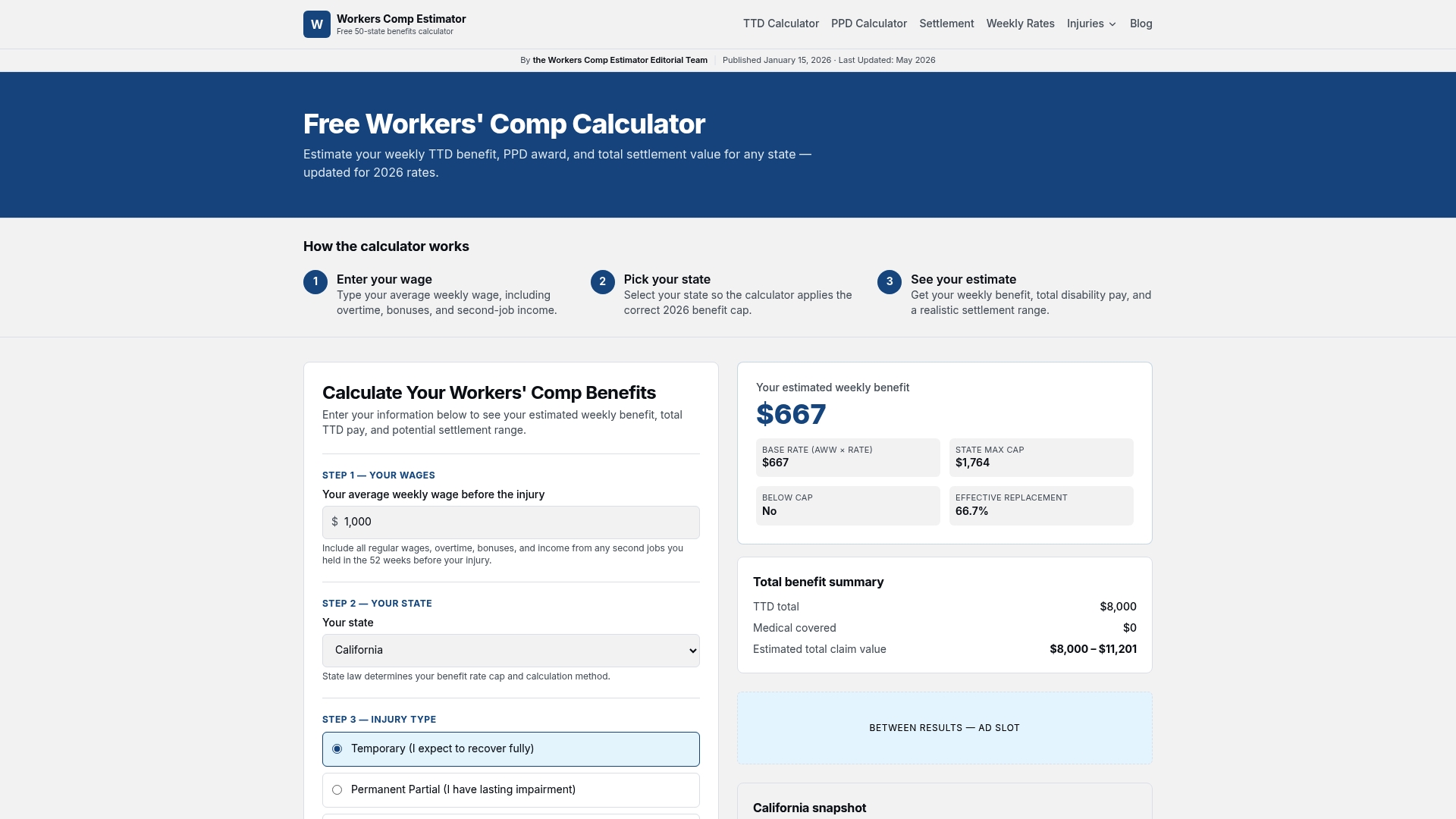
If your case involves a specific injury type, the back injury settlement calculator and the settlement calculator break down numbers by injury and by state. Someone in Oregon might check the Oregon calculator, while a Colorado worker would use the Colorado calculator to see their $1,397 weekly cap applied to their own wage. Print your results and attach them to your petition file, or bring them to your attorney consultation so the conversation starts with numbers instead of guesswork. Start with your state’s calculator and see what your reopened claim could actually be worth.
Where to Verify Your State’s Reopening Rules
- Your state workers’ compensation board’s website for petition forms and statute lookups.
- The DEEOIC reopening process for federal energy employee claims.
- Legal guidance summaries like AllLaw’s overview of reopening a worsened injury claim for state-by-state context.
This article is general information, not a substitute for advice from a qualified lawyer. Consult a qualified legal professional about your own circumstances before acting on anything here.
Sources
- Reopening a Workers’ Compensation Claim & the Legal Process — Justia
- Reopening a Closed Workers’ Comp Case — Nolo
FAQ
Can I Reopen My Workers’ Comp Claim if I Feel Worse?
Feeling worse alone won’t reopen a claim. You need objective medical evidence, like imaging or physician-documented decline, tied to a causal opinion from your treating doctor.
How Long Do I Have to Reopen a Workers’ Comp Claim?
It depends on your state and how it measures the clock, whether from date of injury, last payment, or the original award. California allows up to five years from the injury date for new and further disability claims.
Does a Settlement Stop Me From Reopening My Claim?
A full-and-final lump-sum settlement usually bars reopening, while structured settlements or agreements that reserve future medical care often leave that option open.
Will the Insurer Order a Medical Exam if I File to Reopen?
Yes, insurers commonly order an Independent Medical Examination to challenge your evidence, and its findings often shape the hearing outcome.
Should I Use a Calculator Before Filing to Reopen?
Yes. The Free Workers’ Comp Calculator estimates your potential weekly benefit and settlement value using your state’s 2026 caps, which helps you decide whether pursuing reopening is worth the time and cost.
Recommended
More from the blog
Learn who coordinates care, who approves treatment, and when to contact the adjuster. Use the free workers' comp calculator to estimate benefits.
Understand U.S. workers comp waiting periods (typically 3–7 days). See state examples, learn how to protect and claim retro pay, and use a free 50 state...
Compare workers comp and personal injury for U.S. workers. Learn which deadlines matter, how liens reduce settlements, and use the free 50 State...
Free workers' comp calculators
Put the numbers in this article to work on your own claim.
Weekly benefit, PPD, and settlement in one place.
What your weekly temporary disability check should be.
Scheduled weeks and permanent impairment awards.
Light-duty benefit when you earn less while healing.
Federal employee FECA award by body part.
Lump-sum value of your full claim.
Turn a 5%, 10%, or 20% rating into dollars.
Max and min weekly rates for all 50 states.
Typical settlement ranges by injury and state.
Average settlement for fusion, rotator cuff, knee replacement, and more.
Why comp does not pay it, and when a third-party claim does.
When carriers typically make an offer.
What coverage costs by class code and payroll.
Guides, state updates, and claim strategy.