MSA Workers’ Comp: Run Free 50 State Calculators Before You Negotiate

A Workers’ Compensation Medicare Set-Aside sets money aside from a settlement to pay for future injury-related medical care that Medicare would otherwise cover. CMS reviews these arrangements once your case crosses specific workload thresholds, but the legal duty to protect Medicare’s interest applies regardless of size. If you’re Medicare-eligible or approaching eligibility, your first move is getting a realistic settlement and future-cost estimate, then documenting how you accounted for Medicare before you finalize anything.
TL;DR:
- CMS reviews MSAs only if the case exceeds $25,000 for current Medicare beneficiaries or $250,000 if Medicare enrollment is expected within 30 months, but the duty to account for Medicare applies regardless of these thresholds.
- Calculating an accurate future medical cost, based on recent medical records and state fee schedules, is crucial to determining a realistic MSA amount that aligns with settlement negotiations.
- Self-administration requires strict recordkeeping, separate accounts, and timely attestations, but professional administration reduces compliance risks for complex cases with multiple providers.
- Submitting a proposed MSA through CMS’s portal speeds up approval, typically taking two to six months, and ensures Medicare coverage for future injury-related care after account exhaustion.
- Using a settlement calculator beforehand helps claimants set realistic expectations, making their negotiations more grounded and reducing the risk of underfunding or overfunding the MSA.
Table of Contents
- What Is a Workers Comp MSA and Why Does It Exist?
- Who Actually Needs an MSA: CMS Review Thresholds Explained
- How Insurers Calculate Your MSA and How the Money Gets Funded
- Self-Administration vs. Professional Administration: Which Fits You?
- What Happens When You Submit to CMS: Timeline and Outcomes
- Running Your MSA: Permitted Uses, Payment Rates, and Attestations
- Common MSA Mistakes That Put Your Medicare Coverage at Risk
- Using the Free Workers’ Comp Calculator to Plan Your MSA Numbers
- An Editorial Take on Getting the MSA Process Right
- Get Real Numbers Before You Negotiate Your MSA
- CMS Resources Worth Bookmarking
- Sources
- FAQ
What Is a Workers Comp MSA and Why Does It Exist?
The Medicare Secondary Payer law exists because Medicare was never meant to foot the bill for injuries that workers’ compensation insurance already covers. When a settlement resolves your future medical treatment, Medicare needs assurance that money for that treatment gets spent first, before Medicare picks up the tab. That’s the entire reason a Workers’ Compensation Medicare Set-Aside exists: it carves out a specific portion of your settlement, earmarked only for the Medicare-covered treatment tied to your work injury.
An MSA isn’t a penalty or an extra fee. It’s a portion of money you were already going to receive, just redirected into an account with rules attached. Once that account is appropriately spent down, Medicare resumes paying for your related care like normal.
Here’s where claimants and their attorneys diverge on strategy:
- CMS-reviewed submission: You send your proposed allocation to CMS, get an approved amount, and gain certainty that Medicare will honor it.
- Non-submission (evidence-based): You calculate a defensible amount without CMS sign-off, saving time but accepting more risk if Medicare later disputes the figure.
- Zero-dollar allocation: Historically an option in narrow cases, now off the table for CMS review as of mid-2025.
Each path carries trade-offs in speed, certainty, and cost, which is why the decision usually involves your attorney and a settlement consultant, not just a calculator.
Who Actually Needs an MSA: CMS Review Thresholds Explained
CMS reviews a proposed MSA when your case hits one of two workload triggers. These aren’t laws that make an MSA mandatory. They’re the dollar lines CMS uses to decide whether it will bother reviewing your specific number.
- You’re already a Medicare beneficiary and the total settlement exceeds $25,000.
- You have a reasonable expectation of Medicare enrollment within 30 months (commonly because you’re 62.5 or older, or you’ve applied for Social Security Disability Insurance) and the anticipated settlement-related payments exceed $250,000.
The “settlement total” for this math generally includes indemnity payments, future medical exposure, and related costs, not just the medical portion. A $200,000 settlement that’s mostly wage-loss benefits might still trip the 30-month trigger if you’re near Medicare age.
Here’s the trap: falling under these numbers doesn’t mean you’re off the hook. Legal analyses of the Medicare Secondary Payer statute make clear that the thresholds are workload triggers CMS uses to decide what it will review, not a legal safe harbor that erases your duty to account for Medicare’s future interest. A $22,000 settlement for a Medicare beneficiary with ongoing injury-related prescriptions still needs a documented rationale.
How Insurers Calculate Your MSA and How the Money Gets Funded
Allocation reports typically start by pulling roughly the last two years of your medical records to establish a baseline for future costs. From there, a rated age or life expectancy table projects how many years of care you’ll likely need, and each anticipated service, surgery, injection, medication refill, gets priced out using your state’s workers’ comp fee schedule (OMFS) rather than retail billed rates. That distinction alone can shift a projection by tens of thousands of dollars.
Once the total dollar figure is set, you and the payer choose how it gets funded:
- Lump sum: The full MSA amount is deposited at once. Simple, but it front-loads the entire obligation.
- Structured settlement: An initial seed deposit, equal to the cost of the first surgery plus two years of annual payments, is followed by scheduled annual deposits going forward.
- Rollover of unused funds: Money left over at the end of a structured payment year rolls forward and gets added to the following year’s deposit, rather than disappearing.
Structured funding tends to fit lower earners better because it spreads risk. If you burn through the seed deposit faster than projected, say a surgery gets pushed up two years, you’re not left holding an empty account with years to go.
Pro Tip: Run your numbers through a settlement calculator before your first allocation consultation. Walking in with a realistic settlement range and weekly benefit figures gives your attorney a stronger starting point for negotiating the MSA amount instead of accepting the insurer’s first offer.
Self-Administration vs. Professional Administration: Which Fits You?
Once your MSA is funded, someone has to manage it, and CMS gives you two paths.
Self-administration means you handle the account yourself. CMS requires the money to sit in a separate, interest-bearing, FDIC-insured account used for nothing else. You pay providers directly, keep every receipt and explanation of benefits, and submit an annual attestation confirming the funds were spent only on Medicare-covered, injury-related care.
That sounds manageable until you’re three years in and realize you’ve lost half your transaction records. CMS’s own toolkit spells out the required attestation forms and transaction-record templates, and missing a single annual attestation can flag your account for review.
Professional administration hands the recordkeeping, provider payments, and attestation filing to a third-party administrator for an ongoing fee, typically a small percentage of the account balance annually.
Trade-offs to weigh:
- Self-administration saves money but demands discipline most people underestimate.
- Professional administration costs more but sharply lowers the odds of a paperwork slip that jeopardizes future Medicare coverage.
- CMS-approved guidance notes that professional administrators reduce compliance risk specifically for beneficiaries who lack the time or inclination to track every dollar.
Pro Tip: If your MSA involves multiple providers, ongoing prescriptions, and a six-figure balance, the administration fee is usually cheaper than the risk of Medicare denying a claim later because your attestation history has gaps.
What Happens When You Submit to CMS: Timeline and Outcomes
You can submit a proposed WCMSA through the WCMSA Portal or by mailing paper documents and a CD. CMS strongly steers submitters toward the portal because it processes faster, lets you track status in real time, and cuts down on the document-completeness issues that stall paper filings for weeks.
Here’s what the process generally looks like:
- Submission: You (or your attorney) send medical records, a proposed allocation, and settlement documents through the portal.
- Workers’ Compensation Review Contractor (WCRC) check: A CMS contractor verifies the file is complete and reviews whether the proposed amount adequately covers projected future Medicare-covered costs.
- Decision: CMS approves the amount, requests additional documentation, or, if your case falls under the review thresholds, declines to review it at all.
Most complete submissions get a decision within two to six months, though incomplete medical records or ambiguous injury descriptions routinely stretch that timeline further with follow-up document requests. That delay matters if you’re trying to close a settlement on a deadline.
The payoff for going through CMS review: once your amount is approved and the account is properly exhausted, Medicare will pay for future injury-related care that’s otherwise covered, no argument, no second-guessing. Skip CMS review and you keep that certainty question open indefinitely.
Running Your MSA: Permitted Uses, Payment Rates, and Attestations
An MSA only pays for Medicare-covered, injury-related treatment and prescriptions tied to the original workers’ comp claim. It doesn’t cover your annual physical, an unrelated flu shot, or a knee replacement from an injury that happened outside your work incident. Mixing those expenses into the account is one of the fastest ways to trigger a compliance problem.

Payment rates matter just as much as what’s covered. Providers must be reimbursed at your state’s official workers’ comp fee schedule (OMFS) rate, not their standard billed charge. Paying full billed rates instead of OMFS accelerates how fast the account drains and creates exposure if CMS later audits your spending pattern.
Compliance essentials to build into your routine:
- Keep the MSA in a dedicated, interest-bearing, FDIC-insured account separate from all personal funds.
- Save every receipt, explanation of benefits, and provider statement tied to MSA spending.
- File your annual attestation on time, every year, even in years with minimal account activity.
- File a final exhaustion attestation once the account balance hits zero.
CMS’s self-administration toolkit provides the sample attestation language and transaction-record template most beneficiaries use as their baseline recordkeeping format.
One structural detail catches people off guard: structured MSAs seed the account with the first surgery’s cost plus two years of annual deposits, and any funds left unspent at year-end roll forward into the next deposit rather than vanishing or reverting to the insurer.
Common MSA Mistakes That Put Your Medicare Coverage at Risk
Most compliance failures trace back to a handful of avoidable assumptions. Watch for these:
- Assuming a settlement under the review thresholds means no MSA is needed. The dollar figures decide whether CMS will review your number, not whether Medicare’s interest legally applies.
- Relying on a $0 MSA without documentation. As of July 2025, CMS no longer accepts or reviews zero-dollar proposals, so parties choosing that route must keep thorough files justifying the rationale on their own.
- Commingling MSA funds with personal accounts. Even accidental mixing muddies your transaction history and complicates your annual attestation.
- Paying providers at billed rates instead of OMFS. This drains the account faster than projected and can look like mismanagement during a review.
- Missing an annual attestation deadline. A single missed filing can flag the account and delay future Medicare claim payments tied to your injury.
None of these mistakes are exotic. They’re the predictable result of treating an MSA like a one-time paperwork step instead of an ongoing obligation.
Using the Free Workers’ Comp Calculator to Plan Your MSA Numbers
Before you can talk allocation amounts with an attorney or administrator, you need realistic numbers for what your weekly benefits and settlement actually look like. That’s where a calculator-driven approach earns its place in the process, not as a substitute for a formal allocation report, but as a starting point that keeps expectations grounded.
Start with your state’s benefit calculator to establish your weekly TTD or PPD rate under current caps, then run your case through the Workers’ Comp Settlement Calculator to get a settlement range based on your injury type and average weekly wage. If your injury involves a scheduled body part, an injury-specific tool like the knee injury settlement calculator sharpens that estimate further.
Practical steps that actually help:
- Enter your accurate average weekly wage and state to avoid inflated or deflated benefit projections.
- Save or screenshot your results before meeting with your attorney or MSA consultant.
- Cross-check your state’s maximum weekly rate using the 2026 weekly benefit rate chart to confirm your number isn’t being capped incorrectly.
- Bring these figures into settlement negotiations as leverage, not as a final allocation figure.
These tools estimate benefits and settlement ranges. They don’t replace a CMS-compliant allocation report, but they give you the leverage of walking into negotiations with real numbers instead of guesswork.
An Editorial Take on Getting the MSA Process Right
The single most useful thing a Medicare-eligible claimant can do is stop treating the CMS thresholds as a finish line. Get a realistic settlement and future-cost estimate early, then decide with your attorney whether formal CMS submission or a well-documented non-submit approach fits your case.
Submission earns its cost when your future medical needs are heavy, uncertain, or likely to draw scrutiny, chronic pain management, spinal hardware, ongoing opioid prescriptions. For a smaller, well-documented claim with limited future treatment, an evidence-based non-submit file, prepared carefully, can be the more practical route. Either way, the paperwork you skip today is the coverage fight you have in five years.
— Daniel
Get Real Numbers Before You Negotiate Your MSA
Free online resources can provide an immediate look at your likely weekly benefits and settlement range, before you’re locked into a number the insurer proposed first. That matters because MSA allocations and settlement negotiations both hinge on realistic figures, and most claimants walk into these conversations without any.
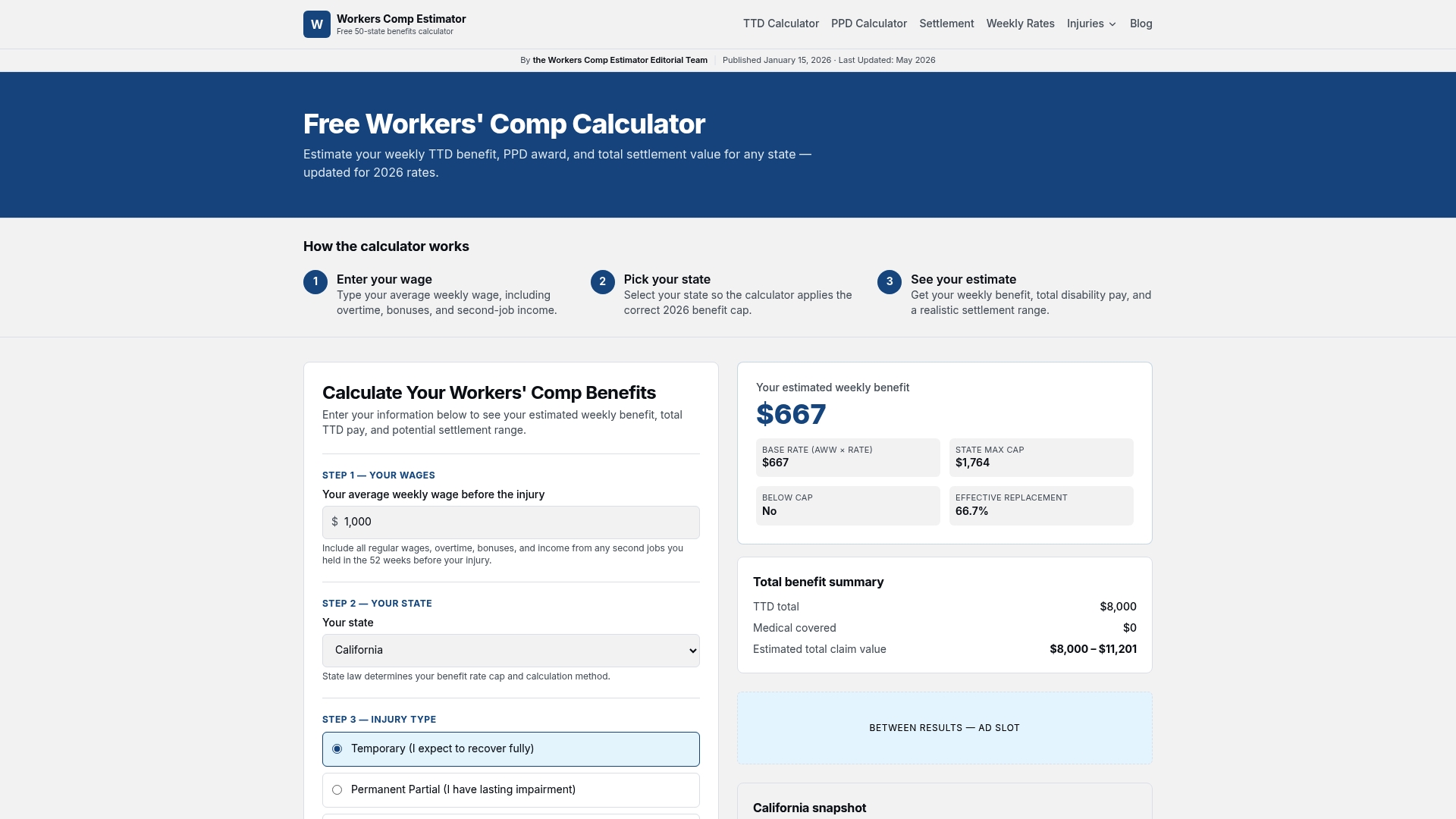
Start with the free 50-state workers’ comp calculator to see your estimated weekly benefit under your state’s 2026 caps, then move to the settlement calculator to model a total settlement range based on your wage and injury type. If you’re in a high-cap state like Washington or California, running the state-specific version first gives you a more accurate baseline before you ever sit down with an MSA consultant. Pull your numbers, save the results, and bring them to your next settlement conversation.
CMS Resources Worth Bookmarking
For the official rules behind everything covered here, go straight to the source:
- WCMSA Reference Guide, CMS’s full technical manual on allocation methodology and submission.
- Self-Administration Toolkit, attestation forms and recordkeeping templates.
- WCMSA What’s New, current policy updates, including the $0 proposal rule change.
This article is general information, not a substitute for advice from a qualified doctor. Consult a qualified healthcare professional about your own circumstances before acting on anything here.
Sources
- Workers’ Compensation Medicare Set Aside Arrangements | CMS
- WCMSA reference guide v4.6 (July 13, 2026)
- WCMSA what’s new | CMS
FAQ
What Is an MSA in a Workers’ Comp Case?
An MSA is a portion of your workers’ comp settlement set aside to pay for future Medicare-covered treatment related to your injury, so Medicare doesn’t pay for care your settlement was meant to cover.
How Long Does It Take CMS to Approve an MSA?
Most complete submissions through the WCMSA Portal get a decision within two to six months, though missing documentation or unclear injury records commonly push that timeline out further.
What Are the MSA Threshold Requirements?
CMS reviews proposed amounts when a current Medicare beneficiary settles for more than $25,000, or when someone with a reasonable expectation of Medicare enrollment within 30 months has anticipated settlement payments over $250,000.
Can I Withdraw My MSA Money for Personal Use?
No. MSA funds may only pay for Medicare-covered, injury-related medical treatment and prescriptions; using the money for unrelated expenses breaks the account’s compliance rules and risks future Medicare coverage denials.
Recommended
More from the blog
See how 2026 state caps, wages, and surgery affect your U.S. hernia workers' comp payout. Run a free 50 state calculator for a realistic estimate.
Use the free 50-state estimator that applies 2026 state caps to estimate your workers' comp lump sum. Run your numbers, check SSDI/Medicare impact, and...
Run a state specific 2026 workers' comp settlement calculation. Use the free 50 state calculator to see how state caps change your payout.
Free workers' comp calculators
Put the numbers in this article to work on your own claim.
Weekly benefit, PPD, and settlement in one place.
What your weekly temporary disability check should be.
Scheduled weeks and permanent impairment awards.
Lump-sum value of your full claim.
Turn a 5%, 10%, or 20% rating into dollars.
Max and min weekly rates for all 50 states.
Typical settlement ranges by injury and state.
Fusion, rotator cuff, knee replacement, and more.
When carriers typically make an offer.
What coverage costs by class code and payroll.
Guides, state updates, and claim strategy.