
Can You Get Workers Comp Back Pay? Yes, Here’s How

Yes, workers comp back pay is available in several common situations: when your state’s waiting period gets paid retroactively, when a denied claim gets reversed on appeal, or when the insurer used the wrong Average Weekly Wage to calculate your check. If your carrier missed a statutory deadline without good cause, you may also be owed statutory interest on top of the missing benefits.
Three things to do right now:
- Check your state’s retroactive trigger (usually 14 to 21 consecutive disability days) against your own timeline.
- Pull together pay stubs, doctor work-status notes, and every letter the insurer sent you.
- Run your numbers through a state-specific calculator before you call the adjuster, so you know the dollar figure you’re actually owed.
Key Takeaways
Workers comp back pay is recoverable when a state’s retroactive waiting-period trigger is met, when a denial gets reversed, or when the insurer miscalculated your Average Weekly Wage, and missed carrier deadlines can add penalties and interest on top.
| Point | Details |
|---|---|
| Confirm your trigger | Check your state’s exact waiting period and retroactive threshold before assuming you’re owed anything. |
| Verify the AWW math | Pull pay stubs and payroll records; a wrong Average Weekly Wage understates every check that follows. |
| Document everything | Save doctor work-status notes, denial letters, and proof of submission like certified mail receipts. |
| Demand in writing first | A short, dated letter citing the exact statute often moves an adjuster faster than a phone call. |
| Escalate to the agency | File a penalty or expedited hearing request if the carrier ignores your written demand. |
Table of Contents
- What “Back Pay” Means in Workers’ Comp, and When It Applies
- How to Calculate the Retroactive Payment You Should Receive
- Timelines, Penalties, and Interest When Payments Run Late
- Records to Gather Now to Prove You’re Owed Back Pay
- A Step-by-Step Plan If Your Back Pay Is Missing or Wrong
- Verify Insurer Math With a Free Workers’ Comp Calculator
- Differences in Back Pay Rules Across Major States
- How Returning to Work Part-Time Affects Your Back Pay
- How a Lump-Sum Settlement Affects Back Pay Eligibility
- How Back Pay Interacts With SSDI and Other Benefits
- An Editorial Take on the 2026 Back Pay Playbook
- Sources
- FAQ
What “Back Pay” Means in Workers’ Comp, and When It Applies
“Back pay” gets used loosely, but in comp practice it almost always means retroactive benefit arrears, not wages for hours you clocked. That distinction matters because the claims process for recovering wage arrears runs through the state workers’ comp agency, not the U.S. Department of Labor’s federal back-wage rules, which govern unpaid overtime and minimum-wage disputes, not disability benefits.
Four scenarios generate workers comp back pay in practice:
- Retroactive waiting-period pay. Most states delay the first check by three to seven days, then pay those days back once you cross a longer disability threshold.
- Miscalculated Average Weekly Wage. If the insurer undercounted overtime, a second job, or bonuses, your benefit rate was too low from day one.
- Reversed denials. A claim initially denied and later accepted on appeal usually owes benefits back to the original date of disability.
- Delayed claim acceptance. Some carriers sit on a claim for weeks while investigating; once accepted, the clock owed runs from the injury, not the acceptance date.
Medical benefits are handled separately and typically start as soon as a claim is accepted, regardless of any wage-replacement back pay dispute.
How to Calculate the Retroactive Payment You Should Receive
Start with your Average Weekly Wage. Most states calculate it from 52 weeks of pay stubs, or a shorter period if you were newly hired, and it should include overtime, bonuses, and in some states a second job.
- Establish AWW. Add gross wages for the lookback period and divide by weeks worked. Pull pay stubs or ask payroll for a wage statement if you don’t have them.
- Convert to a benefit rate. Most states pay roughly two-thirds of AWW for temporary total disability, subject to a state maximum.
- Convert to a daily rate. Divide the weekly benefit by seven to value each waiting-period day owed.
- Multiply by days owed. Count the waiting days retroactively due, plus any additional weeks the insurer underpaid.
Say your AWW comes out to a certain amount. Two-thirds is roughly the benefit rate per week, then divided by seven for a daily rate. Multiplying by the number of waiting period days owed gives the approximate retroactive payment due, before accounting for other adjustments or miscalculations. State maximums cap this figure, so a high earner in a low-cap state may see the two-thirds math overridden entirely.
One more thing worth remembering when you see the total: workers’ comp wage-loss and medical benefits are generally exempt from federal income tax, so the number you calculate is close to what actually lands in your account.
Timelines, Penalties, and Interest When Payments Run Late
Carriers work under statutory clocks for accepting or denying a claim, issuing the first check, and paying ongoing benefits, and those clocks vary state by state. Miss one without a documented good reason, and many states allow penalties, interest, and even attorney-fee awards against the carrier.
- Initial claim acceptance or denial usually has its own short deadline, often measured in days, not weeks.
- The first indemnity check typically has to go out within a set number of days after benefits are approved.
- Ongoing weekly or biweekly payments follow a regular schedule; a skipped check can trigger a penalty on its own.
- Unpaid medical bills carry separate timely-payment rules, often with their own penalty structure.
If a check is late, send a short, dated written demand that cites the exact statute governing your state’s payment deadline. Adjusters tend to move faster on a specific citation than on a phone call. If nothing happens within a reasonable window, file for a penalty or an expedited hearing with your state agency.
Pro Tip: Keep your written demand under one page. State the missed deadline, the statute number, and the dollar amount owed. Adjusters forward short, specific letters to their supervisors faster than long ones.
Records to Gather Now to Prove You’re Owed Back Pay
Winning a retroactive claim comes down to paperwork. Proof of submission, not just proof of entitlement, often decides how far back a correction reaches.
- Pay stubs and payroll records establish your AWW and catch undercounted overtime or bonuses.
- Doctor work-status notes with exact dates prove consecutive disability days, which is what triggers retroactive waiting-period pay.
- Original claim filing and any denial letters show the timeline the insurer is legally bound to.
- All correspondence with the insurer, including emails and claim-portal messages, documents delay.
- Certified mail receipts or portal confirmation numbers prove exactly when you submitted a request, which matters if the carrier disputes your timeline later.
Keep digital copies of everything. A scanned folder beats a shoebox of paper when you’re on a hearing deadline.
A Step-by-Step Plan If Your Back Pay Is Missing or Wrong
- Confirm the trigger was actually reached. Check your state agency’s website for the exact waiting-period and retroactive-trigger rules; some states reset the count if you attempted a return to work, so precise doctor notes matter here.
- Send a written demand. State the facts, the statute, and the amount owed. Keep a copy and proof of delivery.
- File with the state agency if ignored. Request a penalty or expedited hearing, and attach your documentation and a clear timeline of what was owed and when.
- Bring in an attorney for miscalculations or reversed denials. Many states shift attorney fees to the carrier when a penalty claim succeeds, which lowers the real cost of hiring help.
Pro Tip: File the state penalty request even for a small amount. The paper trail alone often gets a stalled check moving before the hearing date arrives.
Verify Insurer Math With a Free Workers’ Comp Calculator
Insurers make math errors more often than most workers expect, and the only way to catch one is to run your own numbers. The Workers’ Comp Calculator uses your Average Weekly Wage, your state, and your injury type to produce a benefit-rate estimate built on each state’s 2026 caps.
- Enter your AWW and state to see your projected weekly TTD rate against the actual 2026 maximum for your jurisdiction.
- Check whether a scheduled injury (a specific body part award) changes your benefit calculation.
- Compare the insurer’s stated weekly check to what the calculator produces for your exact numbers.
State caps swing widely enough to matter. The Massachusetts calculator tops out at a $1,922 weekly maximum for 2026, while the Wyoming calculator caps at $1,032 a week for the same year. If you’re a high earner in a low-cap state, the two-thirds formula may not be what you actually receive, and knowing that before you call the adjuster keeps the conversation grounded in facts instead of guesswork.
Differences in Back Pay Rules Across Major States
No two states run identical back pay rules, and the gaps show up in three places: the waiting period length, the retroactive trigger, and the benefit cap. A worker in one state waits three days before pay starts; a worker in another waits seven. One state pays waiting days back after 14 consecutive disability days; another requires 21.
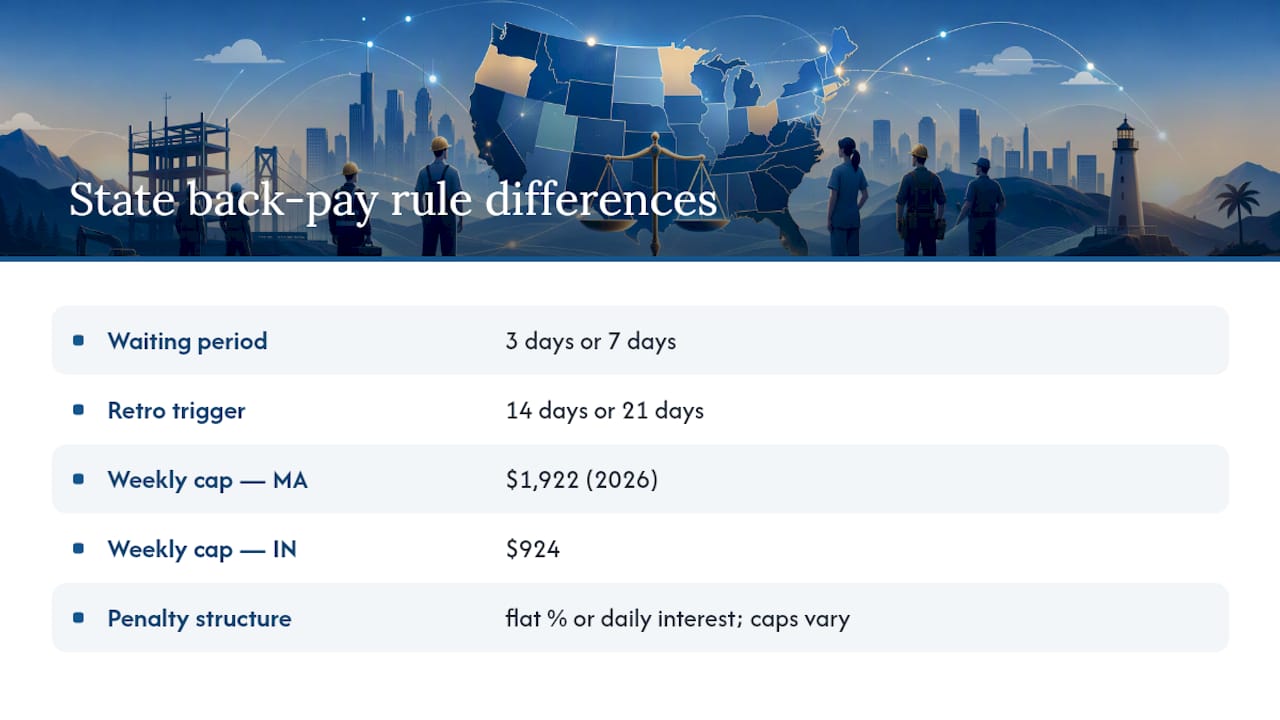
Benefit caps vary even more. Massachusetts caps weekly TTD near $1,922 for 2026, while a state like Indiana caps closer to $924 a week. Two workers with identical wages and identical injuries can end up with wildly different retroactive checks purely because of where they were hurt.
Penalty structures diverge too. Some states apply a flat percentage penalty to late payments; others calculate interest daily from the missed deadline. A few states cap total penalty exposure, while others let it accrue until the carrier pays in full. The agency process for filing a penalty request also differs: some states have a dedicated fast-track hearing for payment disputes, while others fold it into the general claims dispute process, which can add weeks to resolution.
The practical takeaway is that generic advice about “the” workers’ comp system doesn’t hold up. Before you calculate anything or send a demand letter, confirm your specific state’s waiting period, trigger, cap, and penalty rule. The 2026 weekly benefit rate reference for all 50 states and DC is a fast way to check where your state lands relative to others.
How Returning to Work Part-Time Affects Your Back Pay
Going back to work, even part-time, changes the back pay math rather than shutting it off. If you’re released for light duty and your employer pays reduced hours, you typically move from temporary total disability to temporary partial disability, which pays a fraction of the difference between your pre-injury wage and your current reduced wage.
Here’s the part that catches people off guard: a return-to-work attempt that fails, meaning you go back and then have to stop again because the job aggravated the injury, can reset the consecutive-day count some states use for the retroactive waiting-period trigger. That’s why precise, dated doctor work-status notes matter so much. If your file shows gaps or ambiguous return dates, the insurer has grounds to argue you never hit the retroactive threshold at all.

Vocational rehabilitation adds another layer. If you’re placed in a retraining program because you can’t return to your old job, most states continue some form of wage-replacement benefit during the program, but the calculation shifts again, often based on what you’d earn in the new occupation once trained rather than your original job. Any back pay owed from before the rehab placement started still gets calculated on your original AWW. Mixing up which period uses which wage figure is one of the more common insurer errors, so it’s worth checking each phase of your claim separately rather than assuming one number applies throughout.
How a Lump-Sum Settlement Affects Back Pay Eligibility
Settling your claim doesn’t automatically erase back pay you’re owed, but the timing and the settlement language matter enormously. If you settle before resolving a back pay dispute, most settlement agreements include language releasing the carrier from further claims, including retroactive ones, unless you specifically carve out the disputed amount.
That means if you know you’re owed retroactive waiting-period pay or a corrected AWW calculation, you need to raise it before you sign, not after. Once a settlement closes the claim, going back to argue the insurer shortchanged you months earlier becomes far harder, and in many states it’s simply barred.
On the flip side, a settlement can be the vehicle that resolves a back pay dispute in one move. If your attorney has already documented a miscalculated AWW or a late-paid waiting period, that arrears amount often gets folded into the negotiated settlement figure rather than paid separately. Running your numbers through a settlement calculator before you negotiate gives you a baseline for what the arrears plus the ongoing claim value should add up to, so you’re not accepting a number that quietly drops the back pay you’re owed.
How Back Pay Interacts With SSDI and Other Benefits
If you’re receiving both workers’ comp and Social Security Disability Insurance, a retroactive workers’ comp payment can trigger what’s called a reverse offset in some states, or it can cause your combined benefits to temporarily exceed the SSDI offset threshold, prompting Social Security to reduce your monthly SSDI check until the balance evens out.
This isn’t automatic in every state; some jurisdictions offset SSDI instead of workers’ comp, which changes which check gets reduced. But it’s a scenario worth planning for before a lump retroactive check lands, because the timing can catch people off guard when their SSDI payment drops the following month with little warning.
There’s also a tax-year concentration effect worth knowing about. Workers’ comp benefits themselves are generally tax-exempt, but if a retroactive payment overlaps with regular wages you earned in the same tax year, for example if you returned to work partway through the arrears period, the combined income can shift your tax bracket for that year even though the comp portion itself isn’t taxed. A partner resource on back payments and SSDI walks through how these offset and tax-year rules interact in more detail, which is worth reading before a large arrears check arrives if you’re on both programs.
An Editorial Take on the 2026 Back Pay Playbook
Most advice on this topic treats workers comp back pay as a legal problem first and a math problem second. That’s backward. The insurer’s math is usually where the error actually lives, whether it’s an undercounted AWW or a waiting period that never got reconciled. Legal remedies matter, but they only work once you can point to a specific dollar figure and a specific missed deadline.
The conventional advice to “consult an attorney” the moment something feels off skips a step, which costs nothing and takes ten minutes: run your own numbers first. A state-aware calculator turns a vague suspicion into a concrete claim, and adjusters respond differently to a demand letter that cites an exact figure versus one that says “I think I’m owed more.”
If there’s one thing readers underestimate, it’s how much state variation matters. The same injury, the same wage, and the same insurer behavior produce different outcomes depending on which state’s cap and trigger apply. Check your state’s specific rule before you do anything else.
This article is general information, not a substitute for advice from a qualified lawyer. Consult a qualified legal professional about your own circumstances before acting on anything here.
Sources
Confirm your state’s exact rules before filing anything:
- Is It Possible To Receive Back Pay For Workers’ Comp Settlements? — Super Lawyers
- Workers’ comp waiting period: when retroactive benefits begin — LegalClarity
- When can I collect penalties from the insurance company? — Nolo
FAQ
Can I Get Back Pay if My Workers’ Comp Claim Was Denied and Then Accepted?
Yes. Once a denied claim is accepted on appeal, benefits are typically owed retroactively back to the original date of disability, not the date of acceptance.
How Many Days Does My State’s Waiting Period Usually Last?
Most states set a waiting period of several days before wage-replacement benefits begin, with a separate retroactive trigger after a longer period of consecutive disability that pays those waiting days back.
Is Workers’ Comp Back Pay Taxable?
No. Workers’ comp wage-loss and medical benefits are generally exempt from federal income tax, including retroactive payments.
What Should I Do First if My Check Is Late?
Send a short, dated written demand citing your state’s exact statutory deadline, then file for a penalty or expedited hearing with your state agency if the carrier doesn’t respond.
Does a Lump-Sum Settlement Cancel My Right to Back Pay?
It can, if the settlement language releases the carrier from further claims. Raise any known back pay dispute before signing, since most settlements bar reopening it afterward.
Recommended
More from the blog
Discover how U.S. workers' comp surveillance works, the legal limits by state, steps to protect benefits. Run a free 50 state 2026 estimate.
Find out whether PTSD qualifies for U.S. workers' compensation, when first-responder presumptions apply, how FECA and state rules affect proof, and use a...
Discover settlement ranges for knee injury workers' comp claims and learn the essential steps to maximize your benefits and protection.
Free workers' comp calculators
Put the numbers in this article to work on your own claim.
Weekly benefit, PPD, and settlement in one place.
What your weekly temporary disability check should be.
Scheduled weeks and permanent impairment awards.
Light-duty benefit when you earn less while healing.
Federal employee FECA award by body part.
Lump-sum value of your full claim.
Turn a 5%, 10%, or 20% rating into dollars.
Max and min weekly rates for all 50 states.
Typical settlement ranges by injury and state.
Average settlement for fusion, rotator cuff, knee replacement, and more.
Why comp does not pay it, and when a third-party claim does.
When carriers typically make an offer.
What coverage costs by class code and payroll.
Guides, state updates, and claim strategy.