
2026 Workers’ Comp Settlements: 50 State Net Estimates

Workers’ comp settlements typically fall into a broad range, reflecting the varied nature of injuries and state rules. Minor injuries often settle for amounts in the low thousands, surgical cases generally command higher settlements, permanent impairments tend to be substantially more, and catastrophic injuries may reach very high amounts. The real number for your case depends on your state’s benefit caps, your average weekly wage, and how severe the injury actually is, not some national average pulled from an insurance industry report.
TL;DR:
- Settlement amounts vary widely depending on injury severity, from a few thousand dollars for minor injuries to over a million for catastrophic cases.
- Key factors influencing settlement value include average weekly wage, impairment rating, future medical costs, and state benefit caps, which can differ significantly by location.
- Calculating your actual weekly benefit and injury value with a state-specific tool helps determine a realistic settlement range before negotiations begin.
- The highest payout claims generally involve spinal cord injuries or severe traumatic brain injuries, which can surpass half a million dollars due to lifetime care costs.
Table of Contents
- What Does “Average Workers Comp Settlement” Actually Mean?
- Settlement Ranges by Injury Type
- What Influences the Number: Key Factors That Change Settlement Value
- How to Estimate Your Own Likely Settlement
- Timeline of the Workers Comp Settlement Process
- What Does a Workers’ Comp Settlement Actually Cost You?
- Why State-Aware Estimates Matter More Than a National Average
- Get a Real Number: Free 50-State Settlement Calculators
- Sources
- FAQ
What Does “Average Workers Comp Settlement” Actually Mean?
Insurance companies and researchers love to cite averages, but the average workers comp settlement figure you see quoted in headlines is almost always a cost-per-claim number, not a payout promise. The National Safety Council reports an average cost per claim that varies by injury type and severity, showing that motor-vehicle-related claims tend to be higher than typical cases. Those figures blend medical costs, indemnity payments, and administrative overhead across millions of claims nationwide. They tell you almost nothing about what your specific injury is worth.
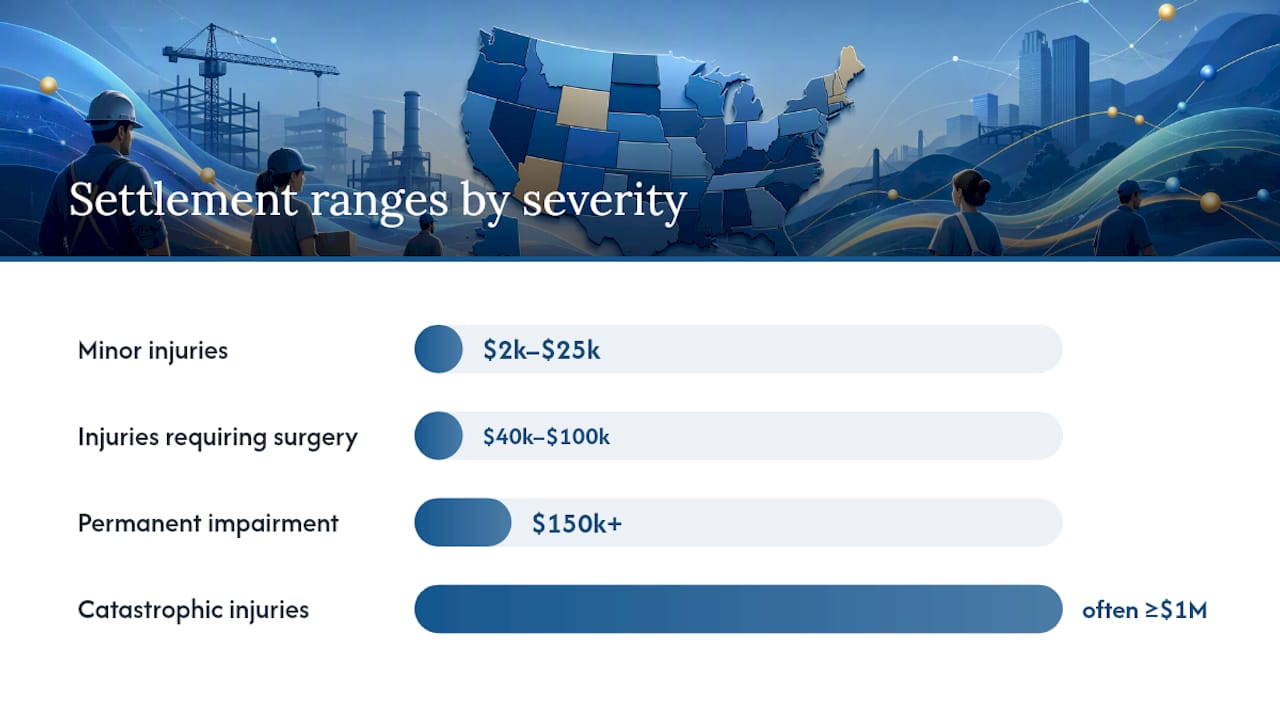
Here’s how the ranges actually break down by severity:
- Minor injuries (sprains, minor lacerations, short-term soft tissue damage): $2,000 to $25,000
- Injuries requiring surgery (rotator cuff repair, meniscus tears, disc surgery): $40,000 to $100,000
- Permanent impairment cases (lasting nerve damage, chronic pain, reduced range of motion): $150,000 and up
- Catastrophic injuries (spinal cord damage, severe TBI, amputation): often into seven figures
Bureau of Labor Statistics data on workplace injury frequency and severity helps explain why the spread is so wide. Some industries see mostly minor, short-duration claims. Others, like construction and heavy manufacturing, produce a smaller number of severe claims that pull the aggregate averages upward without reflecting what a typical worker in a typical job actually receives.
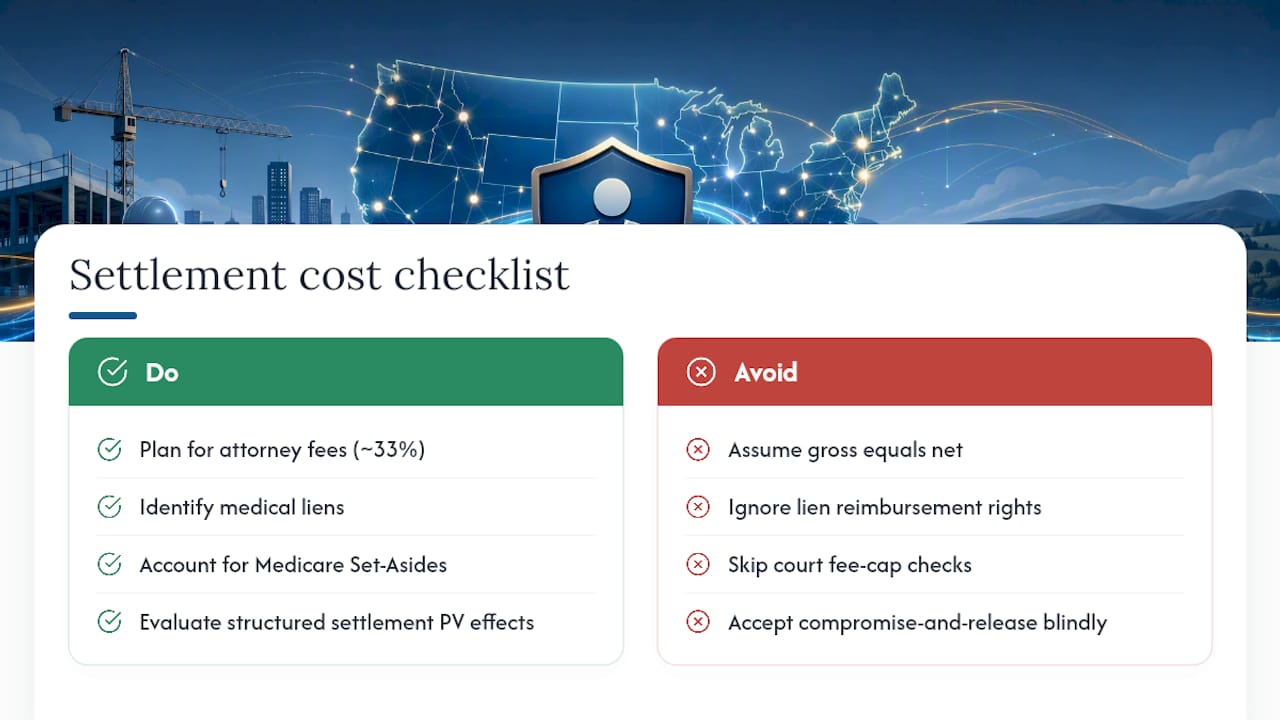
The gross settlement figure is not what lands in your bank account. Attorney fees generally constitute a significant portion of the settlement where contingency arrangements are permitted. Medical liens from your health insurer or Medicare, if applicable, get paid out of the settlement before you see a dime. Medicare Set-Asides carve out funds for future injury-related care if you’re a Medicare beneficiary or expect to become one soon. A $60,000 gross settlement can easily net $35,000 to $40,000 once those deductions clear.
Settlement Ranges by Injury Type
Body part and injury severity drive settlement value more than almost any other factor. Some numbers below come from documented ranges in published settlement guides; others reflect broader industry ballpark figures for common claim types.
| Injury Type | Typical Settlement Range | Notes |
|---|---|---|
| Back or neck (surgical) | $80,000 and up | Non-scheduled in most states; highly variable |
| Shoulder repair | $35,000 to $90,000 | Scheduled in many states; formula-driven |
| Knee injury | $30,000 to $85,000 | Depends on surgery type and mobility loss |
| Carpal tunnel / wrist | $20,000 to $60,000 | Often scheduled; predictable weeks-based math |
| Hand injury | $15,000 and up | Varies with finger loss or grip impairment |
| Head injury / mild TBI | $50,000–$150,000 | Cognitive impairment ratings drive wide range |
| Severe TBI | $500,000+ | Lifetime care projections dominate the number |
| Amputation | $100,000–$500,000+ | Scheduled award plus vocational loss claims |
| Spinal cord injury | $500,000 and up | Catastrophic category; rarely settles low |
Scheduled injuries, meaning body parts your state assigns a fixed number of compensable weeks, follow a fairly predictable formula. Non-scheduled injuries like back and neck cases, along with anything catastrophic, depend on vocational assessments, lifetime medical projections, and negotiation, which makes them far harder to pin down without a detailed case review.
What Influences the Number: Key Factors That Change Settlement Value
Adjusters and attorneys don’t pull settlement numbers out of thin air. They run calculations built on a handful of specific inputs, and small errors in any one of them shift the final number by tens of thousands of dollars.
- Average weekly wage (AWW): Most states use a 52-week lookback period. Overtime, bonuses, and second-job income get missed constantly, and that omission alone can shrink your weekly benefit rate for the life of the claim.
- Impairment rating: A doctor assigns a percentage of permanent impairment, which then gets multiplied by scheduled weeks or plugged into your state’s own formula.
- Future medical costs: If your claim stays open or settles with continuing medical rights, insurers project lifetime treatment costs and apply a discount rate to arrive at a present-day lump sum.
- Vocational loss and age: Younger workers with permanent restrictions often see higher settlements because lost future earning capacity gets factored in.
- Preexisting conditions and offsets: A prior injury to the same body part, or overlapping Social Security Disability payments, can reduce your net award.
- Attorney representation and timing: Workers with legal representation tend to settle for more, largely because early documentation prevents insurers from disputing wage calculations or injury severity later.
Pro Tip: Pull your pay stubs from the full 52 weeks before your injury and add up every overtime shift, bonus, and second-job paycheck before you accept any settlement figure. Insurance adjusters calculate your AWW using only what’s reported to them, and unreported income doesn’t get included unless you bring it forward yourself.
How to Estimate Your Own Likely Settlement
You don’t need a law degree to build a realistic starting number. Run these four steps before your first conversation with an adjuster or attorney:
- Calculate your AWW. Add gross wages from the 52 weeks before your injury (most states’ standard lookback), including overtime and bonuses, then divide by 52.
- Find your state’s weekly benefit rate and 2026 cap. Multiply your AWW by your state’s compensation percentage (often two-thirds), then check it against the 2026 weekly benefit rates for all 50 states. Rates range widely, from around $1,032 a week in Wyoming to $1,922 a week in Massachusetts.
- Estimate your impairment rating or scheduled weeks. Your doctor’s impairment percentage, multiplied by your state’s scheduled weeks for that body part, gives you a rough indemnity figure.
- Subtract fees and offsets. Deduct roughly 33% for attorney fees where applicable, plus any known medical liens, to reach a net estimate.
Run optimistic, median, and conservative scenarios rather than trusting one number.
Timeline of the Workers Comp Settlement Process
Settlements rarely happen quickly, and understanding the sequence helps you avoid settling before your medical picture is clear.
The process starts the day you report the injury to your employer, ideally within 24 to 48 hours. Your employer files a claim with their insurance carrier, which then has a state-mandated window (often 14 to 30 days depending on the state) to accept, deny, or investigate. Once accepted, you begin receiving Temporary Total Disability (TTD) benefits while you’re out of work and unable to earn wages.
The middle stretch is medical treatment and recovery, which can run anywhere from a few weeks for minor injuries to over a year for surgical or catastrophic cases. Settlement conversations typically don’t start in earnest until you reach maximum medical improvement (MMI), the point where your doctor determines your condition has stabilized and won’t meaningfully improve with more treatment. That’s when an impairment rating gets assigned, and that rating becomes the backbone of any settlement offer.
From MMI, negotiation usually takes another one to six months, depending on whether the case is scheduled and formulaic or non-scheduled and contested. Cases that go to a hearing or require vocational assessments extend the timeline further, sometimes past a year from injury to final settlement. Structured settlements or ongoing medical benefits can stretch the financial relationship even longer, since a settlement isn’t necessarily the end of the paperwork.
What Does a Workers’ Comp Settlement Actually Cost You?
The gross number in your settlement agreement is not the number you take home, and understanding the deductions ahead of time prevents an unpleasant surprise at the finish line.
Attorney fees typically run around 33% of the settlement in states that permit contingency-fee arrangements, though some states cap fees or require court approval of the percentage. Medical liens come next: your health insurer, workers’ comp carrier, or Medicare may have paid for treatment during the claim, and those parties generally have a right to reimbursement from the settlement before you receive your share. Medicare Set-Asides apply if you’re a current Medicare beneficiary or reasonably expected to become one, setting aside funds specifically for future injury-related medical care so Medicare doesn’t end up covering costs the settlement was meant to handle.
Structured settlements, where payments arrive over time rather than as a single lump sum, come with their own present-value discounting considerations. The insurer applies a discount rate to future medical and indemnity obligations, and that rate directly shapes how much smaller the lump-sum offer looks compared to the nominal total. Compromise and release agreements, common in many states, close out the claim entirely, including future medical rights, in exchange for a single payment. That trade-off can be worth it or badly against your interest depending on how much future treatment you’re likely to need.
Why State-Aware Estimates Matter More Than a National Average
Two workers with identical shoulder injuries and identical wages can walk away with settlements $30,000 apart simply because one lives in Massachusetts and the other in Wyoming. The 2026 weekly benefit caps aren’t a footnote. They’re often the single biggest lever in the entire calculation, and most generic advice ignores them completely.
The mistake I see most often is workers accepting an early settlement offer before their AWW gets corrected for overtime or before future medical needs get properly projected. Both errors are avoidable with fifteen minutes of arithmetic. That’s the entire reason the Free Workers’ Comp Calculator exists: to turn vague national statistics into a number tied to your actual wage and your actual state.
— Daniel
Get a Real Number: Free 50-State Settlement Calculators
Workerscompestimator gives you what a national average never can: a number tied to your actual state, your actual wage, and your actual injury, built into 2026 benefit caps for all 50 states plus DC. Instead of guessing whether your offer is fair, you enter your average weekly wage, state, and injury type, and get an estimate of your weekly TTD benefit alongside a potential settlement range for negotiations.
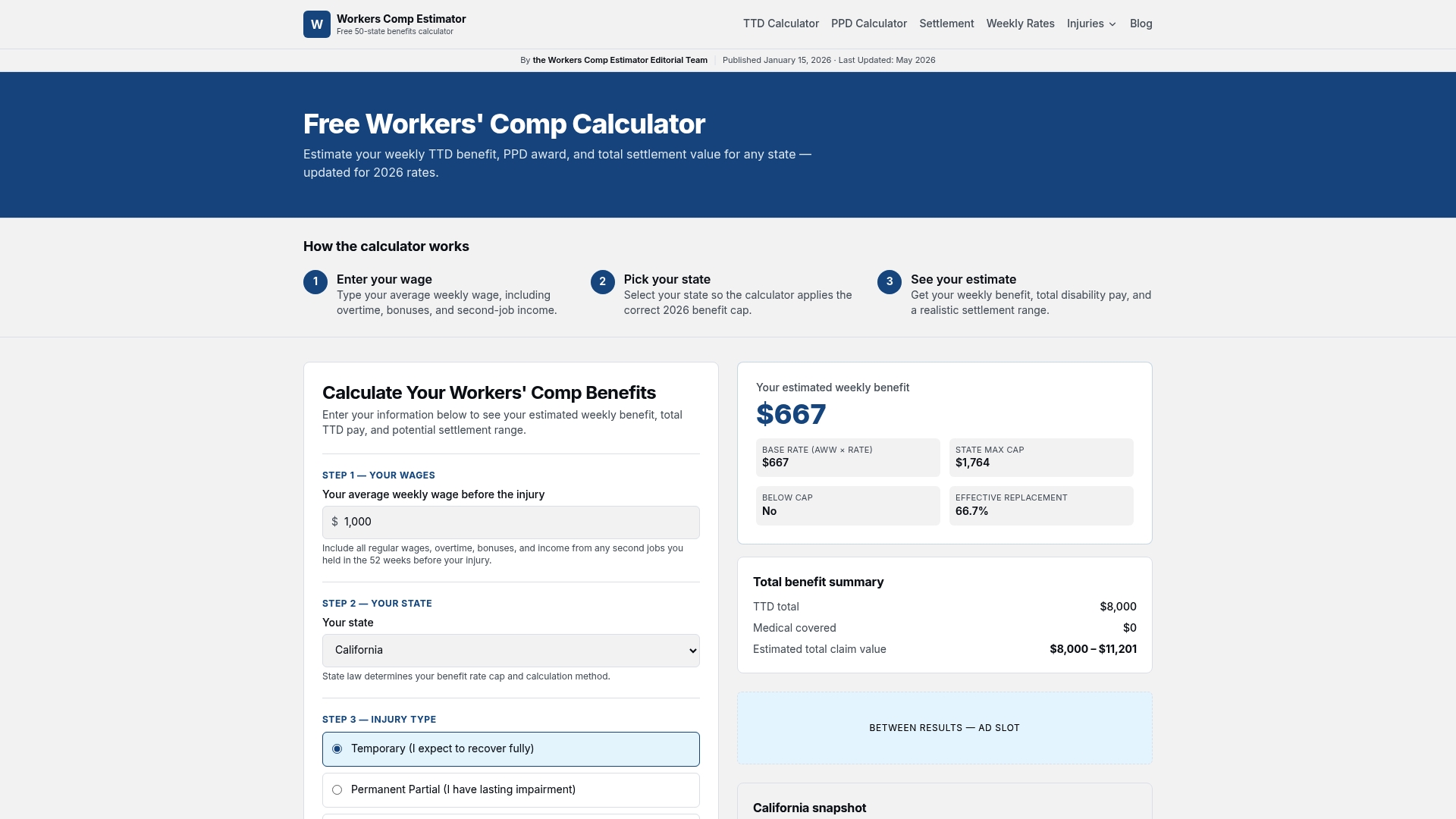
Use a state-specific calculator when you know your state and want the exact weekly cap applied automatically. Use the general settlement estimator when you’re still exploring rough numbers across a few scenarios. If your case involves permanent impairment, run it through the PPD calculator as well, since scheduled-injury math depends heavily on impairment percentage.
None of these tools replace an attorney for a contested or catastrophic claim, but they give you a defensible starting number before that conversation happens. Head to Workerscompestimator and run your numbers before you sign anything.
Sources
Before you accept any offer, verify your numbers against sources that don’t have a financial stake in your case:
- Workers’ Compensation Costs - Injury Facts
- Bureau of Labor Statistics — workplace injury releases
- How Does Workers’ Comp Calculate a Settlement – Catalyst Legal
- Workers Comp Settlement Amounts (2026): How Cases Are Valued | Lawsuit Legal
This article is general information, not a substitute for advice from a qualified lawyer. Consult a qualified legal professional about your own circumstances before acting on anything here.
FAQ
How Much Will I Get Out of a $50,000 Settlement?
After typical deductions, expect to net roughly $30,000 to $40,000. Attorney fees around 33% take the largest bite, followed by any medical liens or Medicare set-aside requirements specific to your case.
What Is a Fair Settlement for Workers’ Comp?
A fair settlement fully covers your lost wages up to your state’s weekly cap, accounts for your impairment rating using your state’s formula, and includes a realistic present-value estimate of future medical costs. Anything less than that, especially an early offer made before you reach maximum medical improvement, deserves a second look.
Which Body Part Has the Highest Value in a Workers’ Compensation Claim?
Spinal cord injuries and severe traumatic brain injuries carry the highest settlement values, often exceeding $500,000, because they involve lifetime care costs and permanent loss of earning capacity rather than a fixed scheduled-weeks calculation.
What Are the Top Workers’ Compensation Claims?
The most common claims involve back and neck strains, shoulder injuries from repetitive lifting, knee injuries, carpal tunnel syndrome from repetitive motion, and slip-and-fall related fractures. Back and shoulder cases tend to produce the widest settlement range because so much depends on whether surgery is required.
How Do I Get a Realistic Number Before Talking to an Insurer?
Calculate your AWW using the full 52-week lookback including overtime, then run that figure through a free settlement calculator that applies your state’s 2026 benefit cap. That gives you a defensible starting point instead of accepting the first number an adjuster offers.
Recommended
More from the blog
See how 2026 state caps, wages, and surgery affect your U.S. hernia workers' comp payout. Run a free 50 state calculator for a realistic estimate.
Use 2026 U.S. state caps and a free 50‑state calculator to estimate your permanent disability workers' comp pay. Learn P&S/MMI ratings, apportionment, and...
Run a state specific 2026 workers' comp settlement calculation. Use the free 50 state calculator to see how state caps change your payout.
Free workers' comp calculators
Put the numbers in this article to work on your own claim.
Weekly benefit, PPD, and settlement in one place.
What your weekly temporary disability check should be.
Scheduled weeks and permanent impairment awards.
Light-duty benefit when you earn less while healing.
Federal employee FECA award by body part.
Lump-sum value of your full claim.
Turn a 5%, 10%, or 20% rating into dollars.
Max and min weekly rates for all 50 states.
Typical settlement ranges by injury and state.
Average settlement for fusion, rotator cuff, knee replacement, and more.
Why comp does not pay it, and when a third-party claim does.
When carriers typically make an offer.
What coverage costs by class code and payroll.
Guides, state updates, and claim strategy.