
TBI Workers’ Comp Settlement: What Brain Injuries Are Worth

There is no standard payout for a traumatic brain injury (TBI) or concussion under workers’ compensation. Settlements depend on your wages, how long you are off work, your medical needs, your permanent impairment and your state’s rules. Workers’ comp does not pay for pain and suffering. Reported averages run from the tens of thousands of dollars into seven figures, so the useful question is not “what is the average?” but “what does my claim include, and what am I giving up by settling?”
This guide walks through the benefits a brain injury can trigger, the factors that move the number, what the published figures really measure, and the checks to make before you sign anything.
TL;DR
- Workers’ comp pays for medical care, wage replacement, permanent disability and sometimes vocational help. It does not pay for pain and suffering.
- A national NCCI analysis found TBI claims cost far more than the typical lost-time claim, but that is total claim cost, not what a worker receives in a settlement.
- Value rests on proof: your average weekly wage, your impairment rating, and evidence of how the injury limits your work.
- A lump-sum settlement can close your right to future benefits, including medical care, so weigh the long-term picture first.
- If you are on or near Medicare, a settlement that covers future medical care raises extra rules.
Table of Contents
- What benefits can a work-related TBI or concussion trigger?
- How a settlement amount is actually built
- What drives the value of a TBI or concussion claim
- What the published TBI figures really mean
- Workers’ comp settlement versus a personal injury claim
- Before you accept a TBI settlement offer
- Our perspective
- Get a starting estimate for your claim
- FAQ
- Sources
What benefits can a work-related TBI or concussion trigger?
A brain injury at work can open several kinds of benefits at once. According to the California Division of Workers’ Compensation, workers’ comp generally provides medical care, wage replacement, permanent disability benefits, vocational help and, if the injury is fatal, death benefits for dependents. Those pieces are what a settlement eventually puts a price on.
- Medical care. Emergency treatment, imaging, neurology visits, therapy and medication related to the injury.
- Temporary disability. Weekly payments while you cannot work or can only work reduced hours. You can estimate this part with our TTD calculator or, if you are back part-time, the temporary partial disability calculator.
- Permanent disability. Payments for lasting loss of function once your doctor says you have stopped improving.
- Vocational help. In California, for example, a supplemental job displacement voucher may be available to eligible workers who cannot return to their old job.
The states differ in the details. In Georgia, income benefits start if you miss more than seven days of work, and in non-catastrophic cases total-disability benefits are limited to 400 weeks. In Virginia, temporary wage-replacement benefits cannot exceed 500 weeks unless the person is totally and permanently disabled. Those limits matter because a settlement is, in effect, a buyout of what the rules would otherwise pay you over time.
How a settlement amount is actually built
Insurers do not look up a brain injury in a price list. They add up what the law says you are owed and what they expect the claim to cost, then negotiate from there. Illinois practitioners put it plainly: benefits depend on wages, time away from work, medical needs, permanent impairment and ability to return to suitable employment.
The wage and time-off piece
Your average weekly wage sets the weekly rate, subject to your state’s minimum and maximum. Wage calculations should count every source of income your state includes, not just the base hourly rate on your last paycheck. Check the cap for your state in our 2026 weekly benefit rates table.
The permanent disability piece
This is where brain injury claims diverge most from other injuries. Many states convert a physician’s impairment rating into weeks of benefits or a dollar figure, and the formulas differ. California’s permanent disability benefits, for instance, follow a formula that considers the extent of the injury, your age at injury, your occupation and the injury date, with apportionment and loss of future earning capacity also in play. In Illinois, permanent partial disability is often expressed as a percentage of the person as a whole, using statutory weeks and benefit rates rather than a single lump-sum formula.
Because a brain injury is rarely a scheduled body part like a finger or a knee, the percentage assigned to cognitive, behavioral and neurological effects carries a lot of weight. Our settlement chart by body part shows how scheduled awards work, and the head and brain injury calculator is built for the non-scheduled side of the picture.

The future medical piece
If your claim stays open, the insurer keeps paying for treatment. If you settle, that future care is either carved out or priced into the lump sum. For a brain injury with ongoing therapy or medication, this is often the largest unknown in the whole negotiation.
What drives the value of a TBI or concussion claim
Five factors do most of the work, according to a workers’ comp firm’s overview of head injury settlements: the severity of the injury, your average weekly wage, the expected length of treatment, the impairment rating from a physician, and your ability to return to gainful work. Lasting symptoms that limit what you can earn push up the permanent disability portion.
In practice, that breaks down like this:
| Factor | Why it matters | What to gather |
|---|---|---|
| Severity and diagnosis | Sets the baseline for treatment and impairment | Hospital records, imaging, neurology notes |
| Objective findings | Abnormal scans or tests can strengthen a claim | MRI, CT, EEG and neuropsychological testing results |
| Wage history | Sets weekly benefit rates | Pay stubs, tips, overtime, second jobs |
| Impairment rating | Drives permanent disability value | Report from the treating or evaluating physician |
| Work capacity | Shows lost earning power | Work restrictions, job descriptions, vocational opinions |
A diagnosis alone does not set the value. Illinois practitioners note that the evidence has to show how the injury objectively affects your functioning and earning capacity. That is why mild injuries with symptoms that fade tend to settle low, while a concussion that leaves you unable to concentrate, tolerate noise or hold your old job can be worth far more. If you want a lawyer’s view of how the evidence gets built, traumatic brain injury attorneys can explain what records and expert support matter in your state.
Some sources say abnormal findings on MRIs, CT scans and EEGs may increase the value of a TBI case. Keep in mind that many concussions show nothing on standard imaging. A normal scan does not mean your symptoms are not real, and it is a reason to ask your doctor about neuropsychological testing that documents what you are experiencing.
Catastrophic classifications
Some states treat severe brain injuries differently. Georgia, for example, classifies severe head injuries as catastrophic, as well as injuries severe enough to keep you from doing your prior work or any work available in substantial numbers in the national economy. In that state, the classification changes how long benefits can last.
What the published TBI figures really mean
Search results for this topic are full of ranges, many from law firm marketing pages. Treat them as rough context, not as a promise. Here is what the better data says.
The National Council on Compensation Insurance (NCCI) reported that active TBI claims from 2013 to 2018 averaged about $136,000 in total incurred costs, compared with $51,000 for all lost-time claims, and about 2.5% of TBI claims exceeded $1 million.
Two things to notice:
- Incurred cost is not your settlement. It adds up medical bills, wage benefits and other costs the insurer expects to pay. A settlement may cover only part of that, and the medical portion usually goes to providers, not to you.
- Averages hide the spread. A handful of very expensive claims pull the average up. Most claims are far smaller, and a few are much larger.
Practitioners agree that there is no universal average, and amounts vary with medical needs, wage history and permanent impairment rather than pain and suffering. If you are reading a page that promises a specific range for a “mild” or “moderate” TBI without naming a state, wage or rating, it is describing marketing, not your claim. For a sense of how lawyers frame expectations, Florida personal injury counsel is one place readers go for case-by-case discussion of brain injury claims.
A worked illustration
Here is a simplified, hypothetical case to show how the pieces stack up. It is not a prediction, and your state’s formulas will change every number.
A warehouse worker earning $900 a week hits her head in a fall and is diagnosed with a concussion. She is off work for several months, then returns with restrictions. Her doctor assigns a permanent impairment rating because of persistent headaches and difficulty concentrating. Her claim then has three parts: weekly wage benefits for the months off, a permanent disability amount based on the rating, and the cost of continuing neurology visits. A settlement would fold some or all of those into one figure. If the insurer ignores the continuing treatment or lowballs the rating, the number can look reasonable while shortchanging her.
Workers’ comp settlement versus a personal injury claim
Workers’ comp is a no-fault system. You generally get benefits regardless of who caused the accident, and in exchange you cannot sue your employer for pain and suffering. But if someone other than your employer caused the injury, such as a negligent driver, an equipment maker or a property owner, a separate third-party claim may exist. In Illinois, a third-party civil claim may allow recovery of damages like pain and suffering that workers’ comp does not provide. Whether this applies to you depends on your state and the facts, so ask a lawyer licensed where you were hurt.
That is also why some of the large brain injury verdicts you see online are not workers’ comp settlements at all. They come from third-party lawsuits. Do not benchmark a comp claim against them.
Before you accept a TBI settlement offer
A lump sum feels final because it is. State agencies warn about this directly. California’s DWC advises that a Compromise and Release typically waives the right to seek future benefits if your condition worsens, and that guide describes it as a final resolution that typically releases the employer from future liability for medical care and income benefits. Brain injuries can change over months or years, so this deserves real thought.
Use this checklist:
- Confirm your condition has stabilized. Have you reached maximum medical improvement, and does the rating reflect your cognitive and behavioral symptoms, not just headaches?
- Check your wage figure. Is the insurer’s average weekly wage correct, including overtime, tips and second jobs where your state counts them?
- Price future care. Ask your doctors what treatment you will likely need and for how long. Compare that with what the offer leaves for medical costs.
- Understand what you are releasing. Some settlements close only the wage portion and leave medical open. Others close everything. Our guide to workers’ comp settlement types explains the difference.
- Ask about approval. Many states require a judge or the agency to approve a settlement. Under the federal Longshore Act, for example, a district director or administrative law judge approves settlements unless they are inadequate or procured by duress.
- Check Medicare. See below.
- Run your own estimate. Compare the offer against a state-specific figure before you respond.
Medicare and the future medical question
If you receive Social Security Disability or are approaching Medicare eligibility, a settlement that includes future medical expenses has to protect Medicare’s interests. CMS says settling parties must consider Medicare’s interests, and a Workers’ Compensation Medicare Set-Aside (WCMSA) allocates settlement funds for future work-injury-related medical care that Medicare would cover. The CMS reference guide also states that no statute or regulation requires you to submit a set-aside proposal to CMS, though a review can give certainty about the amount that must be used before Medicare starts paying for related care. Ask your attorney or the claims adjuster whether a set-aside applies to you before agreeing to terms.
Our perspective
Most injured workers who come to us with a brain injury claim have the same problem: they have a number from the insurer and nothing to compare it with. Brain injuries are hard to price because the damage is often invisible, and the weekly wage, state cap and impairment rating all change the answer.
We built our calculators around the facts that move a claim: your average weekly wage including all income sources, your state’s 2026 benefit caps, and your injury type. Our estimate is not a legal valuation and it will not replace a doctor’s rating. What it gives you is a realistic starting point, so you can see whether an offer looks far below what your state’s rules suggest and ask better questions.
Our advice is simple. Estimate first, gather your medical evidence second, and never sign a lump-sum release while you are still getting better.
Daniel
Get a starting estimate for your claim
If you have an offer in hand, or you are about to negotiate, start with numbers specific to your state. Our free workers’ comp settlement calculator uses your average weekly wage, state and injury type to produce an estimate based on 2026 state benefit caps. For brain and head injuries specifically, the head and brain injury calculator is the place to begin.
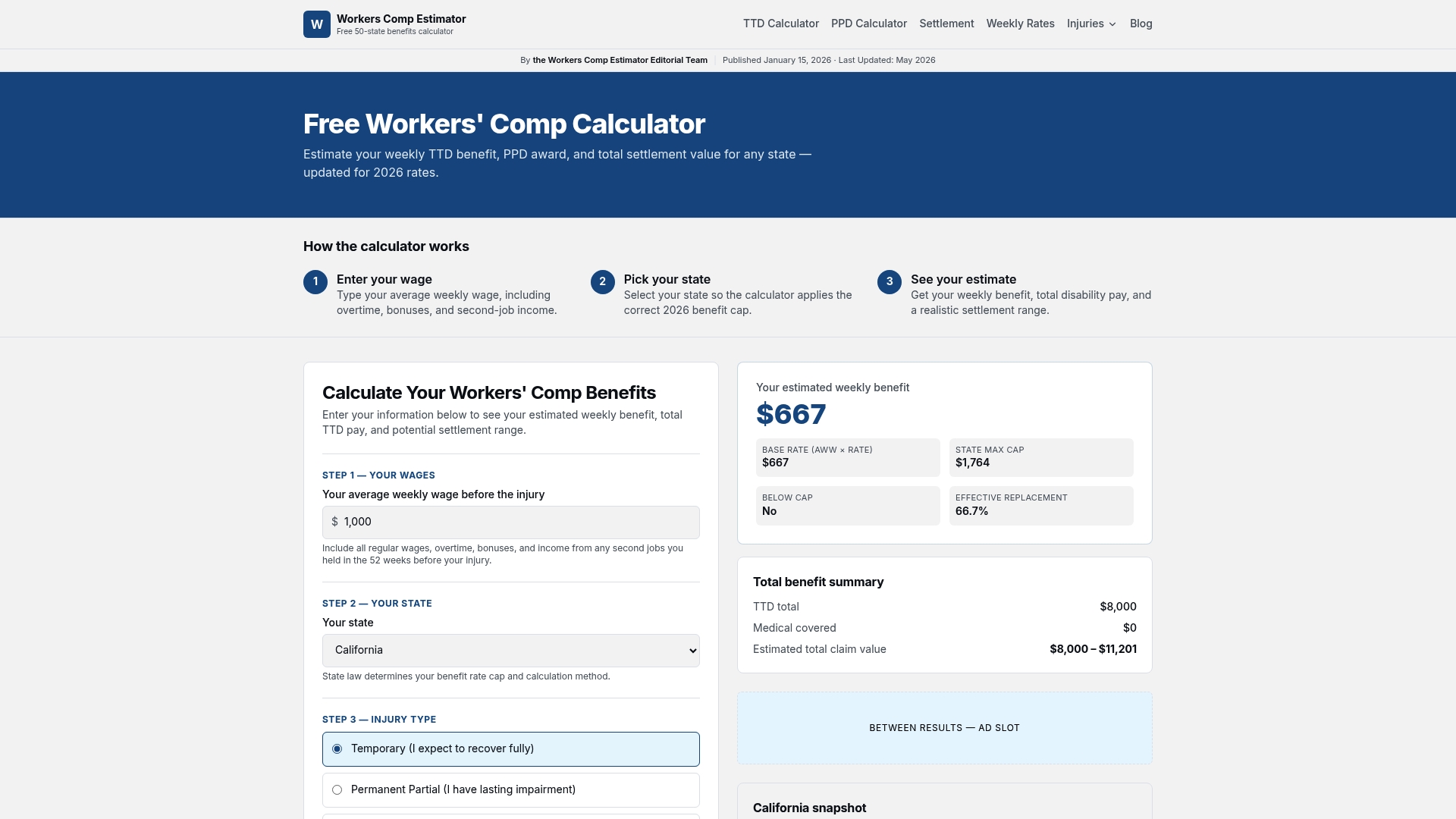
If you only need your weekly rate while you are off work, the main calculator covers all 50 states and DC. Estimates are informational. They do not account for every detail of your case, so use them to prepare for a conversation with your adjuster or a licensed attorney, not to replace one.
FAQ
Is there an average workers’ comp settlement for a concussion?
No reliable single average exists. Settlement amounts depend on your wages, how long you were off work, your medical needs and any permanent impairment, and practitioners note there is no universal average. A concussion that resolves in weeks usually settles for far less than one that leaves lasting symptoms and work restrictions.
Can I get pain and suffering for a TBI through workers’ comp?
No. Workers’ comp pays medical care, wage replacement and permanent disability benefits, not pain and suffering. If a third party caused your injury, a separate civil claim may allow broader damages, and a lawyer in your state can tell you whether that applies.
Should I settle my brain injury claim now or wait?
Wait until your doctors can say whether your condition has stabilized and what future care you will need. A lump-sum release can end your right to future benefits, including medical care, if your condition worsens. Ask for your impairment rating and a treatment outlook in writing before you decide.
Does a TBI settlement affect Medicare or Social Security Disability?
It can. If a settlement covers future medical expenses and you are on Medicare or may be soon, CMS expects Medicare’s interests to be considered, often through a set-aside. Talk with your attorney or a Medicare specialist before you sign.
Sources
- NCCI: Traumatic Brain Injuries in Workers Compensation
- California DWC: FAQs for employees
- California DWC: Workers’ Compensation in California, A Guidebook for Injured Workers
- Georgia State Board of Workers’ Compensation: Bill of Rights for the Injured Worker
- Virginia Workers’ Compensation Commission: Information for Employees
- California Department of Insurance: Workers’ Compensation Information Guide
- IL Work Injury Lawyer: Brain Injury Workers Compensation
- Koonz: Workers’ Comp Head Injury Settlements
- Factors that Add Value to Traumatic Brain Injury Cases
- U.S. Department of Labor: Longshore Act Section 8(i) Settlements
- CMS: WCMSA Reference Guide v3.9
- CMS: WCMSA Reference Guide v4.3
Recommended
More from the blog
What a workers' comp ankle settlement can pay, how the main settlement options compare, and how to check an insurer's offer against your state's rules.
Learn how the 80% SSDI offset works, how lump sum settlements affect payments, and what U.S. workers should check before signing a workers’ comp agreement.
Hurt by someone other than your employer? Learn how a third-party settlement works with workers' comp, how liens and subrogation cut your payout, and what to check first.
Free workers' comp calculators
Put the numbers in this article to work on your own claim.
Weekly benefit, PPD, and settlement in one place.
What your weekly temporary disability check should be.
Scheduled weeks and permanent impairment awards.
Light-duty benefit when you earn less while healing.
Federal employee FECA award by body part.
Lump-sum value of your full claim.
Turn a 5%, 10%, or 20% rating into dollars.
Travel reimbursement for medical appointments.
Max and min weekly rates for all 50 states.
Typical settlement ranges by injury and state.
Average settlement for fusion, rotator cuff, knee replacement, and more.
Why comp does not pay it, and when a third-party claim does.
When carriers typically make an offer.
What coverage costs by class code and payroll.
Guides, state updates, and claim strategy.