
Florida Impairment Rating: How It Works and What It Pays

A Florida impairment rating is the percentage a licensed doctor assigns for permanent loss of function once you reach maximum medical improvement (MMI). Any rating above 0% entitles you to impairment income benefits (IIBs): the higher the percentage, the more weeks of checks. IIBs are paid at 75% of your temporary total disability rate, so the rating and your wage together set the payout.
TL;DR
- The rating is assigned at MMI by a licensed Florida physician, using the schedule tied to your date of injury (for injuries on or after January 8, 1997, the 1996 Florida Uniform Permanent Impairment Rating Schedule).
- Weeks of benefits scale with the rating: 2 weeks per percent for the first 10%, then 3, 4 and 6 weeks for higher bands.
- Each weekly check is 75% of your weekly temporary total disability benefit.
- A 0% rating means no impairment benefits, but you can still dispute it through the state’s assistance office or a Petition for Benefits.
- Before you accept any rating or offer, run your own numbers with a calculator.
Table of Contents
- What a Florida impairment rating measures
- Which impairment schedule applies to your injury
- How the rating becomes weeks of benefits
- When impairment benefits start and how they are paid
- Psychiatric injuries and the 1% limit
- What a 0% rating means
- The paper trail: who gets the report
- If you disagree with your rating
- How the rating affects settlement value
- Perspective
- Check your own number
- FAQ
- Sources
What a Florida impairment rating measures
The rating is not a measure of pain, and it is not a measure of how much you earned. It describes permanent loss of function from your work injury, expressed as a percentage of the whole person. It comes into play when your treatment has plateaued.
According to the Florida Division of Workers’ Compensation system guide, the doctor should evaluate you for a permanent impairment rating at MMI. MMI does not mean you are healed. It means your condition is not expected to improve much more with further treatment.
Only certain doctors may assign the rating. The same guide says that only physicians licensed under Florida statute chapters 458, 459, 460, 461, 463 or 466 may determine permanent impairment, using the uniform schedule required by Section 440.15(3)(b), F.S. In practice, that covers medical doctors, osteopaths, chiropractors, podiatrists, optometrists and dentists, each within their field.
Which impairment schedule applies to your injury
The schedule your doctor must use depends on when you were hurt, not when you were rated. The state system guide lists four:
| Date of injury | Schedule used |
|---|---|
| Before July 1, 1990 | AMA Guides, 3rd Edition |
| July 1, 1990 to June 20, 1993 | Minnesota Department of Labor and Industry Disability Schedule |
| June 21, 1993 to January 7, 1997 | 1993 Florida Impairment Rating Guide |
| January 8, 1997 or later | 1996 Florida Uniform Permanent Impairment Rating Schedule |
Nearly every current claim falls in the last row. The 1996 schedule assigns ranges for specific conditions, such as spinal problems, joint limits and amputations, and the doctor picks a percentage within the range based on exam findings. That judgment is where two doctors can differ by several points on the same injury.
If your rating comes back with a number that seems to come from a different method than you expected, ask the doctor’s office which schedule they applied and confirm it matches your date of injury.
How the rating becomes weeks of benefits
The Florida Division of Workers’ Compensation publishes an impairment income benefit calculator that sets out the formula. Benefits are paid at 75% of the average weekly temporary total disability benefit, and the number of weeks rises with the rating: 2 weeks per percent from 1% to 10%, 3 weeks per percent from 11% to 15%, 4 weeks per percent from 16% to 20%, and 6 weeks per percent at 21% or more. The higher bands apply only to the percentage points inside each band, as set out in Section 440.15 of the Florida Statutes.

A worked example
Say your temporary total disability rate was $800 a week (a made-up figure for illustration). Your IIB check would be 75% of that, or $600 a week.
| Rating | Weeks | Weekly IIB | Total IIB |
|---|---|---|---|
| 5% | 10 | $600 | $6,000 |
| 10% | 20 | $600 | $12,000 |
| 12% | 26 (20 + 3 × 2) | $600 | $15,600 |
| 18% | 38 (20 + 15 + 4 × 3… see note) | $600 | varies |
The last row shows why the bands matter, so work it carefully: the first 10 points give 20 weeks, points 11 to 15 add 3 weeks each (15 weeks), and points 16 to 18 add 4 weeks each (12 weeks). That is 47 weeks, or $28,200 at $600 a week. Rather than doing this by hand, use our Florida impairment rating payout calculator, which applies the bands for you.
One point moves the total more than people expect. Going from 10% to 11% adds 3 weeks, not 2. Going from 20% to 21% adds 6. A one-point difference in your rating can be worth several weekly checks.

When impairment benefits start and how they are paid
Per Section 440.15, impairment benefits begin the day after you reach MMI or the day your temporary benefits expire, whichever comes first. The carrier owes the payment within 14 days after it knows of the impairment.
For accidents on or after October 1, 2003, the Division’s impairment income benefits presentation explains that checks are paid bi-weekly. They are reduced by 50% for each week you earn income equal to or greater than your average weekly wage. So if you return to full-wage work while still receiving IIBs, expect those checks to shrink.
Your weekly rate also depends on the state’s cap. For injuries in 2026 we list Florida’s maximum weekly benefit as $1,358 on our Florida workers’ comp benefits calculator, and that cap flows into the IIB math.
Psychiatric injuries and the 1% limit
Mental and nervous conditions are treated differently. Under Section 440.15, impairment benefits for permanent psychiatric impairment are limited to a maximum of 1% permanent impairment, and it must be backed by objective medical findings. If you have a physical injury plus a psychiatric component, ask your doctor to document each separately.
What a 0% rating means
A 0% rating means the physician found no permanent impairment at MMI. The Division’s page on benefits available to injured workers states that a rating above 0% brings money based on that number, so a zero means no IIB checks.
That does not end every other right. Medical care related to the accepted injury can continue, and a zero is a medical opinion that can be challenged. Common reasons people see a low or zero rating include an exam done before the condition stabilized, a doctor who did not measure range of motion carefully, or an injury described too narrowly in the report.
The paper trail: who gets the report
The certifying doctor must issue a written report to you and the carrier. If a different doctor performs the evaluation, Section 440.15 requires that the report go to the treating doctor, you and the carrier within 10 days, and the treating physician must say whether they agree or disagree with that rating.
Read the report itself, not just the summary letter. Check:
- The date of injury and the schedule cited
- The body parts rated and whether each injury you reported appears
- The measurements behind the number (range of motion, strength, diagnostic findings)
- Whether the doctor states you are at MMI and on what date
If a provider fails to release records or full and truthful reports on reasonable request, the Division’s health care provider manual rule says that violates Chapter 440 and can bring penalties. You are entitled to see the reasoning.
If you disagree with your rating
You have real options, and none require accepting the first number.
- Ask the Employee Assistance and Ombudsman Office (EAO). Per Section 440.15, the EAO at the Division of Workers’ Compensation can help resolve disputes over a rating or other benefits.
- File a Petition for Benefits. If informal help does not resolve it, a Petition for Benefits starts the formal dispute process.
- Expect a possible expert medical advisor. The Division’s health care provider manual rule notes that when there is disagreement about a rating, an expert medical advisor may be appointed to evaluate you.
- Get your own medical opinion. A second evaluation by a qualified physician gives you something concrete to compare against the first report.
If you believe a carrier is handling your claim unfairly, not just disagreeing on a number, it can help to understand insurance bad faith representation and what that kind of legal help involves. A Florida workers’ compensation attorney can tell you which route fits your facts.
How the rating affects settlement value
The rating is one of several inputs to what a claim is worth. A higher rating raises the IIB total, which gives you a floor to measure any lump-sum offer against. But settlement offers also reflect your remaining medical needs, your wage and weekly rate, whether you can return to your old job, and how strongly the carrier disputes compensability.
A practical test: before you respond to any offer, calculate the IIB you would receive at your rating, then ask what the offer adds for future medical care and lost earning capacity. Our Florida workers’ comp settlement chart lays out example ranges, and our settlement calculator lets you test different scenarios.
Perspective
Most injured workers we hear from see a percentage on a report and have no idea what it is worth. The rating feels like a verdict, when it is really the first number in a formula.
Our view is simple: nobody should respond to an offer before they know the weekly rate, the number of weeks and the 2026 cap that applies to them. We built our Florida tools around the state’s real figures and around all of a worker’s income sources, so the estimate you see is close to what a claim would actually look like.
A calculator does not replace a doctor or a lawyer. It gives you the ability to ask sharper questions and spot an offer that does not add up.
Daniel
Check your own number
If you have a rating or expect one soon, enter your wage and percentage into our Florida impairment rating payout calculator to see the weeks and weekly amount.
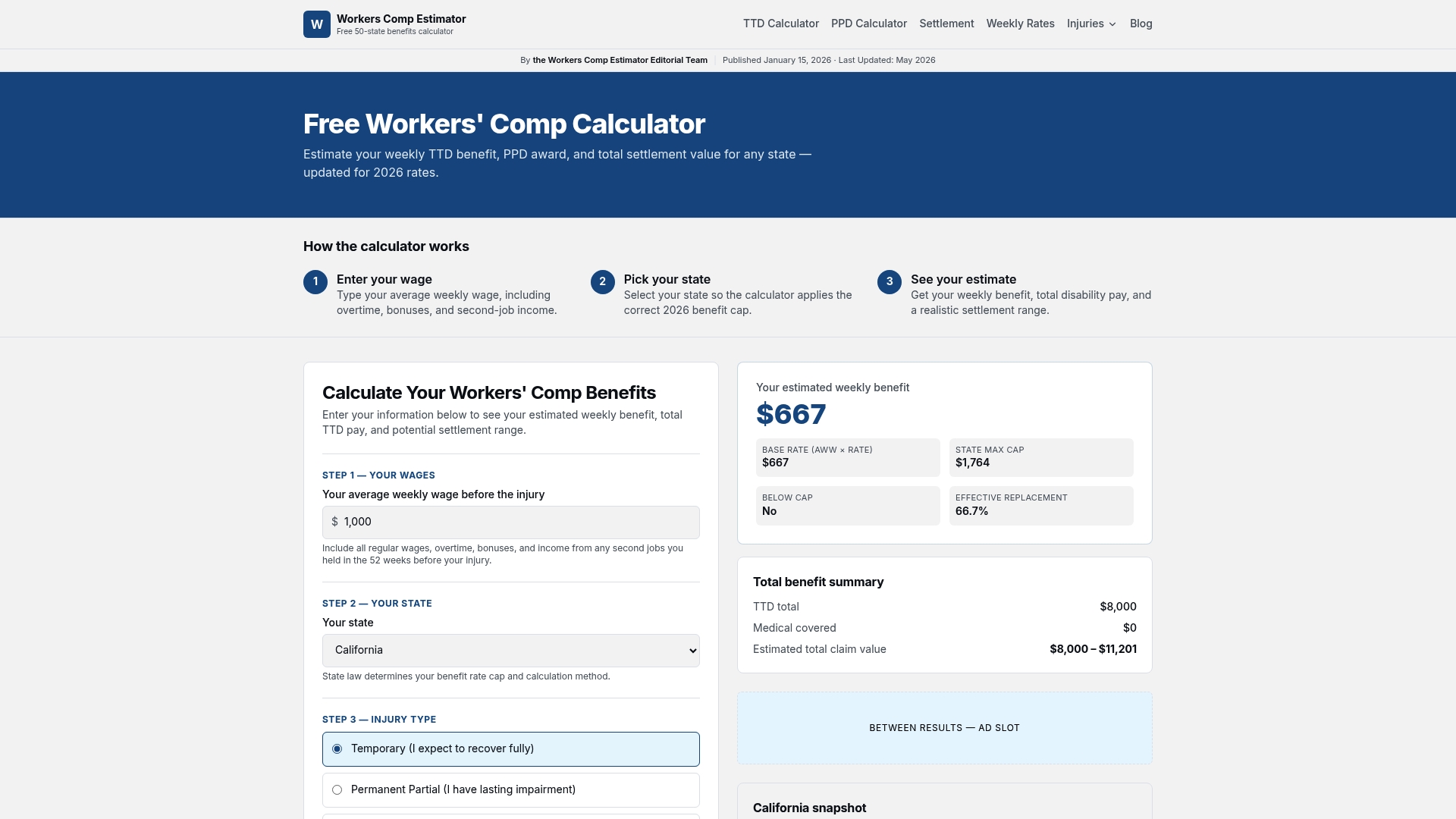
For a wider view of your benefits, including temporary disability and the state cap, start with the free workers’ comp calculator. For other states’ formulas, see our impairment rating payout calculator by state and our guide to what an impairment rating means for your payout.
FAQ
Who decides my impairment rating in Florida?
A physician licensed under Florida statute chapters 458, 459, 460, 461, 463 or 466 determines it, using the schedule that matches your date of injury. If a doctor other than your treating physician does the evaluation, your treating doctor must state whether they agree with it.
How many weeks of benefits does a 10% rating give me?
A 10% rating produces 20 weeks of impairment income benefits, since the first 10 percentage points count 2 weeks each. Each check is 75% of your weekly temporary total disability benefit.
Can I get benefits with a 0% rating?
Impairment income benefits are not paid at 0%, because they are based on a rating above zero. You can still ask the EAO for help or file a Petition for Benefits if you think the rating is wrong.
Does my rating change if I work while receiving IIBs?
The rating itself does not change, but the checks can. For accidents on or after October 1, 2003, IIBs are reduced by 50% for each week you earn income equal to or above your average weekly wage.
Sources
- Florida Division of Workers’ Compensation system guide
- Florida impairment income benefit calculator
- Chapter 440, Section 15, 2025 Florida Statutes
- Impairment income benefits presentation
- Benefits available to injured workers
- Health care provider manual rule 69L-7.020
- Insurance bad faith representation
Recommended
More from the blog
Use a 50 state calculator to see how a U.S. impairment rating payout is built: two step-by-step examples ($24,000 and $40,020), 2026 caps, and lump-sum tips.
Understand how an impairment rating impacts your workers' comp payout. Learn key steps to maximize your settlement before signing any documents.
Learn how PPD is calculated in workers' comp: impairment rating times weeks times weekly rate, with worked examples, state differences and a check on offers.
Free workers' comp calculators
Put the numbers in this article to work on your own claim.
Weekly benefit, PPD, and settlement in one place.
What your weekly temporary disability check should be.
Scheduled weeks and permanent impairment awards.
Light-duty benefit when you earn less while healing.
Federal employee FECA award by body part.
Lump-sum value of your full claim.
Turn a 5%, 10%, or 20% rating into dollars.
Travel reimbursement for medical appointments.
Max and min weekly rates for all 50 states.
Typical settlement ranges by injury and state.
Average settlement for fusion, rotator cuff, knee replacement, and more.
Why comp does not pay it, and when a third-party claim does.
When carriers typically make an offer.
What coverage costs by class code and payroll.
Guides, state updates, and claim strategy.