2026 State Caps Can Cut U.S. Back Injury Settlements, Estimate Yours

A back injury settlement in workers’ comp is a state-regulated payout, either weekly benefits or a lump sum, built from your compensation rate, your impairment rating, and your state’s maximum weekly benefit for 2026. It is not a personal injury lawsuit award. The fastest way to a realistic number is plugging your wage and injury details into a state-specific calculator that already accounts for this year’s caps.
TL;DR:
- The settlement amount depends on your wage, impairment rating, and whether your claim is accepted or disputed, with caps for 2026 affecting the final payout.
- A settlement typically closes multiple benefits at once, but workers should know which benefits remain open before signing any agreement.
- Accurate documentation, including pay stubs, medical records, and impairment reports, is essential for realistic settlement estimates and effective negotiations.
- Independent medical exams can significantly influence the impairment rating used to determine settlement value, making it vital to prepare properly.
- Most workers’ compensation settlements are tax-free, but those receiving SSDI benefits may face offsets, so consulting a tax professional is recommended.
Table of Contents
- What Is a Back Injury Settlement in Workers’ Comp?
- What Determines How Much a Back Injury Settlement Is Worth?
- How to Estimate a Fair Back Injury Settlement
- How to Prepare and Negotiate a Back Injury Claim
- Do You Pay Taxes on a Lump-Sum Back Injury Settlement?
- How Pre-Existing Back Conditions Affect Your Settlement
- Why Independent Medical Examinations Matter for Back Claims
- Author Perspective: Real Numbers Change Real Negotiations
- Get Your State-Specific Back Injury Estimate Now
- Sources
- FAQ
What Is a Back Injury Settlement in Workers’ Comp?
A back injury settlement closes out your workers’ compensation claim, either partially or completely, in exchange for a defined payment. It almost always takes the form of a written agreement, commonly called a Stipulation for Settlement, that a workers’ comp judge or board has to approve before it’s binding. That approval step matters because once signed off, these deals are hard to undo.
Settlements can resolve several categories of benefits at once. A single agreement might close out Temporary Total Disability (TTD) payments you were already receiving, Temporary Partial Disability (TPD) if you returned to reduced duty, Permanent Partial Disability (PPD) for lasting impairment, or in severe cases, Permanent Total Disability (PTD). Medical benefits can be part of the deal too, either closed out entirely or left open depending on what the paperwork says.
The finality is the part-injured workers underestimate. Minnesota’s own guidance on workers’ compensation settlements notes that a court will only reopen a settlement for fraud, mistake, newly discovered evidence, or a substantial change in your medical condition, and those are rare exceptions, not a safety net.
Two structures dominate:
- Full and final settlements close the entire claim, including future medical treatment, for one lump sum.
- Disputed-claim settlements (called claim disposition agreements in some states) let you accept a payment while the claim itself technically stays denied, and Oregon’s injured-on-the-job guide spells out that you may be giving up future rights in exchange for that money.
Before you sign anything, know exactly which benefits stay open and which ones disappear for good.
What Determines How Much a Back Injury Settlement Is Worth?
Your average weekly wage (AWW) is the starting point for nearly every number that follows. Most states calculate your weekly compensation rate at two thirds of your AWW, but that fraction only matters up to a ceiling: your state’s maximum weekly benefit for 2026. A worker earning $1,800 a week might expect $1,200 under the two thirds formula, but if the state cap is lower, the cap is the real number, not the theoretical one.
Pro Tip: Never assume two thirds of your wage is your actual rate. Check your state’s current maximum first, then apply the fraction, because the cap almost always wins.
Beyond wage math, three variables swing your settlement value the most:
- Impairment rating. Your Permanent Partial Disability percentage, assigned using a state schedule like California’s Permanent Disability Rating Schedule or the AMA Guides, drives the scheduled-weeks calculation for your specific body part. California’s DWC guidance for practitioners notes that which schedule applies depends on your date of injury, so two workers with identical spine injuries in different years can get different ratings.
- Future medical needs. A back injury with a likely future surgery is worth more to settle than one with a clean prognosis, because the insurer is buying certainty.
- Claim status. Accepted claims settle differently than disputed ones, where you may be trading rights for a smaller, faster payment.
Insurers sometimes prorate lump sums against your remaining benefit period or apply offsets for other disability payments. Occasionally, either side will argue for an “alleged” higher or lower wage than what payroll records show, which is exactly why documentation matters before negotiations start.
How to Estimate a Fair Back Injury Settlement
You don’t need a law degree to get a realistic number. You need five pieces of paper and a formula.
- Gather your facts first. Pin down your date of injury, your average weekly wage before the injury, your treating doctor’s records, and any impairment rating already assigned.
- Calculate your compensation rate. Take two thirds of your AWW, then compare it against your state’s 2026 maximum weekly rate using the state-by-state benefit tables the Social Security Administration maintains. Whichever is lower is your real weekly rate.
- Run the PPD math. Missouri’s settlement guidance lays out the standard formula: scheduled weeks for the body part multiplied by your disability percentage, multiplied by your compensation rate. If your state assigns a certain number of weeks to a back injury and you’re rated at a percentage disability with a given weekly compensation rate, multiplying these factors gives a rough lump-sum baseline before adjustments.
- Plug your numbers into a calculator built for this. Workerscompestimator’s back injury settlement calculator takes your wage, state, and injury details and returns weekly and lump-sum figures using this year’s caps, so you’re not guessing at the formula by hand.
- Check for offsets and rate disputes. If the insurer prorates your award or claims a different wage than your pay stubs show, flag it immediately. That’s often where settlement offers quietly shrink.
How to Prepare and Negotiate a Back Injury Claim
Walking into a settlement conversation with paperwork beats walking in with a feeling. Before you talk numbers with an adjuster, collect:
- Pay stubs covering at least 13 weeks before the injury, to nail down your true AWW.
- Every medical record and impairment report tied to the back injury.
- A log of workers’ comp payments received so far, including any gaps.
When you sit down to negotiate, ask for a specific dollar breakdown, not a round number. Insist on knowing which benefits, medical, wage loss, future treatment, are being closed and which remain open. And remember that in most states, the settlement isn’t final until a judge or board signs off, so a verbal offer is a starting point, not a deal.
Pro Tip: Bring your own calculated number to the table. A concrete weekly rate and lump-sum figure, backed by the actual formula, is a far stronger opening position than asking the adjuster “what’s fair.”
Watch for a few warning signs: pressure to sign quickly, vague language about future medical coverage, or an offer that doesn’t reference your actual impairment rating. Any of those is a reason to loop in an attorney before you put your signature on anything.
Do You Pay Taxes on a Lump-Sum Back Injury Settlement?
Generally, no. Workers’ compensation settlements, including lump-sum payments for a back injury, are typically not subject to federal or state income tax under the Internal Revenue Code’s treatment of workers’ comp benefits. This applies whether you receive weekly TTD payments or a single lump-sum PPD award.
There’s one wrinkle worth knowing. If you also receive Social Security Disability Insurance (SSDI) alongside your workers’ comp benefits, part of your settlement could trigger an offset that makes a portion of your SSDI taxable, even though the workers’ comp payment itself still isn’t taxed directly. This happens because SSDI and workers’ comp combined can’t exceed a certain percentage of your prior earnings, and any offset amount gets treated differently for tax purposes.
The safest move is running your settlement structure past a tax professional before you finalize anything, particularly if SSDI is in the picture or if part of your settlement is allocated to something other than physical injury, like lost wages that might be characterized differently. Most injured workers with a straightforward back injury claim and no SSDI overlap won’t owe anything on the settlement itself. But a five or six figure lump sum is worth ten minutes of a tax preparer’s time, if only to confirm you don’t owe anything and avoid a surprise the following April.

How Pre-Existing Back Conditions Affect Your Settlement
A prior back problem doesn’t disqualify you from a settlement, but it changes the math. Workers’ comp generally covers the aggravation of a pre-existing condition, meaning if your job made an old herniated disc worse, that aggravation is compensable even though the underlying disc problem existed before you were hired.
The catch is proving how much of your current impairment comes from the work injury versus the pre-existing condition. Insurers frequently argue for apportionment, splitting your impairment rating between “pre-existing” and “work-related” portions, which directly shrinks your PPD calculation.
This is where your medical records before the injury become as important as the records after it. If you had no documented back complaints, no prior treatment, and no earlier impairment rating, it’s much harder for an insurer to argue apportionment successfully. If you did have prior treatment, the claim isn’t dead, but expect more scrutiny and possibly a lower initial offer that assumes a bigger pre-existing share than is fair. An independent medical opinion that clearly separates aggravation from baseline condition can meaningfully move that number back in your favor.
Why Independent Medical Examinations Matter for Back Claims
An independent medical examination, or IME, is a physical exam performed by a doctor chosen by the insurance company rather than your own treating physician. Insurers request them constantly in back injury cases because spine injuries are subjective. Pain levels, range of motion limits, and functional capacity don’t show up cleanly on an MRI the way a fracture does.

The IME doctor’s findings can directly shape your impairment rating, and by extension, your PPD settlement value. If the IME doctor rates your impairment lower than your treating physician did, the insurer will typically use that lower number as its opening position in settlement talks. This is one of the most common friction points in back injury claims, because two qualified doctors examining the same spine can land on meaningfully different percentages.
You have the right to have your own doctor present findings too, and in many states you can request your own independent evaluation if you disagree with the insurer’s IME. Don’t skip your IME appointment, don’t downplay your symptoms to seem tough, and don’t exaggerate either. IME reports get picked apart, and inconsistency between what you tell the IME doctor and what’s in your medical file is exactly the kind of detail that erodes your credibility during negotiation.
Author Perspective: Real Numbers Change Real Negotiations
Most injured workers walk into a settlement conversation with a vague sense they’re “owed something.” That’s a losing position. In every state chart I’ve looked at, the gap between what someone assumes their wage-based benefit should be and what the actual 2026 cap allows is often significant, sometimes hundreds of dollars a week.
Presenting a calculated weekly rate and a lump-sum figure, built from your actual AWW and your state’s real formula, does something an adjuster’s vague offer can’t: it forces the conversation onto specifics. Workerscompestimator’s free calculator exists precisely for that moment. It’s not a substitute for legal advice, but it’s a credible starting number, and a credible starting number is worth more in negotiation than confidence alone.
— Daniel
Get Your State-Specific Back Injury Estimate Now
There are tools built for exactly the math this article just walked through: real 2026 state caps, scheduled-weeks formulas, and wage inputs, instead of generic online guides that quote national averages nobody’s insurer actually uses.
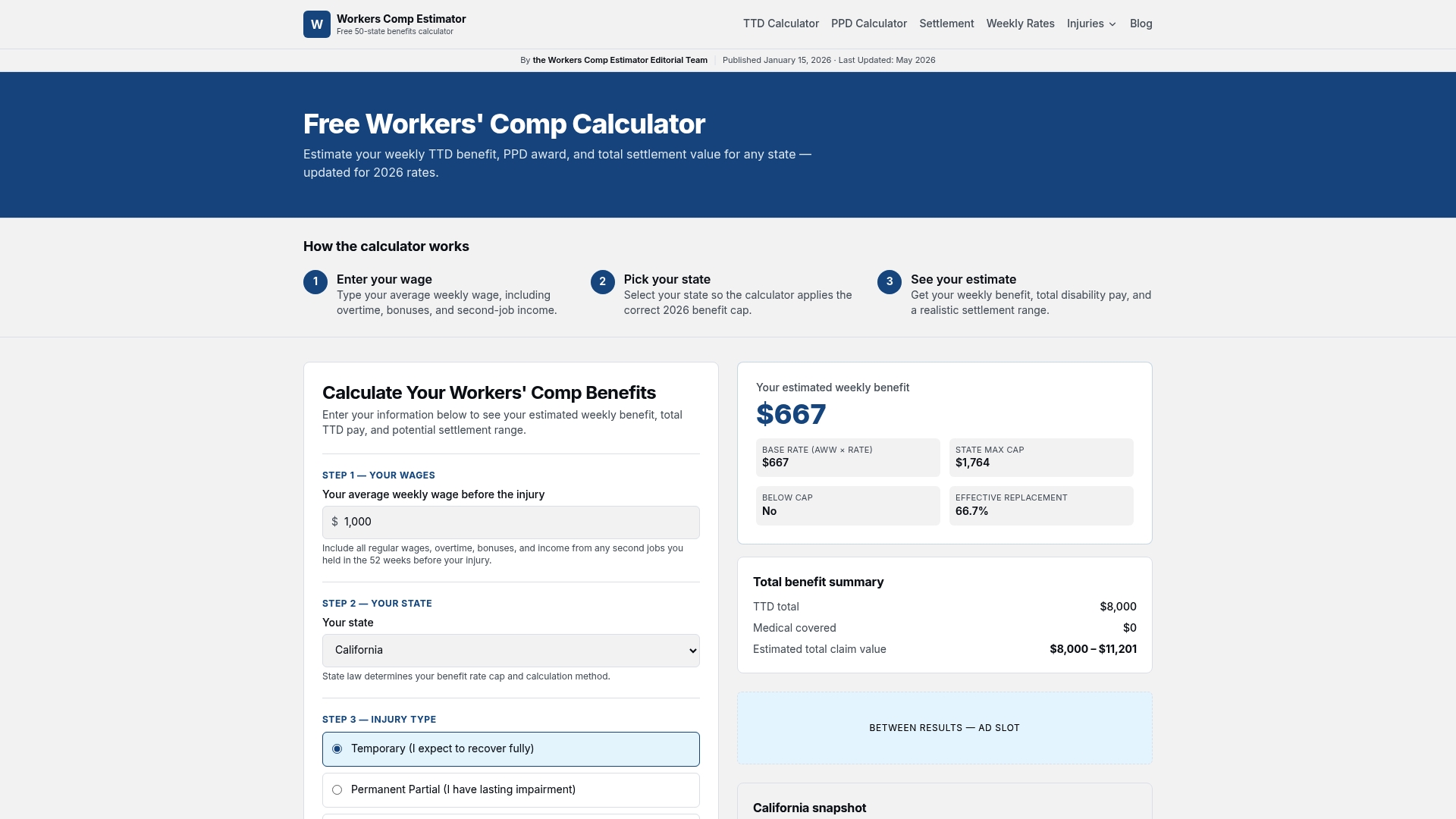
The back injury settlement calculator takes your average weekly wage, state, and impairment details and returns both a weekly benefit estimate and a projected lump-sum range, using this year’s caps rather than outdated averages. If your claim includes a broader mix of TTD and PPD, the full settlement calculator walks through the same math for a complete claim picture. Either output gives you a concrete number to bring into an adjuster conversation or reference when a judge reviews your stipulation.
Start by entering your wage and state at Workerscompestimator to see where your back injury claim actually stands before you agree to anything.
Sources
Double-check any estimate against primary sources before you rely on it in a negotiation.
- POMS: WC maximum weekly payment tables (state charts)
- Information sheet: Workers’ compensation settlements (Minnesota Department of Labor and Industry)
- Settling a Case | Missouri Department of Labor and Industrial Relations
- What happens if I’m injured on the job? (Oregon workers’ comp publication)
FAQ
What Is a Back Injury Settlement in Workers’ Comp?
It’s a negotiated payment, either a lump sum or structured benefits, that closes some or all of your workers’ comp claim for a back injury. It typically requires approval from a workers’ comp judge and should specify which benefits, medical, wage loss, or future treatment are being closed.
How Is a Back Injury Settlement Calculated?
Most states start with two thirds of your average weekly wage, capped at the state’s 2026 maximum, then apply a scheduled-weeks formula for permanent impairment: weeks assigned to the body part × disability percentage × compensation rate. Tools like Workerscompestimator’s PPD calculator run this math automatically using your inputs.
How Long Does a Back Injury Settlement Take?
Timelines vary widely by state and whether the claim is contested, but many settlements finalize within a few months of reaching an agreement, once medical treatment stabilizes and a stipulation is drafted for judge approval. Disputed claims or cases needing an independent medical examination often take longer.
Are Back Injury Settlements Taxed?
Generally no. Workers’ compensation settlements, including lump-sum back injury payments, are typically exempt from federal and state income tax, though an SSDI offset can occasionally make a portion of related Social Security benefits taxable.
Can I Get a Settlement If I Had a Prior Back Condition?
Yes, aggravation of a pre-existing back condition is generally compensable, but insurers often argue for apportionment, splitting your impairment rating between pre-existing and work-related causes. Clean prior medical records make that argument harder for the insurer to win.
Recommended
More from the blog
Get a state-accurate 2026 estimate for your U.S. burn injury settlement. Use the free 50-state calculator with your AWW, MMI date, impairment rating, and...
Use the free 50-state estimator that applies 2026 state caps to estimate your workers' comp lump sum. Run your numbers, check SSDI/Medicare impact, and...
Use your state’s 2026 weekly caps and the AWW×scheduled‑weeks×impairment math to estimate a realistic workers comp shoulder settlement. Run the free 50...
Free workers' comp calculators
Put the numbers in this article to work on your own claim.
Weekly benefit, PPD, and settlement in one place.
What your weekly temporary disability check should be.
Scheduled weeks and permanent impairment awards.
Lump-sum value of your full claim.
Turn a 5%, 10%, or 20% rating into dollars.
Max and min weekly rates for all 50 states.
Typical settlement ranges by injury and state.
Fusion, rotator cuff, knee replacement, and more.
When carriers typically make an offer.
What coverage costs by class code and payroll.
Guides, state updates, and claim strategy.