Estimate Your 2026 Settlement: QME vs AME in California
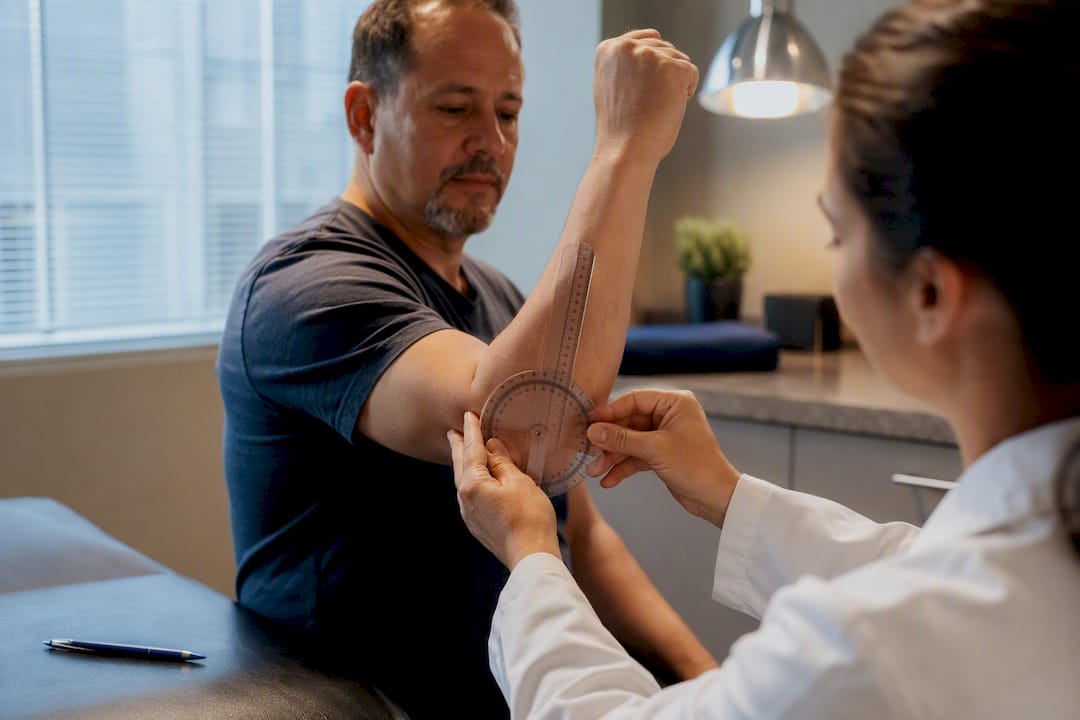
A QME is a state-certified doctor picked from a randomly generated Division of Workers’ Compensation panel, while an AME is a physician both sides agree on by name. The practical difference comes down to control and clout: you can only get an AME if you have an attorney, and an AME’s report typically carries more weight in settlement talks and before a judge than a QME’s does.
TL;DR:
- An AME generally carries more legal weight than a QME because it is mutually agreed upon by both attorneys, making its opinion harder to challenge later.
- Only workers represented by an attorney can request an AME, while unrepresented workers must go through the random QME panel process.
- The DWC typically mails a three-doctor QME panel within 20 working days, and the injured worker has 10 days to select a doctor from that panel.
- Attorneys favor AMEs when they have a trusted specialist to streamline negotiations and settlement, but most workers rely on QME panels unless they are represented.
- Both AME and QME expenses are paid by the claims administrator according to official fee schedules, with no direct bills to the worker.
Table of Contents
- QME vs AME: What Each Term Actually Means
- What an AME Is and Who Can Actually Get One
- QME vs AME: Comparing Control, Access, and Legal Weight
- How to Request a QME Panel or Agree to an AME
- What to Bring to Your Evaluation, and What to Leave Unsaid
- Who Pays for the Exam, and Where to Check the Fee Schedule
- Turn Your Evaluation Results Into a Real Number
- Presumption of Correctness: Why an AME Report Is Harder to Overturn
- Preparing for the Exam Without Undermining Your Own Case
- When AME Selection Actually Changes the Outcome
- Try the Free Workers’ Comp Calculator Before You Negotiate
- Where to Verify the Rules Yourself
- Sources
- FAQ
QME vs AME: What Each Term Actually Means
A Qualified Medical Evaluator (QME) is a physician certified by California’s Division of Workers’ Compensation (DWC) to resolve medical disputes in a workers’ comp claim, things like whether an injury is work related, whether you’ve reached maximum medical improvement, and how much permanent disability you have. QMEs come from several licensed practitioner types, including MDs, DOs, chiropractors, and psychologists, and they’re the default path when the treating doctor’s opinion is contested.
Getting certified isn’t a rubber stamp. A physician has to pass the DWC competency exam and complete a 12-hour report-writing course, and the passing score sits at 70%. Industry test-prep resources report that more than half of doctors fail the exam on their first try, which tells you something about how technical these reports need to be.
Once you need a QME, the DWC’s Medical Unit handles the administrative side, not you or the insurance company. QMEs typically weigh in on:
- Whether an injury arose from work duties (causation)
- When you reached permanent and stationary status (P&S)
- Your percentage of permanent disability
- Future medical care needs tied to the injury
What an AME Is and Who Can Actually Get One
An Agreed Medical Evaluator (AME) is a doctor both your attorney and the claims administrator’s attorney agree on by name, instead of one assigned randomly. That agreement replaces the QME panel process entirely for the dispute at hand. Once both sides sign off on a name, neither side gets to request a QME panel for that same issue.
Here’s the catch that trips people up: you can only use an AME if you’re represented by an attorney. Unrepresented injured workers go through the QME panel process, full stop, no exceptions.
A few points worth flagging:
- An AME doesn’t have to be a DWC-certified QME, though many are.
- The agreement usually happens through direct negotiation between the two attorneys.
- Because both sides chose the doctor, AME reports face less procedural pushback later.
QME vs AME: Comparing Control, Access, and Legal Weight
The differences that actually shape a case outcome aren’t philosophical. They’re procedural.
- Who selects the doctor. QME panels are randomly generated by the DWC Medical Unit, so neither side hand-picks the evaluator. AMEs are chosen by mutual agreement, giving both attorneys direct input.
- Who can use each option. Unrepresented workers only have access to the QME panel process. Represented workers can choose either, though most represented cases move toward AME once litigation gets serious.
- Legal weight. An AME’s opinion often carries a practical presumption of correctness because both parties selected the doctor, which raises the bar for challenging it later, as explained in this employers’ guide to workers’ compensation insurance in Arlington.
- Timing and follow-up. Both AME and QME reports allow supplemental questions or depositions, but overturning an AME finding on appeal generally takes more.
Pro Tip: If your attorney suggests pushing for an AME instead of waiting on a panel, ask why. It usually means they think a specific specialist’s opinion will hold up better in negotiations than a random draw would.
Attorneys tend to push for AME when they already have a working relationship with a well-regarded specialist and want predictability. QME stays the default when there’s no negotiated agreement yet, or when the claimant has no legal representation.
How to Request a QME Panel or Agree to an AME
The process has real deadlines, and missing one can cost you the choice of doctor entirely.
- File the Request for QME Panel form. Either party can submit it once a medical dispute exists. The form specifies a medical specialty.
- Wait for DWC to issue the panel. The Medical Unit generally mails the panel within 20 working days of receiving a valid request.
- Pick your doctor within 10 days. Once the panel arrives, you have 10 days to select one of the three listed physicians. Miss it, and the claims administrator can select for you.
- Or skip the panel and agree to an AME. If both attorneys agree on a name before or instead of requesting a panel, that agreement cancels the panel process for that dispute.
- Respond to the report within 30 days. After you receive the evaluator’s report, you typically have a limited window to request supplemental records review or object.
What to Bring to Your Evaluation, and What to Leave Unsaid
Show up prepared, or the evaluator only has one side of the story to work with.
Bring your treatment notes, current medication list, a written timeline of the injury and treatment history, and a plain description of your actual job duties before and after the injury. Photos of the workplace or equipment involved can help too, especially in ergonomic or repetitive-strain cases.
When answering questions, stay truthful, stay consistent with what you’ve told your treating doctor, and keep answers short. Don’t guess at diagnoses, don’t speculate about what caused something you’re not sure about, and don’t bring up unrelated health issues that have nothing to do with the injury. Saying “I can lift 50 pounds, but it hurts for a week after” gives the evaluator something specific to weigh. Saying “I probably have a torn rotator cuff” when you’re not a doctor gives them a reason to doubt the rest of your testimony.
Pro Tip: Ask your attorney for a 15-minute prep call before any AME or QME exam. Aligning your answers with your medical records ahead of time reduces the odds of a restrictive report.
Who Pays for the Exam, and Where to Check the Fee Schedule
Generally, the claims administrator pays for both AME and QME exams as part of the claim. Under California Code of Regulations definitions, Agreed Panel QME arrangements carry payment parity with standard AME billing, meaning the fee structure doesn’t shift dramatically based on which path you take.
- Official fee schedules are published through the DWC Medical Unit.
- Billing disputes between a doctor and the claims administrator get resolved through DWC’s administrative process, not through the injured worker.
- You shouldn’t receive a bill directly for either exam type.
Turn Your Evaluation Results Into a Real Number
Once you have an impairment rating or a permanent and stationary (P&S) date from your AME or QME report, that number is the raw material for estimating what your claim is actually worth. The California Workers’ Comp Benefits Calculator takes your average weekly wage, injury type, and state benefit caps for 2026 and turns them into a weekly Total Temporary Disability estimate and a settlement range. Run your numbers after the report lands, before you sit down to negotiate.
Presumption of Correctness: Why an AME Report Is Harder to Overturn
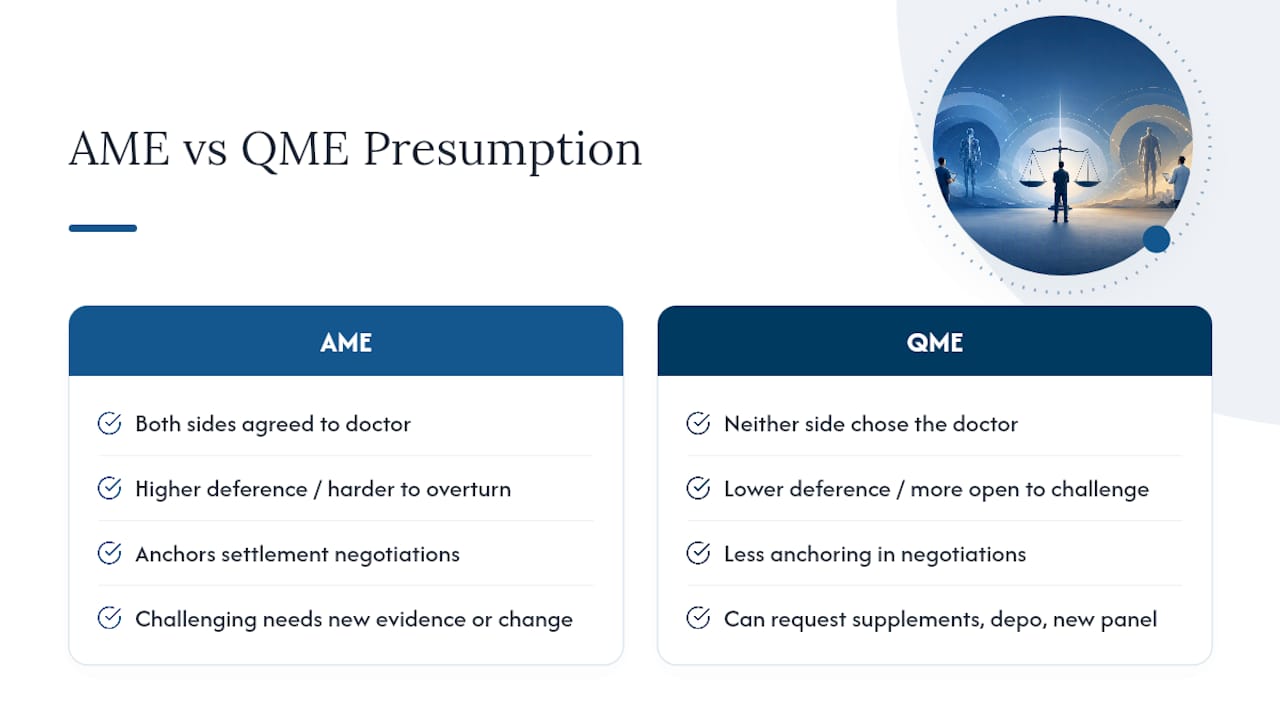
An AME’s opinion generally receives more deference than a QME’s, and the reason is procedural, not medical. Both attorneys picked that doctor. Once both sides agree to a physician’s judgment, it’s much harder to argue afterward that the doctor was biased or unqualified, since neither side can claim they didn’t have a say in the selection.
That practical presumption shows up most clearly at two points: settlement negotiations and appeals. During negotiation, an AME’s impairment rating tends to anchor the conversation, because both the applicant’s attorney and the defense already implicitly trusted the source. Challenging it requires more than disagreement, it usually requires new medical evidence or a documented change in condition.
A QME report, by contrast, stays more open to challenge specifically because neither side chose the doctor. If the QME’s report seems inconsistent with treatment records or appears to misunderstand job duties, either party can request supplemental questions, depose the QME, or in some cases request a new panel. That flexibility cuts both ways. It gives you room to push back on a report that got something wrong, but it also means the case might not settle as cleanly since either side can keep contesting details.
This is part of why so many represented claimants, once litigation starts, shift from panel QMEs toward negotiated AMEs. The tradeoff is real: you get more predictability and more settlement leverage with an AME, but you give up the neutral randomness that protects an unrepresented worker from a stacked panel. Unrepresented workers don’t get to make that tradeoff at all, since AME access requires an attorney of record.
Preparing for the Exam Without Undermining Your Own Case
Most damage to an evaluation happens in the exam room, not in the paperwork beforehand. Evaluators are trained to notice inconsistency between what you say, what your medical chart says, and what you’re physically observed doing during the exam.
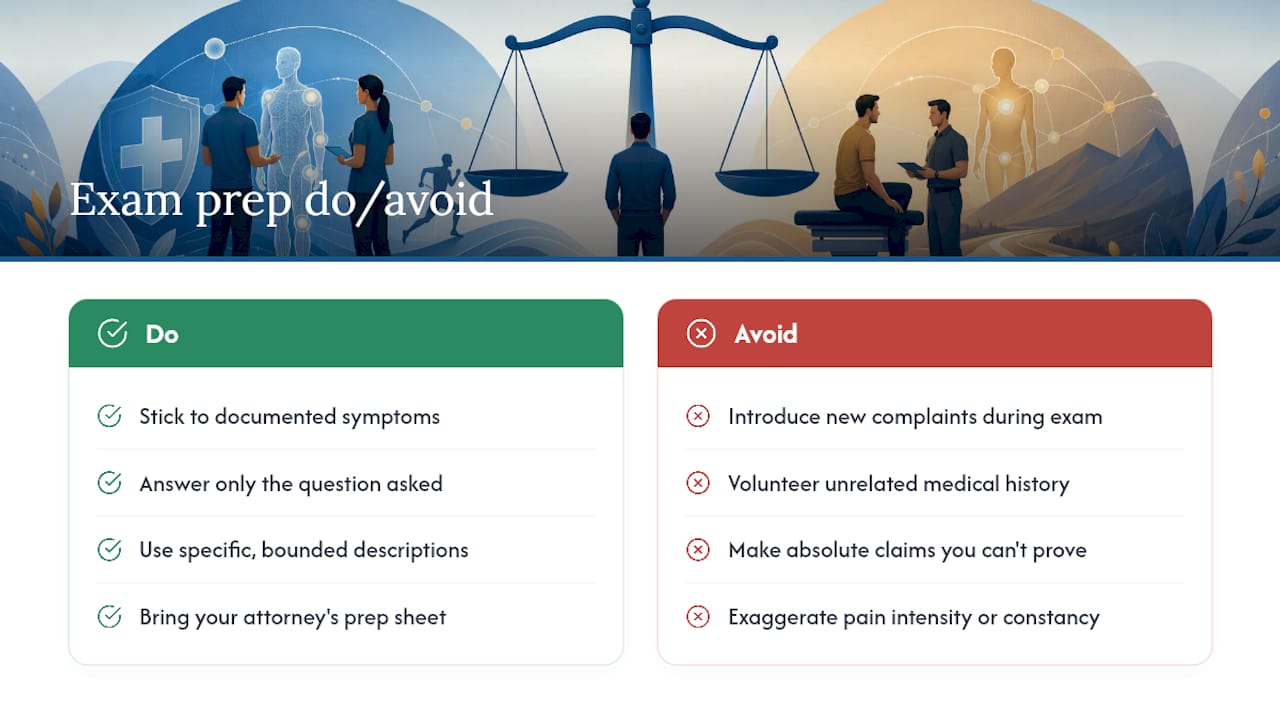
Stick to your documented symptoms. If your chart says you have limited range of motion in your right shoulder, don’t describe pain in your left shoulder for the first time during the AME or QME exam, that kind of new complaint raises red flags rather than sympathy. Answer only the question asked. A common mistake is volunteering extra context, like mentioning an old back injury from years ago that has nothing to do with the current claim, which can muddy causation findings.
Avoid absolute statements you can’t back up, phrases like “I can never lift anything again” or “the pain is constant and unbearable every second” tend to read as exaggeration rather than fact, even when you’re genuinely struggling. Specific, bounded statements carry more credibility: “I can carry light grocery bags but can’t lift more than 10 pounds without sharp pain.”
Bring your attorney’s prep sheet if you have one, and if you don’t have an attorney yet, know that this is exactly the kind of exam where representation changes outcomes. An unrepresented worker walking into a QME exam without guidance is at a real disadvantage compared to someone who has rehearsed consistent, documented answers beforehand.
When AME Selection Actually Changes the Outcome
AME selection matters most once litigation is underway and both sides have something to gain from certainty. The tradeoff is real: you trade the neutrality of a random panel for a doctor whose findings both attorneys already expect to hold up, which often speeds settlement and raises leverage in negotiation. Unrepresented workers don’t get that option, which is exactly why getting an attorney early, before disputes calcify, opens doors that stay closed otherwise.
— Daniel
Try the Free Workers’ Comp Calculator Before You Negotiate
You can obtain an estimate to use in negotiations, instead of a guess. Once your AME or QME report lists an impairment rating or a P&S date, plug it into the California Workers’ Comp Benefits Calculator to see a weekly TTD estimate and a settlement range built around 2026 state caps.
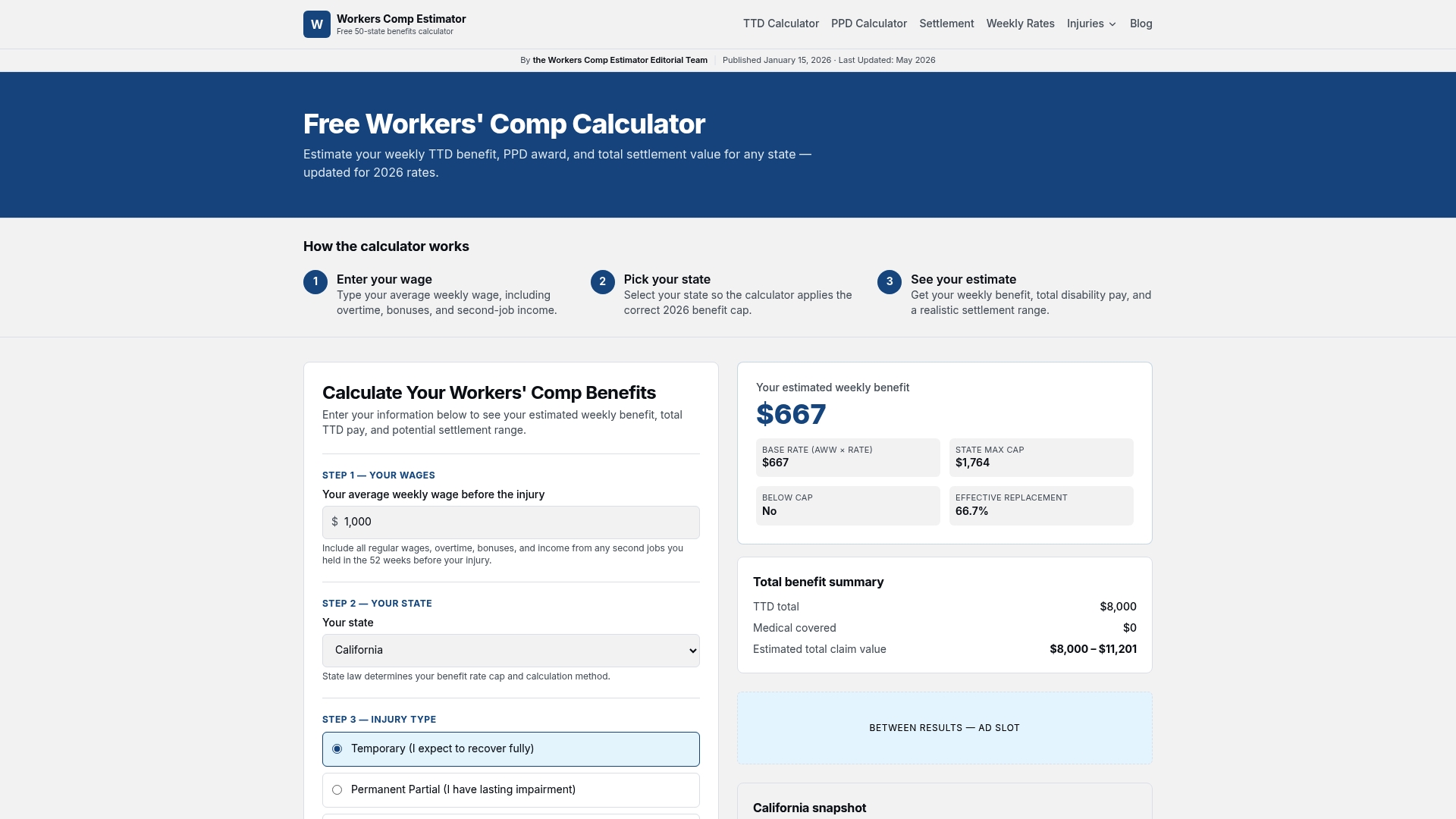
If your claim isn’t based in California, the free 50-state workers’ comp estimator covers every state’s benefit structure, so you’re not relying on a national average that doesn’t match your jurisdiction’s caps. Both tools are free, require no sign-up, and give you a realistic figure to bring to your attorney or to the negotiating table. Try the calculator as soon as your report lands, while the numbers are fresh and before anyone offers you a settlement figure first.
Where to Verify the Rules Yourself
For the official rundown, DWC Fact Sheet E covers QME and AME definitions and selection rules directly. The DWC QME page has certification and continuing education details. DWC’s FAQ for injured workers walks through panel timing in plain language. Use DWC’s own forms and addresses for anything you file or appeal.
This article is general information, not a substitute for advice from a qualified lawyer. Consult a qualified legal professional about your own circumstances before acting on anything here.
Sources
- Answers to Your Questions About Qualified Medical Evaluators and Agreed Medical Evaluators (Fact Sheet E)
- DWC FAQs about QMEs for injured workers
- IW Guide 2: Requesting a QME panel
FAQ
What Is the Difference Between QME and AME?
A QME is a state-certified doctor randomly assigned from a DWC panel, while an AME is a doctor both attorneys agree on by name. AME access requires legal representation; QME panels are available to represented and unrepresented workers alike.
What Is the Pass Rate for the QME Exam?
The DWC sets the passing score for the QME competency exam at 70%, and industry test-prep resources report that more than half of doctors fail on their first attempt.
What Should You Avoid Saying to a QME Doctor?
Avoid speculating about diagnoses, exaggerating with absolute statements like “I can never lift anything,” and volunteering unrelated medical history that has nothing to do with the current claim.
How Much Does a QME Get Paid?
QME fees are generally covered by the claims administrator under DWC’s official fee schedule, and Agreed Panel QME arrangements carry payment parity with standard AME billing under California regulations.
Can an Unrepresented Worker Choose an AME?
No. AME selection requires an attorney of record for the injured worker; unrepresented workers must use the QME panel process for any disputed medical issue.
Recommended
More from the blog
Get a state-accurate 2026 estimate for your U.S. burn injury settlement. Use the free 50-state calculator with your AWW, MMI date, impairment rating, and...
File the correct state claim and collect medical and wage records. Run the free 50 State calculator to see your likely weekly TTD and settlement before...
Run a state specific 2026 workers' comp settlement calculation. Use the free 50 state calculator to see how state caps change your payout.
Free workers' comp calculators
Put the numbers in this article to work on your own claim.
Weekly benefit, PPD, and settlement in one place.
What your weekly temporary disability check should be.
Scheduled weeks and permanent impairment awards.
Lump-sum value of your full claim.
Turn a 5%, 10%, or 20% rating into dollars.
Max and min weekly rates for all 50 states.
Typical settlement ranges by injury and state.
Fusion, rotator cuff, knee replacement, and more.
When carriers typically make an offer.
What coverage costs by class code and payroll.
Guides, state updates, and claim strategy.