
Estimate Your 2026 NJ Workers’ Comp Rates and Weekly Benefit

The 2026 maximum weekly workers’ comp benefit in New Jersey is $1,199, and the minimum sits at $320 for temporary or total disability (with a separate $35 floor for permanent partial disability). If your wage was high, the cap decides your check. If it was low, the floor does.
TL;DR:
- The 2026 maximum weekly workers’ comp benefit in New Jersey is $1,199, established based on the annual rise of the state’s average weekly wage.
- Benefit calculations rely on your average weekly wage, capped at $1,199 or floored at $320 for temporary and total disabilities, with a minimum of $35 for partial disabilities.
- The payout depends on your injury’s date of accident, using the statutory rate of that year, not the current rate, for scheduled awards and permanency calculations.
- The workers’ comp settlement considers factors beyond the schedule, such as future medical costs, age, job prospects, and pre-existing conditions, influencing the final offer.
- Using online calculators and carefully documenting your wages, medical records, and accident date can help you assess whether settlement offers are fair before negotiations.
Table of Contents
- What Determines NJ Workers Comp Rates Each Year?
- The Exact 2026 New Jersey Workers Comp Benefit Caps
- How to Calculate Your Weekly Workers Comp Benefit
- How the NJ Schedule of Disabilities Sets PPD Awards
- What Determines Your Workers Comp Settlement Value
- Get a Personalized Estimate With Workerscompestimator
- Your Next Steps After Reading This
- Sources
- FAQ
What Determines NJ Workers Comp Rates Each Year?
New Jersey doesn’t pick benefit caps out of thin air. The maximum and minimum weekly rates come from a formula written into N.J.S.A. 34:15-12.a, tied directly to the state’s Statewide Average Weekly Wage, or SAWW. When the SAWW rises, the cap rises with it, on a schedule that resets every January 1.
The 2026 increase to $1,199 reflects a SAWW rise that the New Jersey Department of Labor and Workforce Development cited when announcing the new rate. A few things drive the annual movement:
- Wage growth statewide pushes the SAWW up, which pushes the cap up with it.
- Inflation and cost-of-living pressure show up indirectly through wage data, not through a separate adjustment.
- The increase is rarely dramatic. Practitioner tracking shows the cap climbing from $945 in 2020 to $1,199 in 2026, a steady crawl rather than a jump.
The Exact 2026 New Jersey Workers Comp Benefit Caps
Here’s what actually applies to claims with a 2026 date of accident, straight from the New Jersey Department of Labor and Workforce Development’s rate announcement:
2026 NJ Workers’ Comp Rates at a Glance Maximum weekly benefit: $1,199 Minimum weekly benefit (temporary/total disability): $320 Minimum weekly benefit (permanent partial disability): $35 Effective date: January 1, 2026
The full breakdown by benefit type:
- Temporary total disability (TTD): capped at $1,199/week, floored at $320/week.
- Permanent total disability: same cap and floor as TTD, $1,199/$320.
- Permanent partial disability (PPD): capped at $1,199/week, but the minimum drops to just $35/week.
- Dependency benefits (death claims): calculated using the same maximum, $1,199/week, applied to the dependent’s benefit rate.
These figures come straight from the New Jersey rates and statistics page, which the New Jersey Department of Labor and Workforce Development updates every year. The number that governs your claim isn’t necessarily this year’s number. It’s whatever rate was in effect on your date of accident, a rule worth remembering before you assume 2026’s cap applies to a 2023 injury.
How to Calculate Your Weekly Workers Comp Benefit
Start with your average weekly wage, or AWW. If you worked steady hours at a fixed salary, this is straightforward. If your pay fluctuated, New Jersey generally averages your gross earnings over the 26 weeks before your injury to smooth out variations.
Once you have your AWW, the math runs in three steps:
- Multiply your AWW by 70%. This is your raw benefit rate before any caps apply.
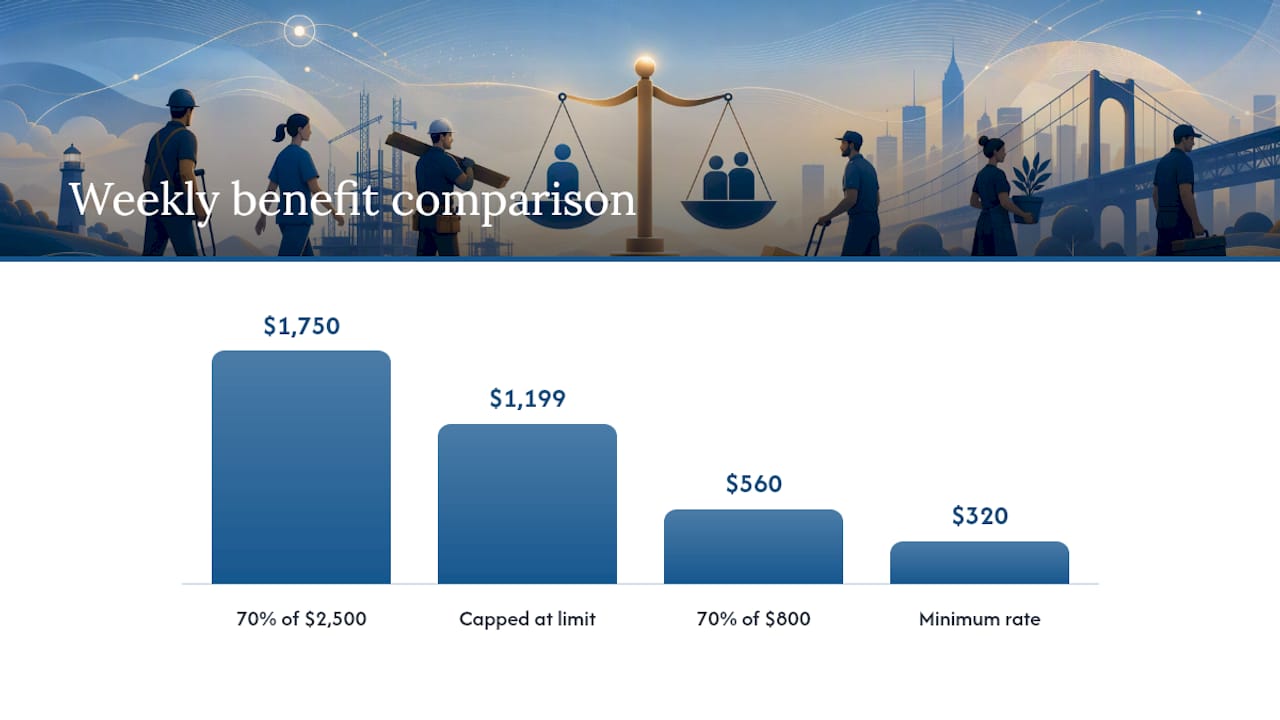
- Compare that number to the 2026 maximum ($1,199) and minimum ($320). If your 70% figure lands between those two numbers, that’s your weekly check.
- Apply whichever limit applies if your number falls outside the range. Too high, you get capped at $1,199. Too low, you get bumped up to $320.
Example 1: AWW below the cap. Say your average weekly wage was $800. Seventy percent of $800 is $560, which falls comfortably between $320 and $1,199. Your weekly TTD benefit is $560.
Example 2: AWW above the cap. Say your average weekly wage was $2,500, common for workers with overtime-heavy trades. Seventy percent of $2,500 is $1,750, well above the $1,199 ceiling. You don’t get $1,750. You get capped at $1,199 flat, regardless of how high your actual wage was.
For scheduled injuries, the math adds a step. New Jersey’s 2026 schedule of disabilities assigns a fixed number of statutory weeks to a total shoulder loss; 17.5% of that week count gives you the number of weeks owed. Multiply those weeks by your weekly statutory rate, and that’s your scheduled dollar award.
How the NJ Schedule of Disabilities Sets PPD Awards
The schedule of disabilities is the document that turns a doctor’s percentage rating into an actual dollar figure.
The mechanics work like this:
- The 2026 schedule PDF assigns each body part a maximum number of weeks for a total loss.
- Your disability percentage, set by a doctor’s evaluation, multiplies against that week count to produce your owed weeks.
- Owed weeks multiply against your weekly statutory rate to produce the total scheduled award.
Pro Tip: The rate used to calculate your scheduled award isn’t necessarily this year’s rate. It’s the statutory rate in effect on your date of accident, so a claim from an earlier year gets calculated using that year’s cap, not 2026’s.
Scheduled awards for common injuries such as shoulders, knees, backs, and hands serve as the basis for many PPD settlement discussions, providing a shared reference point despite potential disagreements about disability percentages.
What Determines Your Workers Comp Settlement Value
A settlement offer is rarely just your scheduled award multiplied by weeks. Insurers and claimants weigh several other variables when negotiating a lump sum, and understanding them helps you evaluate whether an offer is fair or lowball.
- Permanency rating: the higher the percentage disability, the more weeks owed and the higher the baseline number.
- Future medical care: ongoing treatment needs, additional surgery, or physical therapy get factored into projected future costs.
- Age and job impact: a younger worker with decades of earning years left, or someone whose injury blocks return to their specific trade, often commands a higher settlement.
- Causation and pre-existing conditions: insurers frequently argue a portion of your disability predates the work injury, which can shrink the offer.
- Body part and scheduled versus non-scheduled status: injuries to the back, neck, or psyche fall outside the strict schedule and get valued more subjectively.
Before accepting anything, ask the insurance carrier to show its math in writing. Confirm they used the statutory rate tied to your actual date of accident, not a different year’s cap. And keep your own paper trail: pay stubs proving your AWW, medical records documenting your permanency rating, and any wage-loss documentation if you’re out of work. That paperwork is your leverage in a negotiation.
Get a Personalized Estimate With Workerscompestimator
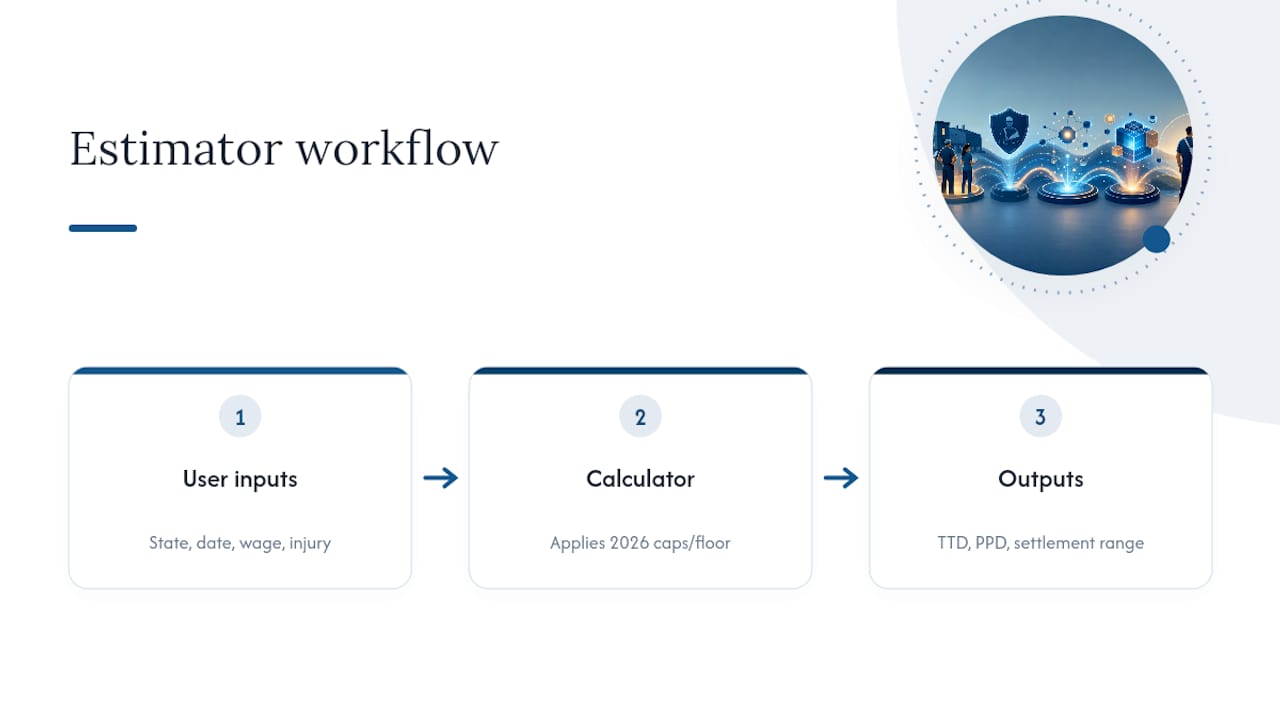
Running these calculations by hand works, but it’s easy to make a small math error that costs you real money when you’re negotiating a settlement. Workerscompestimator’s New Jersey workers’ comp benefits calculator applies the 2026 caps automatically, so you don’t have to track down the current maximum and minimum yourself.
You enter your state, your date of accident, your average weekly wage, and the body part or injury type involved. The tool returns a weekly TTD estimate, a PPD scheduled-award dollar figure if applicable, and a settlement-range estimate that accounts for the 2026 cap and floor. If your injury involves a specific body part like a knee, shoulder, or back, the PPD calculator breaks down the schedule math in more detail.
Everything the tool produces reflects current New Jersey law, not a rough national average, which matters when you’re comparing numbers against an insurance adjuster’s offer.
Your Next Steps After Reading This
Run the numbers before you talk to anyone else. Use Workerscompestimator’s New Jersey calculator with your real average weekly wage and save the output.
Then gather your pay stubs from the 26 weeks before your injury, pull your medical records, and confirm your exact date of accident, since that date decides which year’s rate governs your claim.
Finally, ask the insurance company for their written calculation. Compare it line by line against your own numbers. If their offer sits noticeably below what the math supports, that’s the moment to consult a workers’ comp attorney before you sign anything.
— Daniel
This article is general information, not a substitute for advice from a qualified financial advisor. Consult a qualified financial professional about your own circumstances before acting on anything here.
FAQ
What Is the Maximum Weekly Workers Comp Benefit in NJ for 2026?
The 2026 maximum weekly benefit in New Jersey is $1,199, effective January 1, 2026, up from $1,159 in 2025.
What Is the Minimum Weekly Workers Comp Payment in New Jersey?
The 2026 minimum is $320 per week for temporary or total disability claims, while permanent partial disability carries a separate, lower minimum of $35 per week.
Which Year’s Rate Applies to My Claim?
The statutory rate in effect on your date of accident governs your claim, not the rate in effect when your case settles or gets decided.
How Are Scheduled PPD Awards Calculated in New Jersey?
Your disability percentage is multiplied by the statutory number of weeks assigned to that body part in the schedule of disabilities, then multiplied by your weekly statutory rate.
Recommended
More from the blog
Run a state specific 2026 workers' comp settlement calculation. Use the free 50 state calculator to see how state caps change your payout.
See how 2026 state caps, wages, and surgery affect your U.S. hernia workers' comp payout. Run a free 50 state calculator for a realistic estimate.
File the correct state claim and collect medical and wage records. Run the free 50 State calculator to see your likely weekly TTD and settlement before...
Free workers' comp calculators
Put the numbers in this article to work on your own claim.
Weekly benefit, PPD, and settlement in one place.
What your weekly temporary disability check should be.
Scheduled weeks and permanent impairment awards.
Light-duty benefit when you earn less while healing.
Federal employee FECA award by body part.
Lump-sum value of your full claim.
Turn a 5%, 10%, or 20% rating into dollars.
Max and min weekly rates for all 50 states.
Typical settlement ranges by injury and state.
Average settlement for fusion, rotator cuff, knee replacement, and more.
Why comp does not pay it, and when a third-party claim does.
When carriers typically make an offer.
What coverage costs by class code and payroll.
Guides, state updates, and claim strategy.